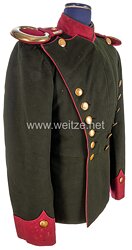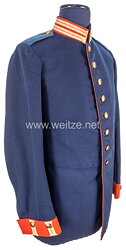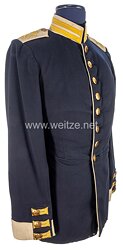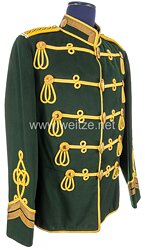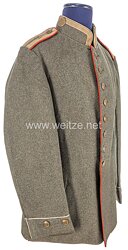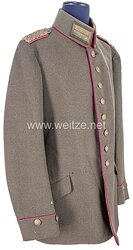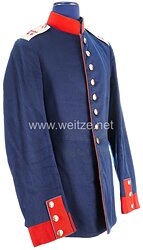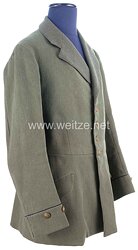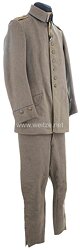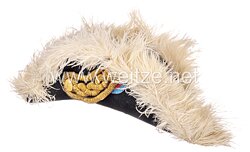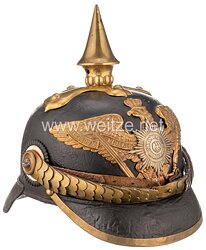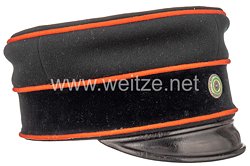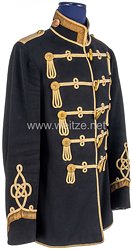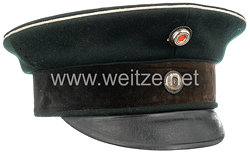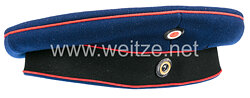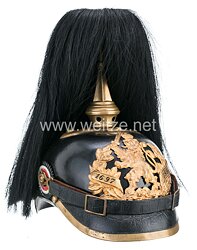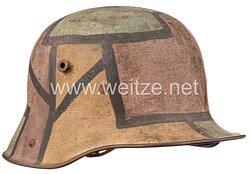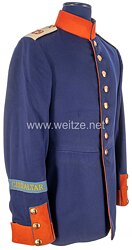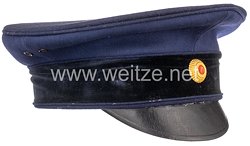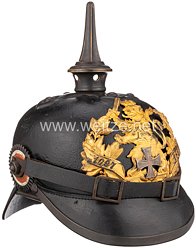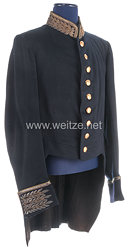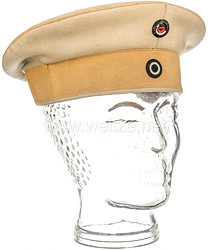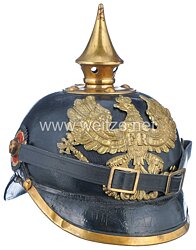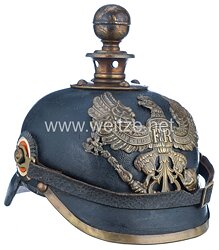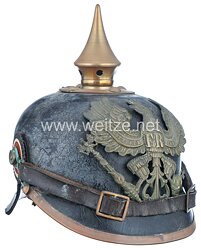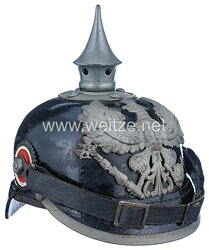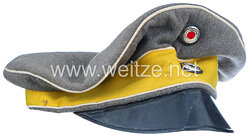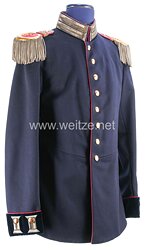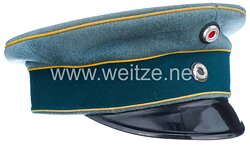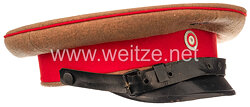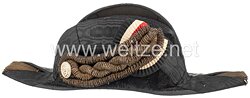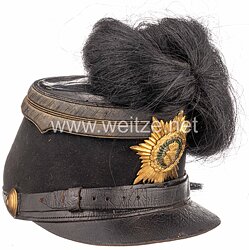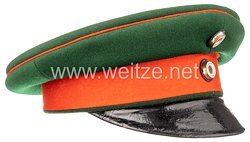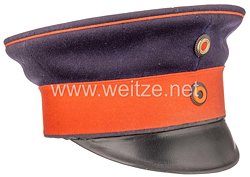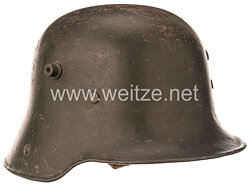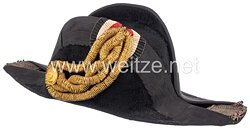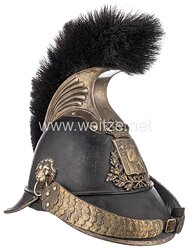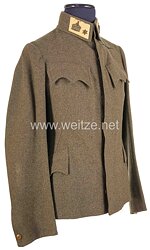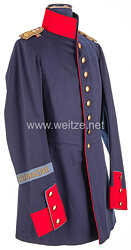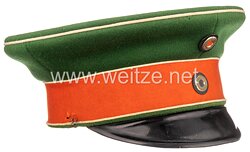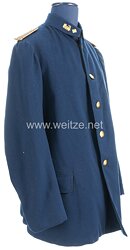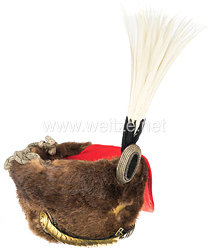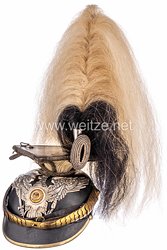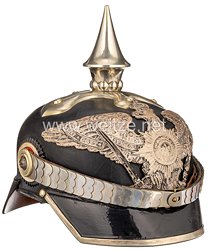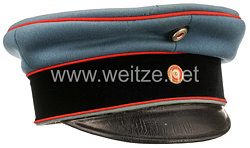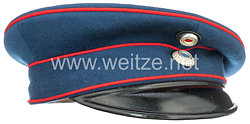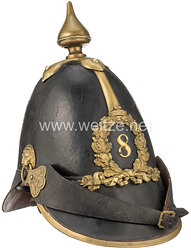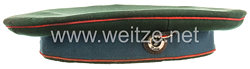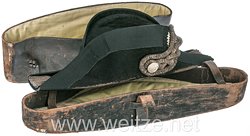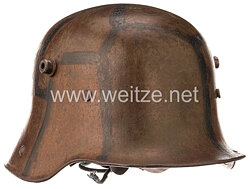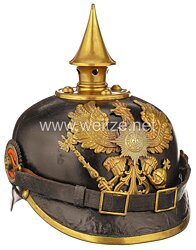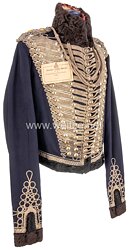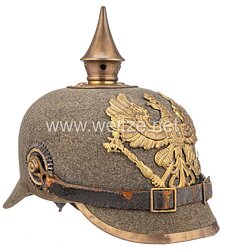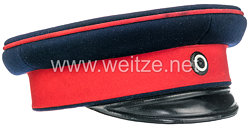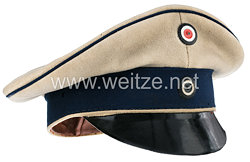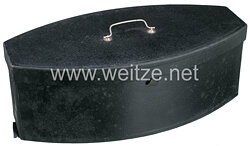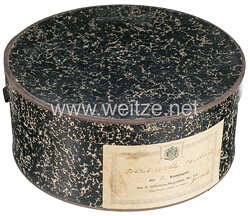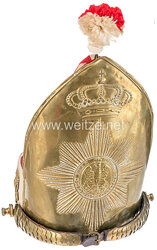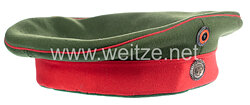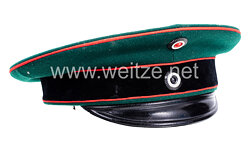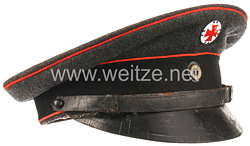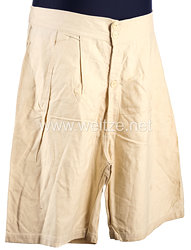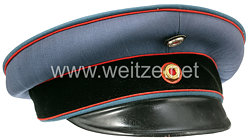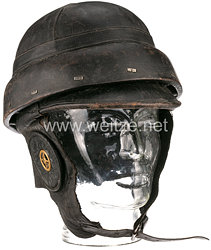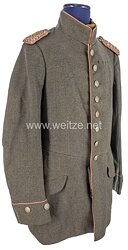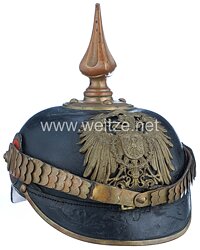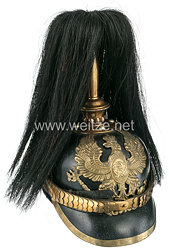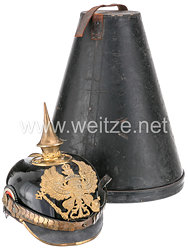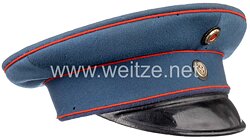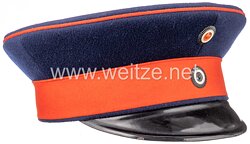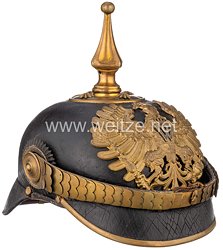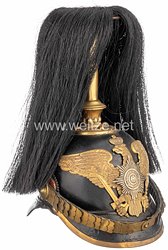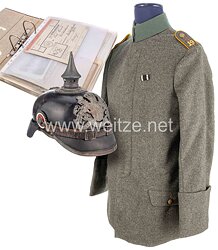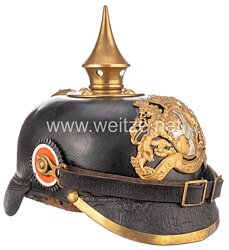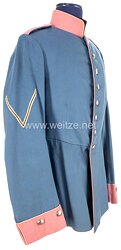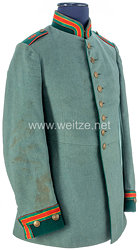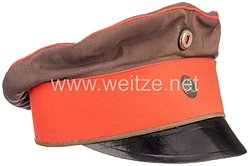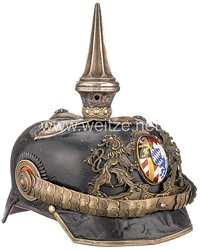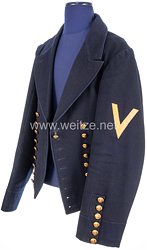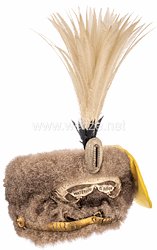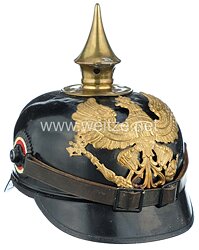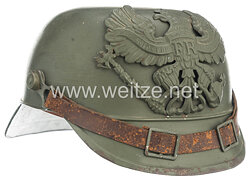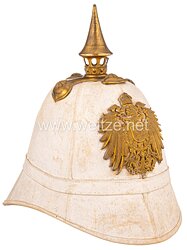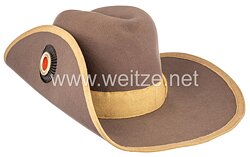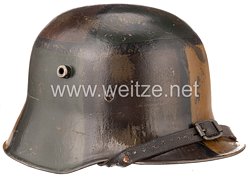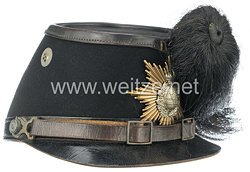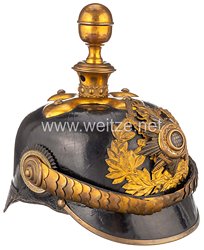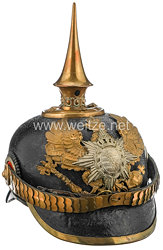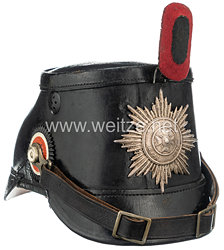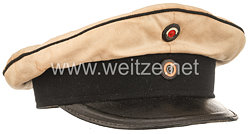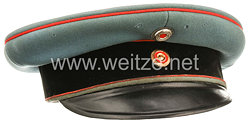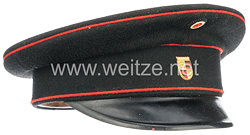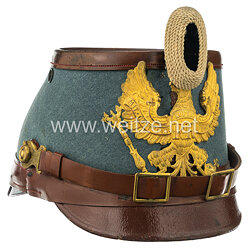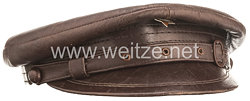
Overview: Imperial Germany & Weimar Republic: uniforms, spike helmets, etc.

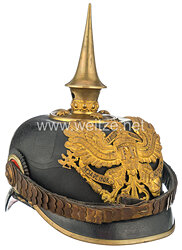
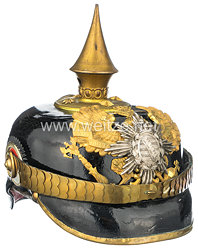
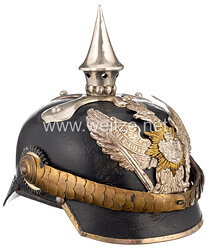
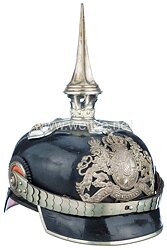
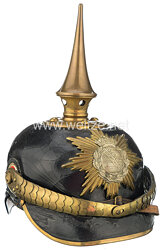
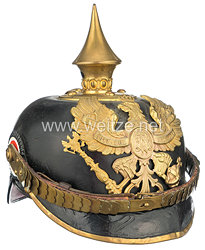
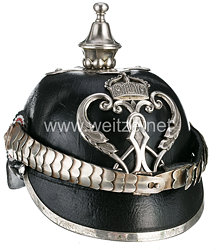
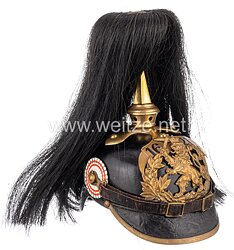
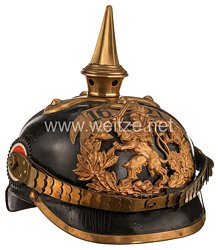
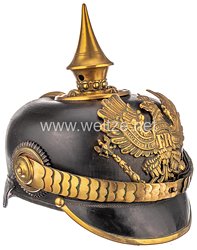
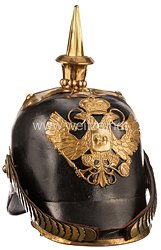
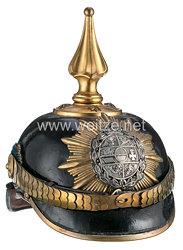
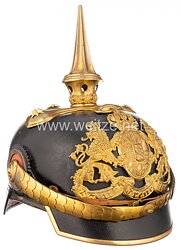
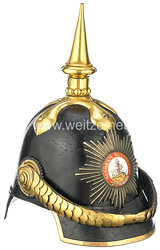
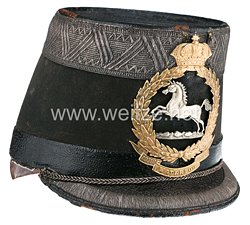
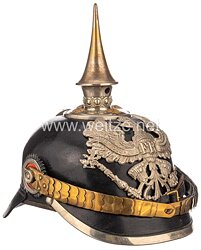
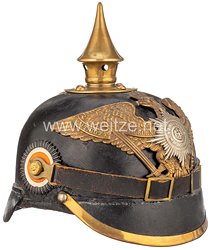
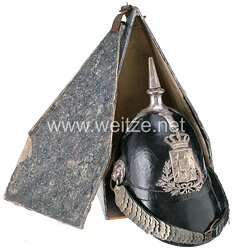
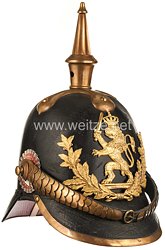
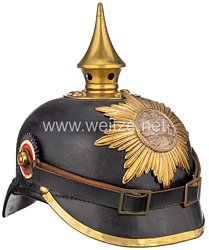
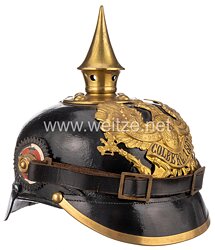
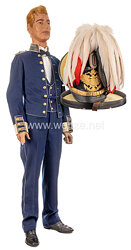
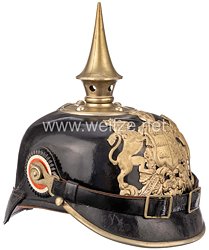
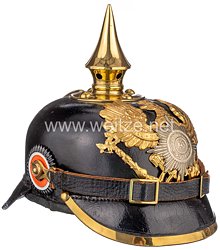
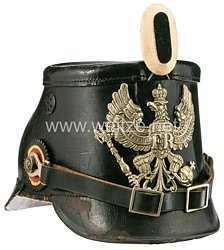
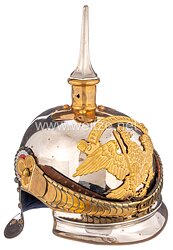
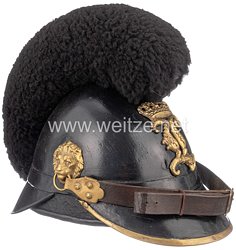
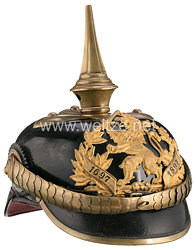
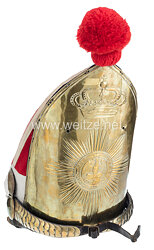
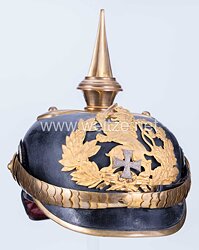
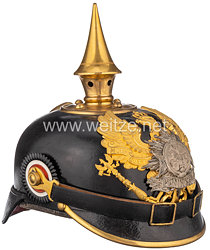
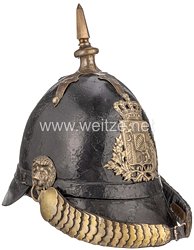
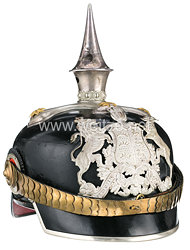
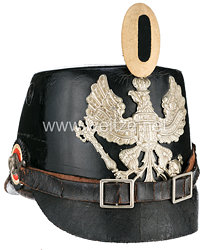
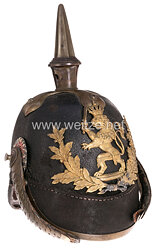
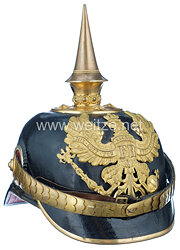
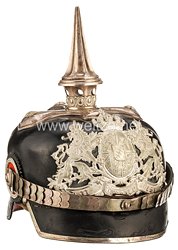
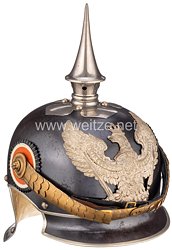
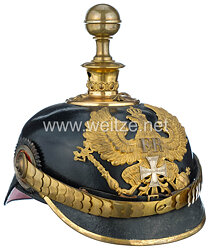
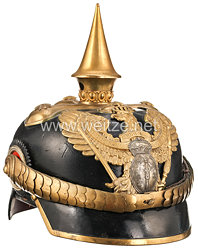
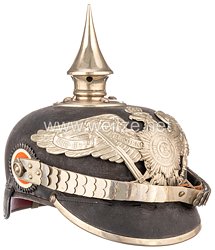
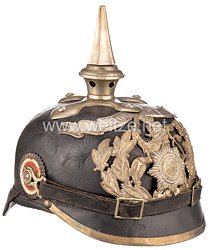
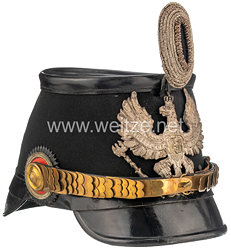
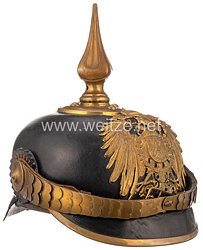
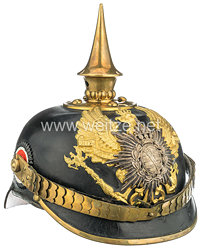
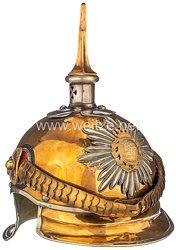
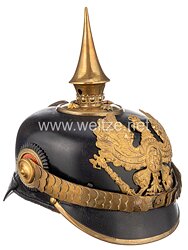
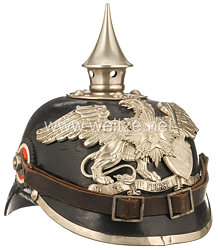
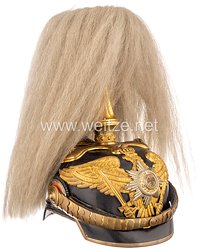
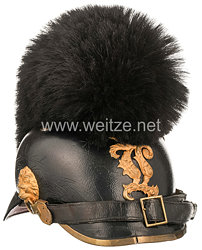
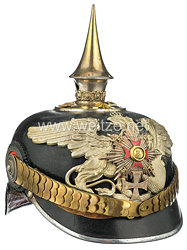
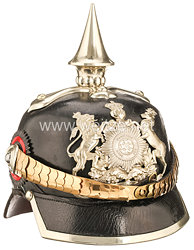
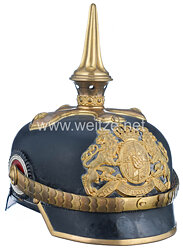
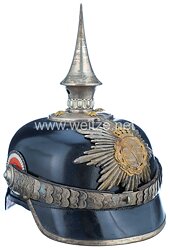
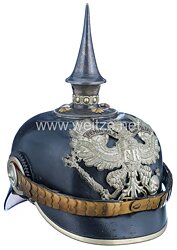
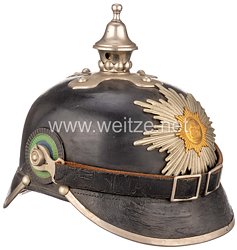
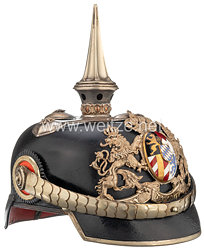
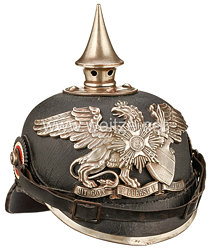
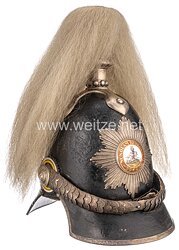
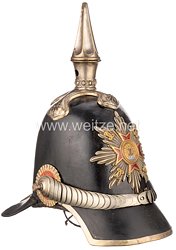
Königreich Sachsen Polizei: Pickelhaube für einen Serganten der Königlichen Landgendarmerie

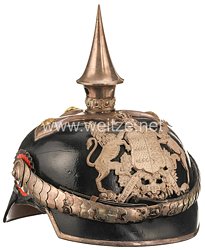
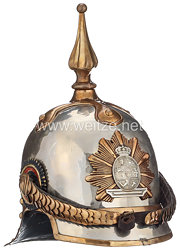
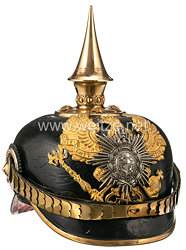
Um 1900. Lederhelm, komplett mit allen Beschlägen in Neusilber. Vorn mit großem Helmstern, im Zentrum aufgelegt das sächsische Wappen. Flache Schuppenketten an Rosetten, rechts mit sächsischer Kokarde, Nackenschiene ohne Belüftungsschieber. Innen gelaschtes Schweißleder, in der Glocke Trägeretikett «... König. Polizeisergeant». Größe ca. 56. Getragen, Zustand 2.
509686
1.450,00

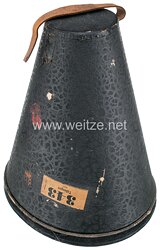
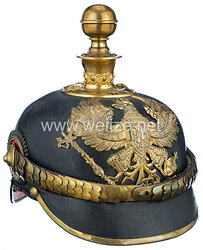
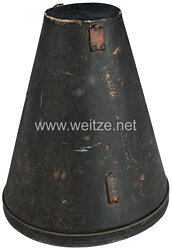
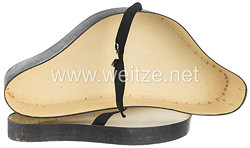
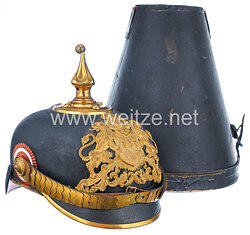
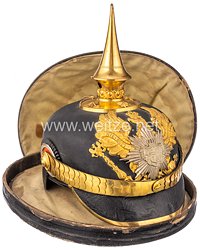
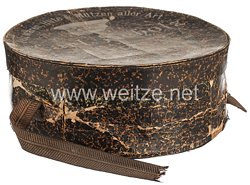
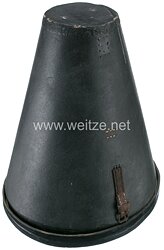
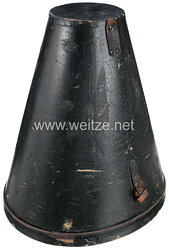
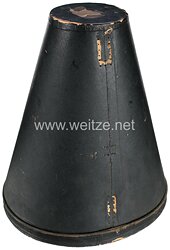
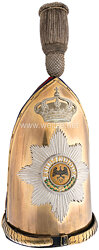
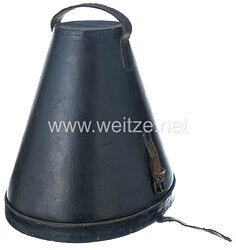
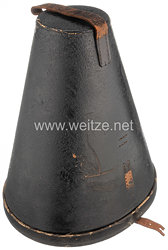
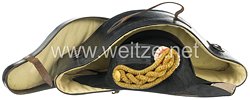
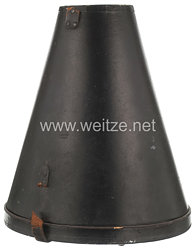
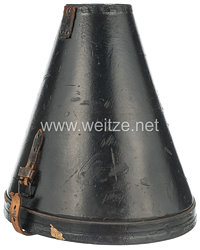
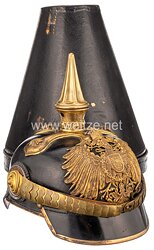
Prussian Helmet Case for an Officer's Pickelhaube

Circa 1910. Height approx. 29.5 cm. Interior lined with yellow fabric, the fabric with foxing stains. All straps intact (!!). Condition 2

One of very few undamaged helmet cases, normally the leather straps are always torn off somewhere.
509389
250,00

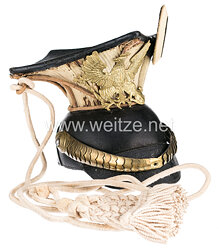
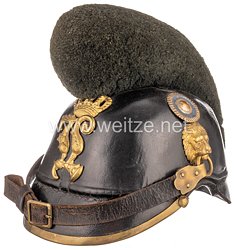
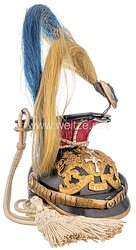
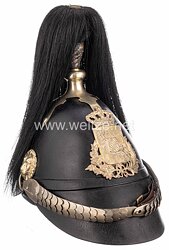
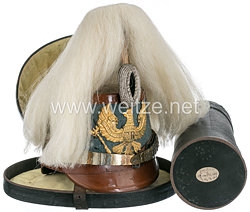
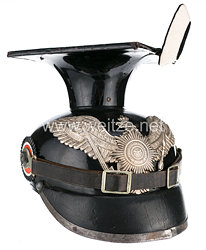
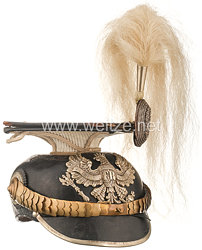
Bavarian Czapka for an Officer of the 1st Uhlan Regiment Kaiser Wilhelm II, King of Prussia, for Parade

Stationed in Bamberg, circa 1910. Highly elegant czapka of black patent leather, complete with all fittings in gilt finish. Front bears the Bavarian coat of arms in the large domed version. Domed scale chains on rosettes, with Reich cockade on the right. The top is complete with crimson parade trim, surmounted by the Bavarian field insignia and blue/white parade plume of buffalo hair. Accompanied by the officer's parade aiguillette with blue strands. Interior with light sweatband and rose-colored silk lining, size 57. Virtually unworn, in nearly mint condition. Includes the box for the parade plume.
A magnificent piece, still in finest quality!
506762
9.500,00

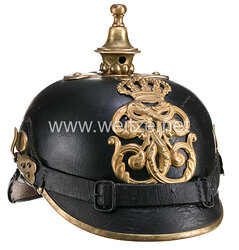
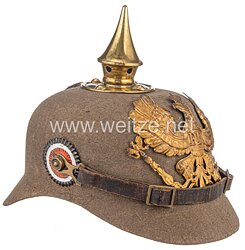
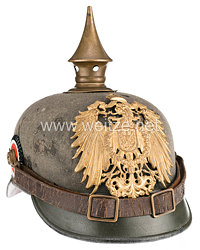
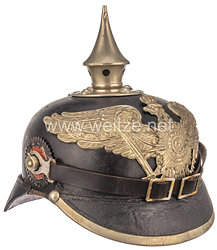
Dachbodenfund: Preußen 1. Weltkrieg Pickelhaube Modell 1915 für einen Offizier in einem Infanterie-Regiment

Um 1915. Die Pickelhaube aus Vulkanfiber, der Korpus stark verdrückt, der Linienadler beschädigt. Zustand 4-5. Ungereinigter Fundzustand.

Es handelt sich hierbei um eine französische Kriegbeute, um 1915, welche auf dem Schlachtfeld bei Arras gefunden wurde, direkt aus französischem Privatbesitz.
Seit über 100 Jahren das erste Mal zurück auf deutschem Boden !
506068
650,00

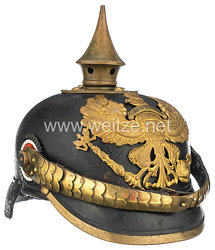
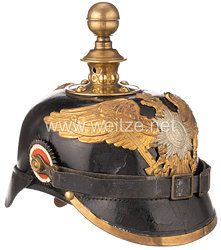
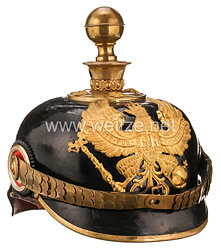
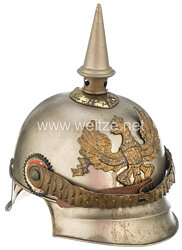
Preußen Pickelhaube für Offiziere der Dragoner-Regimenter Nr. 7, 8, 11 , 13 oder 14

Datiert 1907. Lederhelm, komplett mit allen Beschlägen in Messing vergoldet, die Vergoldung verputzt. Vorne der Dragoneradler mit der Devise «Mit Gott für Koenig und Vaterland», gewölbte Schuppenketten an Durchsteckrosetten, beide Kokarden. Kreuzblattbeschlag mit Sternschrauben und abnehmbarer Spitze. Innen mit braunem Lederschweißband und braunem Seidenripsfutter, der Vorderschirm grün und der Nackenschirm rot gefüttert, in der Glocke Etikett «M. Neumann Lieferant Sr. Majestät des Kaisers und Königs ... Berlin ... Kopfmaass 57 ... 28.2.1907.». Zustand 2-.
Die Standorte der Dragoner Regimenter waren: Nr. 7 (Saarbrücken), Nr. 8 (Öls), Nr. 11 (Lyck), Nr. 13 (Metz) und Nr. 14 (Kolmar)
506042
1.750,00

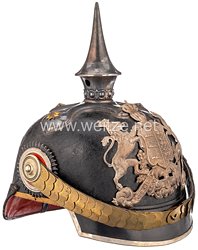
Königreich Bayern 1. Weltkrieg Pickelhaube für Mannschaften im 7. Reserve-Infanterie-Regiment

Kammerstück in der Trageweise um 1914. Lederhelm komplett mit allen Beschlägen, vorne das kleine Helmemblem mit aufgelegtem silbernen Reserve-Kreuz, original Ledersturmriemen an Knopf 91, mit beiden Kokarden. Innen mit gelaschtem Lederfutter. Der Nackenschirm mit der handschriftlichen Größe «53.» sowie Kammerstempel «9IR1898», in der Glocke zu erkennen die ältere Jahreszahl «89», ein weiterer Kammerstempel sowie der jüngere Kammerstempel «7.R.I.R. 4.B.». Die Glocke mit mehreren alt verschlossenen Löchern vom Wechsel vom Kreuzblattbeschlag und dem großen Emblem auf den Teller und das kleine Emblem. Die Krone des Emblems mit alter Lötstelle. Zustand 2.

Ein sehr interessanter und lange getragener Helm! Es handelt sich um ein Kammerstück aus der Zeit um 1889 noch mit Kreuzblattbeschlag und großem Helmemblem, der um 1896 auf das neue Modell mit Teller und kleinem Emblem aptiert wurde. Dabei wurden die alten Löcher verschlossen. Zu Beginn des 1. Weltkrieges wurde er dann an das am 02.08.1914 aufgestellte 7. Reserve-Infanterie-Regiment abgegeben.
505734
1.150,00

Königreich Sachsen Pickelhaube für Offiziere im 1. Pionier-Bataillon Nr. 12 bzw. 2. Pionier-Bataillon Nr. 22

Standort Pirna/Riesa um 1910. Leichter Lederhelm komplett mit allen Beschlägen in versilberter Ausführung. Vorne der Stern mit dem aufgelegten vergoldeten sächsischen Wappen, Als (vom Bataillonskommandeur genehmigte) Eigenmächtigkeit gewölbte Schuppenketten an Rosetten, beide Kokarden in der besonderen sächsischen Ausführung. Der Teller mit vergoldeten Sternen, die Spitze abnehmbar. Innen mit braunem Lederschweißband und braunem Ripsfutter, der Vorderschirm grün und der Nackenschirm rot gefüttert, in der Glocke handschriftlich die Größe «58 ½». Zustand 2.

Sehr selten!
505608
3.500,00

Königreich Sachsen 1. Weltkrieg Pickelhaube für Mannschaften in einem Reserve-Infanterie-Regiment

1916 ins Bekleidungs-Depot übernommen. Lederhelm, komplett mit allen Beschlägen. Vorne der Helmstern mit aufgelegtem neusilbernen sächsischen Landwehrkreuz und dem darauf aufgelegten sächsischen Wappen. Ledersturmriemen an Knopf 91, beide Kokarden in der sächsischen Ausführung. Innen mit gelaschtem Lederfutter. In der Glocke gestempelt «241 B.D.III. 1916». Größe ca. 54. Zustand 2.
503785
1.350,00

Preußen 1. Weltkrieg Pickelhaube feldgrau Modell 1915 für Mannschaften im 1. Hannoverschen Infanterie-Regiment Nr. 74

Heimatstandort Hannover. Kammerstück 1915. Lederhelm, komplett mit allen Beschlägen in Eisen feldgrau lackiert. Vorne der preußische Linienadler. Ledersturmriemen an Knopf 91, beide Kokarden. Die Spitze mit Bajonett-Verschluss abnehmbar. Innen mit gelaschtem Lederfutter. Der Nackenschirm mit Kammerstempel «B.A.X. 1915» und «I.R.74», in der Glocke der Stempel des Herstellers «Gebr. Müller […] 1915». Größe ca. 56. Getragen. Zustand 2-.
503776
2.500,00

Preußen Kinderhelm „Jäger zu Pferde“

Um 1910. Der „Helm“ aus Pappmaché gefertigt und schwarz lackiert, der Adler, Teller und die Spitze aus Messing in verkleinerter Form, die Kokarden militärische Stücke für Mannschaften, die Schuppenkette aus Blech. Die Größe geschätzt 48/50. Die Vorderschirmschiene mit einem kleinen Bruch. Zustand 2.

Ein sehr interessantes Stück! Für den Sohn eines Offiziers. Erstmalig in unserem Bestand!
503622
1.150,00

Prussia World War I Field Cap for Officers of Cuirassier Regiment Duke Friedrich Eugen von Württemberg (West Prussian) No. 5 from the Personal Property of Kaiser Wilhelm II

Home garrisons Riesenburg, Rosenberg, Deutsch-Eylau. Circa 1916. The elegant high visor cap of fine field-gray cloth with rose-colored band and three white pipings, both cockades, black lacquered visor and chin strap. Interior with fine light leather sweatband and light beige silk lining, the lining with gold-embossed Imperial crown and monogram “W”, below the stamp “Kostümfundus Kassel A 16 X 222”. Size approximately 54. Condition 2.

The cap originates from the personal property of Kaiser Wilhelm II. As “Chief of the Royal Prussian Army” and as chief of various non-Prussian regiments, Kaiser Wilhelm II possessed a uniform from each of these regiments, including one from Cuirassier Regiment No. 5. Around 1916, the visor cap entered the “Kostümfundus Kassel”. The palace in Kassel served the imperial family as summer residence from 1891 to 1918. At the initiative of Kaiser Wilhelm II, the new “Hoftheater” was established there in 1909, whose collection was equipped with pieces from the “Zeughaus Berlin” as well as with objects from the Kaiser's personal property. Even during the war, the Kaiser spent much time in Kassel. In 1965, the collection was dissolved and sold to dealers and private individuals.
509745
12.500,00

Prussia/Kingdom of Saxony Visor Cap from the personal possession of Kaiser Wilhelm II as Chef of the Royal Saxon 3rd Uhlan Regiment No. 21 Kaiser Wilhelm II, King of Prussia

The elegant high visor cap of fine white cloth with light blue band and piping, both cockades, the state cockade in the special Saxon form, black lacquered visor. Interior with fine light leather sweatband and light beige silk lining, the lining with gold-embossed imperial crown and monogram “W”, beneath it the stamp “Kostümfundus Kassel A 16 X 320”. Size approximately 54. Condition 2.

The cap comes from the personal possession of Kaiser Wilhelm II. As “Chef of the Royal Prussian Army” and as Chef of various non-Prussian regiments, Kaiser Wilhelm II possessed a uniform from each of these regiments. This included one from the Royal Saxon 3rd Uhlan Regiment No. 21 “Kaiser Wilhelm II, King of Prussia” stationed in Chemnitz, of which he was Chef. Around 1910 the visor cap entered the “Kostümfundus Kassel”. The palace in Kassel served the imperial family as summer residence from 1891 to 1918. At the initiative of Kaiser Wilhelm II, the new “Hoftheater” was established there in 1909 in Kassel, whose costume collection was equipped with pieces from the “Zeughaus Berlin” as well as with objects from the Kaiser's personal possession. In 1965 the collection was dissolved and sold to dealers and private individuals.
509705
8.500,00

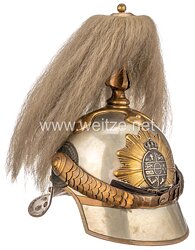
Württemberg Czapka for Officers of the Uhlan Regiment König Karl (1st Württemberg) No. 19

Garrisoned at Ulm, circa 1910. Elegant czapka of black patent leather, complete with all fittings. Silver coat of arms plate, gilt scale chains on pass-through rosettes, right side with Reich cockade. Red parade trim, Württemberg field insignia and parade plume of buffalo hair, without parade dress cord. Interior with light brown sweatband and light beige silk lining. Label inside the bell reading “Oekonomie Kunstinstitut für galvanische Erneuerung ... Berlin ..”. Size 55. Beautifully preserved. Condition 2.
339691
5.200,00

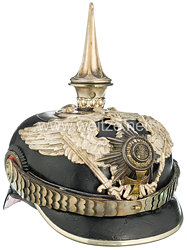
Prussia World War I Pickelhaube in Luxury Quality for a General

Circa 1914. The helmet still in finest peacetime quality made of vulcanized fiber, complete with all fittings in gilt execution. On the front the large Guard eagle, finely crafted with polished edges, mounted with the silver Guard star with finely enameled center. Cross-shaped base with star screws, two of which already made from substitute material, fluted removable spike. Domed scale chains on pass-through rosettes, both cockades present. Squared front visor. Interior with brown sweatband with printed Quadriga and the inscription “Depaheg Patent”, brown silk rep lining, handwritten size “54” in the bell. Condition 2.
500184
5.500,00

Imperial Schutztruppe German Southwest Africa Tropical Service Cap for Non-Commissioned Officers

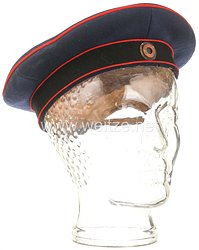
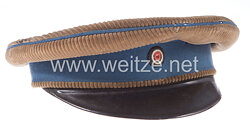
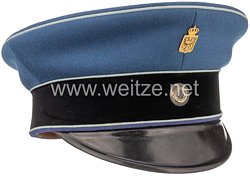
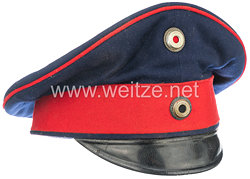
Chamber piece, circa 1905. For the minor service uniform. The visor cap in saddle form made of brown cord drill with cornflower blue band and piping, front bearing the Reich cockade, black lacquered visor. Interior with brown leather sweatband and beige cloth lining with chamber stamp “K.A.1905”. Size approximately 57. Condition 2.

Very rare!
499071
2.800,00

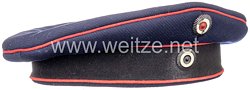
Prussia WWI Visor Cap for Sergeant/Instructor “Rekatzky” in Ersatz-Feldartillerie-Regiment Zossen

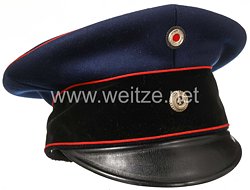
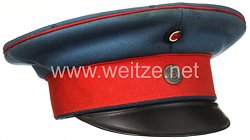
Circa 1916. Visor cap made of dark blue cloth with black band and three red piping stripes, black lacquered visor made of vulcanized fiber, both cockades, as sergeant in officer's quality. Interior with brown sweatband and orange oilcloth lining with label “Rekatzky 3. (F.) Batt. Ers.F.A.R.Zossen”. Size approximately 55. Worn condition. Condition grade 2-.

The regiment was established around 1915/16 in Zossen. At home or during training, the “Bunte Uniform” (colored uniform) was worn.
498261
400,00

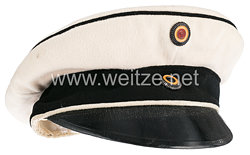
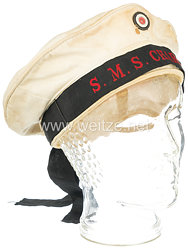
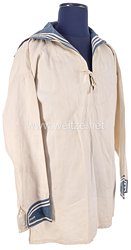
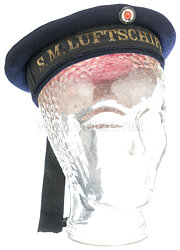
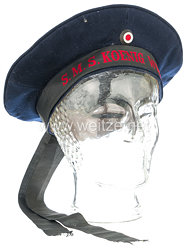
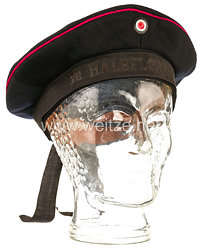
Imperial German Navy White Sailor Cap for a Ship's Boy on "S.M.S. Hertha"

Chamber-marked piece, 1911. Manufactured from white cotton fabric, so-called “wash cap”, complete with cockade, cap tally "S.M.S. Hertha" in red for ship's boys. Interior with chamber stamp "B.A.-W. 6.12.11.", size 58. Lightly worn, somewhat yellowed. Condition 2.

The S.M.S. Hertha was the second ship of the Victoria-Louise-class, a class of five second-class cruisers of the Imperial German Navy, constructed as armored deck cruisers. In 1899 the ship was reclassified as a large cruiser. The Hertha was employed particularly in foreign service and from 1908 onwards as a training ship.


497083
850,00

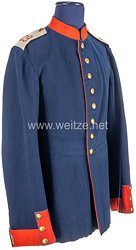
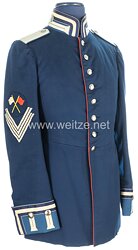
Kingdom of Bavaria World War I Tunic for a Lieutenant in the Infantry Regiment Wrede

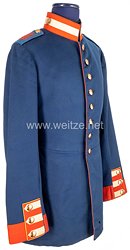
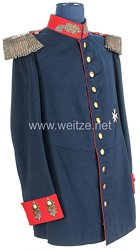
Home garrison Würzburg. Circa 1914/15. The tunic of blue cloth with red standing collar and red “Brandenburg” cuffs, the button panel with red piping, brass-colored buttons, sewn onto the shoulders are the shoulder straps for a lieutenant, early war pattern with white cloth backing, on the chest with 2 loops for a medal bar. Lined internally with black silk. A few small moth holes. Condition 2.

The “colored tunic” was still occasionally worn for parades and home leave after the introduction of the field-gray tunic (for field service). It was not officially replaced by the service tunic (dress tunic) Model 1915 until 1915/16. 


493231
750,00

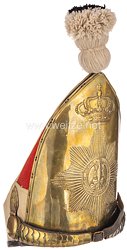
Prussian Grenadier Cap Model 1894 for Enlisted Men in the Kaiser Alexander Garde-Grenadier-Regiment Nr. 1, I. and II. Battalion

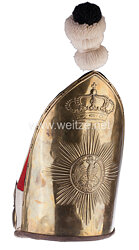
Berlin, circa 1910. Chamber quality manufacture. Brass front plate with embossed Guards star and crown. Red bag, piped in white and with white braiding. Large, domed scale chains, on the original whitened headband with applied flaming grenades on the sides and rear for the I. and II. Grenadier Battalion. Complete with the original black/white plume attached. Interior with black patent leather lining. Size 58. Condition 2.


492236
4.200,00

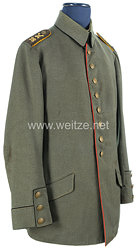
Prussia World War I Ulanka Model 1915 from the Estate of Karl von Diebitsch, Founder of the “Freikorps von Diebitsch”

The Ulanka dating from circa 1918. Made of fine field-gray cloth with red piping, field-gray crown buttons, shoulder boards for an Oberstleutnant (Lieutenant Colonel) affixed to the shoulders, four sewn buttonholes on the left breast for medals/decorations, in the buttonhole the ribbon for the Iron Cross 1914 and the Hanseatic Cross Hamburg. Interior lined with fine brown fabric. Lightly worn, a few small moth holes, on the back with three small period repairs. Condition 2.

A piece of historical significance! The former wearer can be identified as Karl Heinrich Feodor von Diebitsch (*1865, †1924), founder of the “Freikorps von Diebitsch.”
Karl von Diebitsch served in the 2nd Hanoverian Uhlan Regiment No. 14 (garrison St. Avold/Moerchingen). In 1913 he held the rank of Major and was assigned as adjutant to the 1st Cavalry Inspection (Posen). In this capacity he also served during the war as commander of the Landwehr Infantry Regiment No. 17, which was formed in 1914 in Saarbruecken and Forchheim. On April 1, 1919, he formed the “Freikorps von Diebitsch.” It consisted mainly of remnants of Saxon Landwehr units. The Freikorps was deployed primarily in Lithuania/Kurland for the protection of transportation routes such as railway lines in the area. Later it was also deployed in border protection in Silesia. It was dissolved on December 18, 1919 or April 1920. The Freikorps was then integrated into Reichswehr Infantry Regiment 102.
The commander Oberstleutnant Freiherr von Diebitsch established a total of 5 decorations: The Diebitsch Cross was awarded in 2 classes, the Star of Malplaquet, the Ladies' Bow to the Star, and the Medal for Good Horse Care.
Karl Heinrich Feodor von Diebitsch died on February 23, 1924 as Oberst a.D. (retired Colonel). The piece comes from private ownership.


https://www.leo-bw.de/detail/-/Detail/details/DOKUMENT/labw_findmittel_02/labw-4-1069664/Nachrichten+und+Meldungen+des+Freikorps+von+Diebitsch
https://de.wikipedia.org/wiki/Westrussische_Befreiungsarmee
https://www.ehrenzeichen-orden.de/weimarer-republik/diebitsch-kreuz-1-klasse.html
https://www.ehrenzeichen-orden.de/weimarer-republik/diebitsch-kreuz-2-klasse.html
https://www.ehrenzeichen-orden.de/weimarer-republik/stern-von-malplaquet-freikorps-von-diebitsch.html
https://www.ehrenzeichen-orden.de/weimarer-republik/freikorps-von-diebitsch-medaille-fur-gute-pferdepflege.html


491807
6.500,00

Prussian Helmet Case for a Pickelhaube

Circa 1910. Height approximately 26 cm. Interior lined with yellow fabric. Label of the firm “Mohr Speyer ...”, carrying strap present, but the closure strap is torn off on one side. Condition 2-.
489201
100,00

German Empire 1871-1918 Service Tunic for an Official of the Imperial Reichspost Oberpostdirektion Berlin

Chamber piece of the Oberpostdirektion Berlin from 1913. Dark blue tunic, the cuff facings, breast panel and standing collar with red piping, gold lace on the collar, red collar patches each with a golden rank star, the gilt buttons bearing the Imperial coat of arms. Interior with white linen lining, in the back area chamber stamp “O.P.D. Bln. 10. 1913”. Condition 2.


488880
650,00

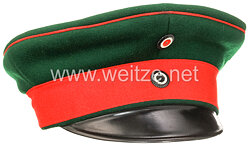
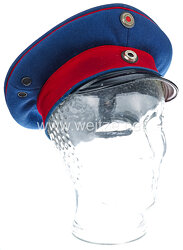
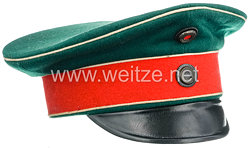
Weimar Republic/Prussia Visor Cap for an Officer and Veteran of the 2nd Westphalian Hussar Regiment No. 11

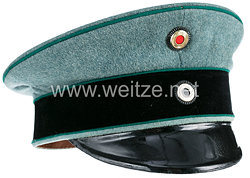
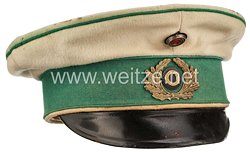
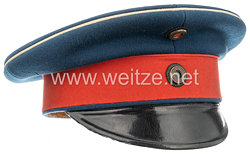
Former garrison Krefeld. Manufactured circa 1920. Tall elegant visor cap. Green cloth with red band and white piping, complete with both cockades. Interior with brown sweatband with size label “54 cm”, brown oilcloth lining with supplier “...Peküro Mütze ... G. Keuthen ...”. Condition 2.
488775
650,00

Imperial Schutztruppe German South-West Africa - Cartridge Belt for Mounted Troops (Second Pattern)

Circa 1910. Brown leather, the waist belt with 10 cartridge pouches and two cutouts, one for the belt frog and one for the water bottle, the belt frog for a smaller bayonet (KS98 or 71/84), with 3 attachment rivets (variant of the second pattern), shoulder strap with two additional cartridge pouches. Worn, only slight signs of age. Condition 2.

Very rare!


485804
2.800,00

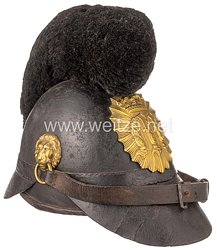
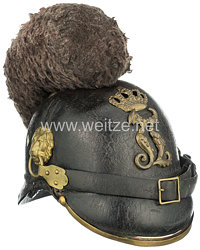
Bavarian Raupenhelm Model 1868 for Enlisted Men in an Infantry Regiment

Circa 1870/80. Chamber quality manufacture. Leather helmet, complete with all fittings. On the front the large three-dimensional helmet emblem “L” and “L”. Leather chinstrap on both sides attached to lion head mounts, on the left with cockade. On top the original wool caterpillar crest, somewhat faded and with a loss at the top. The bell with ventilation grilles on both left and right sides. Interior with tongued leather lining, inside the helmet bell an old collection label from 1929. The lining with an old glued repair at the rear. Size approximately 56. Condition 2.

The helmet was introduced in 1868 and worn during the Franco-Prussian War 1870/71. In 1886 it was replaced by the leather helmet with spike following the Prussian pattern.


484072
1.100,00

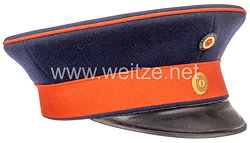
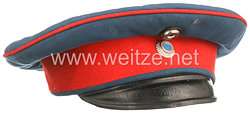
Baden Visor Cap for an Officer in an Infantry Regiment

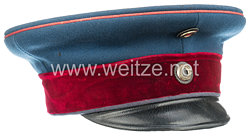
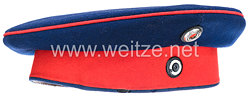
Circa 1910. Tall, plate-shaped visor cap of dark blue cloth with red band and red piping, black lacquered front visor, complete with both cockades. Interior with brown leather sweatband and brown cloth lining. Size approximately 55. An old, discreetly executed repair on the right side of the visor. A few small moth holes. Condition 2.


482674
420,00

Württemberg Visor Cap for an Infantry Officer

Circa 1880/90. The visor cap of dark blue cloth in a high shako form with short visor, red band and bulging red piping, front with the Württemberg state cockade in the officer's pattern. Interior with black leather sweatband and purple oilcloth lining with maker “...Falkenstein Ludwigsburg”. Size 56. Condition 2.
470040
450,00

Kingdom of Bavaria Visor Cap for an Infantry Officer

Personal property item circa 1900. Elegant, high plate form. The cloth in Bavarian blue with red cap band and piping, complete with both cockades, black lacquered visor. Interior with light brown leather sweatband and white silk lining. Size approximately 56. Worn, the crown with moth damage. Condition 2-.


465826
250,00

Kingdom of Württemberg Tunic for a Gefreiter (Lance Corporal) of Dragoon Regiment König (2nd Württemberg) No. 26

Garrison Stuttgart. Chamber piece circa 1910. The tunic of light blue cloth with yellow standing collar, cuff flaps and piping on the chest front, nickel silver buttons, on the shoulders buttons of the 2nd Squadron, without shoulder straps, on the collar the state buttons for the Gefreiter. Interior with white and olive green linen lining, in the lining fine chamber stamp “D.R. 26 gb XIII”. The collar on the right side with moth holes, on the right shoulder rear a small hole, various small period repairs. Condition 2-.
463351
750,00

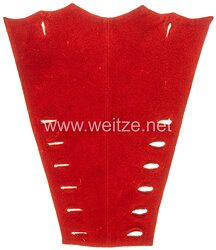
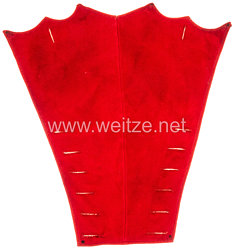
Prussia Red Parade Collar Tabs for the Ulanka of Uhlan Regiment Kaiser Alexander III of Russia (West Prussian) No. 1

Chamber piece 1904. Red parade collar tabs on dark blue cloth backing, interior with chamber stamp “UR1 1904”. Condition 2. Rarely found as a chamber piece.
461613
450,00

Mecklenburg-Schwerin Model 1855/60 Officer's Dragoon Parade Helmet

Private property, circa 1860. Elegant nickel-plated helmet shell of nickel silver, complete with all fittings in tombac. Front bears the gilt “sun” with applied Mecklenburg coat of arms. Domed scale chains, on the right side the state cockade for officers in woven fabric construction. Large cross-shaped plate with quadruple-fluted spike with ball-top cotter pins, topped with screw-attached white parade plume of buffalo hair. Interior is missing the leather liner, front peak with dark green leather lining, at the rear the black velvet lining is preserved but the pile is partially worn. Worn helmet, the soldered seam of the spike has split (can be easily restored), still uncleaned, in good untouched original condition. 

A very rare helmet, as this model was only worn until 1867. Thereafter, the Mecklenburg Dragoons received leather helmets following the Prussian model. The old metal helmets were turned over to the Gendarmerie, adapted and worn out.
453314
7.500,00

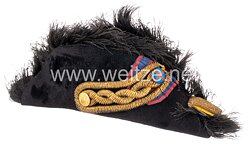
Oldenburg Bicorne for a Diplomat or State Official

Circa 1900. Collapsible bicorne of needle felt with black feather trim, on the right side silk cockade with button in the colors of Oldenburg, gold agraffe and gold button with the coat of arms of Oldenburg. Interior with brown silk lining bearing the maker “A. Pehl & Sohn Oldenburg”. Size approximately 59. Condition 2.
451690
650,00

Oldenburg Bicorne for a State Official

Circa 1900. Collapsible bicorne of needle felt with white feather trim, on the right a silk cockade in the colors of Oldenburg, gold agraffe and gold button with the coat of arms of Oldenburg. Interior with white silk lining. Size approximately 59. Condition 2.
451689
750,00

Bavarian Model 1848 Helmet for Bürgerwehr Officers

Circa 1850. Leather helmet, complete with all fittings in silver-colored finish. Front features the Bavarian state coat of arms, flat scale chains on lion head mounts, cross-shaped finial with screwed spike, on the left above the lion head the Bavarian cockade with the monogram “M”. Interior liner is missing. Size 53. Exterior shows some age. Condition 2-.
438750
950,00

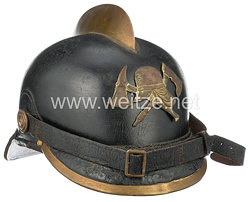
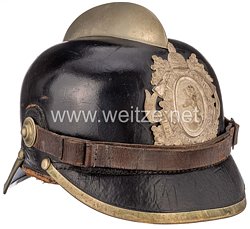
Hessen-Darmstadt - Fire Brigade Helmet

Circa 1900. Black lacquered leather skull with nickel silver comb. Front features the coat of arms with lions and motto “Gott zur Ehr dem Nächsten zur Wehr” (To God's honor, to the neighbor's defense). Leather chin strap on silver rosettes, left side with Hessian state cockade. Interior with reinforced leather lining. Size 57. Condition 2.
431669
320,00

Prussian Grenadier Cap Model 1894 for Enlisted Men of Kaiser Alexander Garde-Grenadier-Regiment Nr. 1, I. and II. Battalion

Berlin, circa 1910. Manufactured in chamber quality. Brass front plate with embossed Garde star and crown. Red bag, piped in white and with white lace. Large, domed scale chains, on the white band at sides and rear with applied flaming grenades for the I. and II. Grenadier-Battalion. Complete with original black/white pompom affixed. Interior with black lacquered leather lining. Size 56. The cloth with a few small moth holes. Condition 2.


428830
4.000,00

Kingdom of Bavaria Full Dress Coat for a State/Court Official

Circa 1900. Dark blue tail coat with standing collar, the cuff slashes and collar with silver and gold embroidery, brass buttons with Bavarian state coat of arms, sword pocket on the left side. Interior with black silk lining, tailor’s label from Würzburg in the neck area. Worn condition, minor repairs and moth holes, adhesive residue on the shoulders - Condition 2-.
399772
650,00

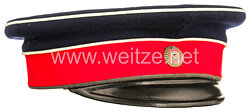
Baden Visor Cap for a Reserve Non-Commissioned Officer

Personal item, circa 1910. Dark blue wool, red cap band and piping, complete with both cockades, the state cockade with applied Landwehr cross. Black visor. Interior with brown sweatband and brown oilcloth lining, the lining stamped "HLB 1918 10.C. II". Size 57. Condition 2.
379416
450,00

Prussian Visor Cap for an Official of the War Ministry

Personal item circa 1910. High form, dark blue cloth with crimson piping, both cockades present. Interior with brown sweatband and brown oilcloth lining with the inscription “Deutsche Wertarbeit”. Size approximately 59. Condition 2.
370322
450,00

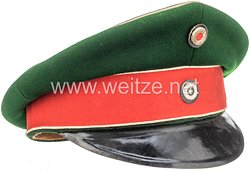
Prussia Visor Cap for Enlisted Men and Non-Commissioned Officers of the Jäger Battalions

Private purchase item, circa 1910. Jäger green with red piping and cap band, complete with both cockades in enlisted pattern. Interior with brown sweatband and honey-colored silk lining. Size 53. Worn condition, sweatband with loss. Condition 2.
358468
400,00

Prussian Czapka for an Ensign in the Westphalian Uhlan Regiment No. 5

Location Düsseldorf. Personal property, circa 1910. Leather czapka, complete with all fittings for parade. Silver-plated eagle in officer's quality, domed yellow scale chains on pass-through rosettes, on the right the Reich cockade for enlisted men, the front visor rail in silver. White parade trim for enlisted men, Prussian field insignia for officers and white parade plume of buffalo hair (as ensign not yet with black base), the sword knot for enlisted men. Interior with brown sweat leather and light brown silk lining. Size 57. The toggle on the crown torn off.  Condition 2.
353383
3.200,00

Prussian Visor Cap for an Officer in Dragoon Regiment No. 6 or 14

Circa 1910. Cornflower blue wool with black velvet trim stripes and black piping. Both cockades present, black leather visor. Interior with brown sweatband and blue silk lining. Size approximately 56. Only slight wear from use. Condition 2.


347443
650,00

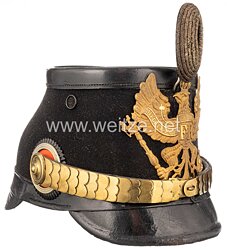
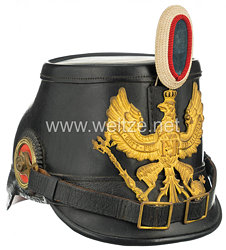
Prussian Shako for Enlisted Men of the Infantry

Personal property item, circa 1910. Dark blue cloth with red band and red piping, complete with both cockades. Interior with brown leather sweatband and brown oilcloth lining, maker's mark in the crown “Jos. Lambert Militär.-& Beamten-Mützenfabrik Hanau a.M.”. Size 57. Worn condition, condition grade 2.

296725
450,00

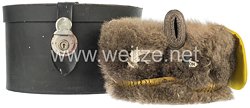
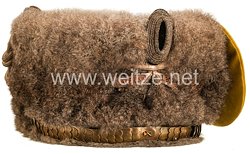
Prussian Fur Busby for Officers of the Husaren-Regiment von Zieten (Brandenburg) Nr. 3

Garrison Rathenow. Private purchase item circa 1910. Elegant fur busby approximately 11 cm high, made of dark brown fur as regulation until 1912, complete with all fittings. Front features the silver “Vaterlandsbandeau” (patriotic front plate), curved gilt scale chains on rosettes, Reich cockade on the right. Complete with ponceau red bag (kolpak), rolled cord lanyard, and plume holder. Interior with brown leather sweatband and yellow cloth lining, sweatband marked with initials “J.B.” Size approximately 54. The bag with a few small moth holes, otherwise very well preserved! With original storage case for the busby. Condition 2.

Could also be worn in the 2nd Westphalian Hussar Regiment Nr. 11 (Krefeld), Husaren-Regiment König Humbert von Italien (1. Kurhessisches) Nr. 13 (Diedenhofen), and Husaren-Regiment Landgraf Friedrich II. von Hessen-Homburg (2. Kurhess.) Nr. 14 (Kassel).
505810
4.500,00

Bavaria World War I Ersatz Pickelhaube Made of Sheet Metal for Enlisted Men in an Infantry Regiment

Circa 1915/16. The helmet shell made of pressed sheet metal and black lacquered, complete with all fittings. Front bears the small helmet emblem, leather chin strap attached to button 91, both cockades present. Interior with tabbed leather liner, inside the shell marked by maker “Gebr. Bing A.G. Nürnberg”, the shell lined with felt. Size approximately 54. Some dents, the lacquer with losses. Condition 2-.
503767
1.450,00

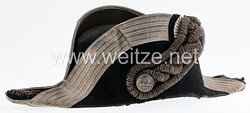
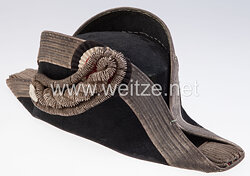
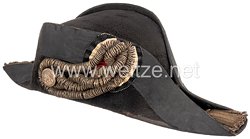
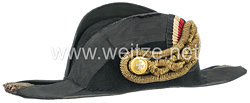
Imperial German Navy Bicorne for Naval Officers

Circa 1910. Bicorne of black needle felt, the edging of black silk ribbon. On right side gold agraffe over silk cockade in black/white/red and gilt naval button. Interior with light leather sweatband with reddish-brown silk lining with maker “Zeugner & Riedel ... Halle ...”. Size approximately 54. Condition 2.
510140
850,00

Kingdom of Bavaria Czapka Model 1864/73 for Enlisted Men Uhlans

Circa 1864, adapted 1873. The czapka of black lacquered leather and crimson cloth on rattan framework, front emblem with cipher “L”, silver scale chains on lion head mounts, the fastener of the scale chains at front with perforation for attachment to the small hook decorated with a lion head below the top (this was removed per regulations in 1873; in that year the chin strap was introduced and the lion head hook was moved from the front underside to the top; this is missing on this example (!)). Inserted on the top is the plume of white horsehair with the white-blue cockade (this was regulation from 1864, after 1873 worn only for parade as the newly introduced field insignia was worn for duty). On the front visor the nickel silver reinforcement strip introduced in 1873 is attached. Interior with glued leather lining. Size approximately 54. Condition 2.

A very interesting and rare piece!
509589
2.650,00

Kingdom of Bavaria Caterpillar Helmet Model 1868 for Infantry Officers

Circa 1870/80. Black lacquered leather helmet, complete with all fittings in fire-gilt finish. Large helmet plate crown over “L”, black patent leather chinstrap on lion head mounts on both sides. On the left above the lion head with Bavarian cockade “L”. Large original bearskin caterpillar crest. Interior with reinforced leather lining, handwritten size “54” and owner's name “Mohr” inside the shell. Condition 2.
509586
2.200,00

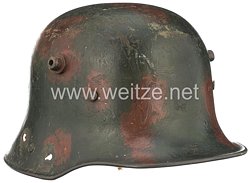
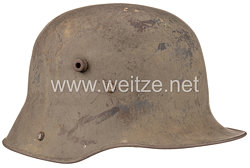
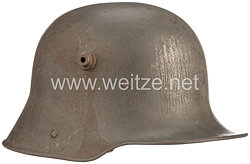
German Empire World War I Two M 1916 Steel Helmets from an Estate, One a “Lifesaver”

Circa 1917/18. The first steel helmet with approximately 80% of its olive green paint finish preserved, the shell lightly surface rusted. Interior with sheet metal ring from 1917 onwards, two segments of the three-piece liner retained, the pads without filling, one segment with the owner’s name “Schäfer”, side stamped with manufacturer “Si.66” (Eisenhütte Silesia, Paruschowitz Upper Silesia), stamped “Bi 329” inside the shell, with original chinstrap.
The second steel helmet with approximately 80% of its olive green paint finish preserved, the shell lightly surface rusted. The liner and one rivet are missing, side stamped with manufacturer “Si.66” (Eisenhütte Silesia, Paruschowitz Upper Silesia), stamped “Bi 651” inside the shell. On the left side with approximately four bullet entry holes, on the right side with one exit hole.

A testament to the horrors of war! The helmets came together from the estate of one and the same World War veteran. The helmet with the bullet holes was placed as a “dummy” on the trench parapet and thus fulfilled its purpose as a “lifesaver”.
505678
2.500,00

Prussian Grenadier Mitre Model 1894 for “Grenadier Rademann 5th Company Regiment Alexander”

Location Berlin, circa 1910. The Grenadier mitre for Kaiser Alexander Garde-Grenadier-Regiment Nr. 1 manufactured in chamber quality. Front with brass plate bearing embossed Garde star and crown. Red bag with white lace. Large, domed scale chains, on the original whitened band at the sides and rear with applied flaming grenades for the 1st and 2nd Grenadier Battalions. Complete with original black and white pompom attached. Interior with lashed leather lining, damaged at the front, owner's label stitched at the rear. Size approximately 55. Condition 2.
504214
4.000,00

Prussian Pickelhaube for Officers of the 1st Guard Dragoon Regiment “Queen Victoria of Great Britain and Ireland” for Parade.

Location Berlin, circa 1912. Elegant helmet of vulcanized fiber, complete with gilt mounts. Large Guard eagle, matte gilt with polished edges, domed Guard star. Domed scale chin chains with both cockades. Tall parade spike with white parade plume of buffalo hair. Interior with light brown sweatband with white silk ribbon drawstring, with “blind embossed” maker mark “Depaheg Patent” with quadriga, dark green silk lining. Size 57. Handwritten owner's name “Wienhold” on rear of sweatband. Only lightly worn in very good condition.
503940
6.000,00

Imperial German Navy Dark Blue Visor Cap for a Reserve Commissariat Secretary Official

Circa 1910. Dark blue elegant visor cap for a naval engineer in the typical naval pattern, light blue band, complete with hand-embroidered crowned badge in silver metallic thread, with reserve cross in the Imperial cockade, black patent leather chinstrap on silver-plated Imperial Navy buttons. Interior with brown leather sweatband and fine cloth lining with maker “Adolf Ernst Mützenfabrik Hannover”. Size 58, condition 2+. Extremely rare visor cap!
503904
4.500,00

Hessen Visor Cap for a Lance Corporal in Infantry Regiment No. 116

Circa 1910. The tall visor cap in dark blue cloth with red band and piping, both cockades, the state cockade with the Landwehr cross, black patent leather visor. Interior with brown leather sweatband and honey-colored cloth with maker “Theodor Schmidt Mützenmachermeister, Giessen Neue Bäue 6”, with owner label “Gefreiter Momberger 4. Kp. Inf.-Rgt. Kais. Wilh. (2. Großh. Hess.) Nr. 116.”, with chamber stamp “E. U.”, condition 2+.
503791
480,00

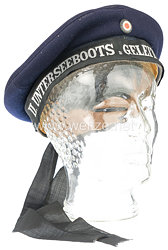
Imperial German Navy World War I White Peaked Cap for U-boat Commanders

circa 1915/16. White one-piece peaked cap in the typical naval pattern made of white cotton fabric. A so-called “Kochmütze” (boiling cap), because it could be completely washed (= boiled). Complete with hand-embroidered crowned insignia in metal thread, black patent leather strap on gilt Imperial Navy buttons, black grosgrain ribbon around the circumference. The grosgrain ribbon could then be removed with the insignia for washing. Interior sweatband of reinforced white cotton fabric, with handwritten owner's name “Eggertin”. Size approximately 56. Worn piece in good condition.

The typical cap of a naval officer, which was worn daily for several years. During World War I, U-boat commanders wore white peaked caps as a distinguishing mark, as was also customary later in World War II. An extremely rare cap!

501709
3.500,00

Prussian Helmet Model 1867 for a Reserve Officer in the 3rd-5th or 7th-8th Cuirassier Regiment

Circa 1870/80. Helmet skull of polished sheet iron, complete with all fittings, some in gilt finish. Front features the large helmet eagle for cuirassiers in the reserve officer version without bandeau with applied silver Landwehr cross. Wide, domed scale chin chains on slotted screws with cloverleaf-shaped rosettes, on the right the Prussian state cockade still in leather execution (!). Cross-shaped base with non-removable fluted spike. Interior with finely laced red-dyed leather lining, the double-curved front visor lacquered green, the neck guard lined with black velvet. Size 55. The skull and spike with fly rust and rust pitting respectively. Condition 2-.

500197
3.800,00

German Empire World War I Steel Helmet M 1916 - American War Trophy 1918 “Verdun 1918”

The original olive green paint finish approximately 80% intact. Interior fitted with three-piece liner on leather headband, one cushion detached, manufacturer not identifiable, bell stamped “R i 554”, neck guard inscribed “Verdun May I 1918”. Without chinstrap. Condition 2.

Between 1917 and 1918, more than one million men of the American Expeditionary Forces fought on the Western Front. The majority in the Verdun sector.
498812
1.650,00

Prussian Visor Cap for a Reserve Officer of Field Artillery

Circa 1890. Dark blue service cap with black velvet band and red piping, black visor, front displays the applied Prussian cockade for Reserve and Landwehr officers. Interior features brown sweatband and brown oilcloth lining with manufacturer marking “Pelzwaren, Schüler, Uniform- & Beamtenmützen Richard Fischmeyer Hettstedt ...”. Size approximately 57. Condition 2.
498274
350,00

Prussian Visor Cap for an Artillery Officer

Personal item circa 1910. The visor cap made of dark blue cloth with black velvet band and three red piping details, black lacquered front visor made of vulcanized fiber, both cockades present. Interior with brown sweatband and purple cloth lining. Size approximately 55. Shows wear. Condition 2-.
498263
400,00

Prussian Helmet Model 1905 for Enlisted Men of the Regiment Jäger zu Pferde Nr. 8

Home garrison Trier. Chamber piece in peacetime quality, circa 1914. The helmet skull of steel, black burnished, complete with all fittings. The helmet eagle, spike, rivets and edge trim in brass finish, domed yellow scale chain on button 94, complete with both cockades in large version. Interior with laced leather liner, the front visor lacquered green, the rear visor black burnished. Interior marked with maker “C. E. Juncker 1914”. On the edge of the rear visor with fine chamber stamp “8. J.P.” and size “56.5” Lightly worn, two small dents at rear, condition 2.

The regiment was only founded on October 1, 1913. The helmets are accordingly very rare.
497097
3.500,00

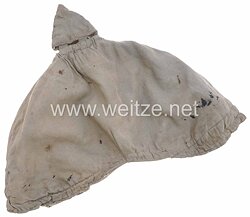
German Empire World War I Field Gray Camouflage Cover for Pickelhaube Infantry Officers

Circa 1915. Olive-colored cloth. Size approximately 58. Condition 2.
493648
300,00

Reuß Pickelhaube for an Officer in the 7th Thuringian Infantry Regiment No. 96, II. Battalion

Garrison Gera, circa 1914. Elegant spiked helmet made of vulcanized fiber, complete with all fittings. On the front the finely crafted and gilt line eagle with the motto “Mit Gott für Fuerst und Vaterland” (With God for Prince and Fatherland), in the center with a high-domed silvered star with the Reuß coat of arms applied on top. The tall spike is removable. Flat gilt scale chin chains on rosettes, both cockades present. Interior with light-colored leather sweatband and olive-green silk grosgrain lining. The bell lined inside with black fabric. Size approximately 57. Condition 2.

Extremely rare, one of the rarest helmets of the old army.
492920
7.000,00

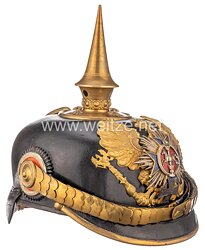
Prussian Pickelhaube for Generals

Circa 1900. Leather helmet, complete with all fittings in gilt finish. Front features the large Garde eagle finely worked with polished edges, mounted with the Garde star in genuine silver (!), the center finely enameled. Cruciform base with fluted removable spike for generals, regulation style flush with the neck. Domed scale chains on rosettes, both cockades. Interior with light leather sweatband and beige silk grosgrain lining. Inside the bell handwritten size “54 1/4” as well as old collection signature. Lightly worn. Condition 2.
492912
6.500,00

Pickelhaube for Officers of the 3rd Battery of Fußartillerie-Regiment von Hindersin (1. Pommersches) Nr. 2

Garrisons Swinemünde/Emden. Private purchase item circa 1910. Lightweight leather helmet, complete with all fittings in gilt finish. Front features the heraldic eagle with oval breast shield bearing the cipher “FWR” and bandeau with the motto “Mit Gott für Koenig und Vaterland”, below which is affixed the distinction bandeau “Colberg. 1807”. The spike is removable. Flat scale chin chains on rosettes, both cockades present. Interior with light-colored leather sweatband and green silk grosgrain lining, the front visor lined in green and the rear visor in red. Handwritten size “58” inside the bell. The helmet's seam reinforced internally with leather. Beautifully preserved helmet! Condition 2+.

Extremely rare! Among all the foot artillery, only two batteries were authorized to wear a distinction band on the helmet. These were the 3rd Battery of Fußartillerie-Regiment von Hindersin and the 4th Company of Garde-Fußartillerie-Regiment.
492896
7.500,00

Prussia World War I Pickelhaube for “Major Budher” of the 2nd Battalion, 8th Lorraine Infantry Regiment No. 159

Home garrison Mühlheim on the Ruhr. Circa 1914. Lightweight leather helmet, complete with all fittings. Line eagle insignia to front. Flat scale chin chains on rosettes, both cockades present. Spike non-removable. Interior with brown sweatband and beige rep lining. Size approximately 54. Worn condition, crown slightly sunken at top. Condition 2-.

491047
950,00

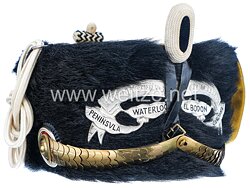
Kingdom of Hanover Pickelhaube Model 1847 for an Officer of the 1st or Leib-Regiment

circa 1850. Elegant tall leather helmet, complete with all fittings in gilt finish. Front helmet plate featuring the large yellow trotting horse (without the motto “Waterloo”!). Cross-shaped base with ball screws (1 missing), tall spike, curved scale chin chains, on the right the large leather officer's cockade, angular front visor. Interior with laced leather lining. Interior front visor lined in green, rear neck guard lined in black. Only lightly worn in very fine untouched original condition.

Very rare! The Pickelhaube following the Prussian model was introduced in 1847 initially only for the Garde-Regiment and then in the same year also for the Leib-Regiment (1st Regiment). In 1850 the line regiments were also equipped with it. The Leib-Regiment was the only regiment that did not carry a motto from the Napoleonic era, as it was only formed in 1838 from detachments of other regiments.
490594
5.500,00

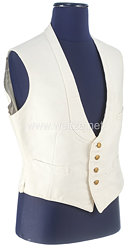
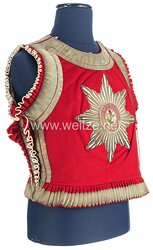
Imperial German Navy Short White Waistcoat from the Estate of Chief Engineer Dietrich Görke

Circa 1914. Elegant white waistcoat made of waffle cloth. Complete with row of fire-gilt Navy buttons. White lining inside. Manufacturer's label “Hermann Holstein Kiel Wilhelmshaven” on the inside back of the adjustment strap. Worn piece in good condition. Very rare.

The waistcoat comes from the estate of Chief Engineer Dietrich Görke, which we were able to purchase in its entirety. Included is a photocopy, a newspaper clipping from Görke's 90th birthday, showing him wearing his old Imperial Navy uniform once more.
489793
650,00

Saxon Helmet for Officers of the Garde-Reiter-Regiment

Dresden, circa 1912/14. The helmet skull in particularly lightweight construction of gilt tombac, complete with all fittings. Large silver-plated helmet star with gilt coat of arms, domed gilt scale chains on cloverleaf fittings and screws, both cockades. Version with tall fluted spike, gilt. Interior with brown sweatband with reddish-brown silk lining. The front visor with brown leather, the rear visor lined with light green velvet. Size 56. Lightly worn, condition 2.
The helmet for the Saxon Heavy Cavalry was introduced in 1876 following the model of the Prussian cuirassier helmets. The same helmet was also worn in the Sächsisches Karabinier-Regiment (2nd Heavy Regiment).
488499
13.500,00

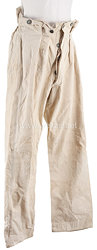
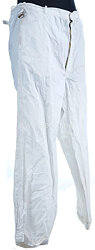
Saxe-Meiningen-Coburg-Gotha White Long Trousers for Enlisted Men of the 6th Thuringian Infantry Regiment No. 95

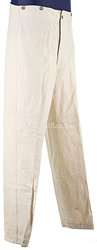
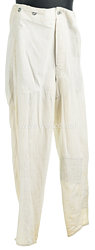
Garrisons Gotha, Hildburghausen, Coburg. Chamber piece from 1880. Long white trousers with zinc buttons. Interior with chamber stamp “6.Th.I.R.95 I.B. 1880 3.C. II”. Condition 2.
487710
450,00

Prussia Enlisted Men's Tunic for the 1st Guard Regiment on Foot

Garrison Berlin. Private purchase item circa 1910. Dark blue tunic with red standing collar and red Swedish cuffs, both with white guard lace, the button front with red piping, nickel-plated buttons. White shoulder straps of the 10th Company sewn onto the shoulders with buttons. White lining inside. The lining with subsequently added regimental stamps (post-1945!). Condition 2.

An original private issued tunic, inside the regimental markings are post-war!
485364
1.450,00

Württemberg Officer's Visor Cap for Infantry from the Franco-Prussian War 1870/71

Personal item circa 1870. Tall, plate-shaped visor cap in dark blue, nearly black cloth with red band and thick red piping, with short black lacquered visor, front bearing the Württemberg state cockade. Interior with black lacquered leather sweatband and violet oilcloth lining with maker's mark “Fr. Enslin ... Stuttgart”. Size approximately 53. Only minor signs of wear. Condition 2.

From 1859, the Grenadier-Regiment Königin Olga Kingdom of Württemberg (1st Württemberg) No. 119 and from 1866 the Infanterie-Regiment Kaiser Friedrich, König von Preußen Kingdom of Württemberg (7th Württemberg) No. 125 were stationed in Stuttgart. Both regiments participated in the Battle of Sedan and the Siege of Paris.


482676
650,00

Prussian Visor Cap for a Reserve Officer in Hussar Regiment Landgraf Friedrich II. von Hessen-Homburg (2. Kurhessisches) Nr. 14

Garrison location Kassel. Early form with short visor circa 1880. The visor cap of dark blue cloth (faded by sun exposure), red band, white piping, black lacquered visor, complete with both cockades, the state cockade with the Reserve cross. Interior with brown sweatband with label showing size “59”, wine-red oilcloth lining with gold embossing “Deutsche Industrie”. Condition 2.
A rare visor cap.
478803
750,00

Kingdom of Saxony Pickelhaube and Shoulder Boards from the Estate of a Major in the 8th Infantry Regiment Prinz Johann Georg Nr. 107

Location Dresden. The Pickelhaube is a privately-owned piece from 1908. Elegant, lightweight leather helmet, complete with all fittings. Front features a high-domed gilt brass star with applied silver Saxon coat of arms. Flat gilt scale chains attached to rosettes, both cockades in the distinctive Saxon form. The spike is removable. Interior with brown leather sweatband with silk ribbon drawstring and light green silk grosgrain lining, the neck visor lined in red and the front visor lined in green, the neck visor rail marked “W.G” and with size “55”, inside the bell handwritten again the size “55” as well as the date “1/10 08”. The lacquer of the helmet has a scratch on the rear right side. Accompanying shoulder boards included. Condition 2.

Directly from a private household.


477518
2.200,00

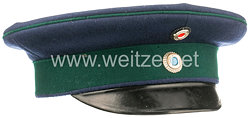
Kingdom of Saxony Visor Cap for a Police Officer

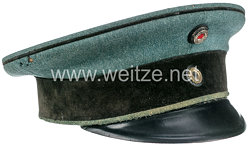
Circa 1900. Visor cap made of black cloth with black velvet band and green piping, front bearing the Saxon state cockade, short black lacquered visor. Interior with black leather sweatband and beige oilcloth lining, the sweatband with small label bearing handwritten size “56”. Condition 2.
475864
350,00

Prussian Shako Model 1860 for Parade for Enlisted Men of Jäger Battalions No. 3, 4 and 7-11 from the Period of the Wars of Unification 1864, 66 and 70/71

Tall black patent leather shako, complete with all fittings. Front features the Prussian line eagle in very fine condition. Leather chinstrap attached at sides to blackened iron screws. Complete with Prussian field insignia and parade plume of black buffalo hair with brass socket. Interior with laced leather lining, handwritten name “Dombrow” in crown. Size approximately 54. Condition 2.

Very rare! The Model 1860 shakos remained in service for a long time, some were later shortened and/or fitted with the 91 button. Some pieces were also transferred to the Landwehr. Only a few pieces have survived in original condition.
475111
2.200,00

Hamburg Pickelhaube for a Customs Official in the Middle Service

Circa 1900. Leather helmet, complete with all fittings in gilded finish. Front features the Hamburg coat of arms, held by two lions. Flat scale chin chains, on the right the Hamburg cockade. Plate with fluted official spike with ball finial. Interior with light brown leather sweatband and light silk grosgrain lining, the neck guard lined in red, handwritten size “58 1/2” inside the bell. With original helmet case. Condition 2.
465908
2.500,00

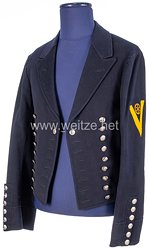
Imperial Navy Short Mess Dress Jacket for Senior Stoker “Schleifenbaum”

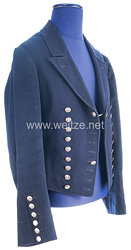
Chamber piece 1910. Blue wool with silver anchor buttons, toggle chain present, on the left upper arm the yellow chevron for leading seaman. Interior with black fabric lining, in the shoulder area with fine chamber stamp “B A-W 24 8. 10 3 ... II. W. 1. 435./11.”, below it the owner label “Schleifenbaum”. Condition 2.
464356
450,00

Kingdom of Bavaria Model 1848 Helmet for an Officer of the Bürgerwehr

Circa 1850. Tall leather helmet, complete with all mounts in nickel silver. Front features the Bavarian state coat of arms, domed scale chin chains on lion head bosses, on the left side with Bavarian cockade, silver cross-shaped plume holder with original black parade plume of horsehair, short rear visor, stamped “W88”. Interior with reinforced leather lining, handwritten inscription “KL B.W.” in the bell. Size 58. Condition 2.
460025
1.250,00

Imperial German Navy Bicorne for a Naval Official

circa 1910. Bicorne of black needle felt, trimmed with black silk ribbon. On the left side a gold agraffe over silk cockade in black/white/red and silvered naval button. Interior with light brown leather sweatband and white silk lining bearing the maker “L.H. Berger, Collani & Co. Hof-Lieferanten Berlin”, below which the owner’s name “Fibel”. Size 57. Light wear from use. Condition 2.
459787
700,00

Prussia Tunic for Enlisted Men of the 3rd Silesian Dragoon Regiment No. 15

Stationed at Hagenau, circa 1910. Cornflower blue tunic with rose-colored standing collar and cuffs, each with white piping, the button placket edges with rose-colored piping, nickel-plated buttons, on the shoulders the shoulder straps with the unit number “15” embroidered in yellow and buttons of the 5th Squadron, on the right sleeve with chevron for good lance fencing. Interior with blue silk lining. Light wear and age marks, pinhead-sized moth holes. Worn, condition 2/2-.
449805
1.000,00

Prussian Visor Cap for an Officer in the Lauenburgisches Jäger-Bataillon Nr. 9

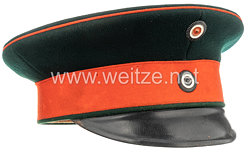
Garrison Ratzeburg, circa 1910. Visor cap of green cloth with red band and piping, both cockades present, black lacquered visor. Interior with brown sweatband and light blue silk lining bearing the maker's mark “Wilh. Reinboth Ratzeburg”. Size approximately 56. Crown with a few small moth holes. Condition 2.
449773
550,00

Imperial German Navy Bicorne for Naval Officers

Circa 1910. Bicorne of black needle felt, edging of black silk ribbon. On left side gold agraffe over silk cockade in black/white/red and gilt naval button. Interior with light-colored leather sweatband with white silk lining bearing the supplier mark “L. H. Berger Collani & Co Hoflieferanten”, the leather sweatband with handwritten owner's name “Ohm.”. Size approximately 56. In original case. Condition 2+
449536
1.200,00

Bavarian Raupenhelm Model 1861 for Enlisted Men in a Landwehr Infantry Regiment

In the style of wear circa 1861. Leather helmet, complete with all brass fittings. Front emblem features the star with the cipher “M” on the oval star for Landwehr regiments (M = Maximilian II Joseph, † 1864), leather chin straps on both sides attached to lion head mounts, left side with cockade, wool caterpillar crest on the comb. Interior with stitched leather lining, neck guard stamped “1861”. Size approximately 54. Condition 2.

Very rare! Only a few examples of the Model 1861 helmet were produced and the helmet was also slowly distributed to the troops. After 1868, the existing helmets received leather chin straps instead of scale chains like the Model 1868 helmet and new emblems, since in the meantime Maximilian II had also died.
449140
1.850,00

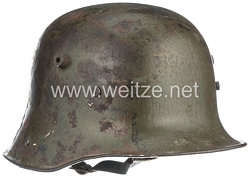
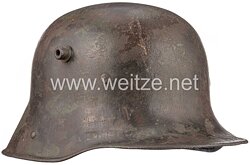
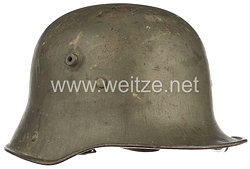
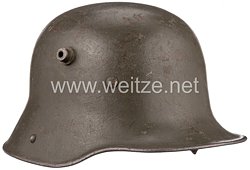
German Empire WWI Steel Helmet M 1916

Variant with sheet metal liner band circa 1917. Continued in use through the Wehrmacht period. Original olive-green paint approximately 75% intact. Interior features three padding pads on the sheet metal liner band, two of the three pads still retain their stuffing, the front pad more heavily worn and without stuffing, the two rear pads replaced during WWI or Reichswehr period, with both front rivets renewed at that time, the rear rivet replaced with a Wehrmacht-period rivet. Owner's name “F. Klee” in neck area, stamped “63” on front, no manufacturer identifiable. Without chinstrap. Condition 2.
447993
1.350,00

Oldenburg Frock Coat for “Finanzrath Buchholz”

Manufactured in 1893. Elegant dark blue-black frock coat with red standing collar, elaborate gold and silver embroidery on collar and cuff flaps, single row of seven gilt buttons bearing the Oldenburg coat of arms. Interior lined with black silk, neck area with tailor's label “Meentzen & Fassbender Bremen”, breast pocket with label “Meentzen & Fassbender, Bremen Herr Finanzrath Buchholz ... 1893”.
Only lightly worn, two small moth holes. Condition 2.
Very rare.
445896
1.200,00

Prussian Visor Cap from the Personal Property of Crown Prince Wilhelm of Prussia as Colonel à la Suite in the 1st Foot Guards Regiment

Circa 1910. Elegant, exceptionally tall saddle-form cap of the style particularly favored by the Crown Prince. The cloth in dark blue with red cap band and piping, both cockades in fine officer's quality, short black embossed leather visor. Interior with light brown sweatband and red silk lining, the lining embossed with the initials of a royal crown over “W” for Crown Prince Wilhelm, size approximately 56. Old inventory stamps from the “Kostümfundus Kassel” (Costume Archive Kassel) in the sweatband at rear. Lightly worn, in good condition.

The Crown Prince also served as Colonel à la Suite in the Grenadier Regiment Crown Prince (1st East Prussian) No. 1, for which this visor cap was also worn.


445861
6.500,00

Bavarian Raupenhelm Model 1868 for Officers of the Landwehr Infantry

Circa 1880. Leather helmet, complete with all fittings in fire-gilt finish. Front displays the emblem for Reserve or Landwehr officers, a star with the crowned cipher “L”. Black patent leather chinstrap attached to lion head side mounts. Left side above the lion head features a cockade with crown “L”. Large original bearskin crest. Interior with lined leather lining. Size approximately 55. Condition 2
443628
2.400,00

Prussian Fur Busby for a Reserve Officer in Husaren-Regiment König Wilhelm I. (1. Rheinisches) Nr. 7

Stationed in Bonn circa 1900. Elegant fur busby made of otter fur, complete with all fittings in gilt finish. On the front the crowned cypher “WRI”, for reserve officers without bandeau, below it the large “frosted” silver-plated Landwehr cross with the motto “Mit Gott für König und Vaterland” (With God for King and Fatherland). Domed scale chains on rosettes, on the right the Reich cockade. Complete with the field insignia and the parade plume of heron feathers. Red cloth bag, rolled chin cord. Interior with light leather sweatband and white silk lining. Size 53. In very fine condition! Condition 2+.

Very rare! Offered in our catalog for the first time in eight years.
434492
8.000,00

Kingdom of Saxony Ulanka for the Future Peace Uniform Model 1915 for Enlisted Men of the Royal Saxon 2nd Uhlan Regiment No. 18

Chamber piece from 1916. The ulanka made of field-gray cloth with purple-red collar, cuffs and piping, silver-colored buttons. Sewn onto the shoulders are the red shoulder straps with purple-red piping and the regimental number “18” embroidered in yellow. Interior lined with olive-colored cloth. In the shoulder area with very fine chamber stamp “BA XIX 16 20”. Various moth damage, on the right sleeve two old darned holes, on the left sleeve an old sewn tear. Condition 3+.

As an ulanka for the future peace uniform Model 1915 extremely rare! First time in our offering.
431753
4.500,00

Prussia World War I Field Gray Tunic M 1910 for a Lieutenant in Foot Artillery Regiment No. 28

Personal property item circa 1917. Made from field gray cloth of fine quality, the front panel with red piping, the collar and cuff flaps with patches with black piping, brass buttons with crowns. Sewn onto the shoulders are the shoulder straps for a lieutenant with crossed grenades and unit number "28". Interior with olive-colored silk lining and gray-olive cloth lining. The lining renewed several times during the period but in very good craftsmanship quality. Exterior somewhat stained. Condition 2.

The I. Battalion of Foot Artillery Regiment No. 28 was with the 303rd Infantry Division established in September 1917 in Romania. The II. Battalion was subordinated in 1918 to Arko 18 with the 18th Division.
431031
3.000,00

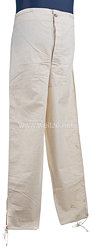
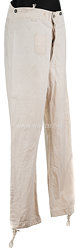
Prussia World War I White Long Drill Trousers (Fatigue Trousers) for Enlisted Men of the Guard Infantry

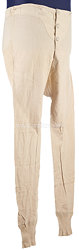
Chamber piece 1915. Long white trousers with zinc button. Interior marked with chamber stamp “K.B.A.G. 1915.” (= Königliches Bekleidungsamt Garde - Royal Clothing Office Guard). Stained, condition 2-.
412431
450,00

Kingdom of Hanover Court Master Huntsman Coat

circa 1860. Heavy dark green coat, double row of buttons, gilt buttons bearing the Hanoverian coat of arms, one button missing on the back. Collar and cuff flaps with wide double gold lace trim. The shoulder boards with applied rank star are covered with mourning crepe. Lightly worn in good condition.

This piece comes from Marienburg Castle from the Sotheby’s auction of the Royal House of Hanover 2005.
411499
850,00

Prussian Shako for a One-Year Volunteer of the Machine Gun Detachments

Private purchase item in officer quality, circa 1914. Elegant brown patent leather shako covered with field-gray felt cloth, with ventilation grommets on the sides. Complete with all fittings in gilt finish. Front with Prussian line eagle in officer quality, brown patent leather chin strap on gilt fittings and button 91, left side with Reich cockade, Prussian field insignia with black velvet backing. Interior with light-colored sweatband with white silk ribbon drawstring, light silk lining, inside crown with handwritten owner's initials “W.G.”, size 55.
The shako shows only light wear, though with some minor moth damage. Overall condition 2. Very rare.
403731
3.500,00

Prussian Visor Cap for an Official in the War Ministry, Quartermaster Department, Clothing Office or Remount Depot Administration

Circa 1900. Blue cloth with band in the same color, red piping, both cockades, short visor. Interior with brown leather sweatband and honey-colored silk lining with maker “Mohr & Speyer ... Berlin ...”. Size approximately 58. Condition 2.
400314
400,00

Prussian Visor Cap for a Mounted Troop Officer Originally from the Infantry

Circa 1910. For wear with army uniform.  Elegant, high plate form. Dark blue cloth with red cap band and piping, white piping on top of the crown, both cockades present, black lacquered visor. Interior with brown sweatband and lining, old inventory stamp in lining. Size 56. Worn condition, crown with minor moth damage, condition grade 2.


395414
450,00

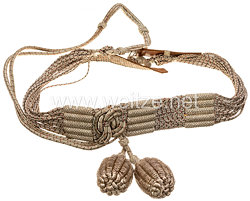
Imperial German Navy so-called “Hussar Sash” Model 1873 for Naval Officers for Full Dress Coat

circa 1875. Silver braid with black/red interwoven threads. Only minimally worn, condition 2+. Very rare.
388718
1.500,00

Bavarian Visor Cap for an Infantry Officer

Circa 1900. Tall blue visor cap with red band and piping, complete with both cockades. Interior brown leather sweatband, bone-colored silk lining. Size 54. In good condition. Condition 2.
379334
400,00

Württemberg Pickelhaube for Officers of Dragoon Regiment König (2nd Württemberg) No. 26 in Full Dress Configuration

Garrison Cannstatt, circa 1910. Elegant leather helmet, complete with all fittings in silver-plated finish. The helmet plate silver-plated with polished edges, applied star of the Order of Merit of the Württemberg Crown, the center finely enameled, the enamel chipped due to wear. Silver crosspiece fitting with parade spike with black parade plume of buffalo hair, gilt star screws. Gilt domed scale chains on silver rosettes, complete with both cockades. Interior brown sweat leather, honey-colored silk lining. Size 55. Front visor lined in green on the interior, rear visor in red. Condition 2.
358169
6.800,00

Imperial German Navy Bicorne for a Naval Official

circa 1910. Bicorne of black needle felt, trimmed with black silk ribbon. On the left side, silver agraffe over silk cockade in black/white/red and silver-plated naval button. Interior with black leather sweatband and wine-red silk lining. Size 57. In original case. Minor signs of wear and age, Condition 2.


326785
750,00

Prussian White Long Drill Trousers (Fatigue Pants) for Enlisted Men of the 3rd Lower Alsatian Infantry Regiment Nr. 138

Peacetime garrison Dieuze, depot piece, 1915. Long trousers of white cotton. With watch pocket, zinc-plated buttons. Interior with fine depot stamp “B.A. XV 1915 - I.R.138”. Well preserved, one button replaced in period. Condition 2.

The IR 138 was initially subordinated to the XV. Army Corps in Straßburg. From 1912 it belonged to the XXI. Army Corps in Saarbrücken. The trousers were transferred in 1915 from stocks of the XV. to the XXI. Army Corps.
323209
450,00

Württemberg Pickelhaube for a Military Official

Circa 1900. Leather helmet, complete with all fittings in silver finish. Front features the frosted silver-plated Württemberg emblem with polished edges, reverse side missing one of the screw posts from the emblem, cruciform base with golden stars and non-removable spike, domed scale chains on rosettes, both cockades present, the Württemberg state cockade in the folded style. Interior with light brown leather sweatband and light-colored liner, the front visor lined in green, the rear visor unlined. Size 56. On the rear of the helmet the lacquer shows small cracks and minor flaking, Condition 2.
319603
2.200,00

Baden Visor Cap for Officers of the 3rd Baden Dragoon Regiment Nr. 22

circa 1910. High elegant plate form, cloth in fine light summer quality, medium blue with black velvet band and red piping, with both cockades, interior with light sweatband leather and white silk lining, some small moth holes otherwise condition 2
313295
380,00

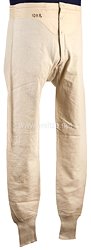
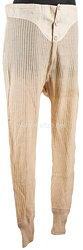
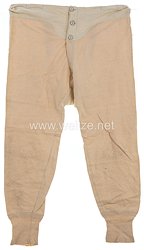
First World War White Long Underwear for Enlisted Men

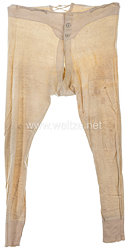
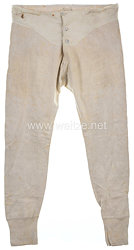
Long underwear made of white cotton. Stained, patched areas, used condition.
311204
70,00

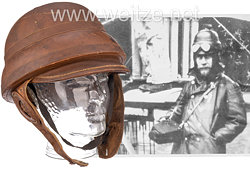
World War I Aviation: “Roold” Protective Helmet for Pilots

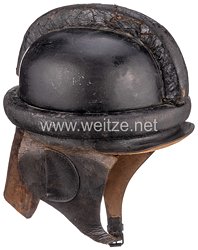
Chamber-marked piece, circa 1916/17. Cork body, exterior covered in black leather, interior with linen lining in field-gray, padded neck and ear protection, black tabbed leather lining, with chamber stamp “Flg. Btl.” Worn piece in good condition, very rare.

The “Roold” type protective helmet was worn with pleasure by German aviators alongside the official protective helmet. Originally this helmet type was manufactured by the French company Roold in Paris. A similar piece is illustrated in Kraus, Die deutsche Armee im Ersten Weltkrieg, 2004, on page 482.
309965
2.200,00

Prussia Visor Cap for a Non-Commissioned Officer in the Garde-Kürassier-Regiment

Location Berlin, circa 1910. Saddle-form construction. White cloth with blue cap band and piping, complete with both cockades in enlisted pattern, black visor. Interior with brown leather sweatband, green lining, size 52. The cloth somewhat soiled, moth holes, condition 2-.


298936
600,00

Prussia Provisional Reichswehr Visor Cap for Officers of Kürassier-Regiment Graf Geßler (Rheinisches) Nr. 8

Garrison Köln-Deutz. This is a visor cap from the Imperial era, circa 1910, which continued to be worn after 1918. Tall form, white cloth, green cap band and piping, complete with both cockades, after 1918 with the additional oak leaf wreath of the Reichswehr, black lacquered visor. Interior with yellow-brown sweatband and blue lining, the maker still faintly visible. Evident signs of age and wear, condition 2-.

Very rare.


298882
600,00

Prussian Field Gray Visor Cap for an Officer in the Garde-Schützen-Bataillon

Deluxe execution, circa 1915. Field gray officer's quality cloth, black velvet trim band, green piping, both cockades present, visor in black lacquer. Interior with brown sweatband, blue-green lining, with maker mark, size 56. Lightly worn, minimal moth damage, condition 2. An exceptionally fine example.
294215
1.200,00

Imperial Schutztruppe in German South West Africa: Visor Cap for Officers

Personal item, circa 1900. Soft visor cap made of brown corded drill fabric, cornflower blue cap band and piping, complete with Reich cockade in officer's quality, short black patent leather visor. Interior with brown sweatband, light blue lining. Size approximately 56. Lightly worn, the corded fabric showing typical signs of age. Overall condition 2. Very rare.
247715
2.300,00

Imperial German Navy Bicorne Hat for a Naval Station Intendant with the Rank of Councilor 1st Class

circa 1913. Elegant bicorne hat for admirals. Black needle felt, edged with wide silver braid, left side with silver agraffe, Reich cockade in silk and silver-plated button. Interior with dark brown lining, light sweatband leather. Lightly worn in good condition.
By A.K.O. (Allerhöchste Kabinetts-Order) of January 21, 1905, Naval Station Intendants received the rank of Councilor 1st Class (equivalent to Rear Admiral), but differ from admirals through the “silver” finish of braid, agraffe and button.
236992
1.850,00

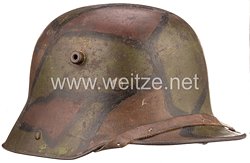
German Empire World War I Steel Helmet M 1916 of Soldier Niemann in Mimicry Camouflage Paint

Variant with sheet metal rim circa 1917. The original paint finish with black-delineated fields and camouflage colors approximately 80% intact. Interior with three-part liner on sheet metal ring, the pads still with filling, tabs partially damaged. Stamped on side “(bell)L 6[4]” (Richard Lindenberg A.G., Remscheid-Hasten), stamped inside shell “...375...”. Owner's name “Niemann” in neck area. Without chinstrap. Condition 2.
510038
2.400,00

Prussian Field Gray Attila M 1910 for a Rittmeister of Hussars

Personal item, circa 1915. The attila in field gray cloth of officer quality, complete with all appointments. Field gray braiding, frogs and rosettes. Sewn-in shoulder boards in field gray with applied rank stars, field gray cloth backing. Interior with field green silk lining. Worn piece, interior lining with a repair that was already made during the war. Typical wear and age-appropriate condition, condition grade 2.
507639
4.500,00

German Empire World War I Steel Helmet M 1916

Circa 1917. The original field-gray factory finish preserved over 95%. Interior with three-piece leather liner already attached to the steel ring, one leather liner torn at the ring, without padding. The leather chin strap for button 91 is missing, one button 91 still retains the attachment loop for the chin strap. Interior side stamped “St. 66.” (Eisenhütte Silesia, Paruschowitz, Oberschlesien). Helmet shows only minimal wear, in unusually fine condition, condition 2+.
507443
1.650,00

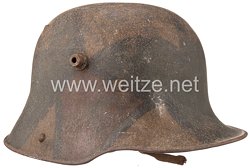
German Empire World War I Steel Helmet M 1916 in Mimicry Camouflage Paint

Circa 1916/17. The original paint finish with black-delineated fields and brown/yellow camouflage colors approximately 50% retained. Interior with remnants of the original field-gray factory paint, with three-part leather liner on leather ring, the padding retained. The leather chinstrap for button 91 is missing. Interior side stamped “St. 66.” (Eisenhütte Silesia, Paruschowitz, Upper Silesia). Clearly worn, the leather liner oiled and somewhat shrunk, but still present. Overall condition 3.
507434
1.450,00

Prussian Enlisted Man's Tunic of the 2nd Hanoverian Dragoon Regiment Nr. 16

Garrison Lüneburg. Private purchase item circa 1900. The tunic of light blue cloth with yellow standing collar, cuff flaps and piping, nickel-plated buttons, the standing collar and cuff flaps with white piping, sewn on the shoulders the yellow shoulder straps with the regimental number “16” embroidered in red, buttons of the 3rd Squadron. Lined interior with light brown and blue silk. With a few small moth holes. Condition 2.
507319
1.200,00

Kingdom of Prussia Officer's Riding Breeches for Officers of the War Ministry or General Staff

Circa 1910. The breeches made of dark blue cloth with broad crimson piping, waistband with black silk trim, lined inside with white linen. One button missing on the left leg, various small moth holes. Condition 2-3.
The same breeches were also worn by General Staff officers in Bavaria, Saxony, and Württemberg.
506022
850,00

Prussian Pickelhaube for a Senior Pharmacist

Circa 1910. Helmet made of vulcanized fiber, complete with all fittings in silver-colored finish. Front featuring the “frosted” silver-plated eagle with applied small gilt “official's eagle,” domed silver scale chains on silver rosettes, both cockades present. Cross-shaped top mount with gilt stars, spike removable. Squared front visor. Interior with brown leather sweatband and green silk rep lining, front visor lined in green and rear visor lined in red, inside the bell a label with size “55 ¼,” also on the button of the rear seam. The lining shows wear from use, the bell with a slight crack on the right rear. Condition 2-.
505751
1.250,00

Württemberg Pickelhaube for One-Year Volunteer “Riedle” in the 10th Württemberg Infantry Regiment Nr. 180

Garrison Tübingen/Gmünd. Private purchase item circa 1910. Leather helmet in fine officer quality, complete with all fittings. Front features the gilt helmet plate in officer quality, with pierced crowns. Flat scale chains on rosettes, both cockades in enlisted pattern. The neck trim in officer style without ventilation slider. The spike non-removable, the neck with pearl ring, the base with ball-head screws. Interior with brown leather sweatband and beige silk rep lining. The visors unlined. Inside the bell, label with the wearer's name and unit “Riedle 180”. Size approximately 55. Nearly mint condition - “in mint condition”.

Seldom found in this quality!
505570
2.200,00

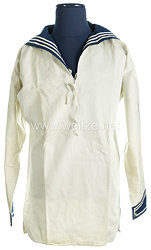
Imperial German Navy Full Dress Tunic and “White Shirt” from the Estate of Oboist and later Senior Oboist “Jaeger”

The full dress tunic, a personally-owned item from the period before 1909, made of dark blue cloth with gilt anchor buttons, with the short toggle chain, on the sleeves with the gold braids for the petty officer, above them the special braids introduced in 1889 for the oboist, on the left sleeve the badge for the oboist, the anchor with the lyre in gilt metal. Lined inside with black silk.
The “White Shirt” a government-issued item from 1909. The “White Shirt” made of cotton drill with blue collar and cuffs, again with the special braids for oboists, sewn on the left sleeve the cloth badge for the senior oboist with the anchor with the lyre and the Imperial crown above it, with chamber stamp “B.A.W. 18.11.09 3” as well as sewn-on owner's label “Jaeger”. Condition 2.

These items originate from a large private naval collection and were purchased by the collector from the estate of the senior oboist.
502853
1.450,00

Imperial German Navy Complete Uniform Ensemble for Senior Engineer Applicant “Cleve”.

Circa 1910. This is the mess dress uniform of the Senior Engineer Applicant consisting of the cap, mess jacket, vest, and dickey.
The cap is made of dark blue cloth with black velvet band, featuring the Imperial cockade on the front, complete with black patent leather chinstrap attached to silver-plated anchor buttons, black lacquered visor. Interior with brown sweatband and fine black cloth lining with manufacturer's imprint “Ed. Langeheine […]”. Size approximately 55. Lightly worn.
The jacket is made of dark blue cloth with black velvet collar, silver-plated buttons with Imperial crown and anchor, with short toggle chain, silver braids on the sleeves, on the left sleeve the silver-plated metal badge for Senior Engineer Applicant. Interior with black silk lining.
The vest is made of dark blue cloth with silver-plated anchor buttons, back panel of fine black cloth, front with three pockets, interior with white fine linen lining, in the neck area with sewn-in label “Cleve”. Shows wear in the neck and shoulder area.
Also included is the matching dickey with button-in stand collar and black necktie “bow tie”.
Additionally, a portrait photograph of the wearer, still as Engineer Applicant, from a photo studio in Kiel. Condition 2.

The uniform ensemble comes directly from family ownership and has been part of a large naval collection for the past decades.

A very rare uniform ensemble, certainly not easy to find another one quickly!

502842
3.500,00

Württemberg Pickelhaube for a General à la Suite for Parade

Circa 1914. Elegant leather spiked helmet, complete with all fittings in silver-plated finish. The helmet plate silver-plated with polished edges, with applied high-domed star of the Order of Merit of the Württemberg Crown, the center finely enameled. Silver quatrefoil fitting with gilt star screws. High silver-plated fluted spike with black/red/white parade plume. Silver-plated domed scale chin chains on silver rosettes, complete with both cockades. Interior with light sweat leather, green silk lining. Size 56 3/4. The helmet worn in good untouched original condition. Condition 2.
503939
18.500,00

Imperial German Navy Full Dress Tunic for a Senior Boatswain's Mate and Gun Captain in the Pre-1888 Pattern (!)

This full dress tunic is a privately purchased piece made of dark blue cloth with gilt anchor buttons bearing the old slanted crown used until 1888, short toggle chain, on the sleeves the gold lace for non-commissioned officer rank, on the left sleeve the badge for Senior Boatswain's Mate in gilt metal, the slanted Imperial crown still without the ribbons introduced in 1888, below it the badge for Gun Captain in the pattern used until 1891. Interior partially lined with black silk. Condition 2.
502833
850,00

Prussia Attila for a Lance Corporal in Husaren-Regiment Landgraf Friedrich II. von Hessen-Homburg (2. Kurhessisches) Nr. 14

Garrison Kassel. Private purchase item circa 1910. Dark blue attila with white braiding and nickel silver frogs and rosettes. White shoulder cords sewn onto the shoulders. On the collar the rank buttons for lance corporal (These are large sergeant buttons that are originally sewn on; an unauthorized modification by the hussar.). On the right sleeve the proficiency badge for lance combat. Interior with black cloth lining. Condition 2.
501715
750,00

German Empire World War I Camouflage Cover for Pickelhaube Artillery Officers

Circa 1915. Olive green cloth. Size approximately 52. Condition 2.
498630
350,00

Oldenburg Pickelhaube for an Officer in the Oldenburg Infantry Regiment No. 91

Located in Oldenburg, circa 1910. Leather helmet, complete with all fittings in gilt finish. The Prussian eagle with the regulation “Koenig” bandeau on the chest with applied two-piece silver Oldenburg star. Flat scale chains, both cockades present. The spike is non-removable. Interior with brown leather sweatband and beige rep lining, the front visor lined in green and the rear visor lined in red. Size approximately 56. The lining shows wear from use. Condition 2.
498424
2.500,00

Oldenburg Pickelhaube for a Customs or Tax Official

Circa 1910. Elegant, lightweight leather helmet, complete with all fittings in gilt finish. Front plate features the star with applied “frosted” silver-plated arms of Oldenburg. Flat scale chin chains on rosettes, right side with Oldenburg state cockade. The plate with star screws, fitted with the distinctive quadruple-fluted “official's spike” with ball finial. Interior with light brown leather sweatband with silk ribbon draw and gold embossing “Awes-Marke”, green silk rep lining with gold embossing “AWS”, front visor lined in green and rear visor lined in red. Handwritten date “27.12.1910” inside the bell. Size approximately 56. In exceptionally fine condition. Condition 2+
492977
2.500,00

Prussian Shako Model 1860/63 for Enlisted Men of the Magdeburg Train Battalion No. 4

Location Magdeburg, depot piece circa 1870/80. Tall black leather shako, complete with all fittings. Front features the Prussian line eagle. Leather chinstrap attached laterally with iron screws. Complete with the Prussian cockade. Interior with reinforced leather lining, the crown with depot stamp “T IV”. Size approximately 57. Condition 2.

The shako was introduced for the Train with A.K.O. (Army Cabinet Order) of January 1863 for enlisted men and non-commissioned officers. It corresponded to the Model 1860 introduced for the Jäger.
Very rare!, as most shakos were subsequently converted to newer models. In 1903 the Pickelhaube was reintroduced for enlisted men and non-commissioned officers in the Train.
492311
1.950,00

Prussia Czapka for Enlisted Men of the 2nd Pomeranian Uhlan Regiment Nr. 9

Personal property item circa 1900. Station Demmin. Czapka of dark blue cloth with white band and piping, both cockades. Interior with brown sweatband and cloth lining. Worn condition. Condition 2.


491670
550,00

Prussia Pickelhaube Model 1860/71 for Officers of Dragoon Regiments 7, 8, 11, 13 and 14

Circa 1870/80. Leather helmet, complete with all fittings in gilt finish. Front features the dragoon eagle with the motto “Mit Gott für Koenig und Vaterland” (With God for King and Fatherland), the eagle's head with an old repair, domed scale chains on push-through rosettes (these were prescribed for officers from November 23, 1871), on the right the Prussian state cockade, cross-leaf fitting with large star screws and removable short spike. Interior with finely laced leather lining as prescribed for officers, the rear visor lined in red and the front visor lined in green. Size approximately 56. Condition 2.

The helmet dates from the period before the Franco-Prussian War of 1870/71. (Regiments 7, 8, 11, 13 and 14 were only established in the years 1860 and 1866). The scale chains were initially attached by means of iron screws. From late 1871, push-through rosettes were then ordered for officers. This helmet exhibits relatively large holes for the split pins of the rosettes, indicating that the scale chain attachment was changed in accordance with regulations in late 1871.
491605
2.100,00

Hansestadt Bremen Pickelhaube for a Customs Official

Circa 1910. Leather spiked helmet, complete with all fittings. Front features the Bremen coat of arms flanked by 2 lions, gilt, with the silvered key applied in the center. Flat brass scale chinstraps on rosettes, Bremen state cockade on the right. Crown with ball-top screws and “official spike”. Interior with finely laced leather lining, the neck guard with handwritten size “57 1/2”. Worn helmet in good untouched original condition. A rare helmet.
491401
1.850,00

Prussian Pickelhaube for a Paymaster in the Garde-Füsilier-Regiment, 5. Garde-Regiment zu Fuß or Garde-Pionier-Bataillon

Circa 1910. Leather helmet, complete with all fittings in silver finish. At front the silver-plated large Guards eagle with applied high-domed Guards star with finely enameled center, for the Assistant Paymaster without the “official's eagle”. Flat nickel silver scale chains on silver rosettes, both cockades present. The base plate with silver-plated stars and removable smooth spike. Interior with light leather sweatband and light beige silk rep lining, the front visor lined in green and the neck guard lined in red, handwritten size “54” inside the bell. Only lightly worn, condition 2+.
Very rare, the regiment had a maximum of 4 paymasters!


491065
4.500,00

Prussian Visor Cap for an Officer of the Hussar Regiment Landgraf Friedrich II. von Hessen-Homburg (2. Kurhessisches) Nr. 14

Garrison Kassel, circa 1900. High, plate-shaped visor cap of dark blue cloth with red band and white piping, black lacquered front visor, complete with both cockades. Interior with brown sweatband and brown oilcloth lining with maker's mark. Size approximately 56. Minor moth damage. Condition 2.

482675
750,00

Imperial German Navy Bicorne for a Reserve Officer

Circa 1910. Elegant bicorne of black needle felt, left side with gold agraffe, Reich cockade of silk and gilt button for reserve officers with applied silver reserve cross. Interior with light-colored sweatband and white silk lining. Size approximately 53. The silk ribbon with minor wear marks. Condition 2.

480899
700,00

Baden Officer's Visor Cap for Infantry

Circa 1897. Flat visor cap with short black lacquered peak made of dark blue cloth with red band and piping, both cockades present. Interior with brown sweatband and brown oilcloth lining bearing the maker's mark “Militair Effecten Fabrik Fr. Betsch Hoflieferant Karlsruhe ...”. Size approximately 55. With moth damage. Condition 2-.

The Leib-Grenadier-Regt. 109 was stationed in Karlsruhe.
467275
420,00

Prussia Tunic for a Cadet Non-Commissioned Officer at the Haupt-Kadetten-Anstalt Berlin-Lichterfelde, 10th Company

Chamber piece 1901. The tunic of blue cloth in size with red standing collar and red cuffs, copper-colored buttons, the collar and cuffs with white Guard lace as well as gold NCO lace, sewn onto the shoulders the white shoulder straps, on the left breast five loops for orders/decorations. Interior with white, red and black cloth lining, in the neck area the chamber stamp “H.K.A. 1901 10. C II II”, below it inventory stamp. Only a few slight moth traces. Condition 2.
459252
1.800,00

Weimar Republic Merchant Marine Dark Blue Sailor Cap for Crew Members of the Training Ship “Schulschiff Deutschland”

circa 1930. Dark blue sailor cap, complete with all insignia. Color-woven cap tally “Schulschiff Deutschland”, with the Reich cockade above. Interior with light brown sweatband, navy blue lining with manufacturer's imprint “Die gute blaue Mütze”. Size 53. Worn piece, in good condition.

The training ship Schulschiff Deutschland was commissioned in 1927 by the Deutscher Schulschiff-Verein (DSV). On June 14, 1927, the Schulschiff Deutschland was launched at the Tecklenborg shipyard in Wesermünde. Her home port was Elsfleth. To instruct prospective sailors in practical seamanship, the ship undertook regular training voyages, in winter in the Atlantic to overseas destinations (mostly Africa and Caribbean/South America), in summer in the North and Baltic Seas. The last winter voyage to the South Atlantic ended on March 22, 1939 at the roadstead of Bremerhaven, and during World War II training voyages took place only in the Baltic Sea; the ship's berth was therefore from April 15, 1940 on the western shore of the Swine in the Bay of Pomerania, then from November 1941 in Lübeck. From 1927 to 1939, 12 overseas voyages were undertaken and from 1928 to 1944 a total of 17 North and Baltic Sea voyages. The last ended on October 1, 1944.
453483
450,00

German Empire World War I Steel Helmet M 1916

circa 1917. Original paint approximately 75% intact. Interior with three padding cushions on the metal liner ring, padding present, leather tabs on two cushions damaged. No manufacturer marking visible. With original chin strap. Condition 2.
448316
1.650,00

Kingdom of Bavaria Raupenhelm Model 1868 for Enlisted Men in a Jäger Battalion from the Franco-Prussian War Period

Circa 1870. Leather helmet, complete with all brass fittings. Large embossed helmet plate with crown over “L”, leather chinstraps on lion head bosses, left side with cockade and replaced green plume of the Jäger battalions, horsehair caterpillar crest on the comb. Interior with reinforced leather lining, remains of a paper label inside the skull. Size approximately 53. Lightly worn and somewhat aged, left ventilation hole fastener discreetly replaced. Condition 2.
446071
1.600,00

Prussian Pickelhaube Spiked Helmet for a Mounted Official in the Simple Service of the Rural Gendarmerie

Cabinet piece circa 1900. Heavy leather helmet in execution similar to those for the Guard Infantry Regiments, complete with all fittings in brass. Front features the Guard eagle with applied silver Guard star. Leather chin strap on button 91, complete with both cockades. Plate with service spike. Interior with lacquered leather lining. Stamped “2E” in the bell, with illegible stamp above. Size 54. Condition 2.

439982
1.750,00

German Empire Storage Box for a Bicorne Hat for Civil Officials

Circa 1910. Rigid cardboard with black paper covering. Dimensions approximately 52 x 22 x 8 cm. Condition 2.
437233
150,00

Württemberg Pickelhaube for Officers of Grenadier-Regiment Königin Olga (1. Württembergisches) Nr. 119

Location Stuttgart, circa 1910. Leather helmet, complete with all fittings in silver-plated finish. The helmet plate silver-plated with polished edges. Silver cruciform base with removable spike, gilt star screws. Gilt convex chin scales on silver rosettes, complete with both cockades. Interior with brown sweatband and green rep lining. Front visor lined green on the interior, rear visor red. Size 53. Worn helmet showing signs of age. Condition 2-.
432831
2.100,00

Imperial German Navy White Sailor Cap for Ship's Boy "Brestel" Aboard S.M.S. Charlotte

Circa 1900. Constructed of white cotton fabric, so-called "Waschmütze" (washable cap), complete with sewn-on cockade, cap tally "S.M.S. Charlotte" in red for ship's boys. Size 53. Interior with owner's label "Brestel". Stained. Condition 2-.
The S.M.S. Charlotte was a cruiser frigate. Commissioned in 1886, she served as a training ship from 1893. She was struck from the naval register in 1914.
425149
600,00

Prussian Shako for an Officer of the Telegraph or Airship Battalions

Circa 1900. Elegant black patent leather shako covered with cloth, complete with all fittings. Silver eagle, flat gilt scale chains on rosettes, on the right the Reich cockade in officer's quality, Prussian field insignia for officers. Interior with black sweatband and silk lining, the rear visor lined in green. Size 56. Lightly worn, condition 2.
405357
2.200,00

Mecklenburg-Schwerin Helmet Model 1847 for Enlisted Men of the Grenadier-Garde-Bataillon

circa 1850. Heavy leather helmet, complete with all fittings in gilt tombac. Front features the gilt “sunburst” with applied Mecklenburg coat of arms above bandeau “Grenadier-Garde”. Domed scale chains, the rosettes with flaming grenades, on the right the large state cockade in lacquered metal. Large crosspiece with the distinctive spike base and screwed-on crown, the crosspiece with ball-head screws. The squared front visor and curved rear neck guard edged with metal rails. Inside, the old sweatband leather was cut out but replaced in period. The front visor and neck guard not lined inside. Only lightly worn in exceptionally fine condition. Extremely rare. In over 30 years, this is the first enlisted man's helmet of the Grenadier-Garde that we have been able to offer.

In 1863, the Grenadier-Garde Bataillon was reorganized into the 1st Infantry Regiment. The old helmets were transferred to the Mecklenburg Gendarmerie and accordingly modified with the Mecklenburg onion-shaped spike and a shield reading “Gendarmerie” beneath the coat of arms. Therefore, virtually no helmets of the Grenadier-Garde-Bataillon have survived.
383660
13.500,00

Prussian Visor Cap for a Reserve Military Pharmacist

Circa 1910. Light saddle form. The cap band with wine-red velvet, crimson piping, black lacquered visor, both cockades, the Prussian state cockade with the Landwehr cross. Interior with brown sweatband leather and light orange silk lining, in the sweatband the maker “Wilhelm Wethausen Hannover”. Size 58. Condition 2.
379025
600,00

Imperial German Navy Grand Gala Uniform Ensemble for a Senior Naval Construction Councilor and Harbor Construction Director

circa 1910. Elegant dark blue gala dress coat of the finest quality. The collar with wide surrounding silver braid, the chest and sleeve facings in black velvet, with surrounding silver braids. Complete with epaulettes featuring black velvet fields, silver overlays, and wide silver bullion fringe. The epaulettes regulation-compliant with silver rank stars following the conversion of naval officials to military status. Complete with shoulder straps on black velvet backing and silver shoulder buttons. Unfortunately, the surrounding silver border of the crescent is missing on the right epaulette. On the sleeves with silver rank braids on black velvet backing denoting Marine-Oberbaurat (equivalent rank of Captain at Sea). All buttons in fine silver-plated finish with crowned anchor. Interior lined with black silk. Imperial bicorne hat for Marine-Oberbaurat circa 1910. Bicorne of black needle felt, edging of black silk ribbon. Left side with silver agraffe over silk cockade in black/white/red and silver-plated naval button. Interior with light leather sweatband with white silk lining, interior marked with maker “L.H. Berger, Collani & Cie. Hoflieferanten Berlin, Lindenstr. 25”. Lightly worn, condition 2.
The entire ensemble is only lightly worn, in magnificent condition. Extremely rare to find.

351050
4.500,00

Württemberg Krätzchen Cap for Driver Burkhard of the 6th Battery, FAR 29

Garrison Ludwigsburg. Personal property item, circa 1890. Dark blue cloth, black cap band and red piping. Front features the Württemberg cockade, still without the Imperial cockade not introduced until 1897. Without sweatband, brown silk lining with maker “G. Maisch Seestrasse v1b Ludwigsburg”, below which owner's label “Fahrer Burkhard 6. Batterie 2. Württ. Feld-Art. Regt. No. 29 Prinz-Regent Luitpold v. Bayern”. Size 53. Worn condition, the sweatband is unfortunately missing. Condition 2-.
326754
300,00

Prussian Shako for an Officer of the Telegraph or Airship Battalions

Circa 1900. Elegant black patent leather shako covered with cloth, complete with all fittings. Silver eagle, flat gold scale chains on silver rosettes, on the right the Reich cockade in officer's quality, Prussian field insignia for officers. Interior with brown sweatband and light brown silk lining, the rear visor lined in green. Size 57. The cloth covering with only one small hole, well preserved, condition 2.
295254
2.100,00

Prussian Shako for an Officer of the Machine Gun Detachments

Circa 1914. Elegant brown patent leather shako covered with field-gray felt cloth, with ventilation grommets on the sides. Complete with all fittings in gilt finish. Front with Prussian line eagle, flat scale chains, Reich cockade on right, Prussian field insignia. Interior with brown sweatband and light green silk lining, size approximately 56. Complete with the very rare parade plume with fluted gilt socket. Original container included with the parade plume. The container bears the owner's label “Einj. Freiw. Armbrecht G.M.G.A.II.”
The crown of the shako has four scratches and one worn area, the felt to the right of the eagle shows moth damage, two additional moth holes. The accompanying original helmet case is somewhat worn on the exterior and stained on the interior. The shako itself shows minimal wear. Despite the described defects, in quite good overall condition. Extremely rare, one of the few originals.
This ensemble comes from an estate. The wearer of the shako was Rittmeister Wiliam Armbrecht, who served in both World Wars and retired from the Wehrmacht in 1943 as a Major of Fahrabteilung 24/Hannover. The parade plume dates from his service as a One-Year Volunteer in the Grade-Maschinen-Gewehr-Abteilung Nr. 2 in Berlin. He was later transferred to another unit.


278282
4.500,00

Prussian field-gray Attila Model 1909 for a Gefreiter (Lance Corporal) in Husaren-Regiment von Zieten (Brandenburgisches) Nr. 3, 2nd Squadron

Peacetime garrison Rathenow. Garment in simplified pattern from 1915 onwards. Made of field-gray wool cloth, with field-gray braiding and rosettes, toggles made of horn, sewn-in shoulder straps in red/white with applied regimental number “3” in metal, on right black horn button with squadron number “2”, the button on the left shoulder was lost and replaced later. The cuff slashes already in simplified pattern from 1915 onwards. Interior with light linen lining, with beautiful chamber stamp “B.A. III - 3 H R”, plus additional old provenance stamps “Stadt Krefeld Stadttheater..”. Clearly worn, the lining was patched at bottom during the war, evident wear and age marks, no moth holes. In relatively good overall condition, condition 2-3.

Extremely rare, most Attilas were worn out during the war or after transfer to the Provisional Reichswehr, only very few pieces have survived.
507503
7.500,00

Prussia WWI M 1915 Field Tunic for a Sergeant in Railway Regiment No. 3

Home garrison Hanau. Chamber piece, circa 1917. The field tunic of field-gray wool with reseda green collar and concealed button placket, the pocket flaps with field-gray lacquered crown buttons, the belt buttons still lacquered in nickel finish, complete with field-gray belt suspension hooks. Complete with all insignia. Sewn onto the shoulders are field-gray shoulder straps with regiment number “E 3” embroidered in red. The reseda green collar with machine-sewn collar patches with black center stripes for technical troops, bordered by field-gray NCO braid, laterally with large field-gray sergeant buttons. Interior with typical olive-green linen lining, with size and manufacturer's stamp, fine chamber stamp “B.A. XVIII - 1917” (Railway Regiment No. 3 belonged to XVIII Army Corps, which included the Clothing Office B.A. XVIII). Worn piece with typical wear and age characteristics, in untouched original condition, condition 2-.

Very rare.
507366
6.500,00

Prussian Field-Gray Attila M 1910 for a Rittmeister in Thüringisches Husaren-Regiment Nr. 12

Home garrison Torgau. Privately purchased item, circa 1915. The attila in field-gray gabardine cloth of fine officer quality, complete with all appointments. Field-gray braiding, frogs and rosettes. The sewn-in shoulder straps in field-gray with applied "12", without cloth backing. On the chest with loops for the Iron Cross 1914 1st Class. Interior with field-green silk lining. Worn piece, interior lining with some repairs that were already made during the war. Typical wear and age signs, a few minor moth damages, otherwise in condition 2/2-.
507349
4.500,00

Prussian Field-Gray Attila M 1910 for a Lieutenant in Husaren-Regiment Fürst Blücher von Wahlstatt (Pommersches) Nr. 5

Home garrison Stolp in Pommern. Personal property item, circa 1915. The Attila made of field-gray gabardine cloth in fine officer quality, complete with all appointments. Field-gray braiding, toggles and rosettes. The sewn-in shoulder straps in field-gray with applied “5”, with field-gray cloth backing. On the chest with loops for a small ribbon bar. Interior with field-green silk lining. Lightly worn, slight wear and age marks, a very minor damage at front above the lowest braiding on the right side, otherwise in good condition. Interior lining with old discovery stamp. Condition 2.
507344
4.800,00

Royal Prussian Navy

Circa 1860, dark blue wool cloth with brownish-black linen lining, one interior pocket, 30 silver-plated buttons with indistinct anchor beneath the Prussian eagle, evident signs of age and wear, nonetheless a piece of museum-quality rarity. Condition 2-3
502844
1.650,00

Prussian Full Dress Coat for a State Official in the War Ministry with the Rank of Councilor First Class

Circa 1900. Elegant dark blue coat with red standing collar and cuff flaps, the collar, cuff flaps and large pocket flaps with rich silver-colored embroidery executed in metal thread, on the left side the slit for the sword, front with eight “frosted” silver-plated coat-of-arms buttons with the Prussian eagle, on the shoulders loops and buttons for attachment of shoulder boards. Interior with light gray silk lining. Condition 2.
499394
1.350,00

German Reich World War I/Early Weimar Republic Steel Helmet M 1916

Circa 1918/19. The shell exterior with light beige-white paint over the factory olive-green finish, with a white stripe approximately 3 cm wide in the center, on the right side hand-painted symbols “S [mushroom?] S”, paint approximately 60-70% intact. Interior with three-piece liner on leather ring, cushion padding missing, manufacturer and size marked “E.T.64.” on side (Eisenhüttenwerk Thale A.G., Thale a/Harz). With original chin strap on button 91. Condition 2-.

The symbol is likely a non-regulation unit marking. Possibly for a Freikorps or home guard unit during the crisis period of the Weimar Republic 1919/20. The paint appears to be winter camouflage.
507637
1.650,00

Kingdom of Bavaria Shako for a Reserve Officer in the 1st or 2nd Jäger Battalion or the 1st Machine Gun Detachment

Circa 1910. Black patent leather shako with felt covering, complete with all fittings. Front features the gilt Bavarian emblem with applied frosted silver cross for the Reserve, domed scale chains on rosettes, national cockade on the right. Complete with the field insignia. Interior with brown sweatband and green silk grosgrain lining, rear visor lined in green, crown with label indicating size “57”. Virtually unworn, mint condition. Condition 2++.
505617
3.500,00

Prussian Helmet for an Officer of the I. Battalion or Regimental Staff of the 1st Guard Regiment on Foot

Stationed in Potsdam circa 1914. Elegant helmet of vulcanized fiber, complete with all fittings in silver-plated finish. On the front, the large Guard eagle with highly domed silver star of the Order of the Black Eagle, the center finely enameled. Above it, the applied bandeau with the motto “semper talis”. Flat silver-plated scale chains on rosettes, both cockades. The plate with silver-plated stars, tall removable fluted spike. Interior with brown sweatband with beige grosgrain lining, the front visor lined in green and the neck guard lined in red, handwritten size “53 ½” in the bell. The lining somewhat discolored from wear, slight signs of aging. Condition 2.

One of the rarest and most sought-after helmets of the Prussian Army.
505596
9.500,00

Prussia World War I Hussar Officer's Attila Model 1910 for a Rittmeister (Captain) in Hussar Regiment “Kaiser Nikolaus II. von Russland” (1. Westfälisches) Nr. 8

Home garrison Paderborn/Neuhaus. Circa 1914. The attila in fine field-gray cloth with gray braiding, rosettes and barrel-shaped buttons with black cord. Shoulder straps sewn onto the shoulders with metal cipher “NII” and two rank stars each. Interior with olive-green silk lining. Two moth holes on the left sleeve and one on the left tail. Condition 2.
500213
4.800,00

Prussian Field-Gray Visor Cap from the Personal Property of Kaiser Wilhelm II, General Field Marshal of the Bavarian Army

circa 1916/17. Elegant high stiff plate form. Field-gray cloth of exceptionally fine officer quality, red cap band and piping, complete with both cockades in fine officer execution, field-gray stiff visor of vulcanized fiber. Interior with light sweatband with white silk ribbon drawstring. White silk lining with gold-printed owner's monogram, imperial crown over “W”, size 57. Minimally worn in magnificent condition.
A unique piece! Price upon request.
491738

Kingdom of Hanover Supravest for Enlisted Men of the Garde du Corps circa 1860

with breast star of the Order of St. George on both sides, red wool vest with white border trim all around, applied breast star with hand-embroidered center in enlisted men's quality, side closure with hooks, light linen lining inside, in fresh color and lightly worn condition.

This supravest originates from the armory of the guard of the King of Hanover. In total there were approximately 20 vests for enlisted men and 3 for officers, which were auctioned at Sotheby's in October 2005 at Marienburg near Hildesheim.
476337
1.500,00

Kingdom of Hanover Helmet and Cuirass for Enlisted Men of the Garde-Kürassier-Regiment – formerly hung as wall decoration in Marienburg Castle

Circa 1860. Tall helmet of tombac with large stepped front visor, complete with all fittings in gilded finish. On the front, the large star of the Order of St. George of Hanover with the motto “Nunquam Retrorsum”, below it the applied bandeau “Peninsula Garzia Hernandez Waterloo”. Attached to the bandeau is the inventory plaque of Marienburg Castle. Large domed scale chains on oval rosettes with brass cross screws, on the right the Hanoverian cockade in leather. Brass cross-piece with detachable iron spike. Interior with black leather lining, the front visor painted green, the rear neck guard painted black. Size approximately 57. The helmet externally somewhat aged, the gilding mostly worn off.
The breastplate of the cuirass is a chamber piece of black-lacquered cast steel with rivets and decorative strips of brass, centrally applied the large crowned star with the “Leaping Horse” in the center and the motto “Nec Aspera Terrent”. The lacquer with significant chipping. The original lining still preserved inside. The cuirass stamped “17.” on the underside.
In the collar area, a wooden board with a holder for the helmet was already attached in the 19th century, with holes drilled on both sides in the shoulder area for attaching the support wires that held the ensemble on the wall.
Helmet and cuirass somewhat aged in still untouched and uncleaned condition.

A very fine ensemble which hung in the Welf Castle Marienburg. It was sold at the Sotheby's auction in October 2005.
452904
7.000,00

Prussia World War I Field Gray Camouflage Cover for Model 1915 Helmet for Enlisted Men of the Regiment König's-Jäger zu Pferde Nr. 1

Home garrison Posen. Circa 1915. Field gray camouflage cover with the regimental number “1” embroidered in red, the camouflage cover damaged at front right with a previously repaired loss above it, another old small repair at rear right. Condition 2-.
Extremely rare!
507723
1.100,00

German Empire World War I Field Gray Camouflage Cover for Pickelhaube Officer Infantry

Circa 1915. Field gray cloth. Size approx. 54. Side slits for chin scales. Condition 2.
505564
300,00

German Empire World War I Liner Pad for the M 1916 Stahlhelm

Circa 1916. Dimensions approximately 11 x 4.5 x 1.5 cm. Condition 2.
507643
45,00

Bavarian Pickelhaube for Parade for a Wachtmeister in the 1st Train Battalion

Location München. Chamber piece 1912. Leather helmet, complete with all fittings. Front with large helmet emblem, domed scale chin chains on rosettes, both cockades, for the Wachtmeister both cockades in officer's pattern. Square front visor. Cross-piece with fluted socket and black horsehair plume. Interior with laced leather lining, inside the bell the maker's mark from “[...] München” and the chamber stamp “B.A.I. 1912.”, the rear visor with the unit stamp “1.T.B. 1912”. Size approximately 53. Interior with old double holes. Condition 2.
509341
1.650,00

Bavaria World War I Pickelhaube for a Non-Commissioned Officer in a Reserve Infantry Regiment

Personal item circa 1914. Light leather helmet, complete with all fittings. Front features the small helmet plate with applied Landwehr cross. Flat scale chin chains on button 91, both cockades present. Interior with light leather sweatband and beige twill lining. Size approximately 55. Seam of front visor detached. Condition 2-.
509330
1.250,00

Württemberg Pickelhaube for an Infantry Officer

Circa 1910. Leather helmet, complete with all fittings in gilt finish. Front features the Württemberg state emblem. Crossguard, spike removable. Flat scale chin chains on rosettes, both cockades present. Square front visor. Interior with light brown leather sweatband and beige liner, handwritten size “55” inside the dome. Condition 2.
509153
1.850,00

German Empire World War I Pickelhaube for a Ministerial Director of the Tax Administration in the Reichslands Alsace and Lorraine

Circa 1916. Elegant, lightweight leather helmet, complete with all fittings in gilt finish, in finest pre-war quality (!!). Front features fire-gilt Reichsadler with polished edges, on the breast with applied silver Reichswappen! Flat scale chains on rosettes, on the right the Reichskokarde in officer's pattern, on the left contrary to regulations the Prussian Landeskokarde. Visor plate with star screws, the fixed fluted spike base with ball finial. Interior with light brown leather sweatband and green silk grosgrain lining, inside the bell handwritten size “56”, the date “29.7.16” and the notation “Steuer [...] Reichs[...].” Nearly unworn, in mint condition. Condition 2++.

An absolute sensation in this quality!


509008
4.500,00

German Empire Reichsland Elsass-Lothringen Pickelhaube for a Fire Brigade Captain

Circa 1885. Leather helmet, complete with all fittings. Front-mounted partially silver-plated brass star with applied nickel silver “Imperial Eagle” at center, flat brass chin scales on rosettes with iron screws, Prussian state cockade on right side. Visor plate with ball-top split rivets, spike non-removable. Version without rear spine. Interior with stitched leather lining, various contemporary handwritten entries inside the bell. Size approximately 53. Chin scale buckle missing. Condition 2-.
508070
1.200,00

Bavaria World War I Pickelhaube for NCO “Neubürger” in a Reserve Infantry Regiment

Circa 1914. Leather helmet, complete with all fittings. Front features the small helmet plate with applied silver Reserve/Landwehr cross. Leather chin strap on button 91, both cockades, the state cockade in the version for sword-knot NCOs (Portepee-Unteroffiziere). Base with ball-top split pins, spike non-detachable. Round front visor. Interior with reinforced leather lining, the front visor with the name and location “L. Neubürger Freising”, inside the bell the size “55” and the maker, the latter only faintly legible. Condition 2.

507962
1.100,00

Prussian Pickelhaube for Generals

Circa 1900. Leather helmet, complete with all fittings in gilt finish. Front with large Garde eagle finely worked with polished edges, surmounted by the Garde star, the center finely enameled. Cross-shaped base with fluted removable spike for generals, regulation pattern terminating flush with the neck. Domed scale chin chains on rosettes, both kokarden present. Interior with light-colored leather sweatband and beige silk grosgrain lining. Size “58” handwritten inside the bell. Lightly worn. Condition 2.
A very fine helmet.
506758
6.500,00

Prussia World War I Fur Busby for Parade for Enlisted Men in Husaren-Regiment Königin Wilhelmina der Niederlande (Hannoversches) Nr. 15

Home garrison Wandsbek (= Hamburg-Wandsbek). Chamber piece 1916. Manufactured in peacetime quality (!). The fur busby with black sealskin, complete with all fittings. At front the silver Fatherland band with the battle honors “Peninsula - Waterloo - El Bodon - Barossa”. Domed brass scale chains on button 91, on right the Reich cockade. Complete with the Prussian field insignia, the parade plume, the orange-yellow kolpak, and the rolled dress cord. Interior with laced leather lining, the lining with chamber stamp “B.A.IX”, the crown with partially unclear maker “[...]&co [...] 1916”. Size approximately 56. The fur with losses, however mostly concealed by the kolpak. Otherwise condition 2.

A manufacture in best peacetime quality at such a late date is quite unusual! The piece likely served at home for parades.
505633
3.700,00

Oldenburg Pickelhaube for an Officer of Dragoon Regiment No. 19 in Deluxe Quality

Oldenburg location circa 1910. Leather helmet, complete with all fittings in genuine (!!) silver finish. Front features the dragoon eagle with highly domed fire-gilt star with applied genuine silver coat of arms. Gilt domed scale chains on the nickel silver special rosettes for dragoons, both cockades. Cross-guard with gilt stars, tall removable spike. Angular front visor. Interior with fine brown leather sweatband and red-brown silk rep lining, the front visor lined in green and the rear visor in red, handwritten size “57 1/2” in the bell. Condition 2.

In this quality, the helmet can be attributed to the regiment's commander, Grand Duke Friedrich August!
504227
9.500,00

Prussian Pickelhaube for an Officer of the Field Artillery Regiments

Circa 1910. Leather helmet, complete with all fittings. Front eagle plate, domed chin scales attached to rosettes with both cockades, spike removable. Interior with light brown leather sweatband and light beige grosgrain lining. Size approximately 54. Worn condition, somewhat aged. Condition 2-.
497928
1.150,00

Württemberg WWI Field-Gray Light Czapka in “Tropical Version” from the Estate of Major von Bülow

Circa 1915/16. This very light czapka is made entirely of field-gray cloth, internally reinforced with a metal cross-piece and two metal rods for stabilization, originally made without front plate insignia, curved scale chin chains, the rosettes and cockade on the right side covered with field-gray cloth, the detachable square top also made of field-gray cloth, bearing the officer's field insignia in field-gray finish (!). Interior with brown sweatband marked “DRGM”, with attached museum or collection label “No 30 UL20 feldgr. Tschapka (ohne Leder v. Frau v. Bülow-Dätzingen April 39 Geschenk). Estimated size 56. Condition 2+.
Extremely rare! Offered for the first time by us, and we are not aware of any other example!

Bernhard-Friedrich von Bülow entered the Ulanen-Regiment König Wilhelm (2. Württembergisches) Nr. 20 (garrison Ludwigsburg), also known as the “Yellow Uhlans,” as an ensign in 1902. From 1913 he attended the War Academy and during World War I served on the staff of the 26. Reserve-Division. He was later transferred to the “Großen Generalstab” (Great General Staff). After the war, he assumed leadership of the regimental association. He died in 1937 in Dätzingen. In 1939, his wife donated this czapka to a collection. He would have worn this during his time with the Great General Staff in the uniform of an uhlan officer.
494459
9.500,00

Baden Pickelhaube for an Ensign in a Field Artillery Regiment

Circa 1914. Elegant helmet made of vulcanized fiber, complete with all fittings in gilt finish. Front features the Baden griffin, finely crafted and gilded, for officers with pierced crown. The plate as for enlisted men with ball-head screws, the neck for officers with beaded edge, the ball removable. Domed scale chin chains on rosettes, both cockades in the version for enlisted men. The neck guard for officers without ventilation slide. Interior with brown leather sweatband and brown silk rep lining, the front visor lined in green and the rear visor in red. Inside the bell, handwritten size “57”. Very well preserved! Condition 2+.
493202
2.400,00

Kingdom of Saxony Pickelhaube for an Officer in an Infantry Regiment

Circa 1910. Leather helmet, complete with all fittings. Front features the high-domed star with applied nickel silver Saxon coat of arms. Flat scale chin chains on rosettes, both cockades in the distinctive Saxon pattern. The tall spike is removable. Interior with brown leather sweatband, liner missing, the rear visor lined in red and the front visor lined in green, the bell painted red on the inside. Size approximately 55. Condition 2.
492565
1.350,00

Prussian Uniform Ensemble for One-Year Volunteer Lance Corporal “Everling” of the König's Ulanen-Regiment (1st Hanoverian) No. 13, 3rd Squadron

Stationed at Hannover, circa 1910. The ensemble consisting of:
Czapka, Ulanka, parade bandolier with cartridge box, waist belt, and cavalry extra saber.
· The leather czapka, a privately-owned parade piece, complete with all fittings. On the front the special eagle for the regiment with the embossed honor battle scroll “Peninsula - Waterloo - Garcia-Hernandez” in officer quality “frosted silver” and with openwork crown, the applied guard star in enlisted execution. Domed gilt scale chains on button 91 with rosettes, on the right the Reich cockade. The squared top with white parade trim. Complete with white enlisted man's chin strap cord, the field insignia, and the parade plume of horsehair in NCO execution. Interior with brown leather sweatband and brown grosgrain lining, handwritten size “58” in the bell.
· The ulanka of dark blue cloth with white standing collar and cuff flaps, white piping, nickel-plated buttons. On the collar the small lance corporal buttons, on the shoulders the enlisted epaulettes with cipher “WRII”, buttons of the 3rd Squadron. The cuff flaps, standing collar, and epaulettes period “whitened”. Interior with black silk lining, in the shoulder area the label “Ulan Everling 3. Eskadron Königs Ulanen-Regt. Nr. 13”. Few small partially repaired moth damages.
· The waist belt of white and blue cloth, complete with buckle, lined on the interior with black cloth, the white cloth also “whitened”.
· The bandolier of leather, exterior whitened, complete with the special cartridge box of black patent leather with applied crowned monogram “WRII”.
· The Cavalry Extra Saber (KD) Model 1889 with an approximately 2 cm wide and 83.3 cm long spear-point blade by “W.K&C”, nickel-plated folding basket with the Prussian eagle, rubber grip, with attached private-purchase sword knot of the 3rd Squadron (!). Black lacquered steel scabbard with one ring band and movable carrying ring.

A very fine ensemble! The sons of the prosperous bourgeoisie were difficult to convince to serve in the military, as they mostly received training in their parents' businesses and often took them over. To counteract this circumstance, the special position of “One-Year Volunteer” was created. This was not only associated with certain privileges, but quite concretely the quality of the uniforms often approached that of officers. Some of the One-Year Volunteers were also promoted to lance corporal during their service, and some remained and pursued a career as officers.


490099
7.900,00

Prussian Ulanka for Enlisted Men of the 3rd Guard Uhlan Regiment

Stationed in Berlin. Private purchase item circa 1910. Dark blue cloth with yellow collar, cuff flaps and piping, collar and cuff flaps with white-yellow Guard litzen, nickel silver buttons, on the shoulders the enlisted men's epaulettes for this regiment. Interior with black silk lining. Various small moth holes, partially repaired. Condition 2.
484492
1.400,00

Prussia Attila for Enlisted Men of Hussar Regiment Queen Wilhelmina of the Netherlands (Hanoverian) No. 15, 5th Squadron

Garrison Wandsbek. Personal item circa 1900. Attila in dark blue cloth with white braiding, nickel-plated toggles and rosettes, shoulder straps with applied metal crowned monograms, buttons of the 5th Squadron. On the right sleeve the chevrons as distinction for good lance fencing. Interior with black silk lining. One moth hole on the front chest, two small moth holes on the back collar, a small repair on the left sleeve. Condition 2.
484160
1.200,00

Mecklenburg-Schwerin Shako for Parade for Enlisted Men of Jäger-Bataillon Nr. 14

Stationed in Colmar in Alsace. Chamber piece 1913. Black patent leather shako, complete with all fittings, with blackened ventilation grilles on sides. Front bears the “Mecklenburg” star in gilt brass with the Mecklenburg coat of arms in silver-plated brass superimposed, both slightly tarnished. Leather chinstrap on button 91, national cockade on right side. Complete with the Mecklenburg field insignia and parade plume of black horsehair with brass socket. Interior with reinforced leather lining, the crown with illegible manufacturer's stamp showing the year “1913” and size “56”, below which the chamber stamp “BA XV. 1913 JB14”, on side the owner's name “Thiel”. Condition 2.
475151
3.200,00

Mecklenburg Visor Cap for a Non-Commissioned Officer in the Grand Ducal Mecklenburg Jäger Battalion Nr. 14

Stationed at Colmar. Privately owned item, circa 1910. Dark green wool with light green piping and red trim, black lacquered visor, complete with both cockades. Interior with brown sweatband and orange lining. Size 56. The sweatband shows wear from use, the piping is a modern replacement (!!!). Otherwise condition 2.

A good substitute for a very rare visor cap.
474400
250,00

Kingdom of Bavaria Visor Cap for Enlisted Men and Non-Commissioned Officers Artillery, Engineers and Transport Troops

Personal item circa 1910. Tall visor cap, dark blue cloth with black fabric band and red piping, both cockades, black lacquered visor. Interior with brown leather sweatband and reddish-brown oilcloth lining with maker “Uniform-Mützen-Fabrik Heinrich Zimmermann ... München”, handwritten period owner's initials “L.B.”. Size approximately 55. Light wear and age traces. Condition 2.
471947
450,00

Imperial German Navy World War I Dark Blue Sailor Cap for Enlisted Men of the 5th Company of the II. Marine Artillery Battalion Wilhelmshaven

Personal item circa 1914. Dark blue sailor cap with original affixed cap tally “5. II. Matr. Artillerie-Abt. II. 5.” woven in gold, complete with the Imperial cockade. Interior with leather sweatband and gold-colored silk lining, the maker no longer legible, handwritten owner inscription “Bulach II. M. A. 5. ...”. Size approximately 55. Condition 2.
470100
450,00

Braunschweig Pickelhaube for a Reserve Officer in Infantry Regiment No. 92, I. and II. Battalion

Braunschweig, circa 1910. Elegant leather helmet, complete with all fittings in gilt finish. Prussian helmet eagle matte gilt with polished edges, for reserve officers without bandeau, surmounted by large silvered star of the House Order, the cross arms lacquered blue, the center red enameled, the appliqués partly silvered and partly gilt. Below it the silver reserve cross with inscription “Mit Gott für Fürst und Vaterland”, the reserve officers wore no “Peninsula” bandeau. Flat gilt chin scales at button 91, both cockades present. The tall elegant service spike unscrewable. Interior with light brown sweatband and light silk lining, size 57. Lightly worn, condition 2.
From 1912 onwards, officers in all 3 battalions uniformly wore the death's head on the eagle, the enameled House Order as appliqué was abolished.
454043
9.000,00

Imperial German Navy Dark Blue Mess Jacket for Lieutenant zur See “Picht”

Circa 1910. Elegant mess jacket, cloth of finest officer quality, complete with all insignia, on the sleeve the rank stripes as Lieutenant zur See, above them the gilt Imperial crowns, gilt buttons with the crowned anchor, complete with the small button clasp with chain. Interior with black silk lining, in the neck area the name label “Picht”. Very well preserved, condition 2+.
453714
2.500,00

Prussian Helmet for Enlisted Men of Cuirassier Regiments - as Children's Helmet

Very fine detailed reproduction made of partially color-lacquered aluminum and iron sheet metal. Shows wear and light aging, the eagle is damaged. Condition 2-.
452740
850,00

German Empire World War I Steel Helmet M 1916 in Camouflage Paint

Circa 1916. Original paint finish with black-outlined fields and olive green and brown camouflage colors. Paint approximately 70% intact, colors faded, corrosion traces on right side. Interior with original three-piece liner on leather ring, one segment damaged, cushions without filling. With original chinstrap. Side marked "T.J.68" (C. Thiel & Söhne, Lübeck). At rear area large owner's initials "N.W.". Condition 2-.
435939
1.750,00

Imperial German Navy Short Dress Jacket for a One-Year Volunteer

Personal property item, blue cloth with gilt anchor buttons, toggle chain present, chevron for One-Year Volunteer on left upper arm, black fabric lining interior, very well preserved. Condition 2
435165
480,00

Weimar Republic Free State of Württemberg Visor Cap for a Fireman

Circa 1930. Visor cap made of black cloth with red piping, featuring the Reich cockade and the Württemberg coat of arms on the front, black lacquered visor. Interior with brown leather sweatband, gray lining and stamp “Albert Ziegler Schlauchfabrik Giengen a. Brenz ...”. Size 55. Condition 2.
433280
300,00

Reichswehr Parade Helmet M 18

Circa 1930, field gray lacquer finish, aluminum shell, interior with leather liner and chin strap, head size approximately 60. Condition 2.
430050
1.400,00

Imperial German Navy Short Parade Jacket for Senior Machinist Candidate “Kukler”

Chamber piece 1908. Blue cloth with silver anchor buttons, toggle chain present, on the left upper arm the yellow chevron and cloth insignia for Senior Machinist Candidate. Interior with black cloth lining, in the shoulder area with beautiful chamber stamp “I.W.2.A. 3431./08.” and owner label “Kukler”. Very well preserved. Condition 2+.
425665
550,00

Vorläufige Reichswehr Visor Cap M 1916 for an Officer in Württembergisches Train-Bataillon Nr. 13

Circa 1919/20. This is a visor cap M 1916 for the dress uniform M 1915, which was adopted into the Vorläufige Reichswehr. The visor cap in light saddle form made of field-gray cloth with light blue cap band and piping, olive-green lacquered visor, with the Reich cockade in oak leaf wreath at front, above it the Württemberg state cockade. Interior with light beige sweatband and white silk lining. Size approximately 54. Light wear, the cloth with moth damage. Condition 2-3.

Very rare! The visor cap for the dress uniform was only rarely procured due to wartime conditions. This piece was then adopted into the Vorläufige Reichswehr.
412246
750,00

Prussian Grenadier Mitre Model 1894 for Enlisted Men of Kaiser Alexander Garde-Grenadier-Regiment Nr. 1, I. and II. Battalion

Berlin, circa 1910. Chamber quality manufacture. Brass front plate with embossed Garde star and crown. Red cloth bag, piped in white and with white braiding. Flat scale chin chains. On the white band at sides and rear with applied flaming grenades for the I. and II. Grenadier Battalions. Complete with original black and white pompom attached. Interior with reinforced leather lining. Size approximately 54. Condition 2.
411027
4.500,00

Kingdom of Saxony First World War White Long Underpants for a Member of Schützen-(Füsilier-) Regiment Prinz Georg Nr. 108

Peacetime garrison Dresden, circa 1915. Long pants made of white cotton. With chamber stamp "108. R" and manufacturer "William Janssen Chemnitz i/S.". Used condition.
326077
150,00

World War I White Long Drillich Trousers (Fatigue Trousers) for Enlisted Men

Chamber piece. Long trousers made of white cotton, interior with acceptance stamp "BAII 1907" (Stettin). Worn condition, waist circumference 56 cm, length 115 cm, condition 2-.
315246
250,00

Prussian Pickelhaube for Reserve Officer in Dragoon Regiments 7, 8, 11, 13, and 14

Circa 1914. Elegant helmet made of vulcanized fiber, complete with all fittings in gilt finish. Front features the special eagle for the Dragoon Regiments, for reserve officers without bandeau, with centrally applied Landwehr cross bearing the motto “Mit Gott für König und Vaterland 1813” (With God for King and Fatherland 1813). Domed scale chains on rosettes, both cockades present. Cross-shaped base with star screws, spike is removable. Angular front visor. Interior with brown leather sweatband and green silk rep lining, front visor lined in green and rear neck guard lined in red. Size approximately 56. Excellently preserved! Condition 2.

This helmet could also be worn by officers of the Provinzial-Landwehr-Kavallerie.
507879
2.800,00

Bavarian Pickelhaube for Infantry Officers

Circa 1910. Leather helmet, complete with all fittings in gilt finish. Front features the “large Bavarian helmet plate,” flat scale chin chains on rosettes, both cockades. Cross-shaped base with star screws and removable fluted spike. Interior with light leather sweatband and brown silk lining, front visor lined in green and rear visor lined in red. Size approximately 56. Condition 2.
507662
1.650,00

Bavarian Raupenhelm Model 1868 for a Reserve Officer of the Infantry

Circa 1870/80. Leather helmet, complete with all fittings in fire-gilt finish. At the front the emblem for the reserve officer, the star with the crowned cipher “L”. Black patent leather chinstrap on either side with lion head attachments. On the left above the lion head the cockade “L”. Large original bearskin caterpillar crest. Interior with brown leather sweatband and “gold” silk lining, the front visor lined in green and the rear visor lined in red. Size approximately 56. Condition 2.
507658
1.950,00

Thuringia Pickelhaube for a Reserve Officer in the 6th Thuringian Infantry Regiment No. 95

Garrison Gotha, circa 1910. Elegant leather helmet, complete with all fittings in fire-gilt finish with polished edges. The helmet eagle without bandeau, on the chest with large high-domed “frosted” silver-plated star with applied Saxon coat of arms flanked by laurel wreaths on both sides, below it the silver reserve cross “Mit Gott für Fürst und Vaterland” (With God for Prince and Fatherland). Flat scale chin chains, complete with both original cockades. Interior with light brown sweatband and silk lining, somewhat worn, size 56 1/2. Only lightly worn, condition 2. Aside from the silk lining, a very fine helmet.
506755
3.800,00

Kingdom of Hannover Uniform of King Ernst August I as General and Chief of the Guard Hussar Regiment; Uniform of the Ernst August Monument (!!)

The uniform ensemble from circa 1845-1850 consisting of twelve individual pieces:
#1. Fur busby of finest brown-white fur with the bag of fine red cloth. At the front as emblem for the Guard Hussar Regiment the gilt bandeau with the three battle honors “Peninsula Waterloo El Bodon”, the surface grained, the letters polished, above this separately applied the gilt royal crown of finest craftsmanship quality. The chin strap of black lacquered leather with black velvet backing and gilt chain reinforcement, attached at the sides to gilt semi-relief lion heads. The extra high parade plume of white particularly soft and approximately 39 cm long heron feathers, at the base with short yellow feathers, the “feather basket” particularly elaborate with small gilt plates and gilt thread embroidery, the parade plume inserted into the fur busby in a gilt socket and fixed with a screw. Complete with the line of silver thread with yellow interweaving. Inside with very fine, almost parchment-like leather sweatband with gilt printing and finest lining of light blue silk cloth. Size approximately 57. Very well preserved. Only the bag with two small moth traces. Accompanying label “Royal Guelph Museum. Uniform piece, belonging to the Hanoverian Hussar uniform of King Ernst August.”
#2. The dolman/pelisse of fine soft dark blue cloth with rich gilt braiding and five rows of 18 gilt buttons each, the middle row of spherical buttons, the other four rows with hemispherical buttons, on the sleeves the special officer's braid for the Guard Hussar Regiment, the high standing collar, the sleeves, the button panels and the hem for officers of the Guard Regiment with gray fur trim, on the shoulders the “caterpillars” of silver wire with yellow cords and two gilt rank stars each for the general. On the left sleeve with the black silk mourning band. The pelisse well lined, inside with red silk cloth. Very well preserved, the lining inside with an approximately five cm long thin tear.
#3. The parade attila of fine soft dark blue cloth with rich gilt braiding and five rows of 18 gilt buttons each, the middle row of spherical buttons, the other four rows with hemispherical buttons, on the sleeves the special officer's braid for the Guard Hussar Regiment, the high standing collar, the chest (under the braiding) and at the hem with broad gilt braid, on the shoulders the “caterpillars” of silver wire with yellow cords and two gilt rank stars each for the general. On the left sleeve with the black silk mourning band. The attila is more lightly lined, inside with red silk cloth, the hem inside reinforced with red leather. Attached on a cord the remnant of a typical label from the royal Hanoverian collection.
#4. Parade bandolier and cartridge box. The parade bandolier of red leather, wrapped with red velvet cloth, applied the silver braid with gilt interweaving, gilt escutcheon with the two priming wires on gilt chains attached to the gilt lion head suspension, gilt buckles. The cartridge box covered with red morocco leather, the sides and lid mounted with gilt brass, on the lid applied in silver the crowned star with the motto “Nec aspera terrent” as well as the bandeau “Peninsula Waterloo El Bodon”. Attached the inventory tag “1501” of the royal Hanoverian collection Marienburg Castle.
#5. Sash of silver braid with auxiliary strap. Attached on a cord the remnant of a typical label from the royal Hanoverian collection.
#6. Sabretache of red leather, the lid with rich decoration in gilt and silver thread embroidery on red cloth, above the crown, below the cipher “EAR” over a trophy of arms. Complete with the three carrying straps and the attached under-buckle belt, also of red leather, decorated with gilt braid and with gilt fittings. Attached the label “Royal Family Museum. No. 1 Hanoverian Guard Hussar Uniform [...]”.
#7. Eagle-head saber with slightly curved double-fullered blade on both sides approximately 84.5 cm long and 2.8 cm wide, the lower third on both sides with gilt engravings. Gilt stirrup guard with finely chased eagle head, leather-wrapped grip with intact silver wire binding. Attached the inventory tag “149” of the royal Hanoverian collection Marienburg Castle. Polished steel scabbard with two brass ring bands. Very well preserved!
#8. Boot trousers of fine dark blue cloth with thin red piping, the waistband outside trimmed with black silk, inside with white silk. The black horn buttons all preserved. The instep straps on buttons for removal.
#9. A second pair of boot trousers of fine dark blue cloth with thin red piping, inside with gray-blue silk lining. The buttons complete. Attached label of the royal Hanoverian collection. The instep straps on buttons for removal.
#10. The spurs of gilt brass with intact strapping of blackened leather. Inside punched with a downward-opening “horseshoe” and therein the letter “S”.
#11. Shabraque of dark blue cloth with red zigzag border trimmed in gilt-embroidered galloon, the edge piped in gilt embroidery. On the sides brown leather applications for protection against abrasion from the rider's legs. The underside protected by black cloth. On the leather application at left with old inventory label "Hannover Guard Hussar Shabraque 1893 from Penzing".
#12. The officer's bridle after English model with rosette and “tassel” decoration of brown leather, complete with the head, breast and crupper harness.


An exhibition piece of great historical and museum significance of which we are very proud to present to you!

The pieces all originate from the royal collection at Marienburg Castle and were sold at the 2005 Sotheby's auction.
At this auction the pieces were acquired by a renowned “Hannover collector” and came from him into our possession.
The pieces in turn originate from the personal property of King Ernst August I (King from 1837-51).
This is precisely the uniform that the King wears on the Ernst August Monument in Hannover, which was created in 1861 by Albert Wolff.
Dating to the year 1849 is a portrait by the court painter Karl Wilhelm Friedrich Oesterley, which shows the King again in precisely this uniform. This portrait achieved wide distribution including as a postcard motif and may also have served as the model for the equestrian statue.
The individual pieces were not sold together at the 2005 Sotheby's auction, also because in the house collection the pieces were kept separately from one another. The collector deserves credit for recognizing the pieces in their historical value and correctly attributing and uniting them.
The association is unquestionable and can be determined apart from the museum label also solely from the high quality of the pieces, the rank on pelisse and dolman and the dating concordance.
Furthermore, sabers with eagle heads were reserved only for the King. The bridle can also be found in its details on the equestrian statue. The shabraque is also clearly recognizable here. The original took a “detour” via the exile collection in Penzing, Austria back to Marienburg.
502974

Prussia WWI Ersatz Pickelhaube Felt Helmet for Infantry Enlisted Men

Circa 1915. Felt pickelhaube, complete with brass fittings. Variant with front visor rail. Front features the Prussian line eagle, leather chin strap with button 91, both cockades present. Interior with stitched leather lining. Size 57. Condition 2.
502514
1.500,00

Prussian Pickelhaube Model 1867/71/91 for Enlisted Men of Fusilier Regiment General-Feldmarschall Prinz Albrecht von Preußen (Hanoverian) Nr. 73, 1st Battalion

Home garrison Hannover. Chamber piece 1880. Tall and heavy leather helmet, complete with all fittings. Front features the special eagle for the regiment with the battle honors “Peninsula Waterloo”. Leather chin strap on button 91, both cockades present. The spike is non-removable, the neck with ball decoration. Rear with helmet drag. Interior with stitched leather lining, the neck guard with chamber stamps “FR73 IB 1880”, handwritten size “55”. Condition 2.

An excellent example of the long service life of helmets in the Prussian Army. The chamber piece from 1880 still has the height of the older Model 67/71 helmets, received the new buttons for the leather chin strap in 1891, and the Reich cockade in 1897. However, in 1887 the spike was not upgraded to the new model, now with a bulge instead of the ball decoration. A helmet for new recruits, worn until after 1900.
498430
2.400,00

Prussian Pickelhaube for an Ensign in Field Artillery Regiment von Scharnhorst (1st Hanoverian) No. 10 for Parade

Peacetime garrison Hannover, circa 1910/14. Light elegant leather helmet, complete with all fittings in gilded finish, the helmet eagle with impressed bandeau “Peninsula - Waterloo - Göhrde”. Domed golden scale chains with both cockades in enlisted men's pattern. Complete with black parade plume of buffalo hair and helmet funnel. Interior with black sweat leather and brown lining, size 55. Condition 2.

The helmet eagle with the bandeau “Peninsula - Waterloo - Göhrde” was awarded in 1899 simultaneously to Field Artillery Regiment No. 10 and to batteries 1, 4, 5, and 6 of Field Artillery Regiment No. 46. This is explained by the fact that the respective batteries of FAR 46 were formed from FAR 10.


498153
3.600,00

Prussian Pickelhaube World War I for Enlisted Men Infantry X. Armeekorps in Tropical Version

Circa 1915. Cork helmet with reed-colored cloth cover, complete with all fittings in field-gray lacquered brass. Lateral chinscale buttons complete with both cockades, the leather storm strap is torn off. Interior with brown sweatband, neckguard stamped with unit mark “B.A.X 1915”. Size 55. Clearly worn with war-related damage.
This is an English war trophy, still uncleaned in original as-found condition!
494016
1.550,00

Prussia WWI Pickelhaube Model 1915 Field Gray for Enlisted Men Infantry

Chamber piece circa 1915. Leather helmet, complete with all fittings in field gray lacquered iron. Front features the Prussian line eagle. Original chin strap with button 91. Both cockades present. Spike with bayonet-type fastening. Interior with reinforced leather lining. Faded manufacturer's stamp inside the bell and stamp “R.B.A. II” (R.B.A. = Reserve-Bekleidungsamt). Size approximately 54. Condition 2.
482953
1.100,00

Prussia World War I Ersatz Pickelhaube Made of Felt for Enlisted Men in a Pioneer Battalion

Chamber piece circa 1915. Ersatz helmet made of felt, simplified version without front visor and neck guard reinforcement bands. Complete with all fittings in silver finish. Front features the Prussian line eagle, silver-plated with “frosted” finish. The spike is non-removable. Original leather chin strap attached to button 91, complete with both cockades. Interior with stitched leather lining, inside the bell manufacturer's label with size and year “Abteilung Berthold Lissner Guben 57 ctm. 1914”. Condition 2+.
470303
1.600,00

Prussia WWI Ersatz Pickelhaube Made of Sheet Iron for Enlisted Men of Infantry Regiment Herzog Ferdinand von Braunschweig (8. Westfälisches) Nr. 57

Peacetime garrison Wesel. Chamber piece 1915. The helmet shell made of black lacquered sheet iron, complete with all fittings in simplified brass construction. The helmet eagle attached with a single mounting tab, the base plate with simulated rivets, original leather chin strap on button 91, with both cockades. Interior with leather lining applied with tabs, the shell lined with a felt cover, the front visor marked with unit designation “No. 57 1915”. Size 58. The spike damaged and soldered in period. Condition 2.
460051
1.550,00

Prussia World War I Field Gray Ersatz Pickelhaube Made of Felt for Enlisted Men of Infantry Regiments

Circa 1915. Ersatz helmet made of felt, complete with all fittings in brass. Simplified version without rear neck visor. Leather chinstrap on button 91, complete with both cockades. Interior with stitched leather lining. Size 56. Condition 2.
456240
1.200,00

Prussian Pickelhaube for Enlisted Men of the Fusilier Battalion of Grenadier Regiment King Wilhelm I (2nd Westpreußisches) Nr. 7

Garrison location Liegnitz in Westpreußen. Chamber piece circa 1910. Leather helmet, complete with all fittings. Front plate features the large Grenadier eagle with the bandeau “22 März 1797”. Leather chin strap on button 91, both cockades present. Interior with tabbed leather liner, in the rear visor very fine chamber stamps “II G.R F.B. 1903” and “B.A.G. 1903” (The helmet was provided to the regiment by the Garde-Bekleidungsamt) as well as size “57”. In beautiful original condition. Condition 2. Very rare.


455723
3.000,00

Prussia World War I Pickelhaube for Enlisted Men in a Landwehr Regiment with Shrapnel Hit

Chamber piece circa 1914. Leather helmet, complete with all fittings. On the front the eagle without motto with the silver Landwehr cross in the center, to the left of the eagle's head a hole from a shrapnel or projectile hit. Leather chin strap on button 91, both cockades present. Interior with reinforced leather lining. Chamber stamp on the neck guard no longer legible, inside the bell the name “H. Walter”. Size 52. The scepter of the eagle damaged. Condition 2.

An impressive testament to the fighting at the beginning of the war.
451502
1.100,00

Prussian Pickelhaube Model 1867/71 for Enlisted Men of the Landgendarmerie

Manufactured circa 1870, worn until after 1897. Heavy leather helmet, complete with all fittings. Front features the large Guard eagle with applied Guard star. Domed scale chains on small rosettes with iron screws, both cockades present, the Reich cockade worn only from 1897 onward. Cross-shaped base with removable spike, the neck with beaded edge, rounded front visor. Rear with helmet spine. Interior with reinforced leather lining. Size 57. Condition 2.


449991
1.650,00

Prussian Pickelhaube for a Feldwebel in a Line Grenadier Regiment

Private property item dated between 1897 and 1913. Leather helmet, complete with all fittings. The helmet eagle still in the old pattern for Grenadiers with oval medallion “FWR”, the crown pierced as for officers, flat scale chains on button 91, both cockades in the enlisted men's pattern, the base with ball-head screws but with officer-style decoration on the neck, the spike removable, the neck trim as for officers without ventilation slide. Interior with light brown leather sweatband, the front visor lined green, the rear visor lined red, the lining is missing (!). Size approximately 55. Condition 2-.

On various occasions between 1897 and 1913, the Line Grenadier Regiments received the “new” Grenadier eagle based on the model of the Guard Infantry, however with an acanthus instead of an eagle on the scepter.
428722
1.350,00

Prussian Pickelhaube for a Feldwebel of the Schlossgarde-Kompanie

Berlin, circa 1910. Leather helmet, complete with all fittings in silver-colored finish. Front features the Guard eagle with applied Guard star in the pattern for enlisted men and non-commissioned officers, flat scale chains on iron screws with rosettes, both cockades in the pattern for non-commissioned officers, crosspiece with ball-head screws, the neck of the non-removable spike with beaded edge. Square front visor. Interior with fine lashed leather lining, the visors unlined. Size approximately 57. The lacquer of the leather helmet on the right side with an approximately 4 cm long chip. Condition 2.
418683
3.200,00

Prussian Pickelhaube for Enlisted Men at a Non-Commissioned Officer Preparatory School

Circa 1910. Leather helmet, complete with all fittings. Front features the Prussian line eagle with applied Gardestern, leather chin strap with button 91, both cockades. Leather chin strap on button 91 with both cockades. Rear visor without ventilation slide. Spike is non-removable. Interior with reinforced leather lining. Size 54. The head of the eagle on the scepter of the line eagle broken off, otherwise very well preserved. Condition 2.

In the German Empire there were a total of 9 non-commissioned officer preparatory schools. There, the descendants of soldiers could receive training free of charge, were given pre-military training, and entered the Prussian Army upon reaching military age.
416907
1.650,00

Bavarian Pickelhaube Model 1886 for a Reserve Officer of the Infantry

Circa 1890. Leather helmet, complete with all fittings in gilt finish. Large helmet plate with Bavarian reserve cross, cross leaves with fluted tip, detachable, flat scale chains on small rosettes, on the right the state cockade in the old pattern (until 1897), squared front visor. Interior with brown sweatband and beige silk lining, the front visor lined in green and the rear visor lined in red. Handwritten size “58” inside the skull. Lightly worn, condition 2.
507950
1.850,00

German Empire World War I Steel Helmet M 1916

Circa 1916/17. The original olive-green lacquer finish approximately 80% intact, the shell with light surface rust. Interior with three-piece liner on leather band, cushion padding missing. Manufacturer marking on side only very faintly visible, likely F.C. Bellinger, Fulda ([B.]F.), alongside size “[6]2”. Chin strap replaced in the 1930s. Condition 2.

A helmet as worn in 1916 at Verdun or on the Somme.
505197
1.250,00

Prussia World War I Ersatz Pickelhaube Made of Felt for Enlisted Men in the 4th Silesian Infantry Regiment No. 157

Chamber piece circa 1915. Home garrison Brieg. Ersatz helmet made of felt, complete with all fittings. Simplified version without front visor and neck guard rails. Side reinforcements sewn on with felt. Front features the Prussian line eagle. Leather chin strap on button 91, complete with both cockades. Interior with laced leather liner, the neck guard with chamber stamp “B.[...] 19[...]” and “I.R.157.”. Size approximately 56. Condition 2.
503640
1.650,00

Prussian Helmet Case for an Officer's Pickelhaube

Circa 1910. Height approximately 26.7 cm. Interior lined with yellow fabric. The carrying strap replaced in modern times. Condition 2.
500856
180,00

Mecklenburg-Schwerin Visor Cap for an Infantry Officer

Personal property item, circa 1910. The saddle-form visor cap made of blue cloth with red band and piping, black lacquered visor, both cockades present. Interior with brown sweatband and light brown oilcloth lining. Size approximately 54. Moth hole on front of crown. Condition 2.


498938
550,00

Prussia Attila for a Sergeant in the Thuringian Hussar Regiment No. 12

Garrison Torgau. Elegant privately-owned piece, circa 1910. The attila in cornflower blue cloth with white braiding and silver buttons. High standing collar with NCO braid around and sergeant buttons, the sleeve slashes also with wide NCO braid, the shoulder straps with the riding school cord for successful completion of the one-year course at the riding school, on the right arm 2 chevrons as award for good lance fencing. Interior with light silk lining. Lightly worn, very fresh color, condition 2.
496742
1.450,00

German Empire World War I Field Gray Camouflage Cover for Pickelhaube Infantry Officers' Helmet

Circa 1915. Olive-colored cloth. Size approximately 54. Condition 2.
493650
300,00

Reichsmarine Bicorne Hat for Officers

This is a bicorne hat of the Reichsmarine, as worn from 1933 until the transition to the Kriegsmarine in 1935. Elegant bicorne made of black needle felt, the brim trimmed with black silk grosgrain ribbon. On the left side with black/white/red pleated silk cockade, gold agraffe and naval button (the Reichsadler cockade of the Weimar Republic was no longer worn after 1933). Interior with light-colored sweatband leather, white silk lining, size 57. Only lightly worn in very good condition. Complete with the original hat case.
From 1935, with the renaming to Kriegsmarine, the naval button was replaced with the gilt button bearing the national eagle.
489777
950,00

Prussian Pickelhaube, Visor Cap and Shoulder Boards from the Estate of Oberleutnant Freiherr v. Althaus, Minenwerfer-Kompanie Nr. 13

, circa 1915. The Pickelhaube is a peacetime production. Leather helmet, complete with all fittings in gilded finish. On the line eagle applied the silvered death's head of the Minenwerfer. Domed scale chin chains with both cockades, with removable spike. Interior brown sweatband with silk ribbon drawstring, maker marked on side “Awes-Marke”, light green silk lining, interior with paper label “Awes Marke”, size 56 1/2. Worn helmet, the black lacquered leather somewhat cracked, condition 2. Field-gray visor cap for officers of the Minenwerfer (like Artillery), circa 1915. High elegant plate form, field-gray cloth, black velvet cap band, red piping. Complete with both cockades and applied death's head. Interior light sweatband and lining, with glued-in owner's label “26. Inf.-Brig., Minenwf.-Komp. 13 Oberlt.. Frhr. Von Althaus”. Only lightly worn, condition 2+. Pair of shoulder boards as Oberleutnant Minenwerfer, with applied “MW”, for sewing in. Together with the original case for the visor cap and helmet, front with large paper label of “Awes-Marke” with imprint “26 Inf.-Brig. Minenwf.-Komp. 13 - Oberlt. Frhr. V. Althaus”, the case strap is present but defective, loosely enclosed. All pieces worn, overall condition 2. An extremely rare ensemble.
Oberleutnant v. Althaus, originally Pionier-Btl. Nr. 2, fell as Commander of Pionier Bataillon 376 on 15.10.1918 in Boult aux Bois.

We could purchase this ensemble initially directly from the family in the late 1990s. It is still in the same untouched condition as we got it.
We will give you our unlimited life-time guarantee for this ensemble.
487541
6.500,00

Prussian Pickelhaube for an Officer of Field Artillery or Train for Parade

Private property circa 1910. Elegant, lightweight leather helmet, complete with all fittings. Front with gilded line eagle with polished edges, domed scale chains on rosettes, with both cockades. The spike with parade plume holder and black buffalo hair, the rear visor without ventilation slide. Interior with light brown leather sweatband and salmon-colored silk grosgrain lining, the rear visor lined in red and the front visor lined in green. Handwritten size “56” inside the bell as well as an owner's name. Condition 2.
485635
2.400,00

Prussian Attila for Enlisted Men of Hussar Regiment Queen Wilhelmina of the Netherlands (Hanoverian) No. 15, 1st Squadron

Garrison location Wandsbek. Personal item circa 1900. Attila in dark blue wool with white braiding, nickel-plated toggles and rosettes, shoulder straps with applied metal crowned monograms, buttons of the 1st Squadron. On the right sleeve the chevrons as decoration for good lance fencing. Interior with white linen lining. The buttons for the lance corporal were removed from the collar. Condition 2.
484510
1.200,00

Baden WWI Field Gray Ersatz Pickelhaube Made of Felt for Enlisted Men Infantry

Circa 1914. Ersatz helmet made of felt, complete with all fittings. Version with front visor rail. Front features the Baden griffin, original chin strap on button 91, both cockades present. Interior with reinforced leather lining. Size approximately 55. Condition 2.
482702
1.550,00

Bavarian Pickelhaube Parade Helmet for Enlisted Men of the 1st Heavy Cavalry Regiment Prinz Karl von Bayern

Location München. Chamber piece 1908/09. Heavy leather helmet, complete with all fittings in nickel silver. Front features the large Bavarian helmet plate. Domed scale chin chains on button 91, with both cockades. Cruciform base with fluted, detachable parade plume holder with white horsehair. Square front visor. Interior with stitched leather lining, the rear visor with chamber stamp “1. R. 1909” and “1. S.R.R. 1908”. Size approximately 55. The lacquer on top of the skull with chipping. Condition 2.
471952
1.850,00

German Empire Pickelhaube for Middle-Grade Civil Servants in the Imperial Territories of Elsass and Lothringen

Circa 1900. Leather helmet, complete with all fittings. Front features the eagle of the German Empire. Flat scale chin chains on rosettes, on the right the Reich cockade in lacquered sheet metal officer's pattern. Fixed service spike for civil servants on round base with ball-head screws. Interior with officer's quality laced leather lining, handwritten size “57” inside the bell. Condition 2.

The wearer was most likely a Baden civil servant, as the Reich cockade is in the pattern for Baden officers.


463290
1.250,00

Prussia Pickelhaube Spiked Helmet for a Mounted Officer in Simple Service of the Rural Gendarmerie

Chamber piece circa 1908. Heavy leather helmet in execution similar to those for the Guard Infantry Regiments, complete with all fittings in brass. Front features the Guard eagle with applied silver Guard star. Leather chin strap on button 91, complete with both cockades. Plate with service spike. Interior with laced leather lining. Stamped “LG 08” inside behind the helmet eagle. Size 55. Worn, condition 2.

450256
1.650,00

Hessen Pickelhaube for Enlisted Men of the Leibgarde-Infanterie-Regiment (1st Grand Ducal Hessian) No. 115

Peacetime garrison Darmstadt, 1915. Chamber piece in peacetime quality. Leather helmet, complete with all fittings in nickel silver. The helmet plate with double laurel and oak leaf wreath, upon which the applied star of the House Order, above it the bandeau “1621”. Crossguard, fluted removable spike in the typical Hessian style. Leather chin strap on button 91, complete with both cockades, the neck guard with ventilation slider. Interior with laced leather lining. In the rear visor chamber stamp “R.B.A.18”. Inside the shell the size “55” and stamp “Martin Mayer Mainz 1915”. Uncleaned, still untouched, condition 2.

Before World War I there was no clothing depot for the XVIII. Army Corps to which the Leibgarde-Infanterie-Regiment also belonged. Only at the beginning of the war was the “Reserve-Bekleidungs-Amt 18” (R.B.A.18) established for the 18th Army Corps.
446295
3.500,00

Bavarian Pickelhaube for a General of the “Peacetime Army” or Provisional Reichswehr

Worn circa 1919. Light leather helmet, complete with all fittings in silver-plated finish. The helmet plate silver-plated, at center with applied enameled Bavarian coat of arms, the crown above the medallion deliberately removed (!), the crown on the head of the right lion broken off (this appears to have occurred frequently, as several known examples show repairs in this area), the silver plating worn. Crosspiece with fluted spike and large silver-plated stars. Scaled chin chains, both cockades present. Squared front visor. Interior with brown leather sweatband, the liner missing (!). Size 56. Condition 3.

This helmet is a historically highly interesting piece from the transitional period from the Imperial Army to the Weimar Reichswehr. During the transition, the crown above the medallion was removed as a symbol of the monarchy.
439276
4.200,00

Prussian Helmet Model 1867/71 for Enlisted Men Guard Infantry

Heavy leather helmet of chamber quality from circa 1870, in the wear configuration of circa 1894, complete with all fittings. Front features the large Guard eagle in brass execution with applied silver Guard star. Flat scale chains on rosettes, both cockades in the large sheet metal execution. Base plate with ball-head screws, the parade spike with black horsehair plume. Interior with layered leather lining. Interior with remains of a label, the screw nuts for the emblem replaced internally. Size 52. Condition 2.

The combination of yellow Guard eagle with silver star and black parade plume was worn only by the III. Battalion of the 2. Garde-Regiment zu Fuß and the III. Battalion of the Kaiser Alexander Garde-Grenadier-Regiment Nr. 1.
438850
2.400,00

Prussian Visor Cap for a Former Officer in a Warriors' and Landwehr Association

Circa 1900. Visor cap of black cloth with green band featuring two white piping and red piping at the crown edge, short black visor, on the front the Prussian state cockade in officer's quality and on top cockade in Prussian colors with Reserve or Landwehr cross. Interior with brown sweatband and brown oilcloth lining with the imprint “Deutsche Industrie”. Size 56. Minor moth damage. Condition 2.
437419
250,00

Imperial German Navy Short Dress Jacket for a Leading Seaman

Chamber piece 1903. Blue wool with gold anchor buttons, on the left sleeve the chevron for Lance Corporal (Gefreiter), somewhat faded. Interior black lining, on the collar with chamber stamp “B.A.K. 25. 09. 03 ...”. Condition 2.
437244
450,00

Bavarian Raupenhelm Model 1868 for Enlisted Men Infantry

Circa 1870. Leather helmet, complete with all fittings. Large relief helmet plate with crown over “L”, patent leather chinstrap on both sides with lion head mounts, left side with cockade, original wool caterpillar crest. Interior with stitched leather lining. The bell stamped “CM”. The rear visor with old label “48”. Size 54. Condition 2.
436294
1.650,00

German Empire World War I - Trench Armor M 1917

Circa 1917/18. Four-piece steel construction, consisting of breast plate and three protective plates for the lower body. The original paint finish still approximately 80% intact. The breast plate with additionally riveted rifle support rest, the two hooks for attaching equipment have been removed. The strapping has been replaced with modern material, a remnant of the original strapping is included. Condition 2-.


425166
6.500,00

Bavarian Pickelhaube for Generals

Circa 1914. Elegant leather helmet, complete with all fittings in silver-plated finish. The helmet plate still with “frosted” silver plating, centered with applied enameled Bavarian coat of arms, the enamel with minor damage. Crosspiece with fluted spike, domed scale chin chains with both cockades, square front visor. The rear cross arm with an old repair. Interior with light brown sweatband and salmon-colored silk lining. Size 55. Light wear and age patina. Condition 2.
389735
7.500,00

Prussian Visor Cap for a Non-Commissioned Officer of the Leib-Kürassier-Regiment Großer Kurfürst (Schlesisches) Nr. 1

Stationed in Breslau, circa 1910. Soft cap made of white cloth, cap band and piping in black, large black lacquered visor, complete with both cockades in enlisted quality. Interior with brown sweatband and white lining. Size 56. The cloth is yellowed and stained. Condition 2-.


370251
650,00

German Empire Pickelhaube Model 1900 for Enlisted Men of the East Asian Expeditionary Corps

Chamber piece, circa 1900. Helmet with green felt cover, the front and rear visors as well as the side reinforcements made of green lacquered leather. On the front the Imperial Eagle in the version used for tropical helmets, brown leather chinstrap with brass fittings on button 91, on the right the Imperial cockade. The enlisted men's spike, encircled by 8 elongated ventilation holes as special version for this helmet model. Interior with black lashed textile lining. Size 55. Worn, in good untouched original condition. Condition 2. 

Extremely rare, a similar piece is illustrated in the reference book “Die Deutschen Kolonial- und Schutztruppen” by Kraus/Müller on pages 484 - 486.
351603
4.200,00

Schwarzburg-Rudolstadt Helmet for Enlisted Men of the Principality of Schwarzburg-Rudolstadt Contingent

Circa 1860. Tall leather helmet in the Prussian pattern, complete with all fittings. On the front the crowned Schwarzburg double-headed eagle, flat scale chin chains attached with iron screws, the clasp of the scale chain replaced, on the right the cockade for the Principality. Crosspiece with ball-head screws, detachable fluted spike. Interior with reinforced leather lining (probably replaced). Size 54. 

Very rare.

The Schwarzburg-Rudolstadt contingent for the Federal Army comprised in 1848 a half-battalion, consisting of 2 fusilier companies and one Jäger detachment, totaling 539 men.
Initially, from 1845 onward, a helmet based on the Bavarian model was worn. The helmet based on the Prussian model was not introduced until the mid-19th century.


342226
3.500,00

Kingdom of Saxony First World War White Long Underwear for a Member of the Schützen (Fusilier) Regiment Prinz Georg Nr. 108

Peacetime garrison Dresden, circa 1914. Long underwear of white cotton. With unit stamp “108. R” and quality label “Guaranteed genuine American plant fiber”. Used condition.
326064
150,00

Prussian Field-Gray Visor Cap for Medical Officers in Tropical Pattern

Circa 1915. Flat-topped form, lightweight field-gray cloth, dark blue cap band and red piping, complete with both cockades, black visor. Interior with olive-colored sweatband. Size 56. Piping around the crown with minor losses, but overall in good condition.
295252
400,00

Prussian Pickelhaube for a Wachtmeister in a Landwehr Foot Artillery Battalion

Circa 1914. Leather helmet, complete with all fittings in gilt finish. Of finest peacetime quality in the style as for officers. Front features the officer's eagle without Fatherland banderole with applied Reserve/Landwehr cross bearing the motto “Mit Gott für König und Vaterland 1813” (With God for King and Fatherland 1813), flat scale chin chains on rosettes, both cockades in the slightly smaller variant for NCOs with sword knot. The front plate with star screws, spike ball non-removable. Interior with brown leather sweatband and light beige silk grosgrain lining, inside the bell the maker's mark “A. Wunderlich IV. Berlin”. Size approximately 55. Condition 2.

During the mobilization of 1914, the 1st and 2nd Guard Landwehr Foot Artillery Battalions as well as Landwehr Foot Artillery Battalions Nos. 1-11 and 13-20 were established.
507987
2.000,00

Bavarian Pickelhaube for an Officer in the 1st Heavy Cavalry Regiment or in the 2nd, 4th, 6th, 8th Chevauleger Regiment

Circa 1900. Leather helmet, complete with all fittings in silver-plated finish. Front bears the smaller helmet plate, quatrefoil with star split pins and a head screw, fluted removable spike, domed scale chains on rosettes, both cockades. Square front visor. Interior with brown leather sweatband and green silk rep lining, the front visor lined in green and the rear visor in red, handwritten size “58” inside the skull. Lightly worn, condition 2.
507958
1.800,00

Kingdom of Saxony Bandolier, Cartridge Box and Waist Belt for Artillery Officers

Circa 1910. The bandolier with gold braid on ponceau red cloth backing, gilt fittings, front with “frosted” silver-plated Saxon coat of arms. The large cartridge box with gilt lid and side panels, on the lid applied nickel silver crowned Saxon coat of arms with flags and cannon barrels, the rim “frosted” silver-plated, the body of the box made of zinc sheet metal with ponceau red cloth covering, the cloth covering with slight moth damage not visible from the outside. The waist belt of red leather with gold braid and fittings. In original cardboard box. Condition 2.
505872
1.850,00

Prussian Helmet Model 1889/97 for Enlisted Men of the Regiment Garde du Corps or Garde-Kürassier-Regiment

circa 1915. Chamber piece, manufactured in fine peacetime quality, complete with all fittings. Tombac helmet skull with nickel silver fittings. Applied Garde star with blackened Prussian Eagle in the center, domed tombac scale chains on button 91, both cockades. Beneath the left cockade with size stamp "55". Complete with attached service spike for daily duty. Interior with black channeled leather lining, maker's stamp "C.E. Juncker 1915", size 58. Front visor green, rear visor lacquered black. Lightly worn helmet in good original condition. A fine helmet.
488695
4.500,00

Prussian Ersatz Pickelhaube for Enlisted Men of the Guard Regiments, Experimental Model in Vulcanized Fiber!

Circa 1915. The helmet shell manufactured in one piece from black vulcanized fiber, lined inside with black felt. Complete with all fittings in brass execution. Front features the Guard eagle with applied Guard star, scale chains on Button 91, with both cockades, the neck guard with ventilation slider, the front visor with brass trim. Interior with stitched leather liner. Label of manufacturer “Hugo Baruch & Cie Berlin” inside the shell. Size 55. On the right side along the leather mount for Button 91, the shell is cracked. Otherwise condition 2.

At the beginning of the war, there was a high demand for headgear, which was met in part by so-called Ersatz Pickelhauben. Most of these were made of felt or metal. Less common were those made of cork, papier-mâché, or plastic. In this form of vulcanized fiber very rare, as the material did not prove successful!
500726
1.850,00

German Empire World War I Aviation Troops Protective Helmet (Crash Helmet M 1913) for Pilots

Chamber piece 1917. Olive green lacquered leather helmet with circumferential ring and crown pad. Complete with ear and neck protection as well as chin strap. Interior leather lining with chamber stamp “Flg. Bekl. Döberitz 1917”. Condition 2.
500211
2.800,00

Brunswick Visor Cap for an Officer in the Brunswick Infantry Regiment No. 92

Estate piece, circa 1910. The saddle-form visor cap in blue cloth with red band and piping, black lacquered visor made of vulcanized fiber, both cockades present. Interior with black sweatband and white silk lining. Size approximately 56. Shows wear. Condition 2-.

Still without the death's head introduced in 1912 between the two cockades!


498260
550,00

Kingdom of Hanover Officer's Shako for Guards Regiment

circa 1860. Black felt shako with needle-felt covering in early pattern with horizontal visor. Complete with applied Guards star, the center of fine hand-painted porcelain, below which the bandeau “Peninsula - Waterloo” within laurel wreath. Black patent leather chinstrap with button rosettes. Topped with officer's plume socket in silver bullion, centered with monogram “GR V”. Interior with sewn leather lining. Size approximately 54. Worn piece in good condition, rare.
498145
4.500,00

Prussian Shako Field Gray for Enlisted Men in the Garde-Jäger-Bataillon

Chamber piece 1916. Black leather shako, complete with all fittings in field gray iron. Front features applied guard star, field gray leather storm strap on button 91, right side with Reich cockade, Prussian field insignia. Interior with reinforced leather lining, stamped with manufacturer “Alexander ...”, “1916” and size marking “56”. The chin strap inconspicuously repaired. Condition 2.

This shako could also have been worn in the Garde-Schützen-Bataillon, the Telegraphen-Bataillon Nr. 1, the Luftschiffer-Bataillone Nr. 1 and 2, as well as the Flieger-Bataillone.


498006
1.250,00

Württemberg Pickelhaube for a Reserve Officer in Field Artillery Regiments No. 13, 29, 49 and 65

Circa 1914. Elegant helmet made of vulcanized fiber, complete with all fittings in gilt finish. Front bears the finest worked and gilt Württemberg helmet emblem, with centrally applied “frosted” silvered Landwehr cross. Large cruciform front plate, the spike ball removable. Domed scale chin chains, both cockades present. Angular front visor. Interior with brown leather sweatband, front bearing owner's name “Kott.”, the front visor lined in green, the neck guard lined in red. Size “57” handwritten inside the bell. Nearly unworn condition. Condition 2++
493579
3.200,00

Bavarian Pickelhaube for a Reserve Officer in one of the Pioneer Battalions

Personal property piece circa 1910. Leather helmet, complete with all fittings in nickel silver. Front features the small helmet emblem with applied reserve cross. Cross finial with removable fluted spike. Flat scale chin chains on rosettes, both cockades. Angular front visor. Interior with brown sweatband and brown silk lining, old sealed double holes from conversion to the small helmet emblem. Size approximately 53. Condition 2.
492652
1.450,00

Bavarian Pickelhaube for One-Year Volunteer “Maier” in an Infantry Regiment

Personal item circa 1914. Leather helmet, complete with all fittings. Front bears the small Bavarian state cockade following Prussian pattern. Leather chin strap on button 91, both cockades present. Neck guard with ventilation slider. Interior with black leather sweatband and brown silk lining, visors unlined, label attached to neck guard split pin inside the bell reading “Einj.-Freiwilliger Maier 2. Compagnie.”, size 55 1/2 handwritten in front of bell. Condition 2.

492573
1.200,00

Reichsmarine Long Dark Blue Coat from the Estate of Kapitän zur See Lutter

Circa 1920/25. This is an old coat from the Imperial Navy (Kaiserliche Marine) that continued to be worn in the Reichsmarine. Elegant dark blue coat of fine manufacturing quality. Complete with double row of fire-gilded navy buttons. Complete with sewn-in shoulder boards, these still from the Imperial Navy, in the left hip pocket with sewn-in hanger for the officer's dagger. On the button panel with sewn-in ribbon for the Iron Cross 1914 2nd Class. Interior lined with gray silk, at the back of the neck with woven owner's label “Lutter”. The coat is worn, in beautiful condition.

Kapitän zur See Max Lutter, born 28.6.1872, in World War I on S.M.S. “Blücher,” 1.14 First Officer S.M.S. “Amazone”, 1917 Commander S.M.S. “Preußen”, thereafter on battleship “Zähringen”, finally 1918 Commander on S.M.S. “König Wilhelm” until the end of the war. Included is the photocopy from the Honor Roll of the Imperial Navy 1914-18.


489786
1.200,00

Imperial German Navy Dark Blue Visor Cap for Portepee Non-Commissioned Officers

circa 1910/14. Dark blue elegant visor cap in the typical naval pattern, front with hand-embroidered metal thread Imperial crown above the Reich cockade. Short black patent leather visor, black patent leather chin strap on gilt naval buttons, black grosgrain ribbon around circumference. Interior with brown leather sweatband, black quilted silk lining, size label “55” inside front visor. Lightly worn in very good condition.
Extremely rare to find, as most caps were continued in service in the Reichsmarine after 1918.
485623
4.000,00

Bavarian Enlisted Men's Visor Cap for the 3rd Chevaulegers Regiment Herzog Karl Theodor

Garrison location Dieuze. Private purchase item circa 1910. The visor cap made of dark green cloth with rose-colored band and piping, complete with both cockades. Interior with brown sweatband and red and salmon-colored silk lining with maker “...Emil Halb... Dieuze”, on the sweatband handwritten size “56”. Very well preserved. Condition 2.

After the Franco-Prussian War, Dieuze became part of the newly created Imperial Territory of Alsace-Lorraine of the German Empire through the Peace of Frankfurt in 1871. In the following years, Dieuze was the garrison location of a German military presence with one infantry and one cavalry regiment: From 1887 to 1906, Infantry Regiment No. 136 was stationed here, and from 1906 until the outbreak of World War I, Infantry Regiment No. 138. Additionally, from 1890 onward, the Bavarian Chevaulegers Regiment No. 3 was stationed in the town. At times, the town had more soldiers than civilian inhabitants.
485038
650,00

German Empire Tropical Pith Helmet for an Officer of the East Asian Expeditionary Corps in China

Circa 1900. Cork tropical pith helmet with sand-colored cloth cover of French origin, front-mounted finely gilt “Imperial Eagle” for officers, below it the Imperial cockade for officers. The helmet lined in green with brown leather sweatband, the chin strap and brass hook for the chin strap on the right side are missing, inside the crown with a no longer legible stamp. Size approximately 53. Condition 2.

During the Boxer Rebellion, the East Asian Expeditionary Corps was established in Germany on July 3, 1900, which was reorganized into the “East Asian Occupation Brigade” in May 1901, which existed until 1906. Due to high demand, in addition to “German” tropical helmets, models from other countries were also used by the troops.
484817
2.400,00

Prussian Pickelhaube for a Paymaster Sergeant

Circa 1910. Leather helmet, complete with all fittings in nickel-plated or nickel silver finish. Front plate featuring the line eagle with motto and pierced crown. Domed scale chin chains on rosettes, both cockades in officer's pattern. Non-removable spike, the base with ball-head screws. Interior with brown leather sweatband and beige silk rep lining, the rear visor lined in red and the front visor lined in green, inside the bell the owner's name “Thiel” and size “56” written by hand. Condition 2.
484756
1.200,00

Prussia/Württemberg Enlisted Men's Tunic for Telegraphen-Bataillon Nr. 4

Garrison Karlsruhe/Freiburg. Personal property item circa 1910. Dark blue tunic with black stand-up collar and cuff flaps, the collar, cuff flaps and front plastron with red piping, single row of nickel-plated buttons, on the shoulders sewn-in gray shoulder straps with unit designation “T4” embroidered in red. Interior with black lining. Various small moth holes, more severe moth damage at hem. Condition 2-3.

Despite the described defects still quite presentable and rare as a “Telegraph” tunic!
484105
650,00

Prussian Visor Cap for a Reserve Officer in a Jäger Battalion

Circa 1890. Visor cap in elegant saddle form made of dark green cloth with red band and piping, short black lacquered front visor, on the front the Prussian cockade with the Landwehr cross, still without the national cockade introduced in 1897. Interior with brown sweatband and light blue cloth lining with maker “K. Hoffmann Forbach”, above it handwritten size “56½”, the sweatband with a name label. Only lightly worn, beautifully preserved. Condition 2.

Around 1890, 4 Jäger battalions were stationed in Alsace-Lorraine. The three Prussian Jäger battalions No. 4, 8 and 10 as well as the Mecklenburg Jäger Battalion No. 14. These 4 battalions formed the Jäger Brigade in Colmar. The Hanoverian Jäger Battalion No. 10 was stationed in Colmar from 1890 to 1901 and in Bitsch from 1901 to 1909.
482673
550,00

Kingdom of Hannover Surcoat for Enlisted Men of the Garde du Corps circa 1860

with breast star of the Order of St. George on both sides, red wool vest with surrounding white trim, applied breast star with hand-embroidered center in enlisted men's execution, hooks on sides for closure, light linen lining inside, in fresh color and lightly worn condition.

This surcoat originates from the armory of the Guard of the King of Hannover. In total there were approximately 20 vests for enlisted men and 3 for officers, which were auctioned at Sotheby's in October 2005 at Marienburg near Hildesheim.
476335
1.500,00

Prussia Visor Cap for Officers of the Garde-Schützen-Bataillon

Garrison Berlin-Lichterfelde. Private purchase item circa 1910. The visor cap in elegant saddle form, dark green cloth with black band and red piping, both cockades present, black lacquered visor, interior with brown sweatband and dove-gray lining. Handwritten size “57” in the visor. Sweatband damaged at front. Condition 2.
474245
450,00

German Empire World War I Steel Helmet M 1916

Circa 1916/17. The original olive green paint approximately 80% intact. Interior with three-piece liner attached to leather band. Chinstrap missing. No manufacturer markings visible. Condition 2.
469972
1.500,00

German Empire 1871-1918 Pickelhaube for a General of the Schutztruppe

Circa 1914. Elegant, lightweight helmet made of vulcanized fiber in the pattern for generals, complete with all fittings. Front features the Imperial Eagle, gilded with polished edges. Gilt slightly curved scale chains on rosettes. Quatrefoil plate with stars and detachable fluted spike in the special pattern for generals. Angular front visor. The helmet interior with embossed brown leather sweatband and blue-white lining, the shell interior lined with black felt, inside the shell the vignette “Oberkommando der Schutztruppen”, handwritten size 56 1/2. In original case. Condition 2.

Extremely rare! 

The helmet was only introduced in 1913 for the generals of the Schutztruppen and replaced the “General's hat”. It corresponds to the Prussian helmet for generals, but features the Imperial Eagle on the front.
The wearer was most certainly Generalmajor Franz Georg von Glasenapp, who held command of the Schutztruppen from October 18, 1908 to April 6, 1914. He was promoted to Generalmajor in 1911. At the time of the introduction of the Pickelhaube for generals of the Schutztruppen in 1913, he was the only active general of the Schutztruppen.

We are delighted to have this very special piece of museum significance in our inventory and to be able to offer it to you!
467878
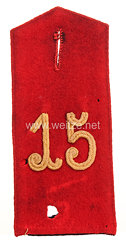
17.500,00

Prussian Pickelhaube for an Officer in the Hanoverian Pioneer Battalion Nr. 10

Garrison Minden, circa 1913. Elegant leather helmet, complete with all fittings in silver-plated finish. The helmet eagle with “frost” silver plating and polished edges, applied bandeaus “Peninsula - Waterloo”. Flat gilt chin scales with silver slide rosettes, both cockades in officer's quality, tall elegant spike with gilt star screws. Interior with light-colored sweatband, light silk lining, size 55 1/2. Only lightly worn, still uncleaned with beautiful patina, condition 2.
A very rare helmet, the battalion had only approximately 15-20 officers.
465461
4.500,00

Prussian Enlisted Men's Tunic of the 2nd Hanoverian Infantry Regiment No. 77

Garrisoned in Celle. Private purchase item circa 1900. The tunic of blue cloth with high red standing collar and red cuff patches with red flaps with blue piping, brass buttons, sewn onto the shoulders white shoulder straps with unit number “77” embroidered in red. Interior with black silk lining. Very well preserved. Condition 2+.
463582
850,00

Kingdom of Saxony Visor Cap for an Artillery Officer

Circa 1890. Tall visor cap of black cloth with black velvet band and bold red piping, short black lacquered visor, Saxon state cockade on front. Interior with dark brown leather sweatband and black oilcloth lining bearing the maker’s mark “Oscar Schieblich Kürschner Netzschkau”. Above this, small portrait of Georg of Saxony in the uniform of a Prussian Generalfeldmarschall (Field Marshal) surrounded by oak and laurel leaves beneath the Imperial crown. Size approximately 56. Condition 2+.

Georg was King of Saxony from 1902 to 1904. During the Franco-Prussian War he commanded the XII. Armeekorps (XII Army Corps). At Versailles in 1871 he represented Saxony at the proclamation of the German Empire. In 1888 he was appointed Prussian Generalfeldmarschall.
The cap corresponds to the type worn during the Franco-Prussian War, but dates only after 1888. It was likely worn by a veteran of that war.
449779
650,00

Prussian Visor Cap for a Reserve Officer in Hussar Regiment Landgraf Friedrich II. von Hessen-Homburg (2nd Kurhessian) Nr. 14

Stationed in Kassel, circa 1910. Dark blue visor cap with red band and white piping, black lacquered leather visor, complete with both cockades, the state cockade with the reserve cross. Interior with brown leather sweatband and wine-red lining. Size approximately 55. Condition 2.
449777
650,00

Württemberg Officer's Visor Cap Infantry

Circa 1910. Elegant tall visor cap of dark blue cloth with red piping and cap band, black lacquered visor, both cockades. Interior with light leather sweatband and silk lining, the lining with stamp “Collection Larcade”. Size 54. The crown with moth traces. Condition 2-.
449064
420,00

Prussian Enlisted Men's Shako for Artillery

Personal item circa 1910. Dark blue cloth with black band and red piping, both cockades present. Interior with brown oilcloth lining. Marked by maker “Heinrich Timm … Berlin …”, sweatband is missing (!). Size approximately 55. Condition 2-3.
447304
200,00

Anhalt Pickelhaube for an Ensign in Infantry Regiment No. 93

Garrison Dessau, circa 1910. Elegant leather helmet, complete with all fittings. The eagle with bandeau “Mit Gott für Fuerst und Vaterland” (With God for Prince and Fatherland), on the breast with silver-plated star and applied Anhalt coat of arms, for the ensign in enlisted men's pattern with closed crown. Flat scale chin chains on rosettes, complete with both cockades, these for the ensign in enlisted men's pattern. The tall spike is removable. Interior with brown sweatband leather, the silk lining is missing. Size 56. Lightly worn, condition 2.
444336
2.800,00

German Empire Pickelhaube for Middle-Rank Civil Servants in the Imperial Territories of Alsace and Lorraine

Circa 1900. Leather helmet, complete with all fittings. Front features the eagle of the German Empire. Flat scale chinstraps on rosettes, right side with the Imperial cockade in lacquered sheet metal officer's version. Fixed service spike for civil servants on round base with ball-head screws. Interior with officer-grade lapped leather lining, black silk lining with maker mark “Eduard Saehs Königl. Hoflieferant Berlin.”, visors unlined. Size 52. Condition 2. 

443152
1.600,00

Brunswick Tunic for a Gefreiter in the Braunschweigisches Infantry Regiment Nr. 92

Garrison Braunschweig. Personal item circa 1910. Dark blue tunic with high red standing collar, cuff slashes and pocket flaps with blue piping, yellow buttons, white shoulder straps sewn on the shoulders with the regimental cipher “W”, buttons for Gefreiter on the collar. Interior with black silk lining. Worn, with minor moth damage. Condition 2-.
442467
750,00

Prussian Pickelhaube for a Royal Prussian Customs or Tax Official in Higher Service, from the Era of Kaiser Wilhelm I

Helmet in the wear style of 1882-88. Leather helmet, complete with all fittings in brass. Front features the large heraldic eagle with openwork crown and the small cipher “W” with crown applied in silver. Flat scale chin chains on rosettes, on the right the Prussian cockade in officer's quality. Helmet plate with star screws, fluted official's spike with small ball finial. Interior with brown leather sweatband and brown silk lining, the latter heavily worn (!), the neck guard lined in red. Size approximately 55. Condition 2.


440895
1.100,00

Bavarian Helmet Model 1842 for Enlisted Men of the Cuirassiers in the Configuration 1848 to 1864

Fine chamber piece with steel sheet bell and tall brass comb with beautifully preserved horsehair crest. Front bears the royal monogram “M” (King Max II). The scale chinchains on lion head mounts, left side with original lacquered Bavarian cockade, leather tongue of the chain repaired. The interior liner is unfortunately not preserved. The bell has been cleaned. Overall in fine condition. Condition 2.

Rare, as most helmets were adapted to the monogram “L” after the death of King Max II in 1864 and the coronation of Ludwig II!
437189
2.800,00

Prussian Tellermütze (Shako Cap) for Enlisted Men Artillery

Private purchase piece circa 1900. Dark blue cloth with black band and red piping, both cockades present. Interior with brown sweatband and brown cloth lining. Size 52. Condition 2.
437185
350,00

Württemberg Fire Helmet

Circa 1900. Leather helmet with brass comb, front emblem in brass depicting helmet with axe and hatchet, leather chin strap attached to brass buttons. Interior with laced leather lining. Inside the bell two plaques bearing the maker “J. G. Lieb Biberach a.d. Riss”. Size 57. Condition 2.
432687
350,00

German Empire World War I Flight Helmet for Aviator Fliegerschule Döberitz 1918

Leather flight helmet with circumferential reinforcement ring and crown padding. Complete with ear flaps and neck protection as well as chin strap. Interior leather lining stamped with unit marking “Flg. Bekl. Döberitz 1918”. Size “58” marked in the crown. Condition 2.

On May 1, 1910, the “Provisorische Fliegerschule Döberitz” (Provisional Flying School Döberitz) was officially inaugurated at Döberitz airfield. In 1914, the central training and testing facility of the newly formed Luftstreitkräfte (Imperial German Air Service) was established here.
430234
2.800,00

Imperial German Navy Bicorn Hat for a Naval Official

circa 1910. Bicorn hat made of black needle felt, edging of black silk ribbon. On the left side silver agraffe above silk cockade in black/white/red and silver-plated naval button. Interior with brown leather sweatband and beige silk lining, inside with supplier's stamp "...Berger, Collani & Cie. Hoflieferanten Berlin Lindenstr. 25", moderate signs of age and use. Condition 2-3.


418946
550,00

Bavarian Visor Cap for a Military Physician

Circa 1910. Tall crown form. Blue wool with blue cap band and red piping, black lacquered visor, both cockades present. Interior with light brown leather sweatband and black silk lining. Size approximately 58. Only minor wear from use. Condition 2.
410947
450,00

German Reich White Long Drill Trousers (Fatigue Trousers) for Enlisted Men

Unit-marked piece, circa 1913. Long white trousers with zinc buttons. Interior with illegible unit stamp. Foxing present. Condition 2-.


399434
350,00

Prussian Visor Cap for an Officer in the 2nd Westphalian Hussar Regiment No. 11

Garrison Krefeld, circa 1910. Saddle-form construction, green cloth body, red cap band, white piping, complete with both cockades, black lacquered visor. Interior with brown sweatband showing old repair, golden-yellow silk lining, maker's stamp and stamp “Fr. Berenberg Dortmund”. Size approximately 56. Condition 2.


387556
650,00

Prussian Visor Cap for a Military Pharmacist

Circa 1910. High plate form. The cap band with wine-red velvet, pink piping, black lacquered visor, both cockades present. Interior with brown sweatband leather and bone-colored silk lining. Size 57. The velvet somewhat faded. Condition 2.

Very rare! Before 1914, only 60 military pharmacists served in peacetime.
321549
650,00

Prussian Pickelhaube for Non-Commissioned Officers of the Feldartillerie-Regiment von Scharnhorst (1. Hannoversches) Nr. 10, 3rd Battery

Garrisoned in Hannover, circa 1892/1900. Unit-marked piece, heavy leather helmet, complete with all fittings. The helmet plate with one-piece stamped eagle bearing the bandeau inscription “Peninsula Waterloo Göhrde”. Domed scale chin chains attached with iron screws, right side with Prussian cockade (the Reich cockade was not introduced until 1897). Interior with reinforced leather lining, the neck visor stamped with unit markings “1882, 1900”, “3te B” (= 3rd Battery) and “2”. Worn piece in good condition. A fine helmet.
299739
1.850,00

Prussia Large Helmet Case for a Pickelhaube

circa 1910. Large version, suitable for a Pickelhaube with parade plume or with visor cap, or for a cuirassier helmet. Height approximately 36.5 cm. The carrying strap detached, the closure strap and one interior strap missing, condition 2-3.
293338
90,00

Brunswick Pickelhaube for a Reserve Officer in Infantry Regiment No. 92, I. and II. Battalion

Brunswick, circa 1910. Elegant leather helmet, complete with all fittings in gilt finish. Prussian helmet eagle matte gilt with polished edges, for reserve officers without bandeau, surmounted by large silvered star of the House Order, the cross arms enameled blue, the center enameled red, the overlays partly silvered and partly gilt. Below it the silver reserve cross with inscription “Mit Gott für Fürst und Vaterland” (With God for Prince and Fatherland). Flat gilt scale chin chains on button 91, both cockades present. The tall elegant service spike is removable. Interior with light brown sweatband and light silk lining, size 61 (extremely large!). Minimally worn, condition 2++.
From 1912 onward, officers in all 3 battalions uniformly wore the death's head on the eagle, the enameled House Order overlay was discontinued.
292731
9.000,00

Prussian Fusilier Cap Model 1894 for Enlisted Men of the Kaiser Alexander Garde-Grenadier-Regiment Nr. 1, 3rd Fusilier Battalion

Berlin, circa 1910. Very fine chamber-quality manufacture. Unlike the caps of the two Grenadier battalions, the caps of the Fusilier battalion are designed not quite as tall with a rigid body. Front bears the brass plate with embossed Garde star and crown. Convex yellow scale chin chains in the special form, attached laterally with screws. Red bag, piped in white and with white braiding. On the white band laterally and to the rear with applied Prussian eagles for the Fusilier battalion. Complete with the original red and white pompom. Interior with laced leather lining, front with sewn-in owner's label “Einj. Freiwilliger tolle 12. Kp. Rgt. Alexander”. The fusilier cap interior with the original reinforcement of aluminum sheet.
The fusilier cap is worn with typical age and wear signs. Rear of the white felt shows 3 small repair patches. Overall condition 2-. Very rare.
283973
3.500,00

Prussian Pickelhaube for Officers of Grenadier Regiments No. 2, 3, 5, 6, 8, 10 to 12

Circa 1910. Leather helmet, complete with all fittings in gilt finish. Front features the large Grenadier eagle with acanthus on the scepter. Flat scale chin chains on rosettes, both cockades present. The spike is removable. Interior with light-colored leather sweatband and green silk lining. The sweatband bears an inventory number, inside the bell an old museum label “Tafel 38 - No 4. Offizier Helm für 7. Grenadiere bis 1914”. Handwritten size marking inside the bell “56 1/2”. The bell interior beneath the left wing with a small old crack. Condition 2-.
501161
2.400,00

Württemberg Pickelhaube for an Infantry Officer

Circa 1910. Leather helmet, complete with all fittings in gilt finish. Front bears the Württemberg emblem. Cruciform base, spike detachable. Flat scale chin chains on rosettes, both cockades present. Angular front visor. Interior with light brown leather sweatband and beige lining, inside the skull with label “Oekonomie Kunstinstitut für galvanische Erneuerung … Berlin … head size 56”. Condition 2.
499329
2.200,00

Prussian Pickelhaube for an Officer Candidate (Fähnrich) of the Foot Artillery

Circa 1914. Elegant light leather helmet in fine officer quality, complete with all fittings in gilt finish. Front eagle, “frosted” gilt with polished edges. Flat gilt scale chains on button 91, both cockades in enlisted men's pattern. The plate with removable ball in officer's pattern, the plate with ball screws. Interior visors lined in green and red, light brown sweatband, yellow silk grosgrain lining. Size 54 1/2. Virtually unworn in mint condition.
The helmet for the Fähnrich (officer candidate) was already an officer's helmet in almost all respects; upon promotion to Leutnant (second lieutenant), only the scale chains, cockades, and split pins on the plate needed to be exchanged. Most likely the Fähnrich was promoted to officer during the war, but the helmet remained at home.

Only very rarely found in this quality.
506761
3.000,00

Württemberg WWI Ersatz Pickelhaube Made of Sheet Metal for Enlisted Men Infantry

Circa 1915. The helmet shell made of pressed sheet metal and painted black, complete with all fittings. Front features the Württemberg state helmet plate, original leather chin strap attached to button 91, complete with both cockades. Interior with brown varnished leather lining, the shell lined with felt. Size approximately 55. Worn, in good original condition, slightly dented, the stag’s antlers on the helmet plate broken off. Very rare.
503751
1.450,00

Prussian Pickelhaube for Enlisted Men of the 5th Hanoverian Infantry Regiment Nr. 165

Garrison Quedlinburg/Blankenburg. Chamber piece 1905. Leather helmet, complete with all fittings. Front plate bearing the eagle with the bandeau “Waterloo”. Leather chin strap on button 91, both cockades present. Interior with stitched leather lining. Rear visor stamped “1905”, “III.B.” and size “57”, front of skull stamped “I.R.165”. Condition 2. Condition 2.
503744
1.950,00

Prussia World War I Field Gray Pickelhaube Model 1915 for Enlisted Men Infantry VII. Armeekorps

Chamber piece 1915. Leather helmet, complete with all fittings in field gray painted iron. Front features the Prussian line eagle. Leather storm strap on button 91, both cockades. The spike removable with bayonet lock. Interior with stitched leather lining, the rear visor with chamber stamp “B.A.VII 1915”. Condition 2.
503737
1.200,00

Prussia World War I Pickelhaube for Enlisted Men of Reserve Infantry Regiment No. 10

Raised in September 1914 in Striegau, Wohlau, and Breslau. Chamber piece from 1905, issued to the regiment in 1914. Leather helmet, complete with all fittings. Line eagle on front, leather chin strap on button 91, both cockades. The spike is non-detachable. Interior with stitched leather lining. The rear visor with obliterated and no longer legible chamber stamp and the year “1905”, beside it the later unit stamp “10.R.I.R.1.B.”, the front visor with the handwritten entry “Selency Apl 3/16”. Size approximately 55. Condition 2.

(Francilly-)Selency is located near Saint-Quentin and was a theater of war in 1914 and from 1917 (after the withdrawal to the “Siegfried Line”). The entry was probably made by a German soldier in the rear area.
503657
950,00

German Empire World War I Protective Flight Helmet after the Style of "Roold"

Privately procured of German manufacture, circa 1916/17. Body constructed of cork, externally covered with brown waxed linen. Interior with brown sweatband and blue silk lining, the sweatband with label "79", the visor lined in green. Condition 2.

The "Roold" type protective helmet was popular among German aviators in addition to the official issue helmet. Originally, this helmet type was manufactured by the French firm Roold in Paris.
427178
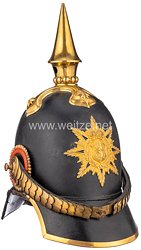
2.000,00

Kingdom of Saxony Visor Cap for Officers in Jäger-Bataillon Nr. 12, 13 or Schützen-Regiment Nr. 108
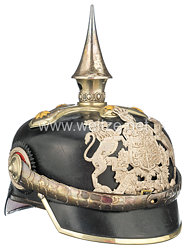
Personal item circa 1900. The visor cap made of dark green cloth with black velvet band and red piping, black lacquered visor made of vulcanized fiber, both cockades present. Interior with brown leather sweatband and reddish-brown lining with the initials “W. M.”. Size approximately 54. Condition 2.
507259
480,00

German Empire World War I Steel Helmet M 1916

Circa 1916/17. The original olive-green paint approximately 70% intact, the shell with light surface rust. The three-piece liner on leather ring. Manufacturer marking on side only faintly visible, presumably Gebrüder Gnüchtel A.G., Lauter in Sachsen (G), alongside size “66”. Without chinstrap. Condition 2.
505198
950,00

Prussian Pickelhaube for a Reserve Officer in the 1st Guards Regiment on Foot, I. Battalion

Potsdam, circa 1910. Elegant leather helmet, complete with all fittings, partially in genuine silver execution. Front features the large Guards eagle for reserve officers without bandeau with highly domed genuine silver star of the Order of the Black Eagle, the center finely enameled. Above this applied the bandeau “Semper Talis”. Below the Guards star the gilt reserve cross “Mit Gott für König und Vaterland” (With God for King and Fatherland). The crown with silver-plated star screws, with tall fluted spike. Flat silver scale chin chains, silver rosettes, both cockades. Interior with light brown sweatband with orange-yellow silk lining. Inside the helmet with vignette and size 57 1/2. The helmet is only lightly worn, condition 2.

The bandeau “Semper Talis” was worn only by the 1st Btn. One of the rarest and most sought-after helmets of the Prussian Army.


408049
8.300,00

Prussian Pickelhaube for an Officer in an Infantry Regiment

Circa 1910. Leather helmet, complete with all fittings. Front plate features the line eagle, flat scale chains attached to rosettes, both cockades present. The spike is removable. Interior lined with brown leather sweatband and beige grosgrain lining, bell marked with size “56 1/2”. Condition 2-3.
498931
1.100,00

Mecklenburg-Schwerin Officer's Bandolier for Dragoon Regiment No. 17

Location Ludwiglust circa 1870/80. Red morocco leather with sewn-on gold braid with blue-gold-red interweave, the braid partially loose, the shield and pricker needles are missing (!!). Condition 3-4.
498568
250,00

German Empire World War I Steel Helmet M 1916 in Mimicry Camouflage Paint

Variant with sheet metal band circa 1917. The original paint finish with black-bordered fields and camouflage colors approximately 90% intact. Interior with three-piece liner attached to the sheet metal band, cushions without filling. Stamped on the side “E.T.66.” (Eisenhüttenwerk Thale A.G., Thale a/Harz), inside the shell “R 1785”. Without chinstrap. Condition 2.
494812
2.500,00

Brunswick Parade Overleg Cover (Shabraque) for Officers in the Brunswick Hussar Regiment No. 17

Circa 1910. Elegant cover made of black fine cloth edged with golden braid, in the front corners the silver-embroidered stars of the Wendish crown with swords and the cipher “W”, in the rear corners each embroidered in silver the large “W” as well as the ducal crown, whose diadem opening is filled with crimson velvet. On the underside with black cloth lining. Beautifully preserved, few small moth holes and signs of use. Condition 2.

Very rare! First time in our inventory in 40 years!
493651
8.500,00

German Empire World War I Field Gray Camouflage Cover for Pickelhaube Infantry Officers' Helmet

Circa 1915. Olive brown cloth. Size approximately 54. Condition 2.
493625
300,00

Baden Pickelhaube for an Officer in a Field Artillery Regiment

Circa 1914. Elegant helmet made of vulcanized fiber, complete with all fittings in gilt finish. Front features the Baden griffin, finely crafted and gilt. The spike ball is removable. Domed scale chin chains on rosettes, both cockades present. Interior fitted with black leather sweatband and green silk grosgrain lining, the front visor lined in green and the neck guard lined in red, the bell lined inside with black fabric. The neck guard rail at rear with button marked size “56 1/2”. Beautifully preserved! Condition 2+.
493575
2.700,00

German Empire World War I Steel Helmet M 1916 with Mimicry Camouflage Paint

Circa 1918. Variant with sheet metal band featuring rectangular eyelets and the very rarely preserved chin strap M18 (the buttons 91 were omitted on this model for this reason). The original lacquer finish with black-outlined fields and camouflage colors approximately 75% intact. Interior features the three-piece liner attached to the sheet metal band, with padding preserved. Side-stamped “T.J.66” (C. Thiel & Söhne, Lübeck). Condition 2.

Very rare! One of the last produced examples. The two-piece chin strap M18 was only introduced to the troops on August 1, 1918.
493549
2.800,00

German Empire World War I Steel Helmet M 1916 in Mimicry Camouflage Paint

Variant with sheet metal rim circa 1917. The original lacquer finish with black-delineated fields and camouflage colors approximately 80% intact. Interior with three-piece liner attached to sheet metal rim, the padding sections preserved. Side stamped “E.T.64.” (Eisenhüttenwerk Thale A.G., Thale a/Harz). Without chin strap. Condition 2.
492657
2.300,00

Bavarian Pickelhaube for a Reserve Officer of the Infantry

Circa 1890. Leather helmet, complete with all fittings in gilt finish. Large helmet plate with Bavarian reserve cross, cross finial with fluted spike, detachable, flat scale chin chains, state cockade on right side, squared front visor. Interior with brown sweatband and light blue silk lining. Size “54 1/2” handwritten inside the skull. Worn condition, Condition 2.
492578
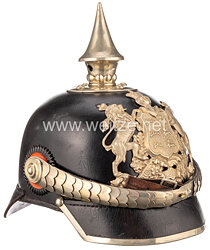
1.350,00

Prussian Pickelhaube for Enlisted Men of Füsilier Regiment von Steinmetz (Westpreußisches) Nr. 37

Garrison Glatz (Kłodzko). Chamber piece 1900. Leather helmet, complete with all fittings. Front features the line eagle, leather chin strap on button 91, with both cockades. The spike is non-removable. Interior with laced liner, the rear visor with chamber stamp F.R.37. 2.B 7 I 1900 1907. Size 54. Worn condition. Condition grade 2.
490095
1.150,00

Mecklenburg-Schwerin World War I Pickelhaube for Officers of Field Artillery Regiment No. 60

Home garrison Schwerin, circa 1914/15, the helmet made of vulcanized fiber still in pre-war quality from around 1914, complete with all fittings. Front features the star with the silver coat of arms of Mecklenburg-Schwerin, domed scale chains on rosettes, both cockades, the ring of the Reich cockade made of substitute material. The spike is removable. Interior with brown leather sweatband with gold imprint featuring the Quadriga and the inscription “Depaheg Patent”, beige silk rep lining, the rear visor lined in red and the front visor in green. Size approximately 57. Condition 2.

A very rare helmet from the period shortly after the outbreak of the “Great War”.
487719
3.800,00

Prussian Visor Cap for a Non-Commissioned Officer in a Jäger Battalion

Personal property item, circa 1910. “Jäger green” cloth with red band and piping, black lacquered visor, both cockades (in the pattern for enlisted men and non-commissioned officers). Interior with brown leather sweatband and rose-colored silk lining with gold initial “W”. Size approximately 54. The sweatband re-glued, with visible glue traces. Condition 2-.
486822
300,00

Imperial Schutztruppe German South West Africa - Cartridge Belt for Mounted Troops (Second Pattern)

Circa 1910. Brown leather, the waist belt with 10 cartridge pouches and two cutouts, one for the belt frog and one for the canteen, the belt frog for a smaller bayonet (KS98 or 71/84), with 4 attachment rivets, shoulder strap with two additional cartridge pouches. Worn, only slight traces of aging. Condition 2.
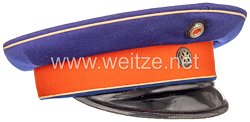
Very rare!


485824
2.800,00

Kingdom of Saxony Pickelhaube for a Customs Official in the Middle Service

Personal property item, circa 1910. Leather spiked helmet, complete with all fittings. Helmet plate features the Saxon coat of arms supported by 2 lions, small official's cross finial with spike, flat scale chin chains on rosettes, right side with cockade. Interior with finely laced leather lining, rear visor stamped “11853”, inside bell with label bearing the owner's name “No. 56, Angermann” and manufacturer's label “...Osang...”. Size approximately 55. Condition 2.
484057
1.200,00

Prussian Pickelhaube for an Officer in the Hanoverian Pioneer Battalion No. 10

Stationed at Minden, circa 1913. Elegant helmet of officer quality. The helmet shell made of leather, complete with all fittings in silvered finish. The helmet eagle silvered with applied bandeaus “Peninsula - Waterloo”. Flat gilt chin scales with silver chin studs, both cockades in officer quality, tall elegant spike with gilt star screws. Interior with light brown sweatband, light silk lining, size 53 3/4. Lightly worn, condition 2.
A very rare helmet.
479207
3.700,00

Württemberg Visor Cap for Non-Commissioned Officers and Enlisted Men Infantry

Circa 1910. Visor cap made of dark blue cloth with red band and piping, black lacquered visor, complete with both cockades. Interior with brown sweatband and orange oilcloth lining with maker “Wilhelm Bauer ... Ulm ..”. Size approximately 54. Worn, a few moth holes. Condition 2-

In Ulm, Infantry Regiments No. 120, 123, and 127 were stationed.
478924
350,00

Bavarian Raupenhelm Model 1868 for Senior Military Officials, Veterinarians and Pharmacists

Circa 1870/80. Lightweight leather helmet, complete with all fittings in silver-plated finish. At front the large three-dimensional helmet emblem crown over “L”, patent leather chinstrap on both sides with lion head attachments, left side with cockade crown “L”. The original bearskin crest still approximately 50% intact. Interior with brown leather sweatband and brown silk lining, front visor lined in green and rear visor lined in red, the haft of the front visor loose. Size approximately 56. Worn condition. Condition 2-3.

Raupenhelme with silver fittings are rarely preserved. The Model 1868 helmet was replaced from 1886 onwards by the helmet following Prussian pattern.


478683
1.500,00

Prussian Czapka for a One-Year Volunteer in the 2. Garde-Ulanen-Regiment

Location Berlin, circa 1910. Elegant privately-purchased piece, complete with all fittings. Elegant leather czapka in fine officer quality. The Guard eagle gilt with silvered star. Domed scale chains in officer execution attached to rosettes, the Reich cockade in enlisted execution. Red parade trimming, the Prussian field insignia for enlisted men. White parade plume of horsehair and white parade lanyard. Interior with light brown sweatband, light silk lining with blackened property stamps. Minimally worn, condition 2+.
477153
4.800,00

Bavarian Caterpillar Helmet Model 1832, Adapted to Model 1845 for Enlisted Men Jäger

Chamber piece 1832. Heavy leather helmet, complete with all fittings. Large brass cipher “L” (Ludwig I, 1825–1848) applied to front. Wide “feathered” brass scale chains on lion head mounts, left side with blue/white enameled cockade, green plume a modern replacement (!!). Original woolen caterpillar crest on the comb. Interior with lined leather lining, nape visor stamped with the year “1832”, furthermore various initials and the year “1874” scratched into the visors. Size approx. 54. Condition 2.
474869
1.450,00

Weimar Republic Reichsmarine Jacket for a Child's Uniform

Circa 1925. Jacket made of dark blue cloth with two rows of “Marine” buttons and white “rank insignia” on the sleeves. Interior with fine black cloth lining. Chest circumference approximately 77 cm. Condition 2.
472302
300,00

Kingdom of Hanover Pair of Boots for a Cuirassier/Gardes du Corps Officer

Circa 1850. Pair of elegant black boots made of fine patent leather. Height approximately 56.5 cm, sole length approximately 27 cm. Complete with buckle-on spurs. Condition 2.

The boots originally came from the Welf auction at Marienburg Castle and were sold by Sotheby's in October 2005.
Such boots were also worn by cavalry officers of other countries such as Prussia.
471940
2.000,00

Bavarian Raupenhelm Model 1868 for Enlisted Men in an Infantry Regiment

Circa 1880. Complete with all brass fittings. Large three-dimensional helmet plate with crown over “L”, leather chinstrap on both sides with lion head bosses, left side with cockade, wool caterpillar crest on the comb. Interior with reinforced leather liner, manufacturer's label inside helmet “Christian Block, Hofgürtler München”. Size 56. Lightly worn in fine condition.
468156
1.350,00

Baden WWI Pickelhaube “Field Gray” from the Estate of Lieutenant Alfons von Carlowitz of the 1st Baden Life Grenadier Regiment No. 109

Home garrison Karlsruhe. Personal item circa 1915. Elegant leather helmet nearly of peacetime quality, complete with all fittings in field gray, predominantly non-magnetic material, likely war metal. Front helmet plate features the Baden Griffin with the star of the House Order of Fidelity in field gray or substitute version, the arms of the cross with remnants of the original red paint. Flat scale chin chains on rosettes, both cockades present. The spike base with gilded stars, the spike removable. Interior with brown sweatband and reddish-brown silk grosgrain lining, the front visor lined in green and the neck guard lined in red, inside the bell the owner’s label “Leutnant Alfons von Carlowitz 1. Badisches Leibgrenadier Regiment”, label with handwritten size “57”. Condition 2.

A very fine untouched helmet! Lieutenant von Carlowitz is listed in the Honor Roll of the Former German Army for the 1st Baden Life Grenadier Regiment No. 109 on page 287. He was reported missing in action on July 19, 1918 in the area of Ploisy-Chaudun (Northern France).
468112
5.500,00

Prussian Tunic for a Non-Commissioned Officer in the Grenadier Regiment Carl von Preußen (2nd Brandenburg) No. 12

Location Frankfurt an der Oder. Private property circa 1910. The tunic made of dark blue wool with high red standing collar and “Brandenburg” cuff flaps, the flaps with white piping, brass buttons, sewn on the shoulders two red shoulder straps with the unit number “12” embroidered in yellow, on the collar and cuff flaps with gold NCO braid. Interior with black silk lining. On the left chest two very small holes. Very well preserved. Condition 2.
465683
1.250,00

Prussia World War I Field Gray Tunic M 1910 for Major “Pfannenstiel” on the Staff of the 48th Reserve Division

Personal item from 1915 in the wearing style of circa 1917/18. The tunic made of fine field gray cloth, the button panel, cuff flaps and collar with crimson piping for General Staff officers, field gray iron buttons with crowns, sewn onto the shoulders the field gray shoulder straps for Major on crimson cloth backing, on the collar the Kolbenlitzen worn from 1915 onwards on reseda green backing, on the chest seven loops for orders/decorations. Interior with olive green silk lining, in the breast pocket with the tailor’s label “Herrmann Hoffmann Hoflieferant Sr. M.. des Kaisers .. König Berlin SW. Herr Hptm. Pfannenstiel No. 1474. 21.7.1915”. Various small moth holes approximately the size of a pinhead, furthermore approximately 5 holes about the size of a 2-cent piece. Condition 2.

A very interesting tunic! The Honor Roll of the former German Army 1914-1918 lists in the supplement the retired Major “Pfannenstiel” for the Great General Staff as well as General Staff of the 48th Reserve Division. The 48th Reserve Division was established in 1914 and was deployed on both the Western and Eastern Fronts, also before Verdun in 1916.
465378
4.500,00

Prussia World War I Field-Gray Tunic with Standing Collar Model 1910 for Major “Ewald Bischoff” in the Westphalian Dragoon Regiment No. 7

Home station Saarbrücken. Manufactured in 1915. The tunic made of fine field-gray cloth with standing collar, single row of field-gray tinted buttons with crown emblem, two skirt pockets and “Swedish” cuff slashes, the breast panel, collar and cuffs piped in pink, on the shoulders the shoulder straps for a Major in the regiment with number “7”, on the left breast with a total of nine loops for orders/decorations. Interior with gray silk lining, in the breast pocket with tailor's label “Trier Leo Büsche ... Herrn Ewald Bischoff Rittm. Drag. 7 2110 17/XI 15”. Few small moth holes. Condition 2.
464807
4.500,00

Imperial German Navy Long White Trousers for Enlisted Men

Property item circa 1910. White cotton trousers with white buttons. Waist circumference 90 cm, side length 102 cm, inseam 70 cm. Slightly soiled. Condition 2.
464354
350,00

Prussian Parade Eagle for Officer's Helmet Garde du Corps or Garde-Kürassier-Regiment

Circa 1900. Large, three-dimensional and finely crafted silver-plated eagle with screw-attached gilt crown, mounted on base, to be affixed to helmet with wing screw and two threaded screws. In rare original transport case. Condition 2.
460216
9.000,00

Bavaria World War I Pickelhaube for an Officer in the Infanterie-Leib-Regiment

Home garrison Munich, circa 1915. Elegant, lightweight leather helmet, complete with all fittings in silver-plated finish. Front features the small helmet plate introduced in 1915, “frosted” silver-plated with polished edges, flat silver scale chains on “suggested button 91,” with both cockades. Cross-shaped base with silver-plated stars and tall fluted spike. Interior with brown leather sweatband and green silk grosgrain lining, the rear visor lined in red, the front visor unlined. Handwritten size “56” inside the crown. Lining somewhat worn. Condition 2.

Inside the crown an old double hole behind the emblem as well as old double holes on the upper part of the crown, resulting from the change from the plate (first introduced in 1913) to the cross-shaped base. Both the impression of the plate and the cross-shaped base are well preserved in the lacquer. This is the Pickelhaube of an officer candidate (Fähnrich) who, after promotion, replaced the plate for enlisted men with the cross-shaped base for officers.


455552
2.800,00

Kingdom of Hanover Supra Vest for an Officer of the Garde du Corps

Circa 1860. Red wool vest with white piping, the hem and armholes pleated, trimmed throughout with silver braid, applied on chest and back the Guard star in the form of the Order of St. George in silver embroidery with colored medallion. Side closures with hooks, on the left hip the vest was laced with a cord, which is also still present. Interior with white silk lining. Very fine condition with fresh colors. Condition 2.

Extremely rare! Only three examples of an officer's supra vest are known worldwide. This piece comes from the Royal House of Hanover and was sold at the Sotheby's auction at Marienburg near Hildesheim in October 2005.


452366
15.000,00

Prussian Visor Cap for a Reserve Official of the War Ministry, Intendantur, Clothing Department or Remount Depot Administration

Circa 1900. Blue cloth with band in the same color, red piping, both cockades, the state cockade with reservist cross, short visor. Interior with brown leather sweatband and honey-colored oilcloth lining. Size approximately 55. Somewhat aged, several small moth holes. Condition 2-.
442171
400,00

Imperial Navy White Shirt for a Sailor

Chamber piece circa 1910. White linen shirt with blue collar and cuff facings. Sleeve length approx. 63 cm, length approx. 67 cm, chest width approx. 42 cm. Without chamber stamp. Condition 2.
437274
250,00

Weimar Republic/Baden Visor Cap for an Official

Circa 1938. Visor cap made of blue cloth with dark blue velvet cap band, Baden cockade at front, black lacquered visor. Interior with brown leather sweatband and light-colored lining with maker “Ludwig Vögele ... Karlsruhe” and stamp “Stadt Karlsruhe ...1938”. Size approximately 58. Condition 2.
433267
250,00

Prussia Old Brandenburg Boots for Enlisted Men of the Gardes du Corps and Cuirassiers

Circa 1870/80. High jackboots made of leather. Sole length approximately 33.5 cm, the soles iron-shod and with old repairs. Worn, still uncleaned, with beautiful patina. A classic “attic find”. Condition 2.

Very rare!

The “Old Brandenburg” boots were part of the equipment of the heavy cavalry from 1867 at the latest. From 1888 they were replaced by the new jackboots.
423141
1.500,00

Prussian Visor Cap for an Official of Officer Rank in the Royal Police Administration Frankfurt am Main

Elegant private purchase piece circa 1910. High visor cap of light blue cloth with dark blue velvet band and cornflower blue piping and black lacquered visor. Complete with the Prussian state cockade and applied civil service emblem. Interior with brown leather sweatband and gold-colored silk lining bearing the maker “Eduard Sachs Frankfurt a/M.”. Size 57. Condition 2.

Toward the end of the German War of 1866, the Free City of Frankfurt was annexed by Prussia and thenceforth remained a Prussian provincial city.
417994
750,00

Prussian Visor Cap for a Military Pharmacist

Circa 1900. Elegant, tall form. The cap band with wine-red velvet, crimson piping, black lacquered visor, both cockades present. Interior with light brown leather sweatband and gold-colored silk lining with owner's initial "A". Stamp of a costume rental company. Size approximately 56. Approximately 3 small moth holes. Condition 2.
406046
600,00

Imperial German Navy White Waistcoat for Naval Officers

circa 1910. White waistcoat made of waffle cloth, complete with small gilt Imperial Navy buttons. Condition 2.
383736
350,00

Prussia Gala Tunic for a Feldwebel of the Schlossgarde-Kompanie

Berlin, circa 1890/1900. Dark blue full-length tunic with red standing collar and red Swedish cuffs. On the collar and cuffs the wide silver braids and on the cuffs the special white lace for the Feldwebel of the Schlossgarde-Kompanie, on the shoulders the large white shoulder straps with the applied metal cipher “Crown FWR”, silver-colored buttons, on the chest with loops for the medal bar. The tunic with iron hooks for fastening. Interior with light cloth lining. Worn piece, well preserved. Condition 2.

A special, extremely rare piece!

The Schlossgarde-Kompanie was charged in Prussia until 1918 with guarding the royal palaces and gardens. On ceremonial occasions it wore tall grenadier caps. The company consisted of non-commissioned officers of the infantry with at least twelve years of service and semi-invalid status. Participation in campaigns was desired, military decorations were an absolute requirement. The company was stationed in Berlin, Charlottenburg, Potsdam, and Kassel.


383515
4.200,00

Prussia Shako for Enlisted Men in a Landwehr Regiment

Personal item, circa 1910. Black cloth shako with red piping, Prussian state cockade on front. Interior with brown sweatband and light blue lining with silver-printed manufacturer “Uniform-Mützen-Geschäft Hut- und Pelzwarenlager H. Stirapfle Lindau”. Size 54. Condition 2.
379177
350,00

Württemberg Pickelhaube Model 1867 for Enlisted Men in Dragoon Regiment König (2nd Württemberg) No. 26

Garrison Stuttgart (Cannstatt), circa 1870/80. Heavy leather helmet of chamber quality, complete with all fittings. Front features the Württemberg helmet emblem in silver finish, mounted with the likewise silver star of the Crown Order. Domed gilt scale chains with silver rosettes on iron screws, on the right the large Württemberg state cockade. Cross-leaf base with ball screws, fixed service spike. Squared front visor with silver trim. Interior with laced leather lining, inside the skull with unit label “Dragoner Ris[...]”. Size 54. The lining inside the skull is adhered, rear visor newly glued from the inside, re-lacquered from the outside in the area of the seam, metal parts cleaned. Condition 2.
372210
2.200,00

Imperial German Navy Dark Blue Sailors' Cap (Tellermütze) of the “VII Half-Flotilla VII”

Personal item, circa 1914. Dark blue sailors' cap (Tellermütze) with sewn-in crimson piping, worn exclusively by members of torpedo boat and submarine flotillas. Complete with original affixed cap tally and Reich cockade. The tally woven in gold for seagoing personnel. Interior with leather sweatband, blue silk lining. Size 54. Condition 2.

The VII. Half-Flotilla with boats S114 through S119 belonged to the IV. Torpedo Boat Flotilla. The flotilla was destroyed on October 17, 1914 in a naval battle off Texel by British warships.


367977
700,00

Grand Duchy of Mecklenburg-Schwerin Model 1848 Helmet for Enlisted Men of the Dragoons

Grabow garrison, circa 1850. Nickel-plated helmet skull of nickel silver, complete with all fittings in tombac. Front features the “sun” with applied Mecklenburg coat of arms. Domed chin scales, on the right the large state cockade. Large cross-shaped base with ball-head cotter pins, quadruple-fluted spike with removable ball finial. Interior with lapped leather lining, with remnants of an old inventory label attached. Helmet skull interior painted black, visors green. Front visor brace with old repair. Condition 2.

A very fine, rare helmet.


Mecklenburg-Schwerin provided one cavalry regiment for the German Confederation. In 1819 the Chevaulegers Regiment was established and renamed Dragoon Regiment in 1837. A second Dragoon Regiment was not established until joining the North German Confederation in 1867.


342194
6.000,00

World War One Short White Underwear

White cotton. Tropical pattern. Used condition.
326117
150,00

Kingdom of Saxony - Visor Cap Storage Box “Karl Scholz ... Pirna”

Height approx. 9.5 cm, diameter 26 cm. The cardboard box with pressure marks on the rim, but still stable. Condition 2-3.

In Pirna were stationed the 5th Field Artillery Regiment No. 64 and the 1st Pioneer Battalion No. 12.
326028
90,00

Bavarian White Long Drill Trousers (Fatigue Trousers) for Enlisted Men

Depot piece. Long trousers made of white linen. Without pockets. Interior marked with size specifications "81 92 116 100" and manufacturer "Georg Gehweyer [...] Augsburg"
313325
300,00

Prussian Visor Cap for a Non-Commissioned Officer of the Infantry, probably 1st Upper Rhine Infantry Regiment No. 97

Personal property item, circa 1890. Dark blue cloth with red piping and red trim, front with the Prussian state cockade (the Reich cockade was not introduced until 1897). Interior with brown sweatband and brown waxed lining, marked by the supplier "Uniform Mützen-Fabrik [...] Breininger Saarburg iL. ...", size 54. Two moth holes on the left side, otherwise well preserved. Condition 2.

The city of Sarrebourg was annexed to the German Empire in 1871. It was the administrative seat of the district of Saarburg in the Lorraine region of the Imperial Territory of Alsace-Lorraine. The city housed an extensive garrison: Infantry Regiment No. 97, Uhlan Regiments No. 11 and No. 15, and two battalions of Field Artillery Regiment No. 15. Infantry Regiment No. 97 had been garrisoned in Sarrebourg since 1887.
312855
420,00

First World War White Long Underwear for Enlisted Men, Radio Operator Hermann 2nd Company 4th Saxon Signal Battalion

Long underwear made of white cotton. Stained, repair patches, used condition.
311197
150,00

Baden Visor Cap for Enlisted Men in a Field Artillery Regiment

Circa 1910. Light blue with black piping and red trim, with both cockades, interior with black sweatband and black lining, illegible maker's marking. Size 56. Condition 2.
288550
430,00

Mecklenburg-Schwerin Dragoon Officer's Helmet - Helmet from the Estate of Paul Friedrich Wilhelm Heinrich, Duke of Mecklenburg

In the style worn from 1848 to 1865. Worn by Paul Friedrich Wilhelm Heinrich, Duke of Mecklenburg, who entered the Dragoon Regiment in 1864 as Second Lieutenant at the age of 12 years.
The helmet conforms in all details to the standard pattern, however handcrafted in boy's size. Very elaborate interior fittings: red morocco leather, green front visor lining, neck guard with dark blue velvet. The silk lining is missing. On the right side the blue-red-yellow cockade, the removable ball finial slightly dented.
Lightly worn in very fine condition. An absolutely unique helmet of museum quality!
89774
6.000,00

Württemberg Pickelhaube for Enlisted Men of the 10th Württemberg Infantry Regiment Nr. 180

Garrison Tübingen/Gmünd. Chamber piece 1907. Leather helmet, complete with all fittings. Front bears the Württemberg emblem, leather chin strap attached to button 91, both cockades present. Interior with laced leather lining, neck guard stamped with chamber mark “I.R.180”, “07”, “B.A.XIII”, two old labels inside the skull. Size approximately 55. Condition 2.
503731
1.450,00

Braunschweig Attila für einen Sergeanten der 1. Eskadron im Husaren-Regiment Nr. 17

Standort Braunschweig. Elegantes Eigentumsstück um 1910. Die schwarze Attila mit gelber Verschnürung, vergoldeten Knebeln und Rosetten, auf den Schultern die gelben Schulterschnüre mit Knöpfen der 1. Eskadron, der Kragen und die Ärmelaufschläge mit der goldenen Unteroffizierslitze, auf dem Kragen die großen Sergantenknöpfe, auf der linken Brusthälfte fünf Schlaufen für Orden/Ehrenzeichen. Innen mit schwarzem Seidenfutter. Das Futter mit zwei kleinen zeitgenössischen Reparaturen. Das Gelb der Verschnürung etwas verblichen. Zustand 2.


500708
1.850,00

Deutsches Reich Polizei: Pickelhaube für einen Wachtmeister der Schutzpolizei in den Reichslanden Elsass-Lothringen

um 1900. Kammerstück, komplett mit allen Beschlägen in Silber. Das Helmemblem ist die Kaiserkrone über der Chiffre "W", flache Schuppenketten an Rosetten, rechts die Reichskokarde für Mannschaften (neu lackiert). Kleines Kreuzblatt mit Beamtenspitze, die Nackenschiene ohne Belüftungsschieber. Innen braunes Schweißleder. Getragener Helm, Zustand 2-3.
298301
800,00

Preußen Koller zur Parade und für den Galaanzug für einen Gefreiten im Regiment der Gardes du Corps

Um 1910. Der Koller in Kammerqualität gefertigt, das Tuch aus weißem Kirsey, roter Kragen und Ärmelaufschläge, beide mit weißen Gardelitzen mit roten Durchzügen, am Kragen, den Brustleisten und den Ärmelaufschlägen die rot-weiß-rote Kollerborte, auf den Schultern eingenäht die weißen Schulterklappen mit roten Vorstößen für das Regiment, vernickelte Knöpfe, am Kragen die Wappenknöpfe für den Gefreiten, auf der linken Brust zwei Schlaufen für Orden und Ehrenzeichen. Innen ungefüttert, mit Verbandspäckchentasche (eingeführt 1907). Nur leichte Mottenspuren, innen diverse Beschriftungen. Zustand 2.

Sehr selten, seit Jahren erstmalig wieder bei uns im Angebot.
504512
4.500,00

Preußen Supraweste für den Galaanzug der Mannschaften des Regiments der Gardes du Corps

Kammerstück um 1910. Rote Wollweste mit umlaufender weißer Borte, mittig auf beiden Seiten aufgelegt der große Stern des schwarzen Adlerordens mit handgesticktem Zentrum in Mannschaftsausführung, die Weste auf der linken Schulter und Seite mit Haken zu verschließen. Innen mit Leinenfutter. Zustand 2.

Sehr selten, seit Jahren erstmalig wieder bei uns im Angebot.

Die Supraweste wurde von zu festlichen Anlässen kommandierten Ehrenwachen aus dem Regiment der Gardes du Corps von getragen. Nur zu diesem Anzug gehörte auch, der Keller und das besondere weiße Bandelier mit dem großen weißen Kartuschkasten.
504507
6.500,00

Kaiserliche Marine Weißes Hemd für den Ober-Matrosen «Krüger»

Kammerstück 1906. Weißes Leinenhemd mit blauem Kragen und Ärmelaufschlägen. Ärmellänge ca. 64 cm, Länge ca. 74 cm, Brustweite ca. 48 cm. Kammerstempel «B.A-K. ... 06», darunter aufgenäht Etikett «Krüger». Auf dem linken Ärmel der Winkel für den Ober-Matrosen. Fleckig. Zustand 2-.

499378
250,00

Preußen 1. Weltkrieg Pickelhaube Modell 1915 feldgrau für Mannschaften Infanterie

Kammerstück um 1915. Lederhelm, komplett mit allen Beschlägen in Eisen feldgrau lackiert. Vorne der preußische Linienadler. Der Lederriemen an Knopf 91 in den 20ern ersetzt, beide Kokarden, die Landeskokarde nachlackiert. Die Spitze mit Bajonett-Verschluss. Innen mit gelaschtem Lederfutter. Größe ca. 54. Die Glocke etwas verzogen, vorne in der Glocke zwei alte Lederflicken. Zustand 2-.


484728
795,00

Baden 1. Weltkrieg Pickelhaube feldgrau für Mannschaften im 2. Badischen Grenadier-Regiment Kaiser Wilhelm I. Nr. 110

Heimatstandorte Mannheim/Heidelberg. Kammerstück 1905, 1915 auf Modell 1915 aptiert. Lederhelm, komplett mit allen Beschlägen in Eisen feldgrau lackiert. Vorne der badische Greif, Ledersturmriemen an Knopf 91, beide Kokarden. Die Spitze mit Bajonettverschluss, abschraubbar. Innen mit gelaschtem Lederfutter, der Nackenschirm mit Kammerstempel «G.R. 110 1.B 1905». In der Glocke vorne die Reste eines entfernten Trägeretiketts. Größe ca. 55. Zustand 2.

Ein sehr interessantes Stück! Es handelt sich um ein Kammerstück von 1905, welches 1915 durch anbringen der eisernen feldgrauen Beschläge auf das neue Modell 15 aptiert wurde.
502867
1.450,00

Bayern Tschako für einen Reserveoffizier im Eisenbahn-, Telegraphen-, Luft- und Kraftfahrt- oder Flieger-Bataillon

Um 1914. Mit schwarzem Tuch bezogener Tschako, komplett mit allen Beschlägen. Vorne das bayerische Emblem frostig versilbert, aufgelegt das vergoldete Kreuz der Reserve, flache silberne Schuppenketten an silbernen Rosetten, rechts die Reichskokarde. Komplett mit dem bayerischen Feldzeichen. Innen mit hellem Lederschweißband und hellbeigem Seidenripsfutter. Größe ca. 53. Das Tuch besonders auf der Rückseite mit Mottenschäden. Zustand 2-.

501103
3.000,00

Preußen Pickelhaube für einen Offizier der Fußartillerie-Regimenter

Um 1914. Eleganter Lederhelm, komplett mit allen Beschlägen. Vorne der Linienadler, feuervergoldet mit aufpolierten Kanten. Flache Schuppenketten an Rosetten, beide Kokarden, zwei der Schuppen aus Ersatzmaterial. Die Helmkugel abnehmbar. Innen mit hellbraunem Lederschweißband mit Prägung «Mars Patent», grünes Seidenripsfutter, in der Glocke handschriftlich die Größe «56 1/4». Zustand 2.
494695
1.350,00

Preußen 1. Weltkrieg Pickelhaube für einen Offizier im Garde-Füsilier-Regiment

Kriegs-Ausführung um 1915/16. Der Helm aus Vulkanfiber, komplett mit allen Beschlägen teils in Neusilber und in Messing. Der Helmadler "frostig" versilbert mit aufpolierten Kanten, mittig mit hochgewölbtem emaillierten Gardestern. Flache Schuppenketten in Messing mit "verdecktem Knopf 91", die imitierten Rosetten ursprünglich versilbert, beide Kokarden. Der Teller, die Spitze und die Nackenschiene in Neusilber. Der Teller mit vergoldeten Sternen, die Spitze nicht mehr abnehmbar. Die Vorderschirmschiene in Messing. Innen mit hellem Lederschweißband, das Futter aus Ersatzmaterial, mit dem Monogramm «R», die Glocke innen mit schwarzem Stoff verkleidet, der Vorderschirm grün und der Nackenschirm rot gefüttert. Größe ca. 56. In allen Teilen originaler sehr gut erhaltener Helm. Zustand 2.

Der Helm könnte so auch im 5. Garde-Regiment zu Fuß, Garde-Pionier-Bataillon oder in einem Eisenbahn-Regiment, bzw. dem Kraftfahr-Bataillon getragen werden.

Sehr selten! Es handelt sich um die letzte Ausführung der Pickelhaube für Offiziere in diesem Regiment, die bereits unter dem Eindruck der Materialknappheit entstanden ist. Der "Knopf 91" wurde ab 1915 auch für den Offiziershelm befohlen. Daran trug man Schuppenketten mit einer Rosette, die in den Knopf einrasten konnte, daher die Bezeichnung "verdeckter Knopf 91".
493595
3.800,00

Hessen Pickelhaube für Offiziere im Leibgarde-Infanterie-Regt. Nr. 115

Standort Darmstadt, in der Trageweise ab 1911. Lederhelm, komplett mit allen Beschlägen in versilberter Ausführung. Vorne der hessische Wappenlöwe mit doppeltem Lorbeer- und Eichenlaubkranz, darauf der aufgelegte Stern des Hausordens, das Zentrum fein emailliert, mit der Devise «Gott Ehre Vaterland». Das Helmemblem "frostig" versilbert mit aufpolierten Kanten, mit doppeltem Lorbeer- und Eichenlaubkranz. Darüber das Bandeau «1621», am Kreuzblatt befestigt. Das Kreuzblatt mit den ab 1911 befohlenen Sternschrauben statt der Kugelkopfnieten, die sechsfach gekehlte Spitze abnehmbar. Flache Schuppenketten, komplett mit beiden Kokarden, die Landeskokarde in der besonderen hessischen Form. Die Nackenschiene typisch für Hessen mit 2 Kugelnieten. Innen mit braunem Schweißleder und hellbeigem Seidenripsfutter. Größe ca. 52. Etwas getragen, hinten rechts die Glocke mit zwei Dellen. Zustand 2.

492956
7.000,00

Preußen Helm für einen Offizier im Kürassier-Regiment Königin (Pommersches) Nr. 2

Standort Pasewalk, um 1910. Eleganter Helm in der letzten Ausführung. Die Helmglocke aus leichtem vernickeltem Eisenblech, komplett mit allen Beschlägen in vergoldeter Ausführung. Vorn der preußische Adler mit mitgeprägtem Bandeau «Hohenfriedberg 4 Juni 1745». Gewölbte vergoldete Schuppenketten mit Kleeblättern, beide Kokarden in der großen Ausführung für Kürassier-Offiziere. Innen mit hellem Schweißleder und hellbeigem Seidenripsfutter. Der Vorderschirm mit braunem Leder, der Nackenschirm mit weichem Stoff gefüttert. Größe ca. 54. Leicht getragen, die Glocke vorne rechts mit einer dünnen Schramme, die Vernicklung stellenweise mit kleinen punktgroßen Närbchen. Zustand 2. 


492926
16.500,00

Preußen Waffenrock für einen Sergeanten im 3. Lothringischen Infanterie-Regiment Nr. 135

Standort Diedenhofen. Eigentumsstück um 1910. Der Waffenrock aus blauem Stoff mit rotem Stehkragen und Ärmelaufschlägen mit roten Patten mit gelben Vorstößen, die Brustklappen mit roten Vorstößen, kupferfarbene Knöpfe, auf den Schultern eingenäht die gelben Schulterklappen mit in rot eingestickten Einheitsnummern «135», die Ärmelaufschläge und der Kragen mit der breiten goldenen Tresse für Unteroffiziere, am Kragen die großen Wappenknöpfe für den Sergeanten. Innen mit feinem schwarzen Tuchfutter. Schön erhalten, nur der Kragen innen mit einem kleinen Mottenloch, die Tresse am Kragen auf der Oberseite fleckig. Zustand 2.
492647
1.000,00

Hessen-Darmstadt Pickelhaube aus dem Besitz von Hauptmann «Lautenschläger» im 2. Großherzoglich Hessischen Feldartillerie-Regiment Nr. 61

Standorte Darmstadt und Babenhausen. Eigentumsstück um 1914. Leichter Lederhelm, komplett mit allen Beschlägen in vergoldeter Ausführung. Vorne das hessische Emblem mit den Löwen, gewölbte Schuppenketten an Rosetten, beide Kokarden, die Kugel abnehmbar. Innen mit hellem Lederschweißband und hellbraunem Seidenripsfutter, der Vorderschirm grün und der Nackenschirm rot gefüttert, in der Glocke handschriftlich die Größe «56 1/4» und der Trägername «Lautenschläger». Zustand 2.

Der Hauptmann «Lautenschläger» findet sich in der Rangliste der königlichen preußischen Armee (...) für 1914 auf Seite 464.
492017
3.500,00

Preußen Uniformensemble aus dem Nachlass eines Rittmeisters der Reserve im Kürassier-Regiment von Driesen (Westfälisches) Nr. 4

Standort Münster. Um 1910. Das Uniformensemble aus folgenden Stücken bestehend:
· Helm für den Offizier der Reserve Kürassiere. Elegante, besonders leichte Helmglocke aus Eisenblech vernickelt, komplett mit allen Beschlägen in Messing vergoldet. Vorne der große vergoldete und fein gearbeitete Linien-Kürassieradler, für den Reserve-Offizier ohne Devise und mit aufgelegtem silbernen Reserve-Kreuz mit der Devise «Mit Gott für König und Vaterland 1813», Gewölbte Schuppenketten mit Kleeblättern und Rändelschrauben, intakter Lederkinnriemen. Komplett mit beiden Kokarden in der großen Ausführung. Vergoldetes Kreuzblatt mit Kugelschrauben, hohe gekehlte vernickelte Spitze. Innen mit braunem Lederschweißband und goldgelbem Seidenripsfutter, der Vorderschirm mit schwarzem Leder gefüttert, der Nackenschirm mit schwarzem Samt. Größe ca. 56. Die Vernicklung des Helmes nur sehr leicht gealtert, vorne rechts eine kleine Kerbe.
·Kürass für Offiziere der Linien-Kürassier Regimenter. Eleganter, leichter Kürass aus vernickeltem Eisenblech. Vergoldete Nieten und Schuppenketten. Die Schließen mit Eichenlaubverzierungen, hinten auf dem Rücken mit aufgelegten Löwenköpfen. Komplett mit dem original Bauchriemen. Innen das originale gesteppte weiße Seidenfutter, an den Armen und dem Hals die schwarz/weißen Manschetten. Leicht getragen.
·Koller für Offiziere. Der Koller aus schwerem weißen Tuch in feinster Qualität mit ponceaurotem Stehkragen und ponceauroten "schwedischen" Ärmelaufschlägen, die Ärmelansätze mit ponceauroten Vorstößen, an den Ärmelaufschlägen sowie am Kragen und auf beiden Brustleisten die silberbestickte Kollerborte mit dunkelroter Nebenfarbe, auf den Schultern die ponceauroten Passanten mit Silbertresse mit schwarzen Durchzügen für die Epauletten, sowie die Schlaufen und Knöpfe für die Schulterstücke, aufgelegt die kleinen Epauletten für den Rittmeister. Auf der linken Brust mit zwei Schlaufen für Orden/Ehrenzeichen. Innen mit feinem weißem Futter. Auf der linken Seite ein verblichener Fleck.
·Paar Stulpenhandschuhe für Offiziere. Elegante weiße Lederhandschuhe mit ledernen Stulpen. Etwas fleckig.
·Hose für Offiziere Kürassiere. Die Hose aus weißem Tuch in feinster Qualität mit feinen weißen Tuchbesatz am Bund, zwei Hüfttaschen und eine Uhrentasche, mit Hornknöpfen.
·Stulpenstiefel für Offiziere. Die eleganten hohen Stulpenstiefel aus geschwärztem Leder, Sohlenlänge ca. 29.5 cm.
·Kürassier-Pallasch Offiziere. Ca. 2.6 cm breite und 86.8 cm lange, vernickelte und beidseitig doppelt gekehlte und geätzte Klinge, terzseitig das Reichswappen, die Vernicklung leicht gealtert. Vierspangiges Messinggefäß, quartseitig gestempelt «953» sowie "Gardestempel", Rochenhautgriff mit intakter Drahtwicklung, auch die Fingerschlaufe intakt, das Gefäß leicht gelockert. Vernickelte Stahlscheide mit zwei Ringbändern und beweglichen Trageringen, leicht beulig. Gesamtlänge ca. 103.5 cm.  
·Auf einer original "Obermaier Uniformpuppe" ohne Kopf aus den 1960er Jahren. 
Gute Erhaltung. Zustand 2.

Ein sehr schönes und gut erhaltenes Zeugnis seiner Zeit von dem wir uns sehr freuen Ihnen dieses präsentieren zu können!
490574
28.000,00

Bayern Tschako für einen Offizier im Eisenbahn-, Telegraphen-, Luft- und Kraftfahrt- oder Flieger-Bataillon

Um 1915. Schwarzer Tschako aus Vulkanfiber mit Tuch bezogen, komplett mit allen Beschlägen in versilberter Ausführung, vorn das keine Helmemblem, flache silberne Schuppenketten aus Kriegsmetall, Reichskokarde und dem bayerischen Feldzeichen. Innen dunkles Schweißband und dunkelgrünes Seidenfutter, Größe 56. Nur leicht getragen, Zustand 2.


489261
2.950,00

Hessen Pickelhaube für Offiziere im Leibgarde-Infanterie-Regt. Nr. 115

Standort Darmstadt um 1910. Eleganter Lederhelm, komplett mit allen Beschlägen in versilberter Ausführung. Das Helmemblem "frostig" versilbert mit aufpolierten Kanten, mit doppeltem Lorbeer- und Eichenlaubkranz, darauf der aufgelegte Stern des Hausordens, das Zentrum fein emailliert, darüber das Bandeau "1621". Kreuzblatt mit silbernen Kugelnieten, gekehlte abnehmbare Spitze in der typisch hessischen Ausführung. Flache Schuppenketten, komplett mit beiden Kokarden, die Nackenschiene typisch für Hessen mit 2 Kugelnieten. Innen mit hellem Schweißleder und Seidenripsfutter. Größe ca. 55. In sehr schönem Zustand, nur das Futter mit leichten Tragespuren. Zustand 2.

488215
8.500,00

Baden weiche Schirmmütze für Offiziere im 2. Badisches Dragoner-Regiment Nr. 21

Standort Bruchsal, um 1910. Weiche elegante Tellerform, hellblaues Tuch mit gelbem Mützenbund und Vorstößen, komplett mit beiden Kokarden, weicher schwarzer Lacklederschirm. Innen braunes Schweißleder und hellblaues Seidenfutter, Größe 55. Getragen, Zustand 2-3.
483920
550,00

Königreich Bayern Helm Modell 1848 für einen Angehörigen der Bürgerwehr

Um 1850. Hoher Lederhelm, komplett mit allen Beschlägen in neusilberner Ausführung. Vorne das bayerische Staatswappen, gewölbte Schuppenketten an Löwenkopfaufhängungen, auf der linken Seite mit bayerischer Kokarde, silbernes Kreuzblatt mit dem original schwarzen Paradebusch aus Pferdehaar, kurze Nackenschiene. Innen mit gelaschtem Lederfutter, Größe ca. 56. Getragen, Zustand 2.


479708
1.150,00

Sachsen Pickelhaube für einen Zollbeamten im unteren Dienst

Eigentumstück, um 1910. Lederhelm, komplett mit allen Beschlägen. Als Helmemblem das sächsische Wappen von 2 Löwen gehalten, kleines Beamtenkreuzblatt mit Spitze, flache Schuppenketten, rechts mit der Kokarde. Innen gelaschtes Lederfutter, Größe 56. Der Helm ist nur leicht getragen, Zustand 2.
479573
1.250,00

Königreich Sachsen Schirmmütze für Unteroffiziere und Mannschaften der Infanterie

Um 1910. Schirmmütze aus dunkelblauem Stoff mit rotem Bund und Vorstoß, schwarz lackierter Schirm, komplett mit beiden Kokarden. Innen mit braunem Lederschweißband und braunem Wachstuchfutter mit Silberaufdruck. Größe 56. Nahezu ungetragen. Zustand 2+


478918
450,00

Preußen Schirmmütze für einen Reserve-Offizier der Infanterie-Regimenter

Eigentumstück um 1910. Schirmmütze in Sattelform aus dunkelblauem Stoff mit rotem Bund und Vorstoß, komplett mit beiden Kokarden, die Landeskokarde mit dem Landwehrkreuz. Innen mit braunem Lederschweißband und schwarzem Seidenfutter. Größe ca. 55. Bund und Vorstoß mit Mottenlöchern und -spuren. Zustand 2-3

478811
300,00

Preußen Flügelmütze Modell 1843 für einen Offizier im Landwehr-Husaren-Regiment Nr. 5

Um 1845. Hohe elegante Flügelmütze mit Deckel aus schwarzem Lackleder, komplett mit allen Beschlägen. Um den Korpus umlaufend der schwarze Tuchflügel, der Korpus außen und der Flügel innen mit feinem goldfarbenem Tuch gefüttert, oben ein kleines Befestigungshäkchen für den Tuchflügel (zur Parade wurde der Tuchflügel lose herunterhängend getragen). Vergoldete gewölbte Schuppenketten an Rosetten, getragen über dem fest vernähter Schirm, die lederne Schnalle an der Schuppenkette fehlt. Darüber die Regiments-Nummer «5», auf der rechten Seite das große silberne Landwehrkreuz mit der Devise «mit Gott für König und Vaterland 1813», darüber aufgesteckt das große preußisches Feldzeichen für Offiziere. Innen mit gelaschtem Lederfutter. Größe ca. 57. Nur minimal getragen in besonders schönem unberührtem Originalzustand. Zustand 2+

Sehr selten! Die Flügelmütze wurde für die Husaren-Regimenter in Preußen 1843 (wieder) eingeführt, jedoch bereits 1850 von der Pelzmütze abgelöst. Die zwölf Landwehr-Husaren-Regimenter trugen die Flügelmütze jedoch noch bis 1866 weiter.
Das 5. Landwehr-Husaren-Regiment war der 4. Kavallerie-Brigade der 4. Division im II. Armeekorps (Pommern, Kommando in Stettin) unterstellt.


478694
3.200,00

Königreich Sachsen Schirmmütze für Mannschaften und Unteroffiziere im Jäger-Bataillon Nr. 12, 13 oder Schützen-Regiment Nr. 108

Eigentumsstück um 1910. Die Schirmmütze in hoher Tellerform mit grünem Stoff mit schwarzem Besatzstreifen und roten Vorstößen, schwarz lackierter Schirm, beide Kokarden. Innen mit hellbraunem Schweißband und feinem grünen Futter. Größe ca. 54. Der Deckelrand mit einem ca. 2mm großen Mottenloch. Zustand 2.
475196
450,00

Braunschweig großer Kristallkelch aus dem Besitz von Rudolf Heinrich Freiherr von Recum, damalig Rittmeister im Husaren-Regiment Nr. 17

Hocheleganter, großer Kristallkelch mit Goldrand, vorne aufgemalt der Totenkopf mit den gekreuzten Knochen und dem Wahlspruch «immota fides», rückseitig die in Goldfarbe aufgetragene Chiffre «BHR17.» (Braunschweigisches Husaren-Regiment 17), am Fuß die Inschrift «Rud. Frhrr. von Recum 16.8.1907, im Stiel mit 9 exakt positionierten Luftblasen im Glas. Höhe des Kelchs 28 cm, Durchmesser der Öffnung 10.5 cm. Zustand 2.

Ein sehr exquisites Unikat! Die Inschrift «immota fides» (unerschütterliche Treue) ist der lateinische Wahlspruch des Braunschweigischen Welfenhauses und geht auf die Stiftung des Ordens Heinrichs des Löwen 1834 zurück. 
Der Rittmeister Rudolf Heinrich Freiherr von Recum findet sich in der "Rangliste der königlich preußischen Armee ... für 1907". Wenig später wurde er zum Major befördert.

Siehe dazu auch Artikel #472490.
472408

Preußen Unterschnallriemen für den Säbel für eine Kinderuniform 

18 mm schmaler Lederriemen mit Löwenkopfschnallen und Schlangeverschluß, inkomplett ! der kürzere der Säbelhänger fehlt !
471852
85,00

Preußen Tschako für einen Unteroffizier der Telegraphen-, Luftschiffer- und Flieger-Bataillone

Eigentumsstück um 1910. Schwarzer Lackledertschako, komplett mit allen Beschlägen. Vorne der "frostig" versilberte Linienadler für Offiziere. Ledersturmriemen an Knopf 91, rechts die Reichskokarde in der Ausführung für Mannschaften. Komplett mit dem preußischen Feldzeichen als Eigentumsstück für Unteroffiziere. Innen mit Lederschweißband und goldgelbem Seidenripsfutter, der Nackenschirm grün gefüttert. Im Deckel die Größe «57». Zustand 2.
470007
1.850,00

Preußen Waffenrock für einen Gefreiten im Füsilier-Regiment von Gersdorff (Kurhessisches) Nr. 80

Standort Wiesbaden/Homburg. Eigentumsstück um 1900. Dunkelblauer Rock mit rotem Stehkragen, Ärmelaufschlägen, Patten und Brustleisten-Vorstößen, die Patten mit gelben Vorstößen, auf dem Kragen und den Patten die besonderen weißen Litzen, Messingknöpfe. Auf den Schultern die blauen Schulterklappen mit dem in Rot eingestickten Chiffre «VFF» und Knöpfen der 3. Kompanie. Am Kragen die Knöpfe für den Gefreiten. Innen mit schwarzem Seidenfutter, im Nackenbereich Etikett des Schneiders «Johann Schwengler Wiesbaden». Sehr schön erhalten. Zustand 2.
Nur ganz selten zu finden.
450676
1.250,00

Deutsches Reich 1. Weltkrieg Stahlhelm M 1916

Ausführung mit Blechbund um 1917. Originale olivgrüne Lackierung zu ca. 75% erhalten. Innen mit den drei Polsterkissen am Blechbund, die Kissen gefüllt. Ohne Kinnriemen. Hersteller nicht erkennbar. Zustand 2.
448204
1.400,00

Deutsches Reich 1. Weltkrieg Stahlhelm M 1916

Ausführung mit Blechbund um 1917. Originale olivgrüne Lackierung zu ca. 60% erhalten. Innen mit den drei Polsterkissen am Blechbund, die Füllungen der Kissen noch erhalten, das Leder schon etwas gealtert, die Laschen am vorderen Kissen abgerissen, die Glocke innen flugrostig. kein Hersteller erkennbar. Ohne Kinnriemen. Zustand 2-.
447997
1.200,00

Preußen 1. Weltkrieg feldgraue Schirmmütze für Offiziere im Kürassier-Regiment Kaiser Nikolaus I. von Rußland (Brandenburgisches) Nr. 6

Heimatstandort Brandenburg a.H., um 1916. Hohe, elegante Schirmmütze in Sattelform aus feldgrauem Tuch, russisch-blauer Bund, weiße Vorstöße, beide Kokarden, schwarz lackierter Schirm aus Vulkanfiber. Innen mit braunem Schweißband und hellgrauem Seidenfutter. Größe ca. 54. Leicht getragen, kleine Mottenlöcher. Zustand 2.
Sehr selten.
443733
1.600,00

Bayern 1. Weltkrieg feldgraue Schirmmütze für einen Offizier im 3. Chevaulegers-Regiment Herzog Karl Theodor

Heimatstandort Dieuze in Lothringen. Eigentumsstück um 1916. Weiche Sattel-, bzw. Knautschform. Feines, feldgraues Tuch aus Seide, rosa Mützenbund und Paspelierung, komplett mit beiden Kokarden in Offiziersausführung, schwarz lackierter Schirm. Braunes Schweißband, beiges Seidenfutter. Größe ca. 54. Zustand 2.
442193
1.350,00

Preußen Schirmmütze für einen Militärarzt der Reserve

Um 1900. Schirmmütze aus dunkelblauem Tuch, der Bund in der gleichen Farbe, rote Vorstöße, beide Kokarden, die Landeskokarde für Reserveoffiziere, kurzer, schwarz lackierter Schirm. Innen mit dunkelbraunem Lederschweißband, dunkelrotes Seidenfutter mit Hersteller "...Collani & Co Hamburg". Größe 55. Zustand 2.
442185
450,00

Deutsche Reich 1. Weltkrieg Stahlhelm M 1916

Um 1916. Die Olivgrüne Lackierung zu ca. 30% erhalten, gereinigt, feine Rostnärbchen. Innen mit dem dreiteiligen Futter am Lederring. Ohne Kinnriemen. Gestempelt "G.B.N 64" (Gebrüder Bing A.G., Nürnberg). Zustand 2-.
441837
1.350,00

Kaiserliche Marine kurze Paradejacke für den Bootsmannsmaat und Geschützführer "Formes"

Kammerstück um 1880/85. Fertigung aus dunkelblauem Tuch, komplett mit allen Effekten. Gelbe Knöpfe mit Anker und Kaiserkrone 1. Modell (bis 1888), auf dem linken Ärmel das Abzeichen für den Maat in großer metallener Ausführung, darunter das Stoffabzeichen für den Geschützführer in der Form von 1873 bis 1893, an den Ärmeln die goldenen Tressen für den Unteroffizier. Innen mit braunem Tuchfutter, im Schulterbereich mit Kammerstempel (leider nicht mehr lesbar), darunter "IM 4 173.86" und darunter Namensetikett "Formes", im linken Ärmel weiteres altes Etikett "Eigenthum von Ch. Meyer geb. Mathissen Hamburg". Zustand 2.

Ein schönes Stück aus der Frühzeit der kaiserlichen Marine. Der ehemalige Träger scheint als einfacher Matrose angefangen und die Jacke als Kammerstück erhalten zu haben und hat sich dann bis zum Bootsmannsmaat hochgedient. Vor 1893 hat er wohl die Marine verlassen, da er sonst das neue Abzeichen für Geschützführer auf der Jacke angebracht hätte.
437238
750,00

Baden Tellermütze Feuerwehr

Um 1900. Tellermütze aus schwarzem Stoff mit purpurroten Vorstößen, vorne aufgelegt das Symbol mit Helm, Axt und Beil. Innen mit braunem Wachstuch mit Hersteller "W. Häussner Bühl". Größe 56. Kein Schweißband. Zustand 2.
433216
250,00

Sachsen-Meiningen-Coburg-Gotha - Pickelhaube für einen Fähnrich im 6. Thüringischen Infanterie-Regiment Nr. 95

Standort Gotha/Hildburghausen/Coburg, um 1910. Eleganter Lederhelm in feiner Offiziersqualität, komplett mit allen Beschlägen in vergoldeter Ausführung. Der Helmadler in Offiziersausführung mit steilkantigem Bandeau "Mit Gott für Fürst und Vaterland", auf der Brust mit großem versilbertem Stern mit aufgelegtem sächsischen Wappen mit beidseitigem Lorbeerkranz. Flache Schuppenketten an Rosetten, die beiden Kokarden in Mannschaftsausführung. Abnehmbare Spitze, der Hals mit Perlring für Offiziere, der Teller mit Kugelkopfsplinten. Innen mit fein gelaschtem Lederfutter, die Schirme nicht gefüttert. Größe ca. 57. Nahezu ungetragen, Zustand 2++.


430056
3.700,00

Kaiserliche Marine Zweispitz für einen Reserveoffizier

Um 1910. Eleganter Zweispitz aus schwarzem Nadelfilz, links mit goldener Agraffe, Reichskokarde aus Seide und vergoldetem Knopf für Reserveoffiziere mit aufgelegtem silbernen Reservekreuz. Innen mit braunem Schweißleder und weißem Seidenfutter mit Hersteller "...Berger Collani & Co ... Berlin". Größe 56. Zustand 2.


424370
800,00

Preußen Schirmmütze für einen Offizier der Infanterie

Um 1910. Elegante, hohe Tellerform. Das Tuch dunkelblau mit rotem Mützenbund und Vorstoß, beide Kokarden, schwarz lackierter Schirm. Innen mit beigem Schweißband und weißem Seidenfutter, im Futter die Trägerinitialen "KP". Größe 56.  Das Futter mit Spuren einer alten Kopfverletzung. Das Tuch besonders am Deckel mit ein paar Mottenschäden. Zustand 2-.


417839
375,00

Baden Pickelhaube für einen Reserve-Offizier im 1. Badischen Leib-Grenadier-Regiment Nr. 109

Karlsruhe, um 1910. Eleganter Helm aus Leder, komplett mit allen Beschlägen in versilberter Ausführung. Vorne als Helmemblem der versilberte Badische Greif, mit aufgelegtem Stern des Hausordens der Treue, fein emailliert und vergoldet. Das Bandeau unter dem Greif für Reserveoffiziere ohne Schriftzug, das äußerste rechte Ende des Bandeaus ist abgebrochen, aber durch die Schuppenkette verdeckt, daher kaum sichtbar. Unter dem Bruststern das versilberte Landwehrkreuz mit Devise "Mit Gott für Fürst und Vaterland". Flache vergoldete Schuppenketten an silbernen Rosetten, beide Kokarden. Silberner Teller mit goldenen Sternschrauben. Komplett mit hoher eleganter Dienstspitze. Innen braunes Schweißleder, rotbraunes Seidenfutter, Größe 55 1/2. Der Helm ist in getragenem Zustand. Die Naht des linken Ohrenleders gebrochen. Das Futter mit einem kleinen Loch. Ein seltener Helm mit kleinen Mängeln.
403874
5.000,00

Preußen Tellermütze für Mannschaften der Infanterie

Eigentumsstück, um 1910. Dunkelblaues Tuch mit rotem Mützenbund und rotem Vorstoß, komplett mit beiden Kokarden. Innen mit braunem Schweißband und braunem Futter. Größe 56. Zustand 2.
380638
400,00

Baden Pickelhaube für Mannschaften der Karlsruher Bürgerwehr aus der Zeit der Badischen Revolution 1848/49

Hoher Lederhelm mit Messingbeschlägen, vorne als Emblem die Nummer "8" in Eichenlaubkranz mit aufgelegter Krone, Kreuzblattbeschlag mit breiter fester Spitze, Ledersturmriemen an Löwenkopfaufhängungen. Innen mit gelaschtem Lederfutter. Größe 60. Im Nackenschirm ein altes Inventaretikett. Zustand 2.
373814
2.100,00

Preußen Schirmmütze für einen Reserve-Offizier im 2. Westfälischen Husaren-Regiment Nr. 11

Standort Krefeld, um 1910. Sattelform, das Tuch grün, roter Mützenbund, weiße Vorstöße, komplett mit beiden Kokarden, schwarz lackierter Schirm. Innen hellbraunes Schweißleder, graues Futter, Stempel eines Kostümverleihes. Größe 54. Getragen, hinten zwei Mottenlöcher. Zustand 2.


372915
450,00

Hessen-Darmstadt Schirmmütze für Angehörige eines Kriegervereins

Um 1890. Dunkelblaue Schirmmütze mit rotem Bund und weißem Vorstoß, vorne die Hessische Landeskokarde in Offiziersausführung. Innen mit schwarzem Schweißleder und weinrotem Futter mit Hersteller "P. H. Lorz Hoflieferant Darmstadt ...". Darunter teils entferntes Trägeretikett. Größe 56. Zustand 2.


367810
350,00

Bayern Raupenhelm Modell 1868 für Offiziere Jäger, Sanitäter etc.

Um 1880. Elegante Lederglocke, komplett mit allen Beschlägen in feuervergoldeter Ausführung. Großes Helmemblem Krone über "L", schwarzer Lacklederriemen seitlich an Löwenkopfaufhängungen. Links über dem Löwenkopf mit einer silbernen Kokarde Krone "L", dahinter die Tülle mit Flügelmutter für den Roßhaarstutz, der Stutz selbst fehlt. Große originale Bärenfellraupe. Innen mit braunem Lederschweißband, das Futter fehlt. Größe 55. die Vorderschirmschiene alt gebrochen und repariert. Zustand 2.
361098
1.800,00

Kaiserliche Marine dunkelblaue Tellermütze für Mannschaften der "8. II. Torpedo=Division. II. 8."

Eigentumsstück, 1913. Dunkelblaue Tellermütze mit der eingenähten karmesinroten Biese, wurde nur von Angehörigen der Torpedoboots- und U-Boots-Flottillen getragen. Komplett mit original fixiertem Mützenband und Reichskokarde. Das Band in Silber gewebt für Heizer und technisches Personal. Innen mit schwarzem Schweißband und schwarzem Seidenfutter. Eingenähtes Trägeretikett "Miohel II T 6 89/13". Größe 56. Getragen, Zustand 2.


351835
600,00

Preußen Pelzmütze für Offiziere im Husaren-Regiment Königin Wilhelmina der Niederlande (Hannoversches) Nr. 15

Standort Wandsbek (= Hamburg-Wandsbek), um 1912. Elegante hohe Pelzmütze aus Opossumfell, komplett mit allen Beschlägen. Großes versilbertes Bandeau "Mit Gott für König und Vaterland - Peninsula - Waterloo - El Bodon - Barossa". Gewölbte Schuppenketten, rechts mit Reichskokarde, preußisches Offiziersfeldzeichen, gelber Kolpak sowie gerollte Fangschnur. Innen helles Schweißleder mit Seidenbanddurchzug, weißes Seidenfutter. Größe 53. Nur leicht getragen in sehr schönem Zustand, sehr selten.

338934
11.000,00

Hessen Pickelhaube des Einjährig Freiwilligen "Trutschler" in der 6. Kompanie des Leibgarde-Infanterie-Regiments (1. Großherzoglich Hessisches) Nr. 115

Standort Darmstadt, um 1895. Schwerer Lederhelm, komplett mit allen Beschlägen. Vorne mit dem hessischen Helmemblem und dem großem Bandeau "1621", Kreuzblatt mit der besonderen hessischen Dienstspitze, abnehmbar. Flache Schuppenketten an Knopf 91, beide Kokarden. Die Nackenschiene mit Lüftungsschieber. Innen gelaschtes Lederfutter. In der Glocke mit Trägeretikett "Einj.-Freiw. Trutschler 6. Komp Inf.-Leibgarde-Regt. Nr. 115.". Größe 54. Getragen, nur leichte Alterungsspuren, Zustand 2.

Es handelt sich um einen älteren Helm mit gelben Beschlägen. 1897 wurden diese durch silberne ersetzt. Im gleichen Jahr wurde auch die Reichskokarde eingeführt, was darauf hinweist, dass der Helm 1987 noch getragen wurde.
333573
3.000,00

Baden Schirmmütze für Offiziere im 3. Badischen Dragoner Regiment Prinz Karl Nr. 22

Standort Mühlhausen i.E., um 1910. Hohe Tellerform, mittelblaues Tuch mit schwarzem Samt-Mützenbund und roten Vorstößen, mit beiden Kokarden, innen helles Schweißleder und beinfarbenes Seidenfutter, Größe 55. Mit leichten Trage- und Alterungsspuren, Zustand 2.
321593
550,00

Bayern Schirmmütze für einen Offizier im 1. bzw. 2. Schweren Reiter-Regiment

Um 1910. Hohe Schirmmütze in hellblau mit rotem Mützenbund und Paspelierung, komplett mit beiden Kokarden. Innen schwarzes Schweißband, beinfarbenes Seidenfutter, mit Hersteller "Carl Nause ... Hildesheim". Größe 57. Getragen, das Seidenfutter etwas verschlissen, kleine Mottenlöcher. Zustand 2-.
321495
650,00

1. Weltkrieg Stahlhelm M 1917

feldgraue Lackierung zu 80 % erhalten. Innen mit Stempel "BF 64", komplett mit 3-teiligem Lederfutter am Stahlring, komplett mit Kinnriemen am Knopf 91. Getragenes Stück, Lederfutter ist beschädigt, die Polstertaschen sind nicht mehr vorhanden, 2 Helmnieten wurden ergänzt, innen leicht mit Flugrost, Kinnriemen ist fragile und nicht vorschriftsmäßig, Zustand 2-
305545
900,00

Preußen Schirmmütze für Mannschaften und Unteroffiziere der Jäger-Bataillone

um 1910. Jägergrün mit rotem Vorstößen und Mützenbund, komplett mit beiden Kokarden in Mannschaftsausführung. Innen braunes Schweißband und orangenes Wachstuchfutter. Größe 56. Das Schweißband mit Tragespuren und teils aus der Naht gelöst, sonst Zustand 2.
292217
400,00

Kaiserliche Marine Zweispitz für einen Marine-Stationsintendant mit dem Rang der Räte 1. Klasse

um 1913. Komplett in der Ausführung wie Admirale, jedoch die breite Litze Knopf und Kantille in Silber ! Innen mit Hersteller "Eduard Schase Hoflieferant Sr. Majest. d. Kaisers & Königs Berlin". Leicht getragen in gutem Zustand .
Mit A.K.O. vom 21.1.1905 erhalten Marine-Stationsintendanten den Rang von Räten 1. Klasse (= Konteradmiral), unterscheiden sich von den Admiralen jedoch durch die "silberne" Ausstattung and Tresse, Agraffe und Knopf.
265193
2.200,00

Hessen Pickelhaube M 1915 für einen Offizier im Infanterie-Leibregiment Großherzogin (2. Großherzogl. Hess.) Nr. 117, 9. Kompanie

Heimatstandort Mainz, um 1916. Eleganter Lederhelm in Friedensqualität, komplett mit allen Beschlägen in vergoldeter Ausführung. Das Helmemblem seitlich mit den aufgelegten Bandeaus der Jahreszahlen "1697" und "1897" zur 200Jahrfeier des Regiments. Vorn aufgelegt der silberne Anker mit gekreuzter Axt und Pike, welche nur von der 9. Kompanie Pioniere getragen wurde. Das Kreuzblatt mit Kugelschrauben, die Nackenschiene mit Kugelnieten. Gewölbte Schuppenkette bereits aus Kriegsmetall an verdecktem Knopf 91 (wurde 1915 eingeführt), mit beiden Kokarden in Offiziersausführung. Innen hellbraunes Schweißleder und rotbraunes Seidenfutter. Größe 57. Unter dem Helmemblem befinden sich alte Doppellöcher, sehr wahrscheinlich durch einen Regimentswechsel des Offiziers zu den 177ern. Nur leicht getragen in gutem Zustand.
Mit Sicherheit einer der seltensten Helme der Hessischen Armee. Die 9. Pionier Kompanie im Inf. Leibrgt. Nr. 117 hatte sicher nicht mehr als maximal 5 Offiziere !
223871
4.800,00

Hessen Pickelhaube für Offiziere im Leibgarde-Infanterie-Regt. Nr. 115

Standort Darmstadt um 1910. Eleganter Lederhelm, komplett mit allen Beschlägen in versilberter Ausführung. Das Helmemblem "frostig" versilbert mit aufpolierten Kanten, mit doppeltem Lorbeer- und Eichenlaubkranz, darauf der aufgelegte Stern des Hausordens, das Zentrum fein emailliert, darüber das Bandeau "1621". Kreuzblatt mit silbernen Kugelnieten, gekehlte abnehmbare Spitze in der typisch hessischen Ausführung. Flache Schuppenketten an Rosetten, komplett mit beiden Kokarden, die Nackenschiene typisch für Hessen mit 2 Kugelnieten. Innen mit braunem Schweißband und braunem Seidenripsfutter, der Vorderschirm grün und der Nackenschirm rot gefüttert. In der Glocke handschriftlich die Größe «57». Zustand 2.
503400
8.500,00

Preußen 1. Weltkrieg Tschako für einen Offizier der Telegraphen-, Luftschiffer- und Flieger-Bataillone

Um 1914/15. Der Tschako noch in feiner Friedensqualität. Eleganter Lackledertschako mit schwarzem Tuch bezogen, komplett mit allen Beschlägen. Vorn der versilberte Gardestern, leicht gewölbt, das Medaillon teils vergoldet aber nicht mehr emailliert. Flache goldene Schuppenketten an silbernen Rosetten, die Reichskokarde auf der rechten Seite. Komplett mit dem preußischen Feldzeichen. Innen mit braunem Lederschweißband und graublauem Seidenripsfutter. Der Deckel handschriftlich mit der Größe «54 1/2». Zustand 2.
503230
4.500,00

Preußen Pickelhaube für Mannschaften im Infanterie-Regiment von Marwitz (8. Pommersches) Nr. 61

Standort Thorn, Pommern. Kammerstück 1913. Lederhelm, komplett mit allen Beschlägen. Vorne der preußische Linienadler. Ledersturmriemen an Knopf 91, beide Kokarden. Die Spitze nicht abnehmbar. Innen mit gelaschtem Lederfutter, der Nackenschirm mit den Stempeln «U», « I.R.61», «1913», «2C» und der Größe «56». Zustand 2.
503760
1.250,00

Bayern Pickelhaube für einen Offizier Infanterie

Um 1910. Eleganter, besonders leichter Lederhelm, komplett mit allen Beschlägen in vergoldeter Ausführung. Vorne das bayerische Helmemblem, flache Schuppenketten an Rosetten, beide Kokarden. Kreuzblatt mit Sternsplinten und hoher abnehmbarer Helmspitze. Innen mit hellem Lederschweißband und hellbeigem Seidenripsfutter, der Vorderschirm grün und der Nackenschirm rot gefüttert, in der Glocke mit Stempel «Federleicht». Größe ca. 54. Zustand 2.
503645
1.850,00

Preußen 1. Weltkrieg Pickelhaube für einen Feldwebel in einem Reserve-Infanterie-Regiment

Um 1914. Lederhelm, komplett mit allen Beschlägen. Vorne der Linienadler in der Ausführung für Offiziere, mit dem Devisenband «Mit Gott für Koenig und Vaterland» und auch aufgelegtem Landwehr- bzw. Reservekreuz. Flache Schuppenketten an Knopf 91, beiden Kokarden in der Mannschaftsausführung. Der Teller für Mannschaften mit Kugelkopfsplinten, der Hals jedoch wie für Offiziere mit Perlrand, die Spitze abnehmbar. Innen mit braunem Schweißband und hellbeigem Seidenripsfutter, der Vorderschirm grün und der Nackenschirm rot gefüttert. In der Glocke handschriftlich die Größe «54». Ein alt verschlossenes Doppelloch. Zustand 2.
503636
1.600,00

III. Reich Tschako für Mannschaften Schutzpolizei - Preussen

schwarzer Lederkorpus, aufgelegte gewölbte Sonne, das Zentrum mit dem preussischen Adler, Kokarde rückseitig mit Stempel "A. 1934 A & S". Innen mit Lederfutter und Stempel "B.P. 1934". Zustand 2.
497484
1.100,00

Preußen Pelzmütze für Offiziere im Husaren-Regiment Königin Wilhelmina der Niederlande (Hannoversches) Nr. 15

Standort Wandsbek (= Hamburg-Wandsbek), um 1912. Elegante hohe Pelzmütze aus Opossumfell, komplett mit allen Beschlägen. Vorne das große versilberte Bandeau « Mit Gott für König und Vaterland - Peninsula - Waterloo - El Bodon - Barossa ». Gewölbte Schuppenketten, rechts die Reichskokarde. Komplett mit dem gelben Kolpak, der gerollten Fangschnur, dem preußischen Offiziersfeldzeichen und dem Paradestutz. Innen mit hellem Lederschweißband und beigem Wachstuchfutter, der Hersteller nicht mehr identifizierbar, darüber der Stempel «P.E.8». Größe ca. 55. Zustand 2.
504239
12.500,00

Baden 1. Weltkrieg Ersatzpickelhaube aus Filz für Mannschaften Artillerie

Um 1915. Filzpickelhaube, komplett mit allen Beschlägen in Messing. Ausführung mit Vorderschirm- und Nackenschiene. Vorne als Emblem der badische Greif, Ledersturmriemen an Knopf 91, beide Kokarden. Innen mit gelaschtem Lederfutter, der Vorderschirm mit Namenseintrag. Größe 52. Zustand 2.
503642
1.850,00

Preußen Schwarzer Paradebusch für die Pickelhaube Offizier der Infanterie

Um 1910. Hoher eleganter Trichter vergoldet, mit schwarzem Büffelhaarbusch - in feiner Offiziersqualität. Leicht getragen, in gutem Zustand. Zustand 2.
497096
700,00

Württemberg Pickelhaube für Generale

Um 1910. Eleganter Lederhelm, komplett mit allen Beschlägen in vergoldeter Ausführung. Das Helmemblem "frostig" vergoldet mit aufpolierten Kanten, darauf der aufgelegte Stern der Württembergischen Krone, das Zentrum fein emailliert. Kreuzblattbeschlag mit eleganter gekehlter Spitze, gewölbte Schuppenketten mit beiden Kokarden. Innen mit hellbraunem Schweißleder und Ripsfutter, in der Glocke handschriftlich die Größe "54 1/4" sowie ein Name, der Vorderschirm innen grün gefüttert, der Nackenschirm rot. Nur leicht getragen. Zustand 2.

Einer der ganz wenigen Originalstücke!
500357
9.500,00

Deutsches Reich 1. Weltkrieg Stahlhelm M 1916

Ausführung mit Blechbund um 1917/18. Die originale olivgrüne Lackierung zu ca. 90% erhalten. Innen mit dem originalen Blechbund und dem gelaschten Lederfutter, seitlich der Hersteller «Si.62». (Eisenhütte Silesia, Paruschowitz Oberschlesien), die Glocke mit dem Stempel «Bi 849». Mit dem originalen Kinnriemen aus Ersatzmaterial in braun(!). Zustand 2.
498810
1.950,00

Preußen Schirmmütze für einen Offizier im Hannoverschen Jäger-Bataillon Nr. 10 aus der Zeit des Deutsch-Französischen Krieges

Standort Goslar. Eigentumsstück um 1870/80. Schirmmütze in hoher Tellerform aus grünem Stoff mit rotem Bund und "dickem" Vorstoß, kurzer schwarz lackierter Schirm, vorne die preußische Kokarde. Innen mit braunem Schweißband und grünem Futter mit Hersteller «G. Schultz ... Goslar», mit Kammerstempel "3.C." der 3. Kompanie. Größe ca. 53. Leichte Mottenschäden. Zustand 2.
498285
550,00

Württemberg Pickelhaube für einen Reserve-Offizier in den Feldartillerie-Regimentern Nr. 13, 29, 49 und 65

Um 1914. Eleganter Helm aus Vulkanfiber, komplett mit allen Beschlägen in vergoldeter Ausführung. Vorne das württembergische Helmemblem feinst gearbeitet und vergoldet, mittig aufgelegt das "frostig" versilberte Landwehr-Kreuz. Großer Kreuzblattbeschlag, die Kugel abnehmbar. Gewölbte Schuppenketten, beide Kokarden. Eckiger Vorderschirm. Innen mit dunkelbraunem Lederschweißband, grünes Seidenfutter, der Vorderschirm grün, der Nackenschirm rot gefüttert. In der Glocke handschriftlich die Größe «59 1/2». Nahezu ungetragen. Zustand 2+.
497094
3.200,00

Preußen Pickelhaube für den Reserve-Offizier «Leglarski» im 3. Posenschen Infanterie-Regiment Nr. 58

Standort Glogau (Głogów)/Fraustadt (Wschowa), um 1910. Lederhelm, komplett mit allen Beschlägen. Vorne der Linienadler, für Reserve-Offiziere ohne Bandeau und mit dem aufgelegten Reservekreuz. Flache Schuppenketten an Rosetten, beide Kokarden. Die Spitze abschraubbar. Innen mit braunem Lederschweißband, das Futter fehlt (!). Das Schweißband mit dem handschriftlichen Vermerk «Leutnant d. Res. Leglarski IR 58». Größe ca. 54. Zustand 2.


492954
1.200,00

Preußen Pickelhaube für einen Offizier der Feldartillerie-Regimenter

Eigentumsstück um 1910. Lederhelm, komplett mit allen Beschlägen in vergoldeter Ausführung. Vorne der Linienadler vergoldet mit aufpolierten Kanten. Gewölbte vergoldete Schuppenketten an Rosetten, beide Kokarden. Abnehmbare Kugel. Innen mit braunem  Lederschweißband und grünem Seidenripsfutter, in der Glocke handschriftlich die Größe «56» sowie der Trägername «Grün». Außergewöhnlich gut erhalten ! Zustand 1a.
492951
2.800,00

Preußen 1. Weltkrieg Tschako feldgrau für Mannschaften der Jäger-Bataillone

Kammerstück 1916. Schwarzer Lederkorpus, komplett mit allen Beschlägen in Eisen feldgrau lackiert. Vorne der preußische Linien-Adler. Ledersturmriemen an Knopf 91, rechts die Reichskokarde. Komplett mit dem preußischen Feldzeichen. Innen mit gelaschtem Lederfutter, im Deckel nicht lesbarer Stempel des Herstellers, die Jahreszahl «1916» und die Größe «60 1/2». Fast undgetragen, Zustand 2+.
491295
1.200,00

Württemberg Pickelhaube für einen Offizier im Dragoner-Regiment König (2. Württembergisches) Nr. 26

Standort Cannstatt, um 1914. Eleganter Helm aus Vulkanfiber, komplett mit allen Beschlägen in versilberter Ausführung. Das Helmemblem versilbert mit aufpolierten Kanten, mit aufgelegtem leicht gewölbten Stern des Verdienstordens der Württembergischen Krone, das Zentrum fein emailliert. Silberner Kreuzblattbeschlag mit hoher eleganter Spitze, vergoldete Sternschrauben. Vergoldete gewölbte Schuppenketten an silbernen Rosetten, komplett mit beiden Kokarden. Innen braunes Schweißband mit Gold gedruckter Herstellerbezeichnung "Depaheg Patent" mit der Quadriga, helles Seidenfutter, Größe 56 1/2. Der Vorderschirm innen grün gefüttert, der Nackenschirm rot. Der Helm ist nur ganz leicht getragen, ZuStand 2+.
Ein sehr seltener Helm, in dieser Qualität nur ganz selten zu finden.
488214
7.500,00

Königreich Hannover Helm Modell 1849 für einen Offizier im Regiment Kronprinz-Dragoner aus der Zeit des "Deutsch-Dänischen Krieges“

Standorte Osnabrück, Lingen, Quackenbrück, Aurich. Um 1860. Hoher Lederhelm, komplett mit allen Beschlägen. Vorne das "springende Pferd" mit darüber aufgelegter Krone. Gewölbte Schuppenketten an Rosetten mit Messing-Schlitzschrauben, rechts die große Kokarde des Königreichs Hannover. Kreuzblatt, der Hals mit Kugelverzierung, die Spitze abnehmbar. Innen mit Lederfutter. Größe ca. 56. Die Kalotte leicht verzogen, eine der Bügelmuttern alt ersetzt, eine weitere fehlt, die Zunge des Lederriemens der Schuppenkette abgerissen. Zustand 2.
488051
5.500,00

Bayern Waffenrock für einen Serganten im 2. Chevaulegers-Regiment Taxis, 5. Eskadron

Standort Regensburg. Eigentumsstück um 1910. Dunkelgrüner Rock mit karmesinrotem Stehkragen, Ärmelaufschlägen und Vorstoß an der Knopfleiste, silberne Knöpfe, am Kragen und den Ärmelaufschlägen die silberne Unteroffiziers-Tresse, dazu am Kragen noch die großen Sergantenknöpfe.  Auf den Schultern rote Schulterklappen eingenäht für den Tagesdienst mit Knöpfen der 5. Eskadron. Innen mit rotem Seiden- und  Tuchfutter. Leicht getragen, Zustand 2. 
480048
1.200,00

Preußen Waffenrock für einen Unteroffizier im Regiment Gardes du Corps, 4. Eskadron

Standort Potsdam. Eigentumsstück um 1910. Blauer Waffenrock mit Stehkragen und roten schwedischen Ärmelaufschlägen, beide mit umlaufender rotweißer Borte wie beim Koller, der Stehkragen mit den in weiß gewebten Gardelitzen, um dem Kragen und den Ärmelaufschlägen umlaufende silberne Unteroffizierslitze, silberne Knöpfe, auf den Schultern die weißen Schulterklappen mit der roten Nebenfarbe für das Regiment, Schulterknöpfe der 4. Eskadron. Auf dem rechten Oberarm mit Winkel für gutes Lanzenfechten. Innen mit feinem schwarzen Tuchfutter. Getragenes Stück, noch ungereinigt, Zustand 2.
479852
3.200,00

Preußen Krätzchen für Mannschaften im Kurhessischen Jäger-Bataillon Nr. 11

Standort Marburg. Eigentumsstück um 1900. Krätzchen in "weicher" Form aus grünem Tuch mit rotem Bund und Vorstoß, beide Kokarden. Innen mit feinem weißen Tuchfutter mit dem Hersteller «Uniform-& Studentenmützenfabrik Georg Rumpf Kürschnerei Marburg ...». Größe 53. Mit Mottenschäden. Zustand 2-3.
475502
350,00

Württemberg 1. Weltkrieg Pickelhaube für einen Offizier der Infanterie

Eigentumsstück, Kriegsfertigung um 1915. Eleganter Helm, die Glocke aus Ersatzmaterial gefertigt, komplett mit allen Beschlägen, diese teils in sehr schöner Vorkriegsqualität, teils aber auch unter Verwendung von Ersatzmaterial gefertigt. Vorne das Helmemblem, fein vergoldet mit aufpolierten Kanten. Kreuzblattbeschlag mit abnehmbarer Spitze, die Spitze selbst aus Ersatzmaterial. Flache Schuppenketten an Rosetten, die Glieder größtenteils aus Ersatzmaterial, beide Kokarden. Eckiger Vorderschirm. Innen mit braunem Lederschweißband und blauem Futter mit weißen Punkten. Der Vorderschirm grün, der Nackenschirm rot gefüttert. In der Glocke handschriftlich die Größe «57». Mit dem dazugehörigen Tarnbezug und Koffer. Ein sehr schöner, unberührter Helm in bester Qualität! Zustand 2++
470689
2.400,00

Preußen Pickelhaube Modell 1867/71 für einen Beamten der Landgendarmerie

Fertigung um 1870, noch bis nach 1896 getragen. Schwerer Lederhelm, komplett mit allen Beschlägen. Vorne der große Gardeadler mit aufgelegtem Gardestern. Flache Schuppenketten an Durchsteckrosetten, beide Kokarden in Ausführung für Offiziere. Kreuzblatt mit abnehmbarer Spitze, der Hals mit Perlrand, eckiger Vorderschirm. Hinten mit Helmschiene. Innen mit gelaschtem Lederfutter, vorne in der Glocke der Stempel «L.G.1896», der Nackenschirm mit der Größe «56», dem Namen «Herbert» und der Markierung «I.C.2-6». Zustand 2.


469366
1.850,00

Preußen Waffenrock für Mannschaften im Garde-Kürassier-Regiment

Standort Berlin. Eigentumsstück um 1910. Der Rock aus blauem Stoff mit blauem Stehkragen und hellblauen "schwedischen" Ärmelumschlägen, die Ärmel und der Stehkragen mit der weiß-blauen Borte, am Kragen weiße Gardelitzen auf hellblauem Grund, die Brustleisten mit roten Vorstößen, silberfarbene Knöpfe, auf den Schultern eingenäht die weißen Schulterklappen mit hellblauen Vorstößen, Knöpfe der 2. Eskadron, am rechten Ärmel mit Winkel für gutes Lanzenfechten. Innen mit schwarzem Seidenfutter. Auf der rechten Brust ein Mottenloch, sonst gut erhalten. Zustand 2.
462919
1.850,00

Königreich Bayern Rote Uniform des Hausritterordens vom Hl. Georg

Um 1900. Das Ensemble bestehend aus dem Zweispitz, der Uniformjacke mit den Epauletten und den weißen Handschuhen, der weißen Hose und dem dazugehörigen Degen.
Der Zweispitz aus schwarzem Nadelfilz mit weißen Federn, auf der rechten Seite mit silberner Agraffe auf blau-weißem Seidenband, der silberne Knopf mit dem Emblem des Georg-Ordens. Innen mit schwarzem Seiden-Schweißband und weißem Seidenfutter. Im originalen Karton.
Roter Frack mit weißen Ärmelaufschlägen und Vorstößen, zwei Reihen a je 7 silberner Knöpfe mit dem Emblem des Georg-Ordens, vorne auf dem Frack aufgelegt die weiße Parade-Rabatte, auf den Schultern die Silber gestickten und mit Pailletten und dem Georg-Kreuz verzierten großen Epauletten mit silbernen starren Kantillen. Innen der Frack mit gesteppter weißer Seide gefüttert.
Dazu die weiße Stoffhose mit Silber gestickten Lampassen mit roten Durchzügen und die weißen Handschuhe zum Frack.
Prächtiger, Silber montierter Degen. Die Klinge 76 cm lang und 1.5 cm breit, das vordere Ende zweischneidig, das untere Ende beidseitig gekehlt, gebläut und mit vergoldeten Gravuren verziert, terzseitig auf der Fehlschärfe der Lieferant «Joh. Stroblberger München». Fein ziseliertes silbernes Gefäß mit floraler Ornamentik, vorne auf dem Stichblatt der Hl. Georg, der Drachen tötet, Perlmuttgriffschalen. Anhängend das Portepee des Ordens aus Silbergeflecht mit roten Durchzügen und dem Georgskreuz auf dem Stängel. Lederscheide mit neusilbernen Beschlägen, das Mundblech sitzt locker auf. Dazu der Trageriemen für den Degen.
Alle Teile in schönem Erhaltungszustand! Ein prächtiges Ensemble von hoher Qualität!

Der Hausritterorden vom Heiligen Georg ist der Hausorden der bayerischen Kurfürsten, gegründet 1729. Benannt ist er nach dem Heiligen Georg, dem Schutzpatron der Ritter. Er war der höchste Orden des Adels des Kurfürstentums und des Königreichs Bayern.
Die Mitglieder teilten sich auf 6 Großkomture (Großkreuz-Ritter), 12 Komture und Ritter auf, die Zahl der jährlichen Neuaufnahmen war auf 6 beschränkt. Großmeister ist stets der Chef des Hauses Wittelsbach, männliche Mitglieder des königlichen Hauses wurden im Rang von Großprioren aufgenommen. 
451544
8.500,00

Preußen Pickelhaube für einen Offizier im 2. Nassauischen Infanterie-Regiment Nr. 88

Standort Mainz/Hanau. Eigentumshelm, um 1900. Lederhelm, komplett mit allen Beschlägen in vergoldeter Ausführung. Der Helmadler mit den separat aufgelegten drei Bandeaus «La Belle Alliance», «Mesa de Ibor», «Medellin». Flache Schuppenketten an Rosetten, beide Kokarden. Hohe, feste Spitze. Innen mit braunem Lederschweißband und beigem Seidenripsfutter. In der Glocke handschriftlich die Größe «56 ½». Leicht getragener Helm. Zustand 2.

Ein sehr seltener Helm, die Bandeaus für das I.R. 88 wurden erst 1899 eingeführt.
450888
4.200,00

Baden Schirmmütze für einen Unteroffizier im 1. Badischen Leib-Grenadier-Regiment Nr. 109

Standort Karlsruhe, um 1910. Schirmmütze aus dunkelblauem Stoff mit rotem Vorstoß und Mützenbund, schwarz lackierter Schirm, beide Kokarden. Innen mit braunem Lederschweißband und beigem Wachstuchfutter mit dem Hersteller «Ludwig Vögele … Karlsruhe i.B.» sowie Stempel «Collection Larcade». Das Schweißband mit Etikett der Sammlung Larcade. Größe 55. Der Deckel mit wenigen kleinen Mottenlöchern. Zustand 2.
449071
450,00

Preußen Pickelhaube zur Parade für einen Offizier im Kriegsministerium

Fertigung Juni 1914. Eleganter Lederhelm, komplett mit allen Beschlägen in vergoldeter Ausführung. Vorne der große Gardeadler, vergoldet mit aufpolierten Kanten, aufgelegt der silberne Gardestern mit fein emailliertem Zentrum. Kreuzblatt mit Sternschrauben, darauf der kannelierte Paradetrichter mit dem Busch aus weißem Büffelhaar. Die Kalotte leicht eingesunken, der Trichter dadurch nach hinten geneigt. Gewölbte Schuppenketten an Rosetten, beide Kokarden. Eckiger Vorderschirm. Innen mit hellem Lederschweißband und weißem Seidenripsfutter, der Vorderschirm grün, der Nackenschirm rot gefüttert. In der Glocke mit Etikett des Herstellers „M. Neumann königl. Hoflieferant Berlin…2/6 14“. Größe 57. Zustand 2.

Hocheleganter Helm für einen Offizier im preußischen Kriegsministerium aus der Zeit kurz vor Beginn des 1. Weltkrieges. Das Kriegsministerium befand sich in der Leipziger Straße neben dem heutigen Bundesratsgebäude. Kriegsminister war zu dieser Zeit Generalleutnant Erich von Falkenhayn (8. Juli 1913 bis 20. Januar 1915).
446066
6.500,00

Bayern Pickelhaube für Mannschaften und Unteroffiziere Infanterie im III. bayerischen Armeekorps

Kammerstück 1915. Lederhelm, komplett mit allen Beschlägen. Vorne das kleine Helmwappen nach preußischem Vorbild. Ledersturmriemen an Knopf, 91, beide Kokarden. Die Nackenschiene mit Belüftungsschieber. Innen mit braunem Lederschweißband, ohne Futter. In der Glocke Kammerstempel "B.A. III 1915". (Das Stück war ursprünglich für einen Einjährig Freiwilligen vorgesehen und wurde dann in die Kammer übernommen). Größe 55. Zustand 2-.
437187
1.150,00

Sachsen-Meiningen-Coburg-Gotha - Pickelhaube für einen Einjährig Freiwilligen im 6. Thüringischen Infanterie-Regiment Nr. 95

Standort Gotha/Hildburghausen/Coburg, um 1910. Lederhelm, komplett mit allen Beschlägen in vergoldeter Ausführung. Der Helmadler mit steilkantigem Bandeau "Mit Gott für Fürst und Vaterland", auf der Brust mit hochgewölbtem versilbertem Stern mit aufgelegtem sächsischen Wappen mit beidseitigem Lorbeerkranz. Flache Schuppenketten an Knopf 91, beide Kokarden. Hohe, nicht abnehmbare Spitze. Innen braunes Schweißleder, Größe 56, Zustand 2.


412448
3.000,00

Preußen Schirmmütze für einen Offizier der Jäger Bataillone

Um 1910. Elegante, hohe Form. Grünes Tuch mit rotem Vorstoß und Bund, komplett mit beiden Kokarden. Schwarz lackierter Schirm. Innen mit hellem Lederschweißband mit geprägtem Herstellerzeichen und Musterbezeichnung "D.R.G.M. 459174 430123", weißes Seidenripsfutter. Größe ca. 57. Zustand 2
398530
480,00

Preußen Schirmmütze für einen Offizier des Garde-Schützen-Landwehr-Bataillons

Eigentumsstück, um 1910. Hohe elegante Tellerform. Dunkelgrünes Tuch mit schwarzem Samt-Bund und weißem Vorstoß, schwarz lackierter Schirm, beide Kokarden, die Landeskokarde mit dem Landwehrkreuz. Innen mit braunem Schweißband und lila Seidenfutter mit Qualitätsnachweis "Deutsche Qualitätsarbeit". Größe ca. 54. Am Deckelrand ein kleines Mottenloch. Zustand 2.
Sehr selten.

Äußerst selten! Erstmalig in unserem Programm!
395145
750,00

Hessen-Darmstadt Pickelhaube für einen Offizier im Garde-Dragoner-Regiment Nr. 23 oder Leib-Dragoner-Regiment Nr. 24 mit Paradebusch

Beide Standort Darmstadt. Eigentumsstück, um 1910. Eleganter Lederhelm, komplett mit allen Beschlägen in Neusilber. Das Helmemblem mit doppeltem Lorbeer- und Eichenlaubkranz. Kreuzblatt mit hessischem Paradetrichter mit schwarzem Rosshaarbusch. Gewölbte Schuppenketten an Rosetten mit silbernen Rändelschrauben, mit beiden Kokarden. Die Nackenschiene mit 2 Kugelnieten. Innen mit schwarzem Schweißleder, ohne Seidenfutter, der Vorderschirm grün und der Nackenschirm rot gefüttert. Größe 55. Zustand 2.
380537
4.000,00

Deutsches Reich 1871-1918/Preußen Schirmmütze für eine Burschenschaft

Um 1900. Dunkelblaues Tuch mit weißen Vorstößen, der Bund in den Farben Rot-Weiß-Schwarz. Kokarde in preußischen Farben. Kurzer schwarz lackierter Schirm. Innen mit braunem Lederschweißband und hellbraunem Futter. Größe 53. Zustand 2.
372625
150,00

Baden Schirmmütze für Offiziere im 3. Badischen Dragoner Regiment Prinz Karl Nr. 22

Standort Mühlhausen im Elsass, um 1910. Hohe elegante Tellerform, kornblumenblaues Tuch mit schwarzem Samtbund und roten Vorstößen, beide Kokarden, schwarzer Lacklederschirm, Innen mit schwarzem Lederschweißband und schwarzem Seidenfutter mit dem Trägernamen in Goldlettern "v. Gustorf". Größe 55. Wenige, kleine Mottenlöcher, Zustand 2. 


367818
450,00

Bayern Raupenhelm Modell 1868 für Mannschaften in einem Infanterie-Regiment

Um 1870. Komplett mit allen Beschlägen in Messing. Großes plastisches Helmemblem Krone über "L", Lederriemen seitlich an Löwenkopfaufhängungen, links mit der Kokarde. Der Lederriemen war gerissen und wurde rückseitig restauriert. Auf dem Kamm die Wollraupe, etwas verfärbt. Innen mit gelaschten Lederfutter. Größe 56. Zustand 2.
361095
1.100,00

Preußen Pickelhaube für einen Offizier der Fußartillerie-Regimenter 

Um 1910. Eleganter Lederhelm in feiner Offiziersqualität. Komplett mit allen Beschlägen, der Helmadler feuervergoldet mit aufpolierten Kanten, flache Schuppenketten an Rosetten, beide Kokarden, die Helmkugel abnehmbar. Innen mit braunem Schweißleder und grünem Futter. Größe 57. Der Lack auf der Rückseite der Helmglocke mit einer kleinen Abplatzung, sonst schön erhalten. Zustand 2.


345182
1.200,00

Preußen Tschapka Modell 1843 für Mannschaften im Westpreußischen Ulanen-Regiment Nr. 1

Standort Militsch, Westpreußen. Kammerstück, um 1843. Schwere Tschapka aus schwarzem Leder mit fest vernähtem weißem Kuvert auf Spanischrohr, komplett mit allen Beschlägen. Der goldene Adler ist vorn am Hals direkt unter dem Deckel auf das weiße Kuvert montiert, um den Hals umlaufend weiße Rundschnur. Der Vorderschirm noch ohne Randschiene, der Nackenschirm "fest hochgeklappt". Gewölbte vergoldete Schuppenketten an Durchsteckrosetten. Komplett mit aufgestecktem großen preußischen Feldzeichen. Innen mit gelaschtem Schweißleder. Größe 57. Dazu die passende Fangschnur in alter Ausführung mit großen Quasten. Leichte Alterungsspuren, das Kuvert mit Mottenlöchern, noch zu ca. 80% erhalten, der Knebel für die Fangschnur fehlt.

Sehr selten, bereits im Jahr 1844 erhielt der Adler das ovale Medaillon "FWR".
294000
4.800,00

Württemberg Pickelhaube für einen Unteroffizier mit Portepee oder Einjährig Freiwilligen der Infanterie

Eigentumsstück um 1910. Eleganter Lederhelm in Offiziersqualität, komplett mit allen Beschlägen. Vorn das vergoldete Helmemblem in Offiziersqualität vergoldet, die Kronen durchbrochen gearbeitet. Flache Schuppenketten an Knopf 91, beide Kokarden in Mannschaftsausführung. Die Nackenschiene offiziersmäßig ohne Lüftungsschieber. Die Spitze abschraubbar, einfacher Perlring, der Teller mit Kugelkopfschrauben für Mannschaften. Innen mit braunem Lederschweißband und rotbraunem Seidenfutter, der Vorder- und Nackenschirm nicht gefüttert. In der Glocke handschriftlich die Größe "56 1/2". Mit dem dazugehörigen Tarnbezug. Der Helm nahezu ungetragen. Zustand 2+. "Mint Condition".

In dieser Qualität nur selten zu finden!
505228
2.450,00

Kaiserliche Marine Waffenrock für Mannschaften im I. Seebataillon

Standort Kiel. Eigentumsstück um 1910. Der Waffenrock aus dunkelblauem Tuch mit weißem Stehkragen, Ärmelaufschlägen und Vorstößen, Messingknöpfe, der Stehkragen mit gelben Gardelitzen, die Ärmelaufschläge mit blauen Patten mit gelben Gardelitzen mit blauen Durchzügen, auf den Schultern eingenäht die weißen Schulterklappen mit in gelb aufgestickter Kaiserkrone mit gekreuztem Anker und der Einheitsnummer «I», Knöpfe der 3. Kompanie, auf der linken Brust mit zwei Schlaufen für Orden/Ehrenzeichen. Innen mit schwarzem Seidenfutter. Diverse kleine geflickte Löchlein und Mottenspuren. Zustand 2-3.
502827
1.450,00

Preußen Pickelhaube für Mannschaften im Königin Elisabeth Garde-Grenadier-Regiment Nr. 3

Standort Charlottenburg. Kammerstück 1900. Lederhelm, komplett mit allen Beschlägen. Vorne der große Gardeadler mit aufgelegtem Stern des Schwarzen Adler Ordens, original Ledersturmriemen an Knopf 91, beide Kokarden, die Spitze abnehmbar. Innen mit gelaschtem Lederfutter, der Nackenschirm mit Kammerstempel «KEGGR3 1900 3. C.». Größe ca. 53. Getragen. Zustand 2-.


498104
1.650,00

Kaiserliche Marine dunkelblaue Schirmmütze für Offiziere - "Weddigen U 9"

um 1915/16. Dunkelblaue Schirmmütze in der typischen Marineform. Komplett mit Metallfaden handgesticktem gekrönten Abzeichen, schwarzer Lacklederriemen an vergoldeten Kaiserlichen Marineknöpfen, umlaufend schwarzes Ripsband. Innen dunkelbraunes Schweißleder mit braunem Seidenbanddurchzug, seitlich "blind geprägt "Weddigen - Leder U 9" schwarzes Seidenfutter, Größe ca. 57. Nur leicht getragen, Zustand 2.

Die typische Mütze eines Marineoffiziers im 1. Weltkrieg. Sehr selten, da die meisten Schirmmützen nach 1918 bei der Reichsmarine aufgetragen wurden.
Der patriotische Werbeeindruck im Schweißleder  "Weddigen - Leder U 9"war zur Erinnerung an den gefallenen U-Bootkommandanten Otto Weddigen, gefallen  18. März 1915.
478315
4.200,00

Königreich Bayern Raupenhelm Modell 1868 für Mannschaften in einem Jäger-Bataillon aus der Zeit des Deutsch-Französischen Krieges

Um 1870. Lederhelm, komplett mit allen Beschlägen in Messing. Großes plastisches Helmemblem Krone über "L", Lederriemen seitlich an Löwenkopfaufhängungen, links mit der Kokarde, die grüne Huppe der Jäger-Bataillone eine moderne Nachbildung (!!), auf dem Kamm die originale Wollraupe. Innen mit gelaschten Lederfutter, dieses leicht beschädigt. In der Glocke eine alte Klebestelle. Größe ca. 54. Zustand 2.

Der Helm wurde 1868 eingeführt und bis 1886 getragen. Von dem Raupenhelm für die Infanterie unterscheidet er sich durch die Tülle für die Aufnahme der Huppe, von den Raupenhelmen für die Chevaulegers, die Artillerie usw. durch das Fehlen der Hiebspangen. In dieser Form wurde der Helm auch von den Sanitätskompanien getragen, jedoch mit roter statt grüner Huppe.
474691
1.250,00

Hessen-Darmstadt 1. Weltkrieg Tellermütze aus dem Nachlass des Dragoners «C.S.» im Leib-Dragoner-Regiment (2. Großherzogl. Hess.) Nr. 24

Standort Darmstadt. Eigentumsstück um 1914. Die Tellermütze aus dunkelgrünem Tuch mit weißem Bund und Vorstoß, beide Kokarden. Innen mit braunem Schweißband und orangenem Seidenfutter mit Hersteller «Ph. Lorz Hoflieferant Darmstadt ...», handschriftlich die Träger-Initialen «C.S.». Größe ca. 55. Im originalen Karton des Hofmützenmachers «Ph. Lorz». Beiliegend ein Foto des Soldaten, der die Mütze trägt, rückseitig beschriftet «Carl. Oktober 1914.», sowie eine Feldpostkarte aus «Beverloo 14.1.15. ... Truppenplatz (Belgien)» mit der Unterschrift «...Carl». Zustand 2.
467297
950,00

Preußen Schirmmütze für den Kanonier "Scheib" im Fußartillerie-Regiment General-Feldzeugmeister (Brandenburgisches) Nr. 3

Standort Mainz. Eigentumsstück um 1910. Blaue Mütze in hoher Tellerform mit schwarzem Bund und roten Vorstößen, komplett mit beiden Kokarden, schwarz lackierter Schirm. Innen mit braunem Schweißband und beigem Wachstuchfutter mit Hersteller "Alb. Jaszczak Mainz, darunter Trägeretikett "Kanonier Scheib 3. Batterie Fußart-Regt. Generalfeldzeugmeister (Brdbg.) 3". Größe 56. Der Deckel mit Mottenspuren. Zustand 2.
439872
400,00

Kaiserliche Marine Weißes Hemd für einen Obermatrosen

Hemd mit Kammerstempel "B.A.K. 18.2.06" und Trägeretikett "Oberdieck", Maße Gesamtlänge ca. 75 cm, Brustumfang ca. 106 cm. Zustand 2.


422632
250,00

Preußen 1. Weltkrieg weiße lange Drillichhose (Arbeitshose) für Mannschaften 

Kammerstück, um 1917. Lange Hose aus weißem Leinen. Mit Uhrentasche. Innen mit Kammerstempel "P.B.86 4.K 08". Zustand 2.

Es handelt sich um ein Kammerstück von 1908 welches um 1917 an das Pionier-Bataillon Nr. 86 abgegeben wurde.

397265
450,00
501714
250,00

Kaiserliche Marine kurze blaue Weste aus dem Besitz von Stabsingenieur Dietrich Görke

Um 1914. Elegante blaue Weste aus Waffeltuch. Komplett mit Knopfreihe mit feuervergoldeten Marineknöpfen. Innen mit weißem Futter. Hinten auf der Innenseite vom Feststellriemen das Herstelleretikett "Hermann Holstein Kiel Wilhelmshaven". Getragenes Stück in gutem Zustand. Sehr selten.
Die Weste stammt aus dem Nachlass von Stabsingenieur Dietrich Görke, den wir komplett kaufen konnten. Anbei die Fotokopie, Zeitungsausschnitt vom 90. Geburtstag von Görke, bei der er seine alte Kaiserliche Marineuniform noch einmal trägt.
489792
650,00

Königreich Hannover Helm Modell 1862 für Offiziere der Reitenden Artillerie aus der Zeit des Deutsch-Deutschen Krieges 1866

Eleganter Lederhelm, komplett mit allen Beschlägen. Die hohe Lederglocke mit großem Vorderschirm mit Messingeinfassung, oben aufgelegt vergoldetes Messingbandeau mit der Inschrift «Waterloo Goehrde», dieses vorn mittig gebrochen und alt repariert, um den Helm umlaufend schwarzes Samtband mit eingearbeiteten vergoldeten Kettchen, darüber rechts aufgelegt die gekrönte Chiffre «GRV» (König von Hannover 1851-1866), links eingearbeitet die Tülle mit dem weißen Stutz, von hinten über dem Kamm bis auf den Vorderschirm reichende schwarze Bärenfell-Raupe, die Schiene der großen Vorderschirms mittig gebrochen. Innen der Helm mit schwarzem Lederschweißband, ohne Futter, mit dem originalen Kinnriemen. Größe ca. 56. Zustand 2.

Ein seltenes und sehr gut erhaltenes Objekt von musealer Bedeutung! Mit Sicherheit einer der seltensten Helme der Hannoverschen Armee.

Der Helm wurde in der hannoverschen Armee 1862 eingeführt und nur bis 1866 getragen. Nachempfunden war er den Helmen der Reitenden Artillerie in der «King’s German Legion». Der Helm war exklusiv der Reitenden Artillerie vorbehalten, die 1866 aus nur zwei Batterien bestand und in Wunstorf stationiert war, insgesamt vielleicht 6 Offiziere . Das Bandeau verweist auf die Schlacht von Göhrde 1813 und Waterloo 1815, an denen hannoverische Kontingente teilnahmen. Die hannoversche Armee konnte 1866 noch einen taktischen Sieg bei Langensalza erringen, musste sich aber der preußischen Übermacht ergeben. Noch im selben Jahr wurde Hannover von Preußen annektiert. König Georg V. war in Exil geflohen und weigerte sich bis zum Schluss die Annexion anzuerkennen. 1867 erfolgte bereits die Neuordnung der hannoverschen Artillerie-Verbände. Die Reitende Artillerie ging im neugebildeten Feldartillerie-Regiment von Scharnhorst (1. Hannoversches) Nr. 10 auf.
486365
7.500,00

Bayern Tschapka für einen Offizier im Königlich Bayerischen 2. Ulanen-Regiment König

Standort Ansbach. Eigentumsstück um 1910. Schwarze Ledertschapka, komplett mit allen Beschlägen in silberner Ausführung. Vorne aufgelegt das kleine bayerische Helmemblem, gewölbte silberne Schuppenketten an silbernen Rosetten, rechts die Reichskokarde, der Vierkant mit dem bayerischen Feldzeichen. Mit der Paradefangschnur. Innen mit braunem Lederschweißband, ohne Futter, in der Glocke handschriftlich die Größe «57». Alte Doppellöcher von dem Wechsel von großen auf das kleine Helmemblem (Februar 1914). Zustand 2. Selten!
485613
4.500,00

Bayern Pickelhaube für einen Offizier in den Chevaulegers-Regimentern 1, 3, 5, und 7 oder der bayerischen Feld-Artillerie- und Train-Regimenter

Um 1900. Großer Lederhelm, komplett mit allen Beschlägen in vergoldeter Ausführung. Vorn das Helmemblem für Offiziere in der großen Ausführung, Kreuzblatt mit gekehlter abnehmbarer Spitze, gewölbte Schuppenketten, komplett mit beiden Kokarden, eckiger Vorderschirm. Innen hellbraunes Schweißband und Seidenfutter, die Schirme rot und grün gefüttert. In der Glocke handschriftlich die Größe «57 ½». Zustand 2.
Ein schöner Helm.
484656
1.850,00

Preußen Pickelhaube für einen Offizier der Feldartillerie-Regimenter

Eigentumsstück um 1910. Eleganter Lederhelm, komplett mit allen Beschlägen in vergoldeter Ausführung. Der Helmadler vergoldet mit aufpolierten Kanten. Gewölbte vergoldete Schuppenketten an Rosetten, beide Kokarden. Abnehmbare Kugel. Innen mit hellem Lederschweißband und hellbeigem Seidenripsfutter, in der Glocke handschriftlich die Größe «56» . Leicht getragen, Zustand 2.
478456
1.450,00

Bayern Raupenhelm Modell 1868 für Mannschaften im 14. Infanterie-Regiment Hartmann aus der Zeit des Deutsch-Französischen Krieges

Standort Nürnberg. Kammerstück um 1870. Lederhelm, komplett mit allen Beschlägen. Vorne das große plastische Helmemblem «♔L», daneben zwei alt verschlossene Löcher. Lederriemen seitlich an Löwenkopfaufhängungen, links mit der Kokarde, der Helm darunter außen und innen mit je einem Stück Leder nachträglich verstärkt. Oben die originale Wollraupe. Innen mit gelaschtem Lederfutter, in der Helmglocke Reste eines Trägeretiketts « ... Rosen ... 1. Kompanie 14. Infanterie-Regiment». Größe 59. Zustand 2.


470288
1.200,00

Württemberg Waffenrock für den Landjäger (und Sergeanten) «Kühnhöfer» im württembergischen Landjägerkorps

Um 1900. Der einreihige Waffenrock aus feinem dunkelblauen, fast schwarzem Stoff mit hellblauem Stehkragen und hellblauen "polnischen" Aufschlägen, am Kragen mit gelben Gardelitzen mit blauen Durchzügen, die Ärmelaufschläge und der Kragen mit goldener Unteroffizierslitze, die Brustleisten, der Kragen und die Ärmelaufschläge mit roten Vorstößen, auf den Schultern eingenäht die dunkelblauen Schulterklappen mit roten Vorstößen und der Chiffre «♔W», auf der linken Brust mit zwei Schlaufen für Orden/Ehrenzeichen. Innen mit grauem, teils gesteppten Futter, im Nackenbereich mit Kammerstempel «L.K.14» und Trägeretikett «Landjäger Kühnhöfer». Zustand 2.

Ein sehr schöner und eher seltener Waffenrock! Das Königlich Württembergische Landjägerkorps bildete von 1807 bis 1918 die Gendarmerie des Königreichs Württemberg.


470055
1.850,00

Kaiserliche Marine Zweispitz für einen Marinebeamten .

Schwarzer Nadelfilz, die Einfassung aus Seidenrips, silberne Agraffe über Seidenkokarde in schwarz/weiß/rot und versilberter Marineknopf, silberne Fransen mit blauer Unterfütterung, innen braunes Lederschweißband und hellem Seidenfutter, etwa Größe 55, leichte Alters- und Gebrauchsspuren, sonst sehr gut erhalten. Zustand 2


467377
750,00

Preußen Schirmmütze für einen Offizier im 2. Westfälischen Husaren-Regiment Nr. 11

Standort Krefeld, um 1910. Hohe elegante Schirmmütze. Grünes Tuch mit rotem Bund und weißen Vorstößen, komplett mit beiden Kokarden. Innen mit olivgrünem Schweißband mit der aufgelegten Initiale «S» und hellblauem Wachsfutter. Größe 56. Zustand 2+.
456235
650,00

Kaiserliche Marine Zweispitz, Epauletten und Paradefeldbinde aus dem Nachlass eines Marine-Oberassistenzarzt

Um 1914. Der Zweispitz aus schwarzem Nadelfilz, die Einfassung aus schwarzem Seidenband. Rechts die goldene Agraffe über Seidenkokarde in schwarz/weiß/rot und vergoldeter Marineknopf. Innen helles Lederschweißband mit weißem Seidenfutter mit dem Lieferanten «J. Robrecht Hoflieferant ... Berlin». Größe ca. 56. · Paar Epauletten für einen Marine-Oberassistenzarzt in der kleinen Ausführung mit Feldern aus blauem Samt, vergoldeten Äskulapstäben und feinen vergoldeten Kantillen. · Paradefeldbinde für Marineärzte mit schwerem vergoldetem Messingschloss mit mitgeprägten Äskulapstäben, die Metallgespinstbinde in der besonderen Ausführung für die Marineärzte mit goldenen Seitenstreifen auf dunkelblau/schwarzer Tuchunterlage. · Der Zweispitz und die Epauletten im original Koffer, die Paradefeldbinde in einer separaten Schachtel, beide mit der Etikett des Lieferanten «Robrecht». Zustand 2.

Ein sehr schönes Ensemble!
455590
2.500,00

Sächsische Herzogtümer: Pickelhaube für einen Polizeibeamten im einfachen Dienst der Kommunalpolizei

um 1900. Schwerer Lederhelm, komplett mit allen Beschlägen in versilberter Ausführung. Vorn mit großem Helmstern, im Zentrum ein vergoldeter kleiner Stern mit Darstellung einer Götting und dem sächsischen Herzogwappen. Schwarzer Ledersturmriemen an Knopf 91, rechts mit sächsischer Landeskokarde Schwarz/grün/blau, Nackenschiene ohne Belüftungsschieber. Innen gelaschtes Schweißleder. Größe 58. Getragener Helm in gutem Zustand. Selten.
445822
1.200,00

Bayern Pickelhaube für einen Reserve-Offizier der Infanterie

Um 1910. Lederhelm, komplett mit allen Beschlägen in vergoldeter Ausführung. Großes Helmemblem mit bayerischen Reservekreuz, Kreuzblatt mit gekehlter Spitze, flache Schuppenketten, beide Kokarden, eckiger Vorderschirm. Innen mit braunem Schweißleder und türkisem Seidenfutter. Größe 52. Getragen, Zustand 2.


436256
1.450,00

Königreich Bayern Schirmmütze für Offiziere Artillerie, Pioniere und Verkehrstruppen

Eigentumsstück um 1910. Hohe Schirmmütze, blaues Tuch mit schwarzem Samt-Bund und roten Vorstößen, beide Kokarden, schwarz lackierter Schirm. Innen mit hellem Leder-Schweißband und weißem Seidenfutter. Größe ca. 56. Leichte Trage- und Alterungsspuren. Zustand 2.


435934
420,00

Preußen Tellermütze für Mannschaften der Landgendarmerie, Leib-Gendarmerie und Stabsordonanzen

Eigentumsstück um 1900. Flache Tellermütze, dunkelgrünes Tuch mit hellblauem Besatzstreifen und roten Vorstößen, beide Kokarden in großer Ausführung. Innen mit braunem Lederschweißband braunem Futter, der Hersteller im Futter nur noch schwach lesbar "H. Deubler ...". Größe ca. 52. Wenige, kleine Mottenlöcher, Zustand 2-.
370314
450,00

Preußen Pickelhaube für einen Reserveoffizier in einem Grenadier-Regiment

Um 1913. Lederhelm, komplett mit allen Beschlägen in vergoldeter Ausführung. Der Helmadler mit dem neuen Grenadieradler ab 1913 für Reserveoffiziere ohne Bandeau, auf der Brust das Landwehrkreuz. Flache Schuppenketten, beide Kokarden. Die hohe Dienstspitze abschraubbar. Innen braunes Schweißleder, helles Seidenfutter. Das Schweißleder beschädigt, das Futter stark zerschlissen. Größe 55. Zustand 2-.
361114
2.200,00

Preußen Schirmmütze für einen Unteroffizier im Leib-Kürassier-Regiment Großer Kurfürst (Schlesisches) Nr. 1

Standort Breslau, um 1910. Weiche Mütze aus weißem Tuch, Mützenbund und Paspelierung in schwarz, schwarz lackierter Schirm, komplett mit beiden Kokarden in Mannschaftsqualität. Innen mit weißem Futter. Größe 56. Nur leichte Alterungsspuren. Zustand 2.

Sehr selten.


298875
650,00

Deutsches Reich - Koffer für einen Zweispitz Beamte oder Marine

Höhe ca. 15,5 cm, Durchmesser ca. 43,5 cm. Leichte Gebrauchsspuren, Zustand 2.
293317
220,00

Königlich Preußische Marine Dienstfrack, Hose, Epauletten und Dolch aus dem Nachlass von „Alfred von Pirch“

Um 1850/60. Der Frack aus dunkelblau-schwarzem Stoff mit den besonderen vergoldeten preußischen Marineknöpfen, an den Ärmeln die beiden goldenen Tressen mit den je drei Knöpfen für den Korvettenkapitän, auf den Schultern die silbernen Passanten mit schwarzen Durchzügen für die Epauletten. Auf der linken Brust mit vier Schlaufen für Orden und Ehrenzeichen. Innen mit schwarzem Seidenfutter, im Nackenbereich leicht verschlissen. Dazu die Hose aus demselben dunkelblau-schwarzem Stoff, seitlich mit breiter goldener Tresse. Weiterhin die Epauletten mit goldenen Monden, Feldern und Kantillen und dem in Metallfaden gestickten unklaren Ankern und je zwei Rangsternen für den Leutnant zur See 1. Klasse (Capitain-Lieutenant), die silbernen Tressen mit schwarzen Durchzügen, die Unterlagen aus dunkelblau-schwarzem Stoff. Dazu auch der Marine-Dolch á la Mammeluk mit keilförmiger Klinge ohne Hohlkehle, gereinigt, ohne Herstellerzeichen oder sonstige Verzierung, vergoldetes Messinggefäß, mit Kette und gewaffeltem Griffstück aus echtem Elfenbein (CITES-Genehmigung anbei), Lederscheide mit drei Messingbeschlägen, das Mundblech graviert mit Anker und dem Namen "von Pirch", komplett mit Koppel und Trageriemen, dieser defekt, gebraucht, aber sonst gut erhalten. Zustand 2.

Der Frack, die Hose und die Epauletten befanden sich in einer bedeutenden Marinesammlung und stammen nach Auskunft des Sammlers aus dem Nachlass von „Alfred von Pirch“. Der Dolch kann dem Nachlass aufgrund der Gravur "v. Pirch" zugeordnet werden.

„Alfred von Pirch“ wird in der „Rang- und Quartier-Liste der Königl. Preußischen Armee für das Jahr 1849“ als „Lieutenant 1ster Kl.“ genannt. Vom 22. Oktober 1854 bis 12. Januar 1855 den Aviso „Salamander“. Aus dieser Zeit stammen die Epauletten und der Dolch. Der Frack stammt aus einem späteren Zeitpunkt seiner Karriere zwischen 1855 und 1860.

Anbei die CITES-Genehmigung für den Verkauf, Ein- und Ausfuhr nach dem Washingtoner Artenschutzübereinkommen, datiert 7.3.2023 für den Dolch.

https://de.wikipedia.org/wiki/Salamander_(Schiff,_1851)


502852
10.500,00

Kaiserliche Marine langer Gehrock für einen Fregattenkapitän

Um 1914/15. Eleganter dunkelblauer Flottenrock in feiner Fertigungsqualität. Komplett mit doppelter Knopfreihe mit feuervergoldeten Marineknöpfen, auf den Ärmeln je drei Tressen für den „Korvettenkapitän“, darüber wahr ursprünglich noch die vierte Tresse für den „Fregattenkapitän“, diese wurde aber später entfernt, darüber die feuervergoldeten Kronen, auf den Schultern die Passanten für die Epauletten, auf der Brust vier Schlaufen für Orden/Ehrenzeichen. Innen mit schwarzem Seidenfutter, im Schulterbereich Etikett «Western Costume Co. Hollywood. Calif.». Zustand 2.

Ein sehr interessantes Stück! Der Mantel eines Fregattenkapitäns der Kaiserlichen Marine gelangte in den 20/30er Jahren nach Hollywood und wurde hier aus optischen Gründen „degradiert“. Die Western Costume Co. Hollywood wurde 1912 gegründet und besteht noch heute. Sie stellt Kostüme für die Film- und Fernseh-Industrie zur Verfügung. Wahrscheinlich wurde die Uniform für einen amerikanischen Kriegsfilm in den 1920er Jahren verwendet.
498685
1.500,00

Preußen Tellermütze für Mannschaften Artillerie

Eigentumsstück um 1910. Dunkelblauer Stoff mit schwarzem Bund und roten Vorstößen, beide Kokarden. Innen mit braunem Schweißband, das Futter fehlt (!). Größe ca. 56. Zustand 2-3.
498265
200,00

Deutsches Reich 1. Weltkrieg Stahlhelm M 1916

Ausführung mit Blechbund um 1917/18. Die originale olivgrüne Lackierung zu ca. 90% erhalten. Innen mit dem originalen Blechbund, zwei der drei Füllungen erhalten. Seitlich gestempelt «E.T.66.» (Eisenhüttenwerk Thale A.G., Thale a/Harz). Ohne den Kinnriemen. Zustand 2.
492669
1.650,00

Württemberg Helm für einen Feuerwehrmann

Um 1910. Lederhelm mit Messingbeschlägen und Ledersturmriemen. In der Glocke mit Plakette des Herstellers «J. G. Lieb Biberach. Riss». Größe ca. 54. Zustand 2.
484762
300,00

Preußen/Weimarer Republik Feldmütze feldgrau für einen Offizier und Veteranen des 1. Weltkriegs im Thüringischen Husaren-Regiment Nr. 12

Heimatstandort Torgau, um 1920. Schirmmütze in Sattelform aus feldgrauem Stoff mit hellblauen Besatzstreifen und drei weißen Vorstößen, beide Kokarden, schwarz lackierter Schirm, Sturmriemen aus schwarz lackiertem Leder seitlich an schwarz lackierten Metallknöpfen. Innen mit braunem Lederschweißband und braunem Wachstuchfutter mit dem Hersteller «Alkero» und der Größe «54» unter Zelluloidtrapez. Ein paar Mottenlöcher und -spuren. Zustand 2-.


484046
550,00

Preußen "Reise"-Zweispitz für Diplomaten und Staatsbeamte

Um 1870/80. Klappbarer Zweispitz aus schwarzem Nadelfilz, auf der rechten Seite mit der preußischen Kokarde, goldener Agraffe und dem Knopf für Staatsbeamte aus Tombak, goldene Quasten in den Hutkrempen. Innen mit schwarzem Seidenfutter mit dem Hersteller «Eduard Sachs Berlin ...». Größe 59. Im originalen Karton. Zustand 2.


475627
450,00

Preußen 1. Weltkrieg Pickelhaube für Sergeanten (Schutzmänner) der königlichen Schutzmannschaft in den Mediatstädten

Kammerstück 1915. Lederhelm, komplett mit allen Beschlägen in neusilberner Ausführung. Das Helmemblem mit dem großen gekrönten «W», Ledersturmriemen an Knopf 91, rechts die preußische Kokarde in Mannschaftsausführung, die Nackenschiene ohne Belüftungsschieber. Innen mit gelaschtem Lederfutter. Größe 54. Der Nackenschirm mit altem Kammerstempel «21.I.R.», in der Glocke der Stempel «241 B.[?] III. 1915». Vorne in der Glocke alt verschlossene Löcher, hinten in der Glocke unterhalb der Nackenschiene nachträglich Schlitz für die Belüftung eingefügt, die Nackenschiene selbst eine Eigenanfertigung aus der Tragezeit. Zustand 2.

Ein sehr interessantes Stück! Der Helm wurde von der Truppe an die Polizei abgegeben und von dieser an ihre Bedürfnisse angepasst.
469861
950,00

Königreich Bayern Krätzchen für Mannschaften im 1. Fußartillerie-Regiment vakant Bothmer

Standort München/Neu-Ulm. Eigentumsstück um 1910. Das Krätzchen aus dunkelblauem Stoff mit schwarzem Bund und roten Vorstößen, mit beiden Kokarden. Innen mit braunem Lederschweißband und hellblauem Futter mit Hersteller «...Max Römer Neu-Ulm...». Größe ca. 53. Getragen. Zustand 2.
465169
450,00

Deutsches Reich 1. Weltkrieg Stahlhelm M 1916

Um 1916/17. Die originale olivgrüne Lackierung zu ca. 80% erhalten, oben auf der Glocke leichte Korrosionsspuren. Innen mit dem dreiteiligen Futter am Lederring. Ohne Kinnriemen. Ein Hersteller nicht zu erkennen. Zustand 2.
460197
1.250,00

Bayern Pickelhaube für Mannschaften in einem Landwehr-Infanterie-Regiment

Kammerstück 1913. Lederhelm, komplett mit allen Beschlägen. Vorn das bayerische Emblem in Messing-Ausführung mit aufgelegtem silbernen Landwehrkreuz, der lederne Sturmriemen an Knopf 91, beide Kokarden. Innen schwarzes gelaschtes Lederfutter. Im Nackenschirm verblichener Kammerstempel, in der Glocke die Größe «58», der Kammerstempel «B.A.II», der handschriftliche Trägername «Brendel» und ein nur noch teilweise lesbarer Herstellerstempel mit dem Jahr «1913». Zustand 2.
451592
1.250,00

Bayern Tschapka Modell 1873 für Mannschaften im 1. Ulanen-Regiment Bamberg

Kammerstück, um 1875. Tschapka aus schwerem Leder mit karmesinroten Hals in Rippen genäht, vorn silberne Chiffre "L" mit Krone. Neusilberne Schuppenketten, seitlich an Löwenköpfen. Auf dem Deckel fehlt der Haken für die Fangschnur, komplett mit Feldzeichen. Der Vorderschirm mit neusilberner Schiene. Innen komplett mit Schweißleder und Leinenfutter. Getragenes Stück in gutem unberührten Originalzustand.
407190
3.200,00

Königreich Bayern Paradebusch für die Tschapka Ulanen Offiziere

Um 1910. Weißes und blau gefärbtes Büffelhaar. In original Karton. Zustand 2. Nur selten zu finden.
375838
1.500,00

Lippe-Detmold Gala-/Haus-Uniform aus dem persönlichen Nachlass des Fürsten Leopold IV. (1871-1949)

Um 1900. Das vollständige Ensemble stellt einen unglaublichen historischen Überlieferungs-Schatz dar. In dieser Vollständigkeit existiert nur eine weitere Gala-Uniform aus dem Hause Lippe, ausgestellt im fürstlichen Museum.
Das Ensemble besteht aus den folgenden Stücken:

Zweispitz. Schwarzer Nadelfilz mit silberner Agraffe, versilbertem Knopf mit Herrscher-Monogramm "E" unter der Krone (Ernst zur Lippe-Biesterfeld, 1842-1904), große gefältelte Kokarde in den Farben Rot/Weiß. Innen mit hellem Seidenfutter. In der originalen Schachtel.
Gala-Rock. Dunkelgrüner, feiner Stoff mit rotem Kragen, Ärmelaufschlägen und Vorstößen. Ärmel und Kragen mit schwerer Silberstickerei, Eichenlaub und Lippischen Rosen, auf der linken Brusthälfte die Schlaufen für die Orden und Ehrenzeichen. Die versilberten Knöpfe wieder mit gekröntem "E" verziert. Innen mit schwarzem Seidenfutter. Beiliegend der originale schwarze Seiden-Kragen. Maße: Schulterbreite ca. 40 cm, Brustumfang ca. 80 cm, Ärmellänge ca. 64 cm.
Gala-Hose. Lange schwarze Tuchhose mit 10,7 cm breitem roten Streifen, darauf aufgelegt eine 2,2 cm breite silberne Tresse. Maße: Bundweite ca. 108 cm, Beinlänge ca. 112 cm.
Geflecht mit Fangschnur. Silbernes Schultergeflecht mit roten Durchzügen, mit roter Unterlage und Schlaufen, mit Haken, aufgelegt die Krone und das Chiffre "E", silberne Knöpfe mit der Verzierung Krone "E", die Fangschnur mit silbernen Pfeifen und beweglichen silbernen Kronen. In der originalen Schachtel, mit Aufschrift "Fangschnur und Achselstücke der Hausuniform vom herzogl. Regenten".
Große Epauletten. Die Felder aus silbernem Waffeltuch, mit aufgestickter roter lippischer Rose, die Monde in Silberkantille, die Silberlitze mit roten Durchzügen, starre silberne Kantillen, grünes Tuchfutter. Das Tuchfutter mit Fehlstellen. Komplett im alten Original Kasten.
Unterschnallkoppel für den Säbel. Bauchgurt aus feinem, rotem Leder, mit breiter Silberlitze mit roten Durchzügen, die Beschläge versilbert, feine, grüne Samtunterlage. dabei das besondere dazu gehörige Portepee. Dazu könnte auch der Säbel # 294777 getragen worden sein, der uns jedoch aus einem Zusammenhang überliefert wurde.
Dazu ein sehr schönes Atelier-Foto des Fürsten aus dem Fotostudio "Photo-Craym" aus dem Jahre 1900. Das Foto ist vom Fürsten selbst signiert und zeigt ihn in genau dieser Gala-Uniform. Gut zu erkennen ist die Verzierung des Kragens, die Achselstücke und die Knöpfe. Auf der Rückseite hat der Fürst selber eine handschriftliche Widmung hinterlassen: "Als kleines Zeichen der Dankbarkeit für die so reizenden Knöpfchen, mit denen Du mir, liebstes Mutterchen, eine so große und herzliche Freude bescheret hast! – Stets in trauter Liebe u. Anhänglichkeit – Detmold, Dezember 1900 – Dein Leopold".

Alle Teile in gutem Erhaltungszustand mit nur minimalen Gebrauchs- und Alterungsspuren. Zustand 2+.

Preis auf Anfrage.
313888
35.000,00

Hessen-Darmstadt Pickelhaube Modell 1849 für Offiziere der Infanterie

Hoher schwerer Lederhelm, altes Modell 1849 auf das Modell 1860 aptiert und gekürzt. Komplett mit allen Beschlägen. Das vergoldete Helmemblem mit dem stehenden hessischen Löwen im offenen Lorbeer- und Eichenlaubkranz, Kreuzblatt mit gekehlter Spitze, abschraubbar. Breite gewölbte Schuppenketten an Rändelschrauben, der vordere Schluß fehlt beidseitig, rechts mit der hessischen Kokarde. Die Nackenschiene mit 2 Kugelnieten. Innen ohne Futter, der rot gefüttert Nackenschirm etwas aus der Form. Größe 54. Deutlichere Trage- und Alterungsspuren, Zustand 2-3 .
291642
2.400,00

Preußen Schirmmütze für einen Offizier im Husaren-Regiment Landgraf Friedrich II. von Hessen-Homburg (2. Kurhessisches) Nr. 14

Standort Kassel, um 1890. Flache Schirmmütze aus dunkelblauem Stoff mit rotem Bund und weißen Vorstößen, kurzer schwarz lackierter Vorderschirm, Innen das Schweißband zu ca. 40% erhalten, mit violettem Wachstuchfutter. Größe ca. 53. Der Bund mit leichten Mottenspuren, oben auf dem Deckel ein kleines Loch. Zustand 2-.

499519
500,00

Königreich Hannover Pelzmütze für Offiziere im Garde-Husaren-Regiment

Garnison Hannover, um 1850. Hohe Pelzmütze aus braunem Pelz. Komplett mit allen Beschlägen. Vorne in 'Buntmetall feuervergoldet aufgelegt die Krone über dem Devisenband "Peninsula - Waterloo - El Bodon", vergoldete Panzerkette auf brauner Samtunterlage, seitlich an Haken mit großen Löwenköpfen. Der rote Kolpak fest vernäht. Komplett mit der silbernen Fangschnur mit gelben Durchzügen mit Quasten. Komplett mit dem original weißen Reiherfeder-Paradestutz mit gelber Wurzel, unten mit vergoldeter vierblättriger Montierung mit Halteschraube zur Befestigung in der Oberkante des Korpus einmontierten Tülle. Innen mit braunem Lederfutter und rotbraunes Seidenfutter. Leicht getragen in wunderschöner unberührter Originalerhaltung ! 
Extrem selten, ein Prachtstück von musealer Seltenheit, seit über 35 Geschäftsjahren das 1. Mal bei uns im Angebot.

Im Jahre 1813 bestanden in der hannoverschen Armee bereits 3 Husaren-Regimenter. Mit der Neuformation der Kavallerie 1816 wurde die Anzahl der Husaren-Regimenter sogar auf vier angehoben. 1833 wurde die Kavallerie erneut reformiert und nun alle Regimenter als Dragoner eingestuft. Jedoch bereits 1838 wurde die Kavallerie nochmals umgeformt und es wurden wieder Husaren-Regimenter erschaffen. Dazu gehörten auch das Garde-Husaren-Regiment und das Königin-Husaren-Regiment. Noch 1847 erhielten die Regimenter Pelzmützen mit rotem bzw. karmesinroten Beutel. 1866 nahm das Regiment am Krieg gegen Preußen teil.


490405
20.000,00

Preußen Tschako Für Offiziere der Telegraphen-, Luftschiffer- und Flieger-Bataillone

Eigentumsstück um 1914. Eleganter schwarzer Lackledertschako mit Tuchbezug, komplett mit allen Beschlägen. Vorne der Adler, "frostig" versilbert, flache vergoldete Schuppenketten an silbernen Rosetten, rechts die Reichskokarde, komplett mit dem preußischen Feldzeichen. Innen mit braunem Schweißband und grünem Seidenripsfutter, der Nackenschirm grün gefüttert, auf dem Deckel innen Etikett mit der Größe «57 ½». Sehr schön erhalten. Zustand 2.
484742
2.500,00

Oldenburg Pickelhaube für einen Beamten der Stadtpolizei Oldenburg

Um 1900. Lederhelm, komplett mit allen Beschlägen in neusilberner Ausführung. Vorne der Stern mit dem aufgelegten Zinnenturm Oldenburgs. Flache Schuppenketten an Rosetten, rechts die oldenburgische Landeskokarde. Kreuzblatt mit Sternen. Nackenschiene ohne Belüftungsschieber. Innen mit gelaschtem Lederfutter. Größe ca. 56. Zustand 2.
469866
1.450,00

Königreich Bayern Helm für einen Wachtmeister der Bürgerwehr-Kavallerie

Um 1850. Lederhelm, komplett mit allem Beschlägen in neusilberner Ausführung. Vorne das bayerische Staatswappen, flache, breite Schuppenketten an Löwenkopfaufhängungen, auf der linken Seite mit bayerischer Kokarde mit dem Monogramm «♔M», Hoher Kamm mit schwarzer Rosshaarraupe. In der Glocke mit gelaschtem Lederfutter. Größe ca. 56. Zustand 2.
460027
1.750,00

Königreich Sachsen Erster Weltkrieg weiße lange Unterhose für einen Angehörigen des Schützen-(Füsilier-) Regiments Prinz Georg Nr. 108

Friedensstandort Dresden, um 1914. Lange Hose aus weißer Baumwolle. Mit Kammerstempel "108. R" und Qualitätsetikett "Garantiert echte amerikanische Pflanzenfaser". Gebrauchter Zustand.
326080
150,00

Königreich Hannover Tschako für Subalternoffiziere der Linien-Infanterie-Regimenter

um 1860. Hoher schwarzer Filztschako mit Nadelfilzbezug. Komplett mit aufgelegtem Tschako Emblem: das springende Pferd im gekrönten Lorbeerkranz, darunter das Bandeau "8. Juni Waterloo 1813", Oben umlaufende Silberborte für Subalternoffiziere. Das Feldzeichen fehlt, innen ohne Futter. Getragen, Zustand 3.
Ein Dachbodenfund, noch unberührt.
294798
1.250,00