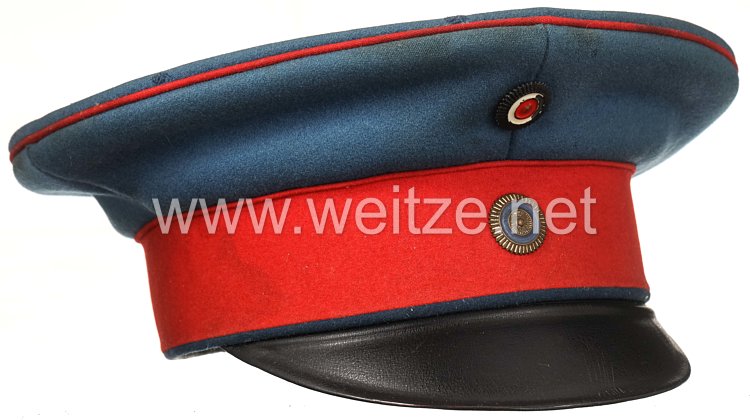
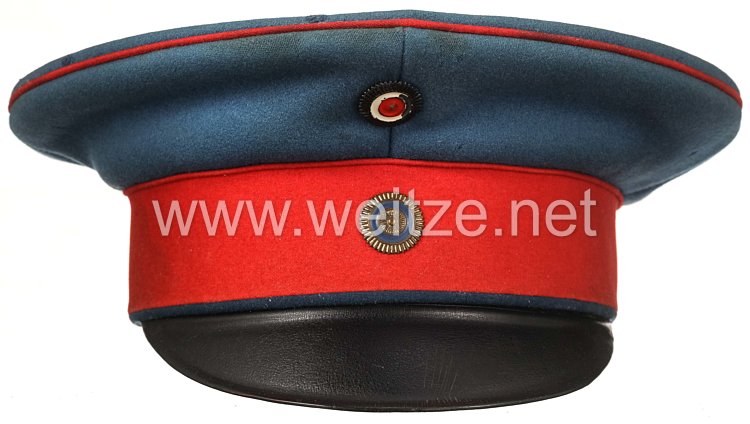
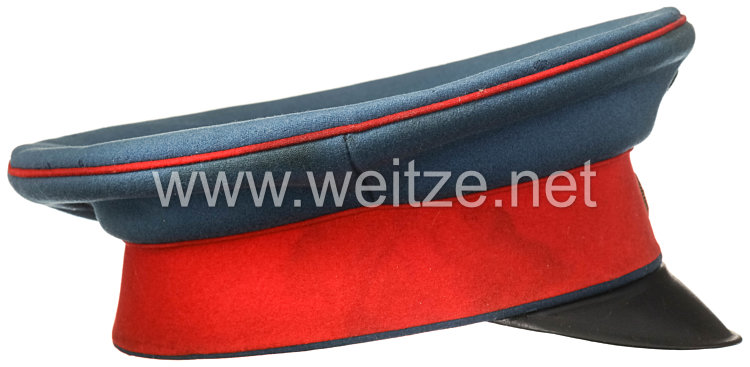
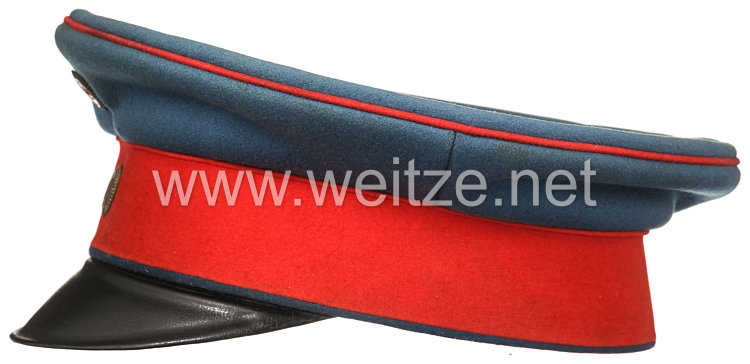
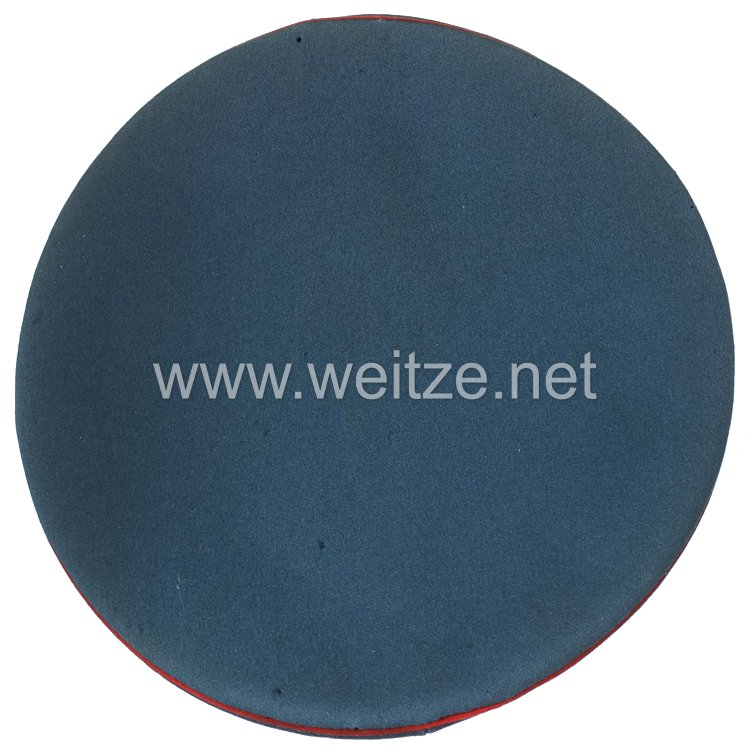
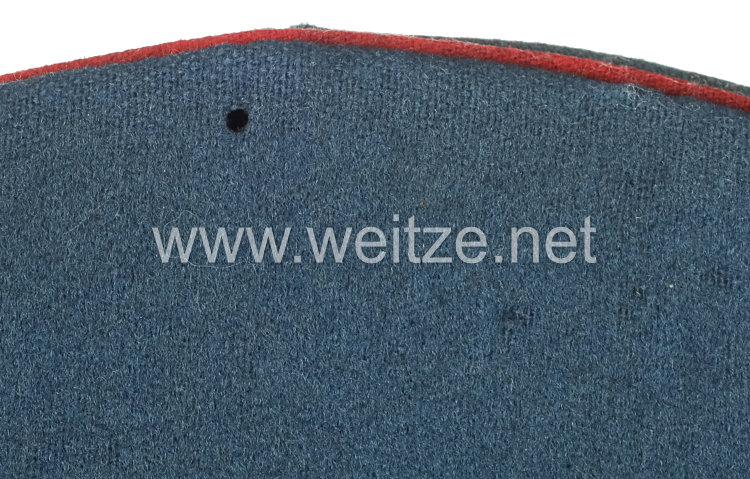
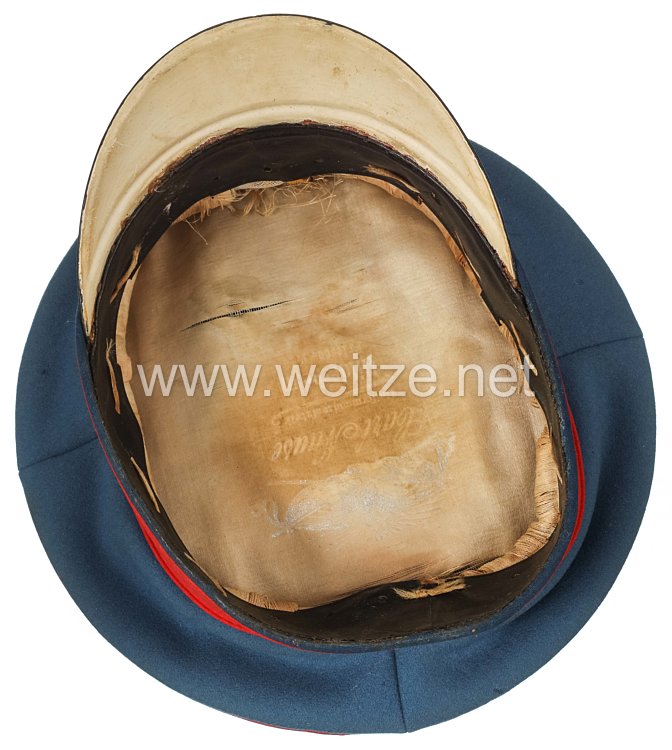
Bavarian Visor Cap for an Officer in the 1st or 2nd Heavy Cavalry Regiment
This Bavarian visor cap for an officer in the 1st or 2nd Heavy Cavalry Regiment represents a fascinating example of military headgear from the Kingdom of Bavaria during the late Imperial period around 1910. This cap embodies not only Bavaria's military tradition but also the complex uniform culture of the German Empire before World War I.
The Heavy Cavalry Regiments (Schwere Reiter-Regimenter) were among the most prestigious cavalry units in the Bavarian army. The 1st Heavy Cavalry Regiment “Prince Karl of Bavaria” and the 2nd Heavy Cavalry Regiment “Archduke Franz Ferdinand of Austria-Este” were cuirassier regiments that played a significant role in Bavarian military history. These units traced their traditions back to the 18th century and were considered elite formations of the Bavarian cavalry.
The characteristic light blue color of the cap was the traditional branch color (Waffenfarbe) of the Bavarian cavalry, while the red cap band represented the specific regimental color. This color combination allowed for immediate identification of the branch of service and regiment, an essential element of military uniform science of that era. The red piping additionally emphasized the wearer's officer rank.
The two cockades on the cap each had specific meanings. The Bavarian cockade in white and blue colors indicated membership in the Kingdom of Bavaria, while the black-white-red Reich cockade symbolized integration into the German Empire. This dual symbolism was characteristic of the federal structure of the Empire, in which individual states maintained their military autonomy.
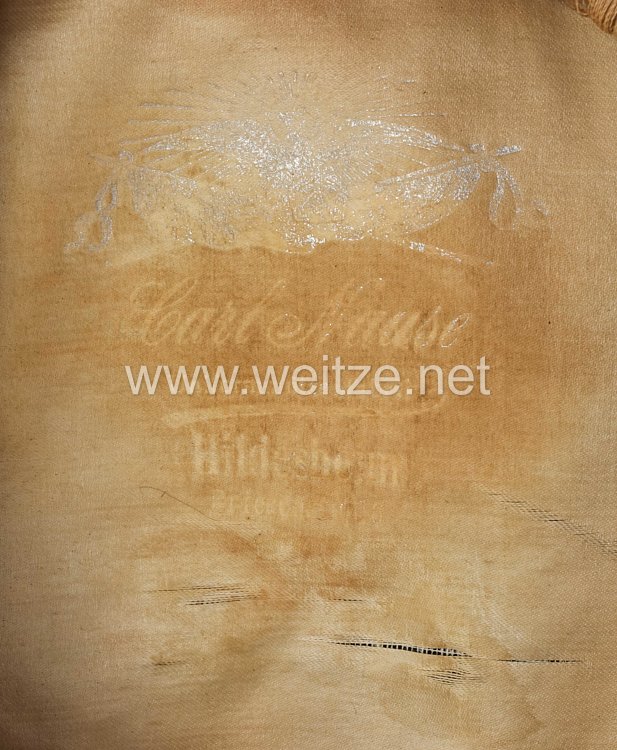
The manufacturer “Carl Nause ... Hildesheim” points to the specialized military equipment industry that had developed in Germany. Although Hildesheim was located in Prussia, North German manufacturers certainly supplied Bavarian military personnel, especially officers who had to procure their uniform items themselves. This was customary, as officers were required to acquire and maintain their equipment at their own expense.
The size 57 corresponds to a head circumference of approximately 57 centimeters, indicating an average male wearer. The bone-colored silk lining and black sweatband were standard features of high-quality officer headgear and testified to the quality and status of these uniform items.
The tall form of the visor cap corresponded to the uniform regulations for the Bavarian army of this period. Around 1910, the Bavarian military was in a phase of modernization while simultaneously maintaining traditional uniform elements. The visor cap was worn on various occasions, particularly during official duties, garrison routine, and certain social obligations.
The Heavy Cavalry were equipped with cuirasses (breastplates) and steel helmets for combat operations, but wore the visor cap for everyday duties. The tactical significance of heavy cavalry was already subject to military debate around 1910, as modern weapons technology questioned their traditional role. Nevertheless, these regiments retained their ceremonial and symbolic value.
The condition showing signs of wear, slightly worn silk lining, and small moth holes is typical for textiles over a century old and confirms that this cap was actually worn. This gives the object authentic historical character and distinguishes it from purely decorative or parade items.
The years before World War I marked both the zenith and the end of traditional European military uniforms. The colorful dress uniforms represented by this cap would soon give way to field-gray and khaki uniforms better suited to the realities of modern warfare. Thus, this visor cap symbolically represents an era that ended irrevocably in 1914, and whose military culture is now preserved only in museums and collections.
These heavy cavalry regiments participated in the last great cavalry actions of the Imperial German Army before mechanization fundamentally changed warfare. The cap represents not just a functional piece of military equipment, but a tangible connection to a vanished world of military tradition, honor codes, and a social order that would be swept away by the cataclysm of the Great War.