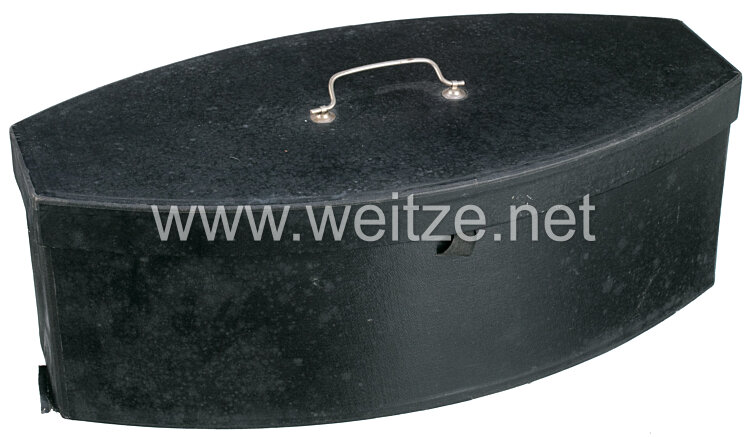
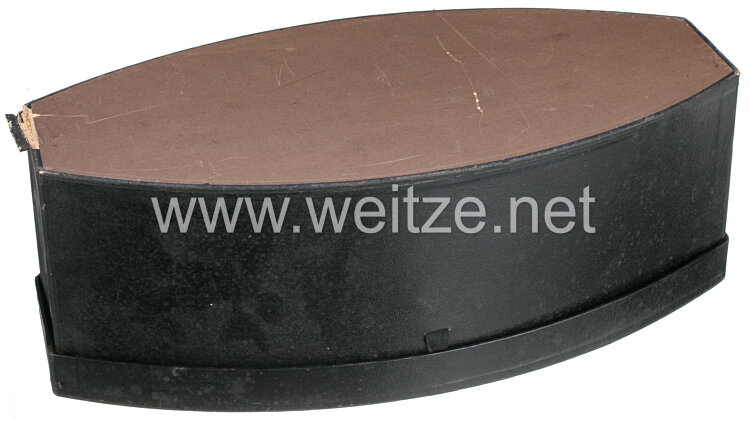
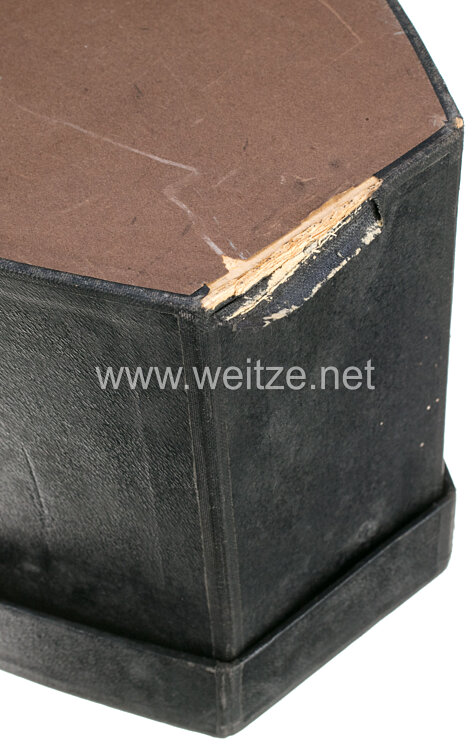
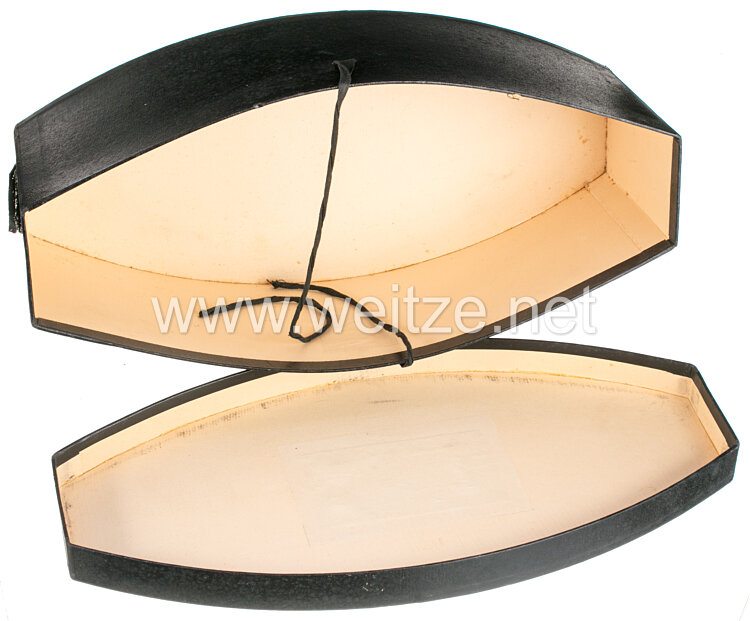
German Reich - Case for a Bicorne Hat for Officials or Navy
The bicorne (also known as bicornus or chapeau claque) represents one of the most distinctive headwear pieces in European military and civil service history. The case described here served for the safe storage and transport of such a bicorne, as worn by civil servants or naval officers in the German Empire.
The tradition of the bicorne dates back to the late 18th century, when this characteristic hat form evolved from the originally triangular tricorne. During the Napoleonic era, the bicorne achieved its iconic shape and spread throughout Europe as part of the dress uniform for senior officers and state officials. In the German Empire, this headpiece retained its significance as a symbol of rank and dignity until the end of World War I in 1918.
The Imperial German Navy, founded in 1871 and massively expanded under Emperor Wilhelm II, used the bicorne as part of the grand gala uniform for officers from the rank of lieutenant commander upwards. The Naval Uniform Regulations of 1895 and its later amendments precisely stipulated when and how this headpiece was to be worn - typically at court receptions, parades, and other ceremonial occasions.
Parallel to the Navy, senior civil servants, diplomats, and members of the Foreign Service also wore the bicorne as part of their official dress. The civil service uniform regulations of the various German federal states and the Reich prescribed different versions for various ranks and uses. The bicorne was always more than just a functional piece of headwear - it was a visible symbol of state authority and hierarchical order.
The storage case described here, with a diameter of approximately 43.5 cm and a height of 15.5 cm, corresponds to the typical dimensions of such specialized cases. These were usually manufactured from sturdy cardboard or pasteboard, often reinforced with leather or made entirely of leather. The cylindrical shape was perfectly suited for storing the flat-folded bicorne. High-quality examples were lined inside with velvet or silk to protect the hats, often decorated with gold or silver embroidery, from damage.
Such cases were indispensable companions for officers and civil servants who had to travel to official occasions. The stable construction protected the delicate headpiece during transport, whether by rail, ship, or carriage. Many of these cases featured carrying handles, clasps, and sometimes the owner's initials or coat of arms.
The significance of the bicorne and its storage diminished dramatically after the end of the Empire in 1918. The Weimar Republic introduced simpler uniform regulations, and many of the old monarchical traditions were abandoned. Nevertheless, some authorities and diplomatic services retained the bicorne for special occasions.
During the period of National Socialism (1933-1945), there was a revival of some traditional uniform elements, although the bicorne was largely replaced by modern headgear. The Kriegsmarine introduced new uniform regulations that, while oriented toward historical models, provided for the bicorne only very restrictedly.
Today, such historical storage cases are sought-after collector's items that represent important testimonies of German military and administrative history. They document not only the craftsmanship quality of their time of origin but also the importance attached to the proper storage and presentation of uniform parts. For historians and collectors, they offer valuable insights into the material culture of the Empire and the everyday practices of officers and senior civil servants.
The preservation of such objects is of cultural-historical value, as they provide, together with the associated uniform pieces, a complete picture of the military and administrative representational culture of their time.