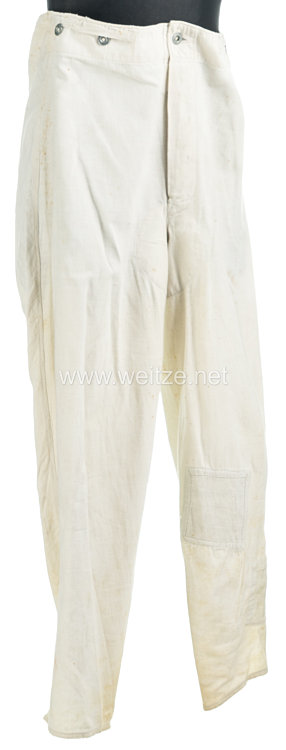
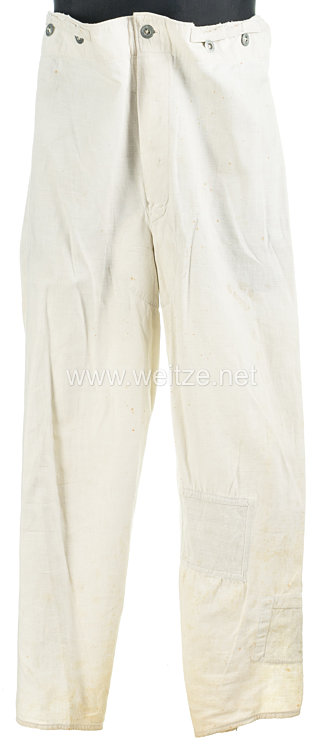
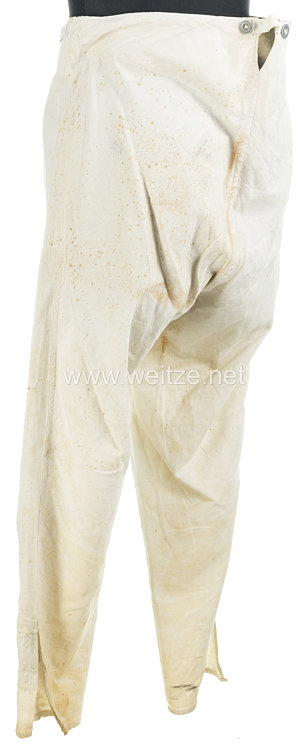
German Reich White Long Drill Trousers (Fatigue Trousers) for Enlisted Men

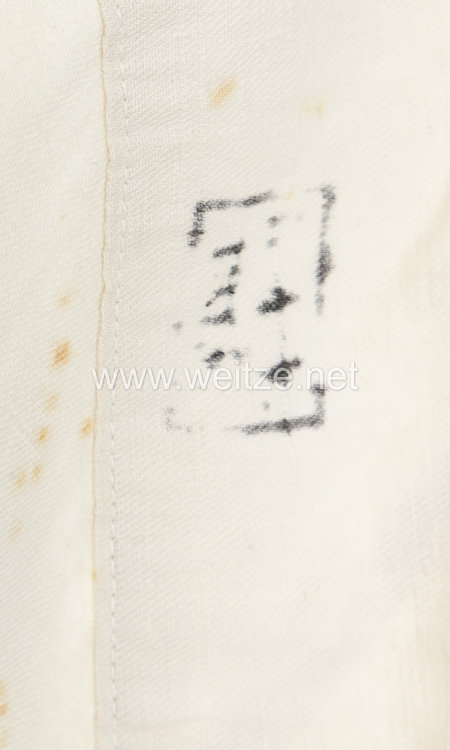
Unit-marked piece, circa 1913. Long white trousers with zinc buttons. Interior with illegible unit stamp. Foxing present. Condition 2-.


399434
350,00

German Reich White Long Drill Trousers (Fatigue Trousers) for Enlisted Men

This white drill work trousers represents an authentic example of German soldiers' work uniform during the German Empire, dated circa 1913, shortly before the outbreak of World War I. Such garments were an integral part of military equipment and served specific practical purposes in daily garrison life.

Historical Context and Purpose

The German military system of the Wilhelmine era strictly distinguished between different uniform categories. Besides the parade uniform, walking-out uniform, and field uniform, there existed the work uniform (Arbeitsdrillich), designated for physically demanding tasks, cleaning duties, and manual work in the barracks. The white color was by no means chosen randomly: it symbolized cleanliness and enabled easy inspection of the garment's hygiene status, corresponding to Prussian standards of orderliness.

Material and Construction

The term Drillich (drill) refers to a robust fabric made of cotton or linen in twill weave, characterized by particular durability. This choice of material was essential for work clothing, as soldiers subjected their uniforms to heavy wear during stable duties, potato peeling, latrine cleaning, and other garrison tasks. The use of zinc buttons instead of the brass buttons of parade uniforms underscores the practical character of this garment. Zinc buttons were more cost-effective and less susceptible to corrosion during frequent washing.

The Chamber Stamp as Identification Mark

The chamber stamp (Kammerstempel) located inside the trousers, although illegible, represents an important historical detail. These stamps served to mark property of the army administration and enabled assignment to specific garrisons, regiments, or clothing chambers. The designation “Kammerstück” (chamber piece) indicates that these trousers came from the inventory of a military clothing depot. Such stamps typically contained information about the unit, year of issue, and sometimes size specifications. The stamp system was part of the Prussian administrative tradition and served inventory control as well as theft prevention.

Uniform Regulations in the Empire

The equipment of enlisted men was regulated in detail in the army's clothing regulations. These regulations, which were regularly updated, specified which garments should be issued in what quantity and quality. For ordinary soldiers (Mannschaften), the equipment was standardized and differed significantly from that of non-commissioned officers and officers, who often had their own uniforms custom-made. The white work trousers belonged to the basic equipment and were issued upon enlistment or at the beginning of service.

Condition and Preservation

The mentioned foxing stains are not unusual for textiles of this age and result from moisture and fungal growth during storage over decades. They bear witness to the object's more than century-long history. The stated condition grade of 2- according to the standard evaluation system for military antiques indicates a well-preserved state with minor signs of use.

Social-Historical Significance

Such everyday items as work trousers offer valuable insights into the lives of common soldiers, which were often characterized by hard physical labor. While parade uniforms and field equipment are frequently represented in museums, authentic work uniforms have survived more rarely, as they were heavily used and often worn until unusable. The year 1913 also marks the last peacetime phase before the catastrophe of World War I, when the German army had its peacetime strength of approximately 800,000 men and barracks service still followed routine procedures.

Collector and Museum Value

For military-historical collections and museums, such an authentic chamber piece represents important evidence of the material culture of the Imperial German Army. It complements the picture of military life beyond battles and parades and documents the everyday reality of garrison duty in the Wilhelmine era. The preservation of such utilitarian items provides researchers and historians with tangible connections to the lived experience of ordinary soldiers who formed the backbone of the Imperial German military system.

r