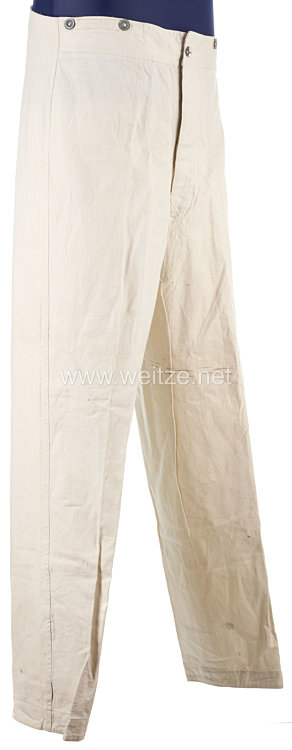
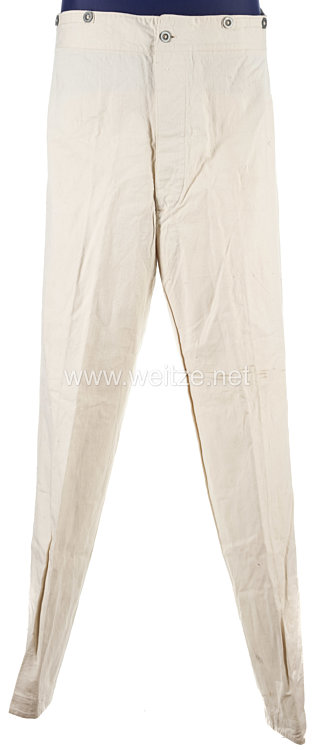
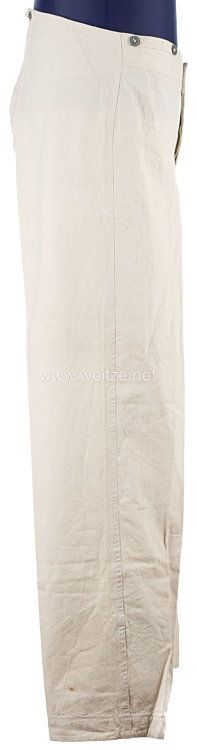
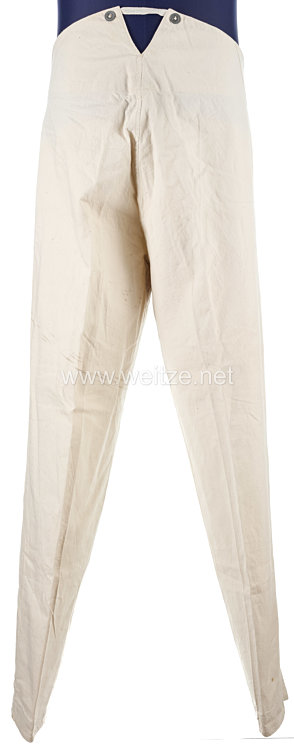
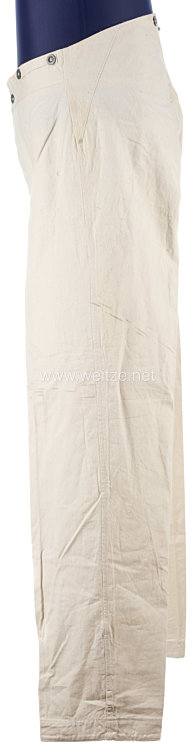
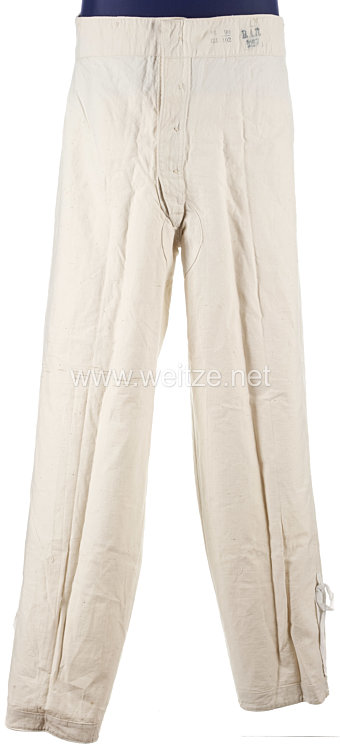
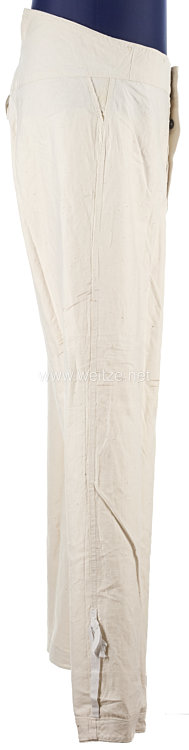
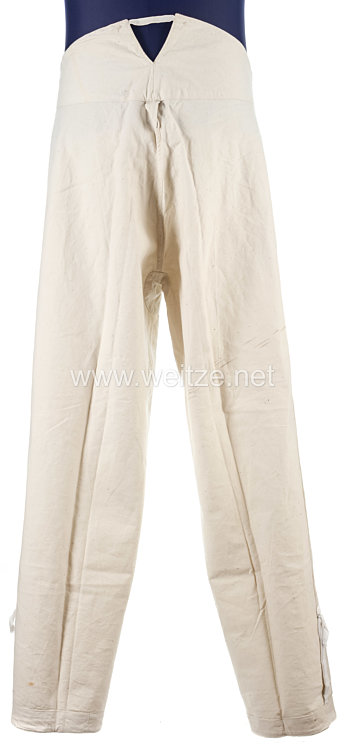
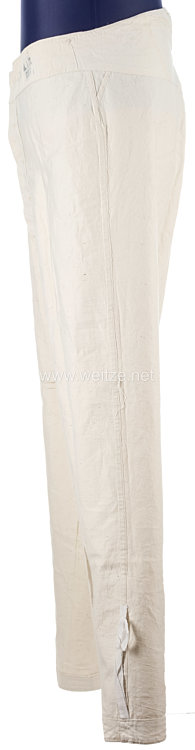
World War I White Long Drillich Trousers (Fatigue Trousers) for Enlisted Men
This white drill uniform trouser from 1907 represents an important aspect of military equipment in the German Empire during the pre-war period and World War I era. As work trousers for enlisted men, it embodies the practical aspects of soldier life beyond combat operations.
Drill Fabric and its Military Use
Drill, or “Drillich” in German, refers to a robust, dense cotton fabric in twill weave, characterized by its durability and longevity. The name derives from the Latin “trilix” (three-threaded). In the military context of the German Empire, drill was primarily used for work and training clothing, as the material was washable, robust, and cost-effective.
The white color of the trousers was characteristic of barracks clothing and served various purposes: it enabled easy cleanliness inspection, could be easily cleaned through bleaching, and symbolized military order even in internal service. White drill uniforms were used for various activities, including guard duty in the barracks, kitchen duties, stable work, and general work assignments.
The Acceptance Stamp and Origin
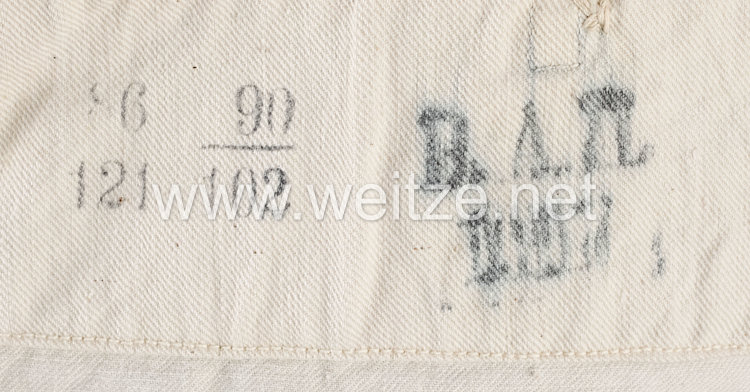
The stamp “BAII 1907” inside the trousers provides important information about its manufacture and procurement. The designation refers to Bekleidungsamt II in Stettin (Clothing Office II in Stettin), one of the central military supply facilities of the Prussian Army. Stettin, today Szczecin in Poland, was an important garrison location and administrative center in the German Empire.
The Prussian Army maintained several clothing offices responsible for procurement, quality control, and distribution of uniforms and equipment items. These offices operated according to strict regulations and specifications set out in the corresponding clothing regulations. Each garment had to pass an acceptance inspection before reaching the troops. The stamp documents this successful acceptance and enables precise dating and attribution today.
Military Clothing Regulations before World War I
The uniforming and equipment of German armed forces was strictly regulated around 1907. The adjustment regulations precisely specified which garments enlisted men were entitled to and under what circumstances they could be worn. Work clothing like these drill trousers belonged to the Kammergut (chamber property), meaning equipment stored in the barracks that did not belong to the soldier's personal property.
The standardization of sizes and cuts was already well advanced at this time, although not yet as perfected as in later decades. The measurements of these trousers (waist circumference 56 cm, length 115 cm) correspond to a smaller to medium size and illustrate that younger or smaller recruits also had to be accommodated.
The Year 1907 in Historical Context
The manufacturing year of 1907 falls within a phase of comprehensive army reforms under Kaiser Wilhelm II. The German Army was continuously modernized and expanded, which also placed increased demands on the supply organization. The clothing offices had to procure and manage growing quantities of uniforms and equipment.
During this period, Europe already experienced a tense political climate, characterized by an arms race and competing alliance systems. Seven years later, World War I would break out, mobilizing millions of soldiers. Garments like these drill trousers gained additional significance during the war when supply systems came under enormous strain.
Life in the Barracks
The existence of such work clothing illustrates an often-overlooked aspect of soldier life: the barracks routine. Soldiers spent much of their service time not in combat or on the drill ground, but with routine tasks: cleaning work, maintenance, kitchen duty, and other necessary jobs. For these activities, the expensive and difficult-to-clean parade uniform was unsuitable – this is where practical drill clothing came into use.
The daily routine in Imperial German barracks was highly regimented. After morning roll call and inspections in full uniform, soldiers would often change into work clothing for the day's assigned tasks. This protected their more valuable uniform pieces and allowed for more practical work. The white color, while impractical from a modern perspective due to its tendency to show dirt, actually served a disciplinary function: it made any uncleanliness immediately visible and thus encouraged constant maintenance of personal hygiene and orderliness.
Textile Production and Military Contracts
The production of military clothing in the German Empire was a significant industrial undertaking. Contracts were awarded to numerous textile manufacturers, particularly in regions with established textile industries. The strict specifications regarding fabric quality, construction, and sizing had to be meticulously followed. The acceptance stamp indicates that this particular item successfully passed all quality inspections.
World War I and After
When World War I began in 1914, items like this trouser, already seven years old, would have continued in service. The massive mobilization created unprecedented demands on military supply systems. Work clothing remained essential throughout the war, as garrison duties, supply operations, and rear-area activities continued regardless of front-line operations.
Preservation and Collector Value
As a chamber piece, these trousers are an authentic testimony to military everyday culture. While parade uniforms and decorations were more frequently preserved, simple work clothing items are rarer today. They were intensively used, often disposed of, or repurposed for civilian use. The good condition (grade 2-) makes this specimen a valuable study object for researching the military everyday history of the German Empire and provides tangible connection to the lives of ordinary soldiers over a century ago.