Hessen-Darmstadt Pickelhaube Model 1849 for Infantry Officers

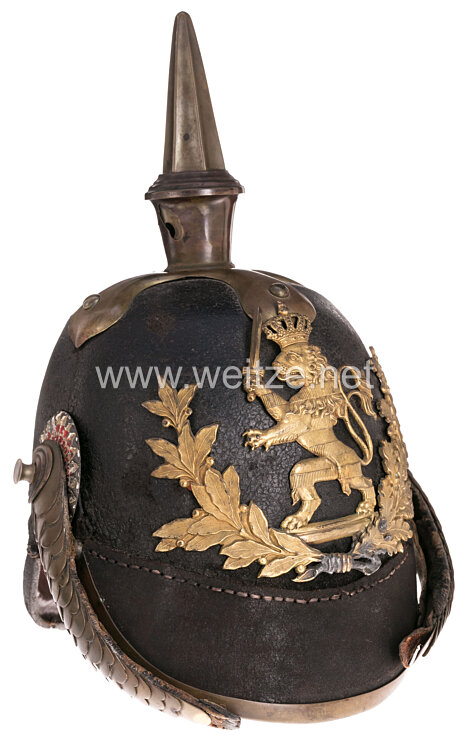
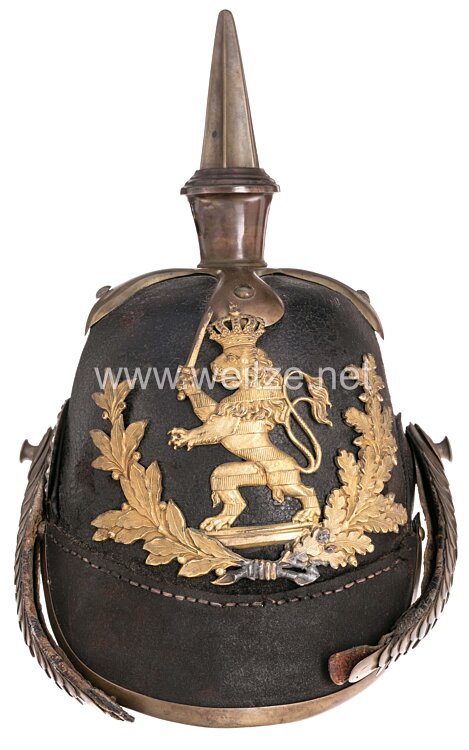
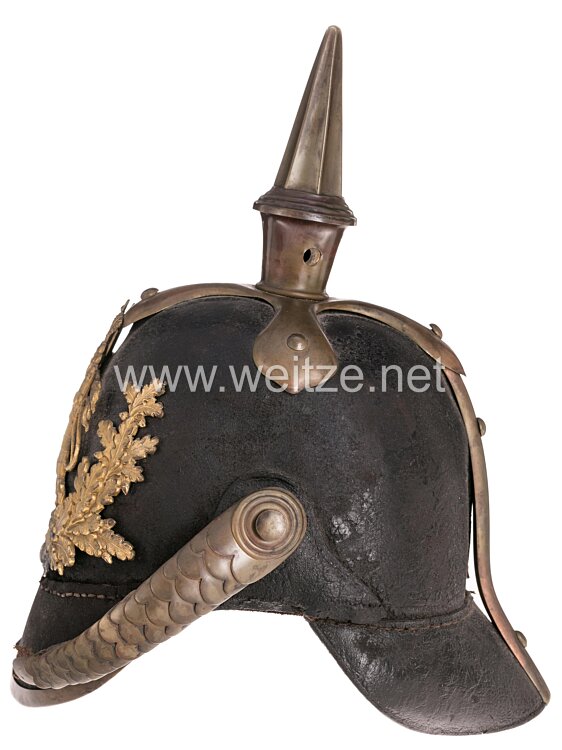
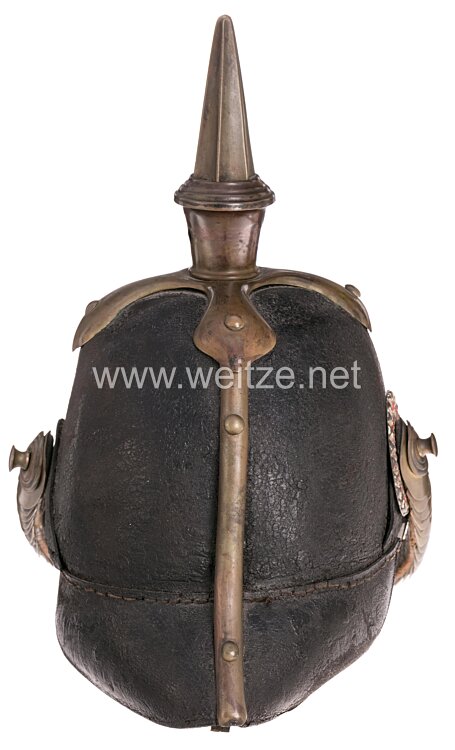
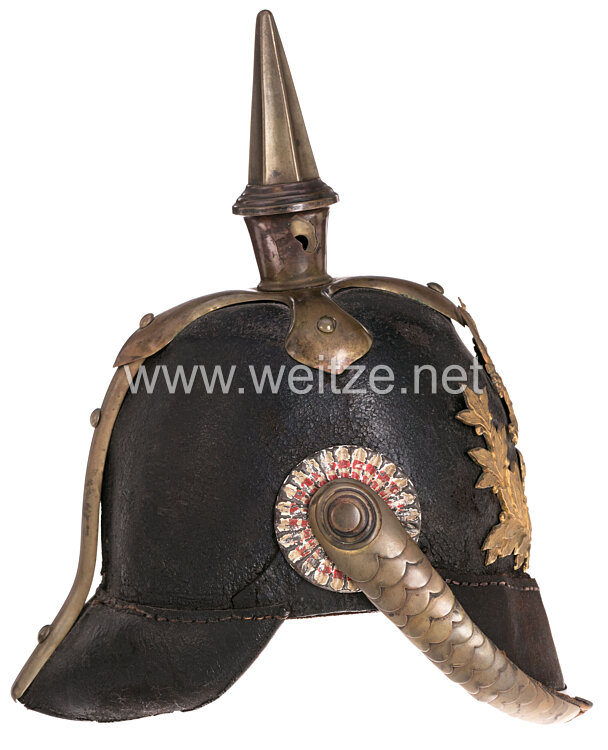
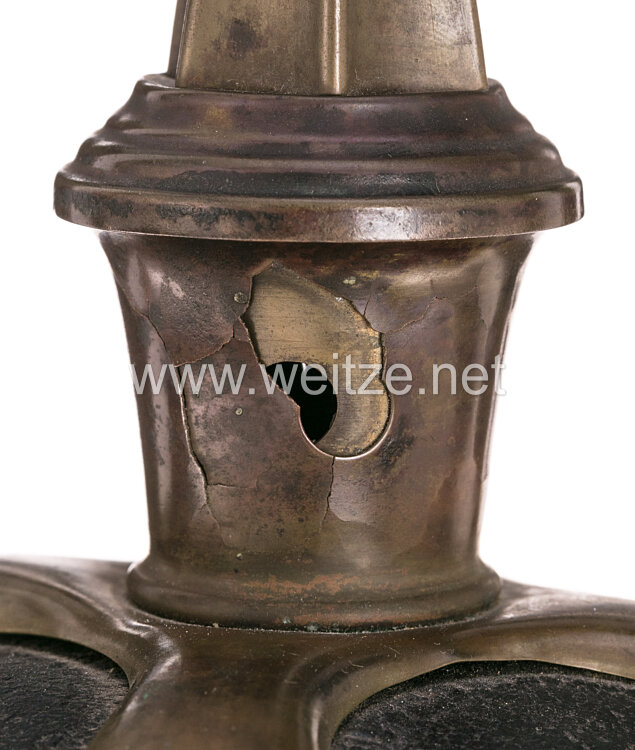
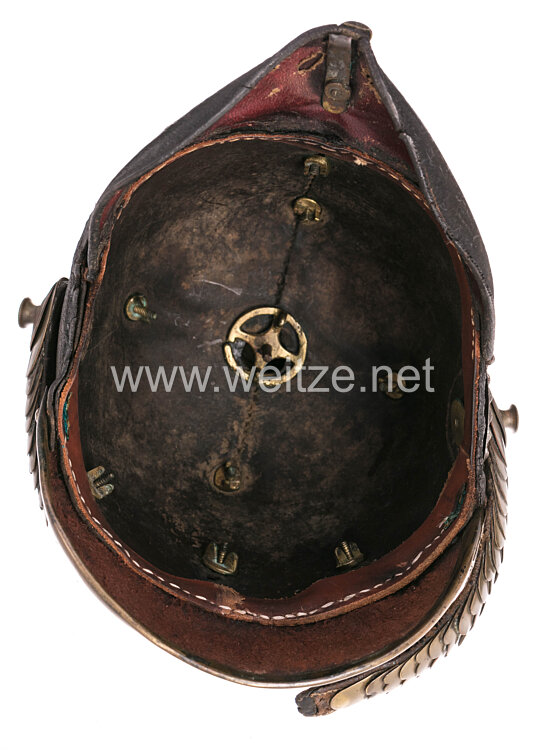
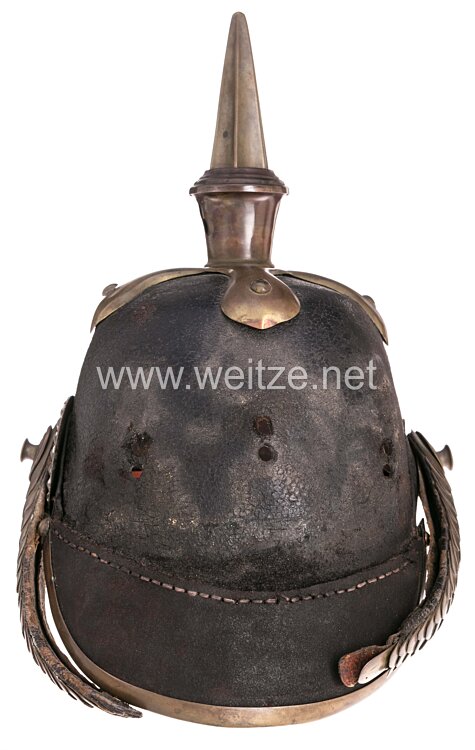
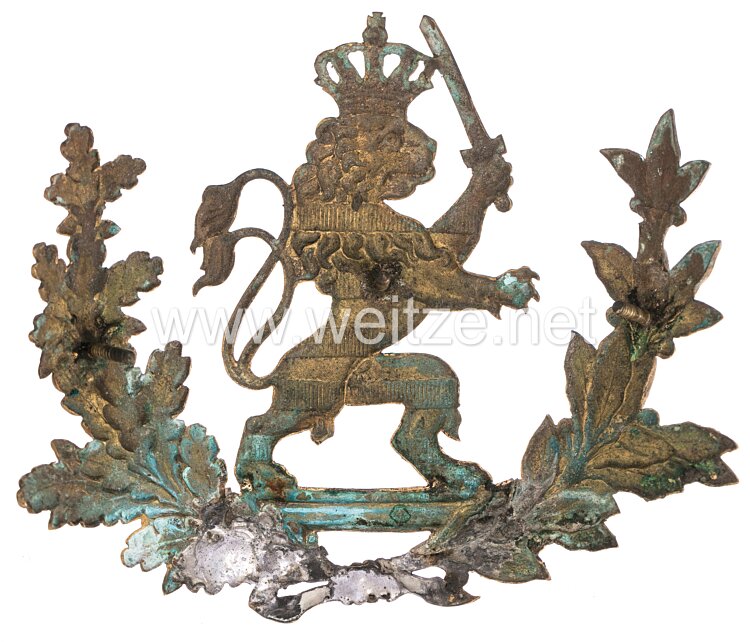
Tall heavy leather helmet, old Model 1849 adapted and shortened to Model 1860. Complete with all fittings. The gilt helmet plate with standing Hessian lion in open laurel and oak leaf wreath, cross finial with fluted spike, removable. Wide domed chin scales on knurled screws, front fastener missing on both sides, right side with Hessian cockade. The neck guard with 2 ball rivets. Interior without liner, the red-lined neck visor slightly out of shape. Size 54. Distinct signs of wear and age, condition 2-3.
291642
2.400,00

Hessen-Darmstadt Pickelhaube Model 1849 for Infantry Officers

The Pickelhaube Model 1849 for officers of the infantry of the Grand Duchy of Hesse-Darmstadt represents a significant chapter in the history of German military uniforms in the 19th century. When the Grand Duchy of Hesse-Darmstadt introduced the Pickelhaube in 1849, it followed a trend that originated in Prussia and rapidly spread throughout the German states.

The Model 1849 was originally constructed significantly taller than later variants. These tall leather helmets were intended to make soldiers appear more imposing and to project military authority. The construction consisted of heavy, pressed leather that was hardened over a mold. The characteristic spike – the namesake “Pickel” – was initially conceived as a practical element to deflect saber strikes, but quickly evolved into a primarily decorative feature.

Around 1860, an important reform of Hessian military uniforms took place. The new Model 1860 was characterized by a reduced height, making the helmet more practical and less conspicuous. Many existing Model 1849 helmets were adapted and shortened during this period rather than being completely replaced – an economical decision that was particularly common with the more expensive officers' helmets.

The helmet plate featuring the standing Hessian lion is the central heraldic element of this helmet. The lion, traditional heraldic animal of the Hessian landgraves and grand dukes, is in this case surrounded by an open laurel and oak leaf wreath. The laurel wreath had symbolized military glory and victory since ancient times, while the oak leaves stood for German strength and steadfastness. The gilding of the plate was reserved for officers and emphasized their higher rank compared to enlisted men, whose helmets bore nickel-plated or brass fittings.

The cross-shaped base with grooved spike was detachable, which facilitated cleaning and maintenance. This practical construction also made it possible to replace damaged spikes without having to replace the entire helmet.

The chin scales served as a chin strap and were traditionally wider and more elaborately crafted on officers' helmets than on enlisted men's helmets. The curved form and attachment with knurled screws were typical of the higher quality of officers' equipment. The Hessian cockade on the right side displayed the colors of the Grand Duchy – red and white – and served as a clear identifying mark of affiliation with the Hessian contingent.

The neck guard with its characteristic ball rivets provided protection for the neck while also serving as a decorative element. The red-lined neck visor was typical for the infantry and distinguished it from other branches of service.

The Grand Duchy of Hesse-Darmstadt was a significant German middle state that played an important role in German politics during the 19th century. Following the revolutionary events of 1848/49, Grand Duke Ludwig III modernized the Hessian army and introduced new uniform regulations. The introduction of the Pickelhaube was part of these modernization efforts.

The Hessian infantry was organized into several regiments, each maintaining their own traditions. Officers had to procure their uniforms and equipment themselves, which explains the higher quality and more expensive execution of their helmets. Size 54 corresponds to a head circumference of approximately 54 centimeters and was a common size.

The Pickelhaube remained a characteristic element of German military uniforms until the end of World War I, although it became increasingly impractical on the modern battlefield. The Model 1849/60 from Hesse-Darmstadt documents an important transitional phase in the development of this iconic headgear and is today a prized collector's item that represents the military history of the German smaller states before the founding of the Reich in 1871.