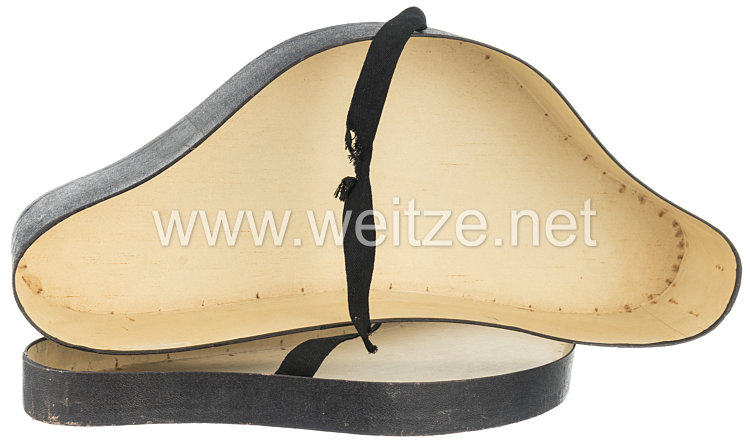
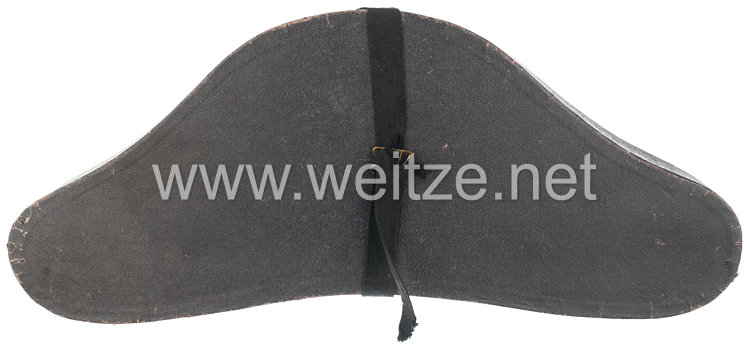
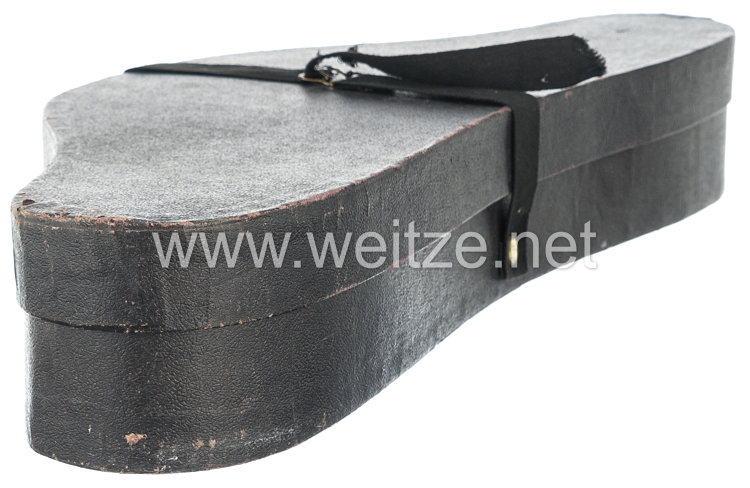
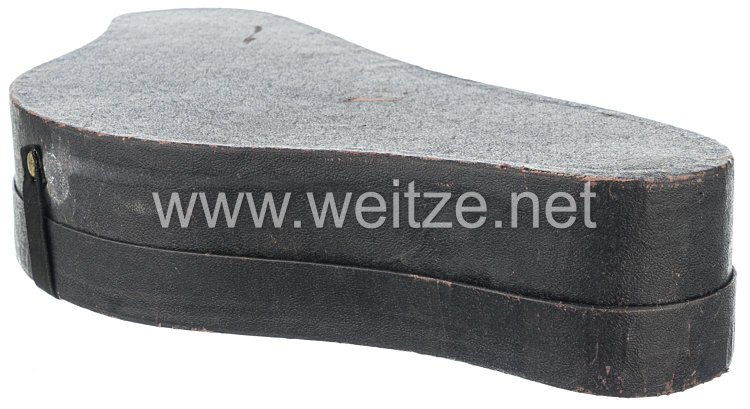
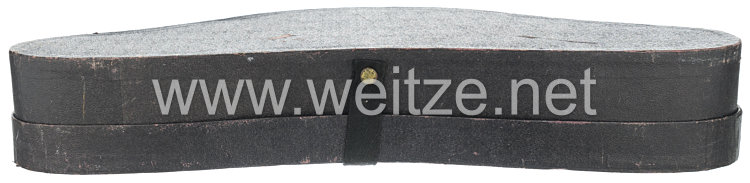
German Empire Storage Box for a Bicorne Hat for Civil Officials

Circa 1910. Rigid cardboard with black paper covering. Dimensions approximately 52 x 22 x 8 cm. Condition 2.
437233
150,00

German Empire Storage Box for a Bicorne Hat for Civil Officials

This storage box made of rigid cardboard with black paper covering dates from around 1910 and served for the safe keeping of a bicorne hat (Zweispitz in German) worn by officials of the German Reich. With dimensions of approximately 52 x 22 x 8 cm, it corresponds exactly to the measurements necessary for housing this characteristic headgear.

The bicorne had a long tradition in the German Empire and was an essential element of the gala uniform worn by higher-ranking officials in various administrative branches. This hat form evolved from the tricorne of the 18th century, which during the Napoleonic era was transformed into the characteristic two-pointed shape. In the 19th and early 20th centuries, the bicorne was an unmistakable sign of state authority and elevated position.

In the German Reich, various categories of officials wore the bicorne as part of their service uniform: ministerial officials, higher judicial officials, diplomatic representatives, and officials of the internal administration during festive and ceremonial occasions. The precise regulations regarding equipment and manner of wearing were laid down in the respective uniform regulations of individual federal states as well as in Reich-wide provisions.

The Imperial Ordinance on Civil Uniforms regulated in detail which categories of officials were entitled to wear the bicorne. The hat was typically made of black felt, trimmed with silk ribbon, and frequently decorated with a black-white-red cockade, the Reich colors, as well as possibly with gold or silver braiding, depending on the rank and affiliation of the wearer.

The storage of such valuable uniform pieces in special boxes was of great importance. The bicorne was not only an expensive item of clothing but also sensitive to moisture, dust, and mechanical damage. The characteristic flat, elongated shape of the box was specifically tailored to the geometry of the bicorne, which was worn crosswise with its two points facing left and right.

The black paper covering of the box was typical for the period from 1900 to 1920. This design corresponded to the general aesthetic sensibility of the Wilhelmine era, which valued solidity and discreet elegance. Such storage boxes were both supplied by hatmakers and offered separately in retail trade.

The period around 1910, when this box is dated, was the heyday of German officialdom. The Reich possessed a highly developed, hierarchically structured administration that served as a model for many other states. The Prussian bureaucratic tradition, with its emphasis on duty fulfillment, loyalty, and correct conduct of office, shaped the entire Reich. The external signs of this order, which included uniforming, were carefully maintained.

The bicorne was generally worn only on special occasions: at court receptions, state celebrations, the Kaiser's birthday, official processions, and similar ceremonial events. For everyday service use, officials wore other, more practical headgear. Precisely because of this limited use, proper storage between deployments was particularly important.

With the end of World War I and the collapse of the monarchy in 1918, the bicorne lost its official significance. The Weimar Republic largely abolished the old court uniforms and introduced simpler, more democratic forms of official dress. Nevertheless, such boxes often remained in family possession, as mementos of a bygone era or because they housed other objects.

Today, such storage boxes are interesting testimonies to the everyday culture of the Imperial era. They document not only the existence of the uniform pieces themselves but also the care and respect with which these symbols of state authority were treated. For collectors of military and civil uniforms of the Imperial period, originally preserved boxes are sought-after additions, as they underscore the authenticity and state of preservation of the main objects.

The solid construction from rigid cardboard and the relatively good preservation of many of these boxes over more than a century attest to the quality of contemporary craftsmanship. They are silent witnesses to an epoch in which form, order, and hierarchy were still self-evident foundations of state and social life.

r