Prussia

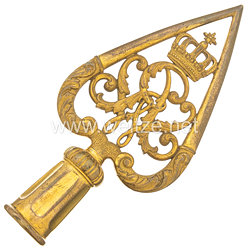
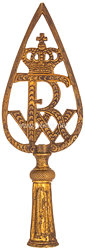
Prussia Finial for Battalion Colors of Infantry and Artillery

Circa 1870. The finial made of brass bronze, fire-gilded, in the center the crowned cipher “WR”. Complete with socket for the flagstaff. Overall height approx. 21.5 cm. The bridge professionally repaired in period. Condition 2.

Used piece with typical signs of age, slightly bent (backward), in beautiful untouched original condition.
486720
1.950,00

Prussian Large Schellenbaum Eagle with the Schellenbaum Banner of the 3rd Magdeburg Infantry Regiment No. 66

Garrison Magdeburg, circa 1900. The schellenbaum cloth made of red silk rep with gilded fringe trim and rich gold embroidery, edged at the top with red leather. On the obverse, the crowned soaring Prussian eagle above the silver bandeau with regimental designation “3. Magdeb. Infanterie-Regiment No. 66.”, on the reverse the crowned royal cipher “WR” within an oak leaf wreath. The schellenbaum cloth is complete with the sewn-in crossbar with gilded terminal finials, the original gilded suspension cord, with 4 gilded tassels with red filling on the sides. Dimensions of the banner cloth 30 x 32 cm. Light signs of age and use, the banner cloth on the reverse with some minor light tears in the red silk, in very fine overall condition.

3rd Magdeburg Infantry Regiment No. 66.
The regiment was established on May 5, 1860 (foundation day). Together with the 1st Magdeburg Infantry Regiment No. 26, it formed the 13th Infantry Brigade.

Initially, the staff and I. Battalion were stationed in Stendal, the II. Battalion in Burg, and the Fusilier Battalion in Neuhaldensleben. In early June 1860, the staff, I. and Fusilier Battalion moved to Magdeburg. The II. Battalion was located in Halle (Saale) from 1864, before the regiment took up garrison entirely in Magdeburg in 1865.
In the German War of 1864, it participated with the I. Army in the battles at Münchengrätz and Königgrätz as well as the engagement at Pressburg.
In the Franco-Prussian War, it fought as part of the IV. Army at Beaumont and Sedan. From September 19, 1870 to January 28, 1871, it was involved in the encirclement and siege of Paris.

World War I
After mobilization, the regiment was deployed as part of the 13th Infantry Brigade on the Western Front in the conquest of Liège, a few days later in the Battle of Mons. Subsequently, it was engaged in fighting on the Somme and on the Aisne. After that, it was involved in some positional warfare in Flanders. In 1916, it fought again on the Somme but remained engaged in positional warfare in Flanders. The following year, it participated in the Battle of Arras and spent the rest of the year again in Flanders. In 1918, it fought in the defensive battle between Oise and Aisne and was involved in positional warfare in the Champagne region before withdrawing under pressure from the Allied Meuse-Argonne Offensive. On November 12, 1918, the day after the ratification of the Armistice of Compiègne, it evacuated all occupied territories and headed toward home.

During the war, the regiment suffered casualties of 104 officers as well as 2,592 non-commissioned officers and enlisted men.
The regiment was demobilized from December 24, 1918 in the Magdeburg garrison until the end of February 1919 and finally dissolved. 

472959
17.500,00

Kingdom of Prussia World War I 3 Plates from the Field Artillery School Service 1916

Large dinner plate, soup plate and breakfast plate, all bearing the emblem of the Field Artillery School within a laurel wreath with Iron Cross 1914 and the year “1916”, Manufacturer: “Hutschenreuther Selb Bavaria Fa. Schumann Berlin W. Leipzigerstr. 107”. Condition 2.
508687
180,00

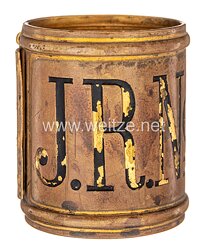
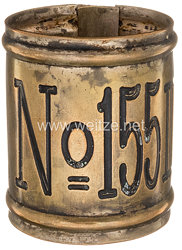
Prussian Flag Ring of the Standard of the 4th Silesian Infantry Regiment No. 157

Stationed at Brieg, circa 1900. Typical signs of use, condition 2.
464801
500,00
250,00

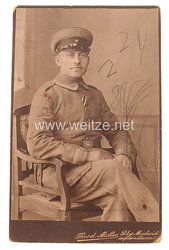
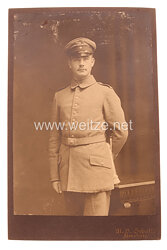
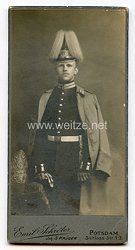
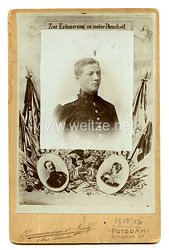
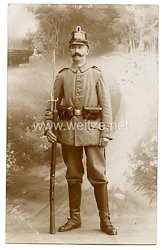
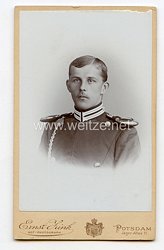
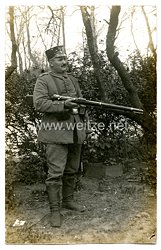
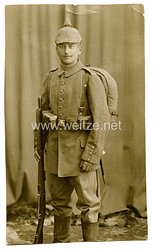
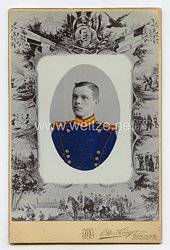
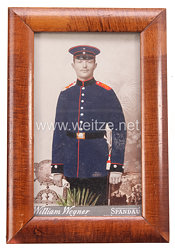
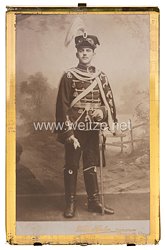
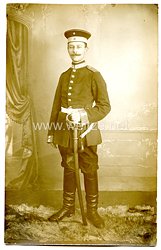
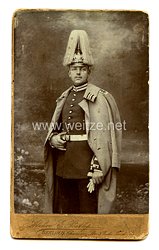
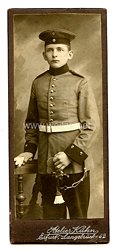
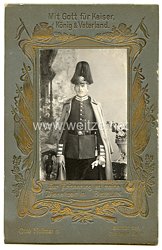
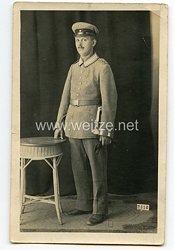
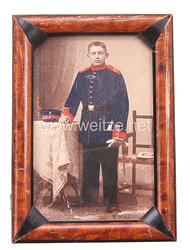
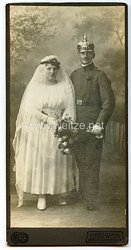
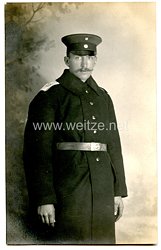
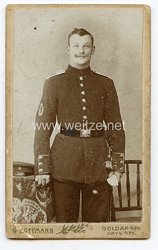
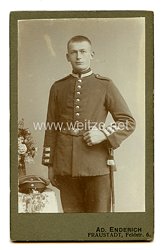
Prussia World War I Cabinet Photo of a Soldier

Circa 1916. 13.6 x 21.4 cm. Condition 2.

Most likely 4th Hanoverian Infantry Regiment No. 164; Hameln.
427583
25,00

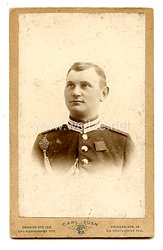
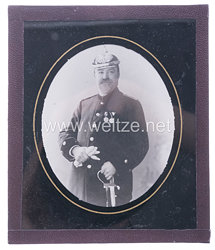
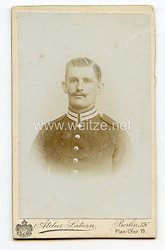
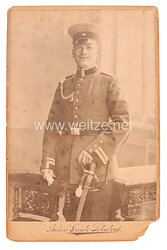
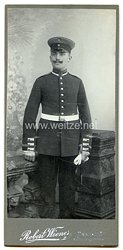
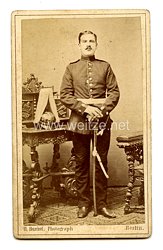
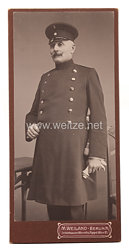
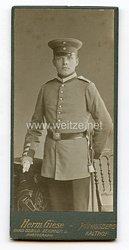
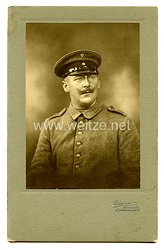
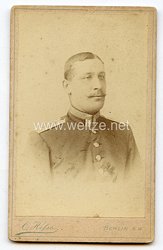
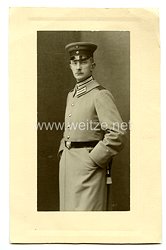
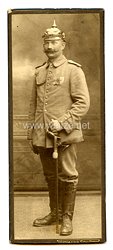
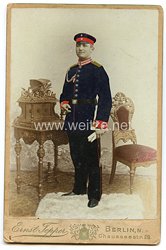
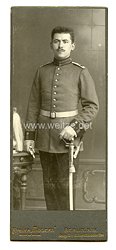
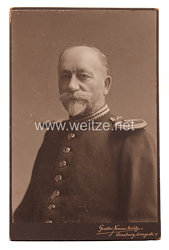
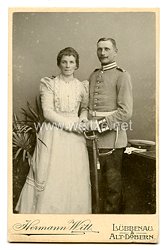
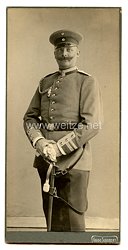
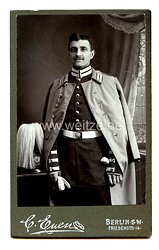
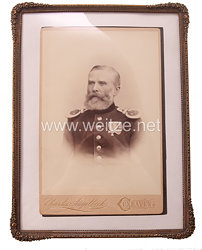
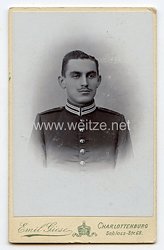
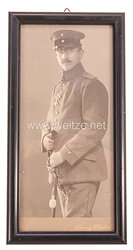
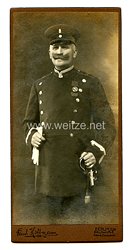
German Empire 1871-1918 Photograph of an Official

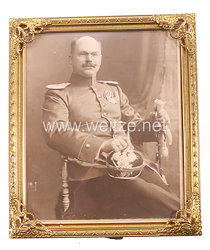
Circa 1900. Dimensions 10.5 x 16.2 cm. Condition 2.
421549
20,00

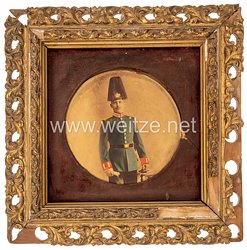
Prussia Large Portrait Painting of Konrad von der Schulenburg as Colonel and Commander of the 2nd Life Hussar Regiment Queen Victoria of Prussia No. 2

Location Danzig. After 1904. Oil on canvas in gold-painted wooden frame with stucco decoration, outer frame dimensions approx. 114 x 153 cm, dimensions of (visible) canvas 85.5 x 125 cm. The painting depicts Colonel “von der Schulenburg” in the regiment's parade uniform. His decorations are depicted in great detail: the Order of Saint John, Cross of Knights of Honor; on the ribbon: the Iron Cross 1870 with the jubilee clasp “25” (1895); the Order of the Crown; the Order of the Red Eagle; the Cross for Distinguished Service for XXV Years; the War Commemorative Medal 1870/71 with campaign clasps: Weissenburg, Worth, Sedan, Loigny-Pourry, Orleans, Beaugency-Cravant, Le Mans; the Centenary Medal (1897); furthermore the Griffin Order (Mecklenburg-Schwerin; awarded from 1904) and the breast cross of the Order of Saint John. The frame and canvas with minor defects, the canvas with four professionally restored areas of loss, the frame on the reverse with two modern steel brackets for hanging the painting. Without artist's signature. Condition 2.

The size and perspective suggest that the painting hung in a prominent, public location, e.g., in the officers' mess or the entrance hall of a barracks.

Konrad von der Schulenburg was a Prussian Major General from the traditional noble family von der Schulenburg of the March of Brandenburg. From October 18, 1897 to September 11, 1902, he commanded as Major, Lieutenant Colonel, and Colonel the 2nd Life Hussar Regiment “Queen Victoria of Prussia” No. 2 in Danzig-Langfuhr. Subsequently, on September 12, 1902, he assumed command of the 6th Cavalry Brigade in Parchim, where he was promoted to Major General and remained in service until March 20, 1908. The painting of him was probably created after 1904, likely for the officers' mess of the Danzig Hussars.

Due to the size and weight as well as the fragility of the object, pickup or delivery at a trade show is requested.
521896
3.500,00

Prussia Flag Finial for a Veterans Association Flag

Circa 1925. Cast brass, Iron Cross 1914 in center. Without socket for flagpole. Height approx. 18.5 cm. Condition 2.
515169
200,00

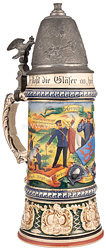
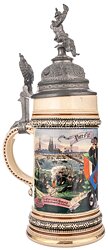
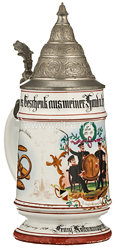
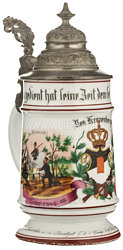
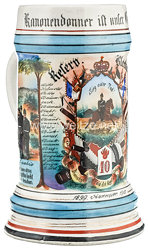
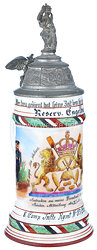
Prussian Reservist Stein for “Kannonier Strucks” of the Feldartillerie-Regiment General-Feldmarschall Graf Waldersee (Schleswigsches) Nr. 9

Garrison Itzehoe 1908. 0.5-liter porcelain stein with polychrome decorations, base image and pewter lid. Lettering partially slightly faded. Condition 2.
512996
280,00

Prussia Royal Railway Seal/Stamp “Kon. Eisenb. Haupt-Casse. Hannover”

Circa 1900. Iron. Diameter of stamp approximately 3.05 cm, height approximately 12.5 cm. Condition 2.
510213
250,00

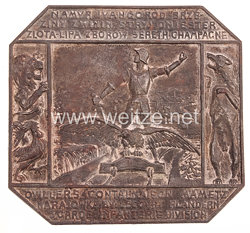
Commemorative Plaque of the 3rd Guards Infantry Division

Cast iron plaque, toned, approx. 14.5 x 13.5 cm, listing battles on the Eastern and Western Fronts.
434864
380,00

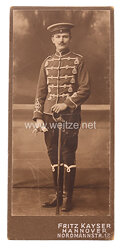
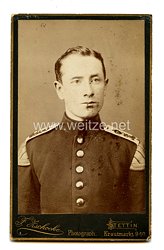
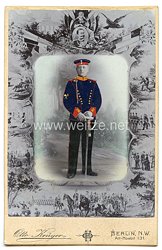
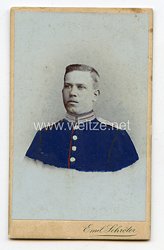
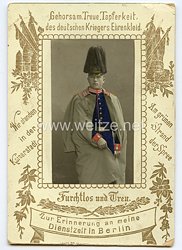
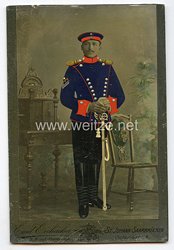
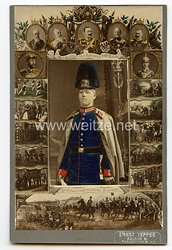
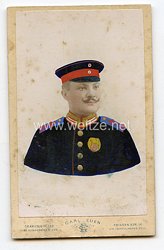
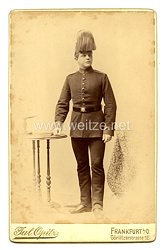
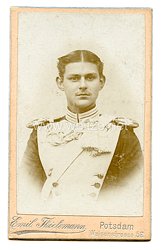
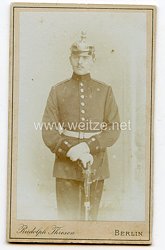
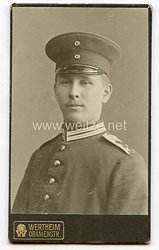
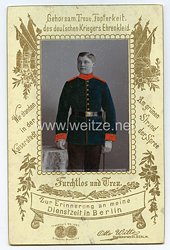
Prussia Partially Hand-Colored Cabinet Photo of a Soldier of the 3rd Foot Guards Regiment

Location Berlin, circa 1910. Dimensions 10.8 x 16.6 cm. Condition 2.

431988
40,00

Prussian Finial for a Veterans Association Flag, the Cross is Missing (!!)

Circa 1900. Brass, total height approximately 28.5 cm, the ball on the thread damaged. Condition 3.
521052
75,00

Prussian Finial for Battalion Colors of Infantry and Artillery

circa 1870. The finial made of brass bronze, fire-gilded, with crowned cipher “WR” in the center. Complete with socket for the flag staff. Total height approximately 21.5 cm. Used piece with typical signs of age, in beautiful untouched original condition.
494036
2.500,00

Prussia Finial for a Veterans Association Flag

Circa 1925. Brass, gilt. Height approximately 29.5 cm. Somewhat aged, the orb with a crack. Condition 2.
500799
250,00

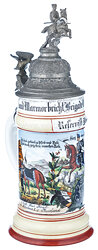
Prussia Reservist Stein for Reservist “Scheid” in the 2nd Rhenish Hussar Regiment No. 9

Garrison Straßburg 1905. 0.5-liter ceramic stein with pewter lid, the saber of the hussar figure on the lid is missing. Condition 2.
489720
450,00

Prussian Reservist Stein for Reservist “Hüsch” of the 6th Rheinisches Infantry Regiment No. 68

Garrisoned at Coblenz 1901. 0.5 liter ceramic stein with polychrome decorations and pewter lid. Condition 2.

489655
350,00

Prussia Flag Nail of the Veterans' Association Infantry Regiment No. 163 “Loyalty is the Core of Honor Local Chapter former 163rd Lübeck 14 and 15 March 1925”

circa 1925. Silver-plated flag nail, finely engraved, height 55 mm, with lateral drillings for attachment to the flagpole. Condition 2.
482524
50,00

Prussian Artificial Marble Plaque with Portrait of Queen Luise (*1776, †1810)

Round plaque with portrait of the Queen in profile as half-relief, diameter approximately 7.9 cm, verso with manufacturer's mark KPM, artist “L. Posch 1810” and inscription “Königin Luise 10.3.1776 19.7.1810”. Reproduction circa 1990 (!). Condition 2.
475995
45,00

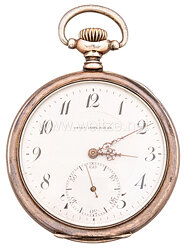
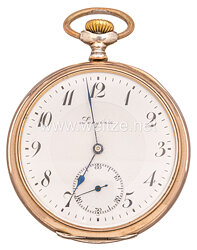
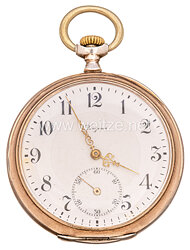
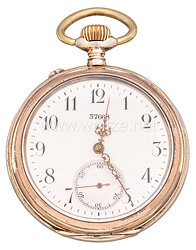
Prussia World War I Silver Pocket Watch as Honor Gift from the Royal Projectile Factory in Spandau to “Worker Haver Vollmer” 1915

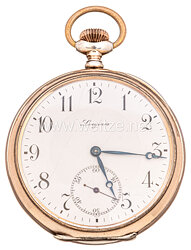
The pocket watch with silver case with gilded edges and enameled dial with small seconds, the lever movement functional (no guarantee), on the dial the manufacturer “Longines”. The outer lid with the Imperial Crown and the cipher “W”, inside the lid the dedication “For 25 years of faithful service to the worker Haver Vollmer Royal Projectile Factory in Spandau 13.4.15.”, engravings of the watchmaker, on the edge the number “1678103”. The movement cover exterior with the applied relief portrait of Kaiser Wilhelm II surrounded by oak leaves engraved into the cover and the Imperial Crown, inside the silver content mark “0.800”, the Reich silver hallmark with the crescent moon and the Imperial Crown as well as the number “3018761”. The movement with the manufacturer “Longines” and the number “3018761”, the case with the capercaillie hallmark. Condition 2.
465064
1.450,00

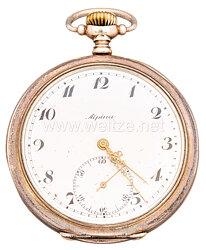
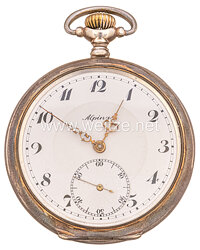
Prussia Silver Pocket Watch as Honorary Gift from the Royal Powder Factory Spandau to “Karl Zeletzki for 25 Years of Loyal Service...”

Circa 1910. Pocket watch with silver case and enameled dial with small seconds, the lever escapement in working order (no guarantee), dial marked by manufacturer “Alpina”, outer lid decorated with the Imperial Crown and cipher “W” within oak leaf wreath, inner lid with dedication “Karl Zeletzki for 25 Years of Loyal Service, the Royal Powder Factory Spandau”, outer movement cover with finely engraved portrait of Kaiser Wilhelm II in gilt oak leaves with the Imperial Crown, cover firmly set in frame. Condition 2.
465044
1.350,00
464806
500,00

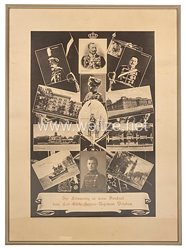
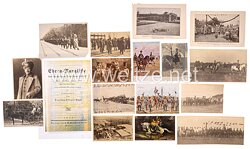
Prussia World War I From the Estate of Hussar “Fritz Krug” of the Leib-Garde-Husaren-Regiment

Grouping of five photographs and nine postcards. Among the photographs a portrait of the hussar with signature, one photograph showing the regimental commander “v. Dommes”, one photograph of the Kaiser, of the nine postcards three are postally used, one postcard with the sender “Oberleutnant and Regimental Adjutant Peter Graf von Hohental”. Condition 2.
461473
250,00

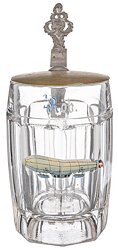
Prussia 0.35 Liter Glass Stein for a Member of the Airship Troops

Glass with simple lid, painted with an airship and the name “Röb”.
459704
350,00

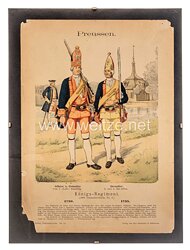
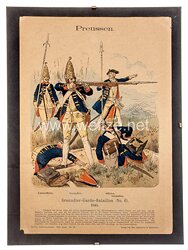
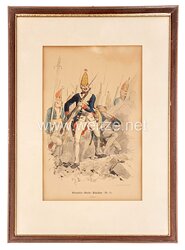
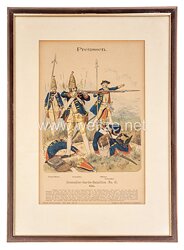
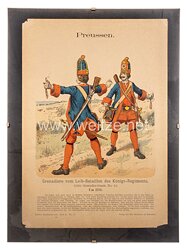
Prussia Framed Uniform Chart by Knötel “Grenadier-Garde-Bataillon”

One of the frame clips is missing. Condition 2-.
454755
20,00

Prussia Partially Hand-Colored Cabinet Photograph of a Soldier in the 3rd Foot Guards Regiment

Stationed in Berlin, circa 1910. Dimensions 10.4 x 15.2 cm. Condition 2.

431990
40,00

Prussia Partially Hand-Colored Cabinet Photo of a Soldier in the Lauenburgisches Jäger-Bataillon Nr. 9

Location Ratzeburg, circa 1910. Dimensions 10.7 x 16.5 cm. Condition 2.

431982
40,00

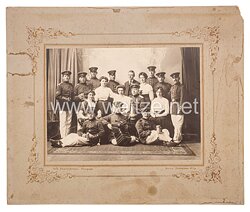
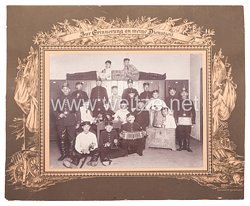
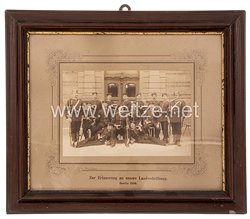
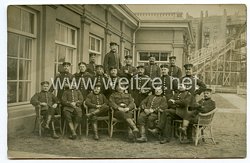
Kingdom of Saxony Group Photograph “In Memory of My Service” 4th Battery Royal Saxon 6th Field Artillery Regiment No. 68

Garrison location Riesa, circa 1910. Dimensions approximately 35.7 x 29 cm. Condition 2.
430995
45,00

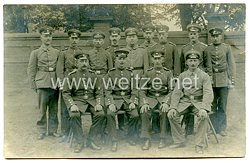
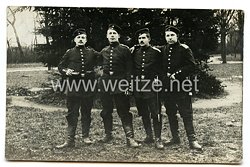
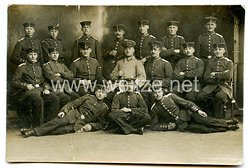
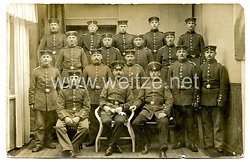
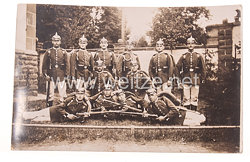
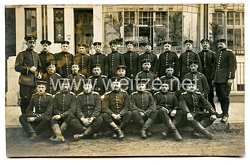
Prussia World War I Photographic Postcard Group of Soldiers

Postmarked Goslar 1915. "Jäger-Bataillon No. 10" (Light Infantry Battalion No. 10). 13.9 x 8.9 cm. Condition 2.
429361
20,00

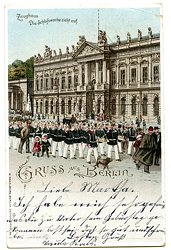
Prussia World War I Photo Postcard "Greetings from Northern France"

Postmarked "... 31.12.15 B.d. 15. Landw.Div. .." (Command of the 15th Landwehr Division). Condition 2.

The 15th Landwehr Division was originally assembled as Division Borries in January 1915 on the Western Front. In 1915 it fought west of Roye-Noyon.

428257
15,00

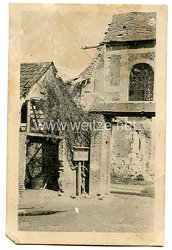
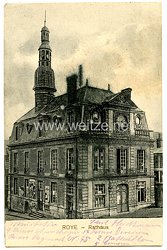
Prussia World War I Postcard “Roye - Town Hall”

Stamped “S.B. 5. Komp. R.-I.-R. 75.” and “...17. Res.-Division 29.7.15...”. Condition 2.
428046
15,00

Prussia World War I Photographic Postcard "Ypres"

Stamped "Reserve Ersatz Regiment No 3" and "...Feldpostamt des XXVI. Res.Armee-Korps 22.2.15..." (Field Post Office of the XXVI Reserve Army Corps, February 22, 1915). Condition 2.
427986
15,00

Prussia World War I Photo Postcard Soldier in Motor Transport Battalion

Peacetime garrison Berlin, circa 1916. Condition 2.


427939
20,00

Prussia Photographic Postcard Soldier in Garde-Train-Bataillon

Location Berlin, circa 1900. Condition 2.


427890
20,00

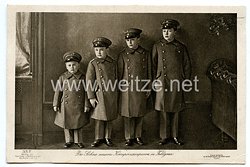
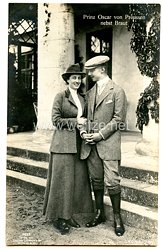
Prussia Postcard "Prince Oscar of Prussia with Bride"

Circa 1914. Condition 2.

Prince Oscar of Prussia served with the Grenadier Regiment "König Wilhelm I." (2nd West Prussian) No. 7 in World War I. On January 27, 1915, he was promoted to lieutenant colonel and from August 1918 served as commander of the 84th Landwehr Infantry Brigade, which was deployed in trench warfare in Lorraine. As a colonel, he was discharged from active military service after the Armistice of Compiègne. He later became Grand Master of the Order of St. John and major general of the Wehrmacht.
427863
20,00
427738
30,00
35,00
40,00

Prussia Cabinet Photo Sergeant in the Queen Augusta Garde-Grenadier-Regiment Nr. 4

Location Berlin, circa 1900. 6.4 x 10.3 cm. Partially hand-colored. Condition 2.
427552
35,00

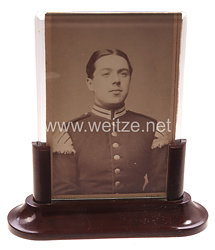
Prussia Partially Hand-Colored Cabinet Photo of a Soldier in a Railway Regiment

Circa 1900. Frame dimensions approximately 8.3 x 12.2 cm. With easel back. Condition 2.
412523
35,00

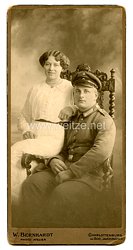
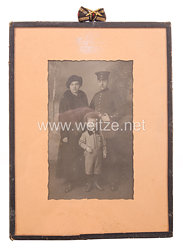
Prussia World War I Framed Photograph of a Soldier with his Family

Circa 1915. Approximately 15 x 20 cm. Condition 2.
412482
30,00

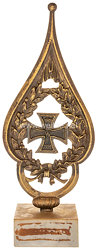
Prussian Flag Finial for a Veterans Association Flag as Table Decoration

Circa 1920. Brass, gilt, screwed into marble base with manufacturer's label "...Petersen ... Schwarzenbek". Total height approx. 24.5 cm. Condition 2.

412383
250,00

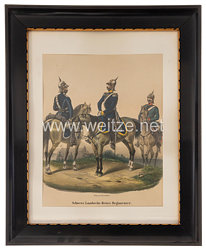
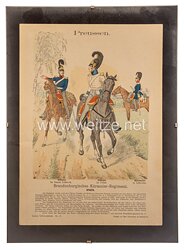
Prussia Framed Color Lithograph "Heavy Landwehr Cavalry Regiments"

Circa 1900. Dimensions approximately 36 x 44 cm. Condition 2.


412071
120,00

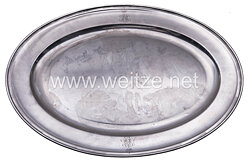
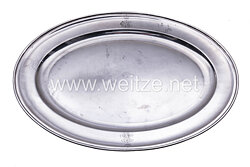
Prussia Large Oval Silver-Plated Serving Tray or Meat Platter from the Property of Infantry Regiment “Bremen” (1st Hanseatic) No. 75

Two engraved monograms on upper rim, dimensions approximately 72 x 53 cm, monogram with minor damage, condition 2.
277635
280,00

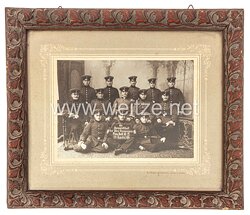
Prussia Framed Cabinet Photograph “6th Corporal's Squad of the 2nd Company Pioneer Battalion No. 21, Kastel 1908”

(= 1st Nassau Pioneer Battalion No. 21, established 1901, garrison Mainz-Kastel). Dimensions 38.5 x 34 cm. Condition 2.
458764
50,00

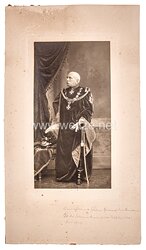
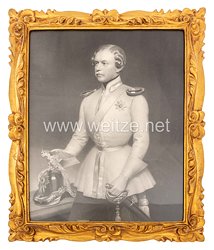
Prussia Large Format Photograph of General of Cavalry Carl Eduard von Hänisch in the Regalia of the High Order of the Black Eagle with Chain

A very fine and rare photograph! The photo shows General of Cavalry Carl von Hänisch (*1829; † 1908) in the uniform of the Uhlans, to his right lies the czapka with its distinctive plume, over the uniform he wears the black velvet mantle with the chain (collane), which was awarded as a special distinction. Furthermore, he wears the Grand Cross of the Order of the Red Eagle with Oak Leaves and Swords.
Dimensions of the photograph approximately 14.5 x 27.8 cm, mounted on cardboard measuring 25.6 x 45 cm, below the image the signature of the studio “E. Bieber K. Hoffotograph. Berlin W. und Hamburg”, the photograph in the lower right corner with year stamp “1908”, on the cardboard below with handwritten accompanying text “Karl Eduard v. Hänisch, General der Kavallerie - Chef des Ulanen Regiments von Katzler (No 2) Juni 1909.”, the handwriting is contemporary. The cardboard with some foxing spots and slightly darkened at the edges. Condition 2.
Carl Eduard Hänisch distinguished himself particularly in the "Wars of Unification" 1864/66/70-71 and was elevated to hereditary nobility in 1871. In 1890 he was promoted to General of Cavalry. In 1896 Hänisch received, together with a personal letter from Kaiser Wilhelm II, the High Order of the Black Eagle as well as the chain on January 18, 1897. On the occasion of his 50th anniversary of service, the Kaiser awarded him by personal letter on July 16, 1897 the Brilliants to the Order of the Black Eagle.

457958
400,00

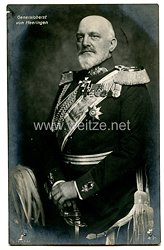
Prussia World War I Photographic Postcard “Generaloberst von Heeringen”

Circa 1915. 8.7 x 13.8 cm. Condition 2.

Von Heeringen served as War Minister and from 1914 commanded the 7th Army. From 1916-18 he was Chief of Coastal Defense.
429145
20,00
15,00

Prussia Photograph of a One-Year Volunteer in the 2nd Guards Regiment on Foot

Stationed in Berlin, circa 1910. Mounted on cardboard. 12.2 x 19.2 cm. Condition 2.
427769
20,00

Prussia Cabinet Photo Soldier of Kaiser Franz Garde-Grenadier-Regiment Nr. 2

Location Berlin, circa 1900. 6.5 x 10.4 cm. Condition 2.
427743
30,00

Prussia Cabinet Card Photograph Soldier in Railway Regiment No. 1

Location Berlin, circa 1900. 6.4 x 10.3 cm. One minor damage. Condition 2-.
427681
20,00
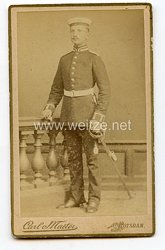
35,00

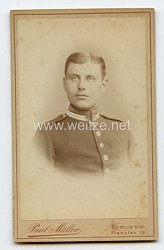
Prussia Cabinet Photo Soldier in a Guard Regiment

Circa 1900. 6.5 x 10.3 cm. Condition 2.
427561
20,00

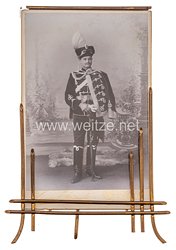
Prussia Framed Photograph of an Official

Circa 1900. Approx. 15.5 x 20.5 cm. With easel stand on reverse. Condition 2.
412467
55,00

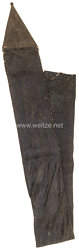
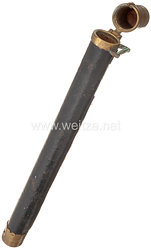
Prussia Flag Case for Battalion Colors

Circa 1900. Black waxed linen fabric, complete with the non-ferrous metal field-gray painted flag case finial, which has a fine crack, the sovereign's monogram has been removed. Overall length 1.7 m. Condition 2. Very rare.


368179
750,00

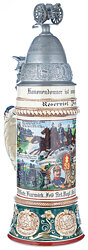
Prussian Reservist Stein for “Reservist Rehder” of the Field Artillery Regiment General-Feldmarschall Graf Waldersee (Schleswigsches) Nr. 9

Garrison Itzehoe 1914. 0.5-liter porcelain stein with polychrome decorations, base lithophane and pewter lid, the finial in the form of an artillery shell fuze, surmounted by representation of a field gun, the finial removable, beneath it portrait of a woman on porcelain. Condition 2.
520802
380,00

Prussia World War I Small Box “Field Post Letter to Landsturmmann Christian Müller ...”

Circa 1916. Dimensions approximately 12.5 x 3 x 11 cm. Condition 2.
512789
25,00

Prussian Commemorative Stein for a Soldier Awarded the Kaiser Shooting Prize 1901

circa 1901. 0.5 liter ceramic stein with pewter lid, featuring a very fine depiction of the Kaiser Shooting Prize 1901, Imperial Eagle and Germania, polychrome painted. Height approximately 23 cm. The pewter lid with patriotic inscription “Dem Land Schutz- Dem Fein Trutz” (Protection for the Country- Defiance to the Enemy), top marked “Poit”, the thumblift with the Imperial Eagle. Undamaged, condition 2.
512386
420,00

Prussia Porcelain Figurine “Grenadier of the Garde-Grenadier-Regiment ‘Lange Kerle’” of Frederick II

This is a product manufactured by Kemer company, 20th century. Detailed realistic representation, hand-painted in color, the musket separately cast, on the underside with manufacturer’s mark and artist’s signature, height approximately 27.5 cm. Undamaged, condition 2+.


503876
450,00

Prussian State Railway: Large Railway Car Sign "K.P.E.V."

modern recast, diameter: 23 cm, originals measure 25 cm.
491889
80,00

Prussia Flag Nail of the Veterans' Association "IR 163 Association of Former 163rd Regiment Members from Hamburg and Vicinity March 14, 1925"

circa 1925. Large silver-plated flag nail, finely engraved, height 90 mm, with lateral drill holes for mounting on the flag staff. Condition 2.
482517
120,00

Prussian Reservist Stein for Reservist “Engelbach” of the Military Baker Detachment of the XI. Army Corps - 8th Company Infantry Regiment No. 83 Cassel 1907

Kassel garrison, circa 1907. 0.5 liter porcelain stein with rich polychrome decoration, obverse with crowned representation of the baker's guild, sides with farewell scene and with the bride. Pewter lid with small figure of a seated soldier, thumblift with crowned eagle. Undamaged, condition 2+.
Extremely rare, in over 35 years this is the first “Baker's Stein” we have been able to offer.
468695
1.250,00

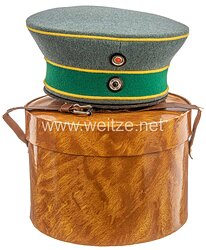
Prussia Miniature of a Field Cap (Tellermütze/Krätzchen) for Enlisted Men Jäger zu Pferde

Circa 1914. Authentic miniature of a field cap for enlisted men Jäger zu Pferde. The field cap made of field-gray cloth with green cap band and yellow piping, complete with both cockades. Crown diameter 12 cm. The field cap has a compartment at the bottom for cufflinks, pocket watch, etc. In the small hatbox, complete with closure strap. Condition 2.
463651
850,00

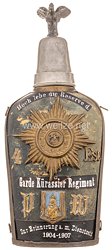
Prussia Trumpet Banner for the Garde-Kürassier-Regiment

Circa 1910. Light blue cloth, edged with black and white cord and white decorative fringe, embroidered in the center with the Gardestern featuring the Prussian eagle on red ground, crowns in the corners. Dimensions approximately 37.5 x 41 cm (excluding fringe). The cloth with moth damage and old repairs. Condition 3.

Very rare! Only very few flags and standards have been preserved.
462940
1.450,00
449686
25,00
449325
60,00

Prussia Cabinet Photo One-Year Volunteer in the 1st Guard Field Artillery Regiment

Location Berlin, circa 1900. 6.4 x 10.5 cm. Condition 2.
427489
35,00

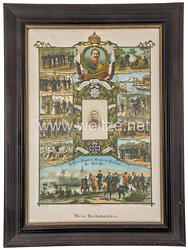
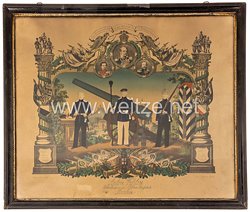
Prussia Reservist Picture "Anton Wöhlers Lehr-Compagnie Artillerie-Lehrschule Berlin"

Before 1886 (still depicted as regents are Kaiser Wilhelm I and Ludwig II of Bavaria). Partially colored print in wooden frame. Dimensions approx. 61 x 52 cm. The frame with minor damage. Condition 2.
421278
150,00

Prussia Case for Fife/Whistle; Infantry Regiment Graf Bülow von Dennewitz (6th Westphalian) No. 55

Garrison Detmold/Höxter/Bielefeld, circa 1910. Black leather case with brass fittings, stamped "55". Condition 2.

The whistle/fife was carried by the buglers of the foot troops. The case was worn immediately behind the side arm.
394697
150,00

Kingdom of Prussia Large Officer's Presentation Gift from the Officers of the 2nd Hanoverian Infantry Regiment 77

Home garrison Celle, circa 1919. This is a farewell gift for Captain Ohldendorf of the 2nd Hanoverian Infantry Regiment 77, 1906 - 1919. Large bronzed statue of a soldier of the Hanoverian Landwehr Battalions from the era of the Napoleonic Wars 1813 to 1815, very detailed. Zinc die-cast with dark patina. Complete on wooden base with dedication plaque "To the departing comrade Captain Ohldendorf - the Officers and Medical Officers of the 2nd Hanoverian Infantry Regiment No. 77. 1906 - 1919." Height 61.5 cm, weight 4.75 kilograms. A piece of the bayonet scabbard is broken off on the reverse, condition 2.
518394
1.850,00

Prussia Flag Finial for a Veterans Association Flag with Wooden Reproduction of the Grand Cross of the Iron Cross 1870

Circa 1900. Brass, gilt, with fixed socket. Overall height approx. 28 cm. The Grand Cross is a wooden reproduction. Condition 2-3.
500797
150,00

Prussia Commemorative Medal by Friedrich Wilhelm Loos for the Centennial of the Kingdom of Prussia 1801

Cast iron, single-sided striking, reverse blank, diameter 55 mm. Below a star, the bust portraits of the five Kings of Prussia. Inscription “Fried. I. FR. Wilh. I. Fried. II. Fr. Wilh. II. Fr. Wilh. III.”, lower right signature “F. Loos”. Condition 2.
499731
250,00

Prussian Reservist's Flask

Circa 1870/80. Glass flask with polychrome-painted black leather cover, featuring circular cutout on obverse revealing portrait of a woman. Cork stopper and straps missing. Condition 2-.
491736
150,00

Prussian Reservist Stein for Lance Corporal “Arthur Menzen” in Hussar Regiment von Zieten (Brandenburg) No. 3, 1st Squadron

Garrison Rathenow 1895. Approx. 0.5-liter ceramic stein with pewter lid, thumblift decoration broken off. Otherwise condition 2.
489601
350,00

Wall Plaque Deutsch Krone East Prussia

Glass plate in wooden and plaster frame, coat of arms and inscription "Deutsch Krone" hand-worked into the glass and painted, overall size 19 cm x 19 cm, reverse with wall hanger and stamp "Herstellung aller Wappen" (Production of all coats of arms). Damage to frame.

The Deutsch Krone district was a rural district that existed in Prussia between 1772 and 1945. It belonged to the part of West Prussia that remained in the German Reich after World War I and became part of the Grenzmark Posen-Westpreußen border march, and from 1938 to 1945 belonged to the Province of Pomerania. Today the former district territory lies in the Polish voivodeships of West Pomerania and Greater Poland.  
483909
180,00

Prussia World War I Silver Pocket Watch as Honorary Gift from the Royal Projectile Factory Spandau to “Worker Eduard Preuss 1.10.14”

The pocket watch with silver case with gilded edges and enameled dial with small seconds, the lever movement functional (no guarantee), the dial marked by manufacturer “Longines”. The outer lid with the Imperial Crown and the cipher “W”, the inner lid with the inscription “For 25 years of faithful service to Worker Eduard Preuss Royal Projectile Factory in Spandau 1.10.14”, on the rim the serial number “5687892”. The movement cover exterior with applied relief portrait of Kaiser Wilhelm II surrounded by oak leaves engraved into the cover and the Imperial Crown, the cover firmly seated in the frame. Condition 2.

A very interesting object! Worker “Eduard Preuss” received the watch only two months after the outbreak of World War I as the “munitions crisis” was already emerging.
464859
1.450,00

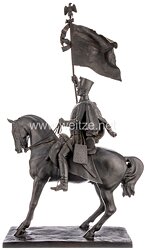
Prussian Bronze Equestrian Statue of a Hussar from the Hussar Regiment “von Prittwitz” (1st Life Hussar Regiment No. 1) with the Flag of the French 55th Infantry Regiment Captured at the Battle of Heilsberg in 1807

Very lifelike and meticulously detailed statue of the hussar mounted on his horse, his left hand on the reins, the horse halting, in his right hand the flag of the French regiment with the Napoleonic eagle on top, the flowing flag on the left side with the inscription “L'Empereur des Francais au 55e Regiment d'Infantrie de Ligne”. The details of the uniform beautifully executed, the shako with the death's head, on the left side the saber and the sabretache with the monogram “WR”, draped over the shoulder the dolman and the carbine sling. The base plate with the artist's signature “V. Seifert fec.”, on the side the foundry mark “Aktien:Gesellschaft Gladenbeck Berlin.”. Bronze casting with browned patina. Total height 62.3 cm. Weight 10.35 kg. The browning rubbed in two to three places, two very minor damages: the sword knot tassel missing as well as the plume holder on the shako. Very well preserved! Condition 2.

The 1st Life Hussar Regiment No. 1 stationed at Danzig/Langfuhr was among the most renowned regiments of the German Army. In 1741, Frederick II established the fifth hussar regiment which received the designation “Regiment schwartze Husaren”. It was renamed several times and received the name “von Prittwitz” in 1804. During the Fourth Coalition War against Napoleon 1806/07, the regiment was initially stationed in Poland and was then advanced to the Vistula up to Thorn. Thus the regiment escaped the catastrophe of Jena/Auerstedt on October 14, 1806. On February 7/8, 1807, Russian forces in the Battle of Preußisch Eylau were able to stop the advance of French troops and entrenched themselves in Heilsberg (Lidzbark Warmiński). Meanwhile, the fortress of Danzig was besieged and captured by the French. On June 10, the French attacked the Prussian and Russian troops at Heilsberg. Despite several attacks, the French could not achieve victory. During the engagements, the Hussar Regiment “von Prittwitz” particularly distinguished itself. The 55e régiment d'infanterie was decimated by the hussars and the regimental color captured. This was one of the few victories of the Coalition partners against Napoleon at that time and was of high morale significance for the troops, thus entering into commemorative culture. On June 14, 1807, however, the Battle of Friedland took place, where the Coalition partners were defeated and forced to make peace. After the Peace of Tilsit on July 7, 1807, the Prittwitz Hussars were now the only hussar regiment of the Prussian Army that still reached full strength.

The statue was probably created for the 100th anniversary of the event in 1907 and presented to the 1st Life Hussar Regiment No. 1 in Danzig. Victor Heinrich Seifert (*1870 in Döblin, †1953 in Berlin) was a renowned sculptor of his time, active since at least 1902. The Gladenbeck bronze foundry in Friedrichshagen was among the most prestigious foundries of that period. It produced numerous significant statues and monuments as well as large and small sculptures, including the Victoria of the Berlin Victory Column.

A particularly beautiful and historically interesting work! We are delighted to offer you this object!


452313
10.000,00

Prussia Cabinet Photo of a Soldier of Infantry Regiment Graf Bose (1st Thuringian) No. 31

Location Altona, circa 1900. Dimensions 8.2 x 16.7 cm. Condition 2.

431992
30,00

Prussia World War I Postcard "Noyon"

Postmarked "K.D. Feldpostexp. 18. Res.-Division 20.3.15 ..." and "...Stab III./ R.I.R. 31". Condition 2.

Reserve-Infanterie-Regiment Nr. 31 was established in 1914 in Altona (Headquarters, I. & II. Btl.) and Bremerhaven (III. Bataillon).


428020
15,00

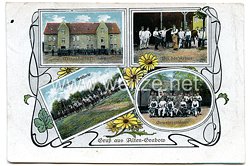
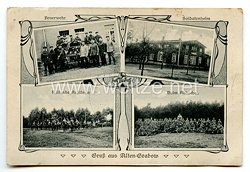
Prussia World War I Postcard “Greetings from Alten-Grabow”

Postmarked 1917. Condition 2.

Alten-Grabow served as a military training ground primarily for the IV. Army Corps (Magdeburg).


427966
15,00
427779
30,00
30,00

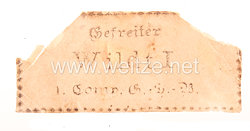
Prussia Label for Lance Corporal “Wildt” in the Garde-Schützen-Bataillon

Circa 1910. Paper label for the cap “Gefreiter Wildt I 1. Comp. G.-S-B.”, corners damaged. Condition 2-
425756
25,00

Kingdom of Prussia “Frederician Era” Finial of a Regimental Color

Circa 1760. Cast brass, at center the cypher “FR”, fluted socket. Height 22.3 cm, outer diameter of mouth 3.3 cm, inner diameter 2.1 cm. Condition 2.

Extremely rare! Relics from the Frederician Era are only sparsely preserved!
519759
2.500,00

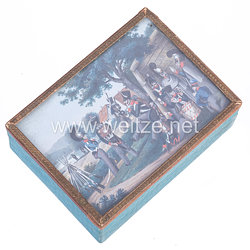
Prussia - Patriotic Box from the Period Shortly After the Wars of Liberation

Circa 1820/30. Small box of heavy cardboard, covered with color-printed paper, the lid features a print under glass depicting a camp scene from the Wars of Liberation, showing line infantry and cuirassiers in the blue small uniform introduced in 1813. Dimensions approximately 9 x 3.4 x 6.5 cm. Typical age-related wear. Condition 2.
351345
280,00

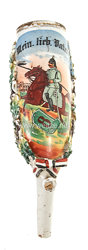
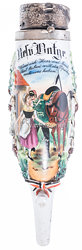
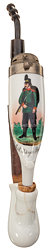
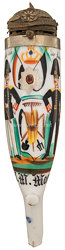
Prussia Pipe Bowl for Reservist “Batge” of the Magdeburg Hussar Regiment No. 10

Stationed at Stendal, 1905. Porcelain, polychrome painted, front depicting a hussar with his sweetheart, the metal lid in the form of a hussar cap. Condition 2.
337831
200,00

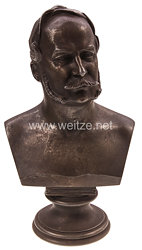
Prussia Large Bust of King Frederick the Great by Artist Cuno von Uechtritz-Steinkirch (d. 1908)

Bronze, brown patina. Height 38 cm. Weight 13.8 kg. Signed on side by artist “v. Uechtritz”, foundry mark on reverse “Lauchhammer Bildguss”. Well preserved. Condition 2.

The Lauchhammer art and bell foundry, located in the town of the same name, is a Saxon company founded in 1725, Prussian since 1815. Since the 19th century, many famous art monuments have been cast here.

Cuno von Uechtritz-Steinkirch was a German sculptor. The artist came from the Dresden school of sculpture and made a name for himself with a monument group for the Berlin Siegesallee and with decorative fountain installations. He was appointed Royal Professor by Kaiser Wilhelm II.
323738
3.850,00

Prussia Framed Portrait Photograph of a Customs Official

Circa 1910. Photograph under glass. Condition 2.
318781
25,00

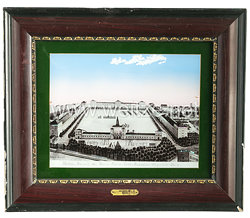
Prussia Framed Glass Picture “Berlin Barracks of the Kaiser Franz Grenadier Regiment No. 2”

Circa 1895. Dimensions of the glass picture 23 x 17.5 cm, with signatures “Anton Grzesik Berlin” and “R. Martzke. Berlin 189[?]”, in wooden frame 36.5 x 31 cm, with plaque “Souvenir of Berlin”. The frame with minor damages, condition 2.
311854
95,00

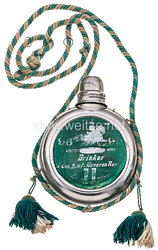
Prussian Reservist Canteen of a Veteran of the 2nd Westphalian Hussar Regiment Nr. 11, 1st Squadron

Stationed in Düsseldorf, 1899. Glass flask with metal frame, heart-shaped disc, interior with well-preserved painting, reverse of metal frame with green fabric covering, inscription in silver: “96 - 99 Reservist Brinker 1. Esc. 2. wf. Husaren Regt Nr. 11 Düsse[ldorf],” complete with original carrying cord in the regimental colors, decoration missing from drinking cup lid, condition 2-.

The regiment was stationed in Düsseldorf until 1906, then in Crefeld.
301812
100,00

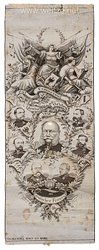
Prussian Patriotic Item from the Franco-Prussian War 1870/71 “In Memory of the German Heroes 1870 - Dedicated to German Women”

Woven silk panel 14.5 x 40 cm, featuring portraits of various German military commanders and princes, artist “J. Chevie G. Amberger Comp.”, publisher “Von der Mühll. Bürgy &Cie Basel”, slight signs of aging, condition 2. Very rare, we have not seen another piece in over 30 years.
301291
220,00

Prussia Large Oval Silver-Plated Serving Tray or Meat Platter from the Estate of Infanterie-Regiment "Bremen" (1. Hanseatisches) Nr. 75

Two engraved monograms on upper rim, dimensions approximately 72 x 53 cm, slightly tarnished, condition 2.
277619
280,00

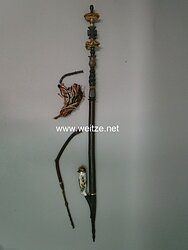
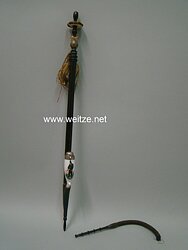
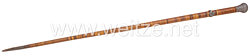
Prussia Reservist Pipe of the 5th Hanoverian Infantry Regiment No.165

Porcelain pipe with inscription “Am Andenken a. m. Dienstzeit b. d. 2 Comp. 5.Hannov. Inftr. Regt. No.165 Goslar 1897 - 99”, front with inscription “Resv. Dirsch”, with multi-part pipe stem and mouthpiece. Hose to mouthpiece broken off, threading between pipe stem sections damaged, overall height approximately 114 cm. Condition 3.
200493
200,00

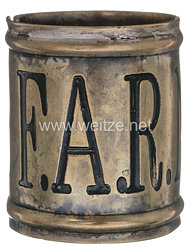
Prussia Standard Finial Ring of the Field Artillery Regiment General-Feldzeugmeister (2nd Brandenburg) No. 18, 1st Battalion

Garrison Frankfurt an der Oder. Silver-plated brass ring, engraved “F.A.R. No. 18 I B”. Clear signs of use, detached from flagstaff, condition 2-. Very rare.
27002
1.000,00

Prussia Large Enamel Sign “Royal Foot Gendarmerie Wachtmeister”

Large version for official building, dimensions 33 x 49 cm, drilled holes in all 4 corners for mounting to building, slightly convex, several enamel chips, used condition. Very rare
517711
1.800,00

Kingdom of Prussia Reservist Stein for “Gefreiter Lütjens” of Hussar Regiment Queen Wilhelmina of the Netherlands (Hanoverian) No. 15

Garrisoned at Wandsbek 1903. 0.5 liter porcelain stein with rich painted decoration, interior base image and pewter lid. On the lid a small statuette of a mounted hussar, the thumblift with the Prussian eagle with spread wings. The tip of the lance broken off, the lid slightly loose. Condition 2.
518184
400,00

Prussia Small Partially Hand-Colored and Framed Photograph of a Soldier in Kürassier-Regiment Königin (Pommersches) Nr. 2

Location Pasewalk, circa 1900. Dimensions 5.9 x 7.8 cm. With easel back stand. Condition 2.

431994
60,00
10,00

Prussia Cabinet Card Photograph Soldier of the 1st Foot Guards Regiment

Garrison Potsdam, circa 1900. 6.3 x 10.3 cm. Partially hand-colored. Condition 2.
427541
35,00

Prussia Framed Hand-Colored Lithograph “Kaiser Franz Grenadier Regiment”

Circa 1850. Modern frame. Dimensions approximately 28.5 x 24 cm. Condition 2
421679
70,00

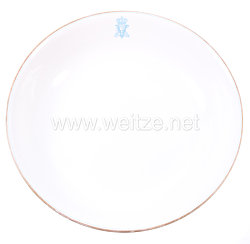
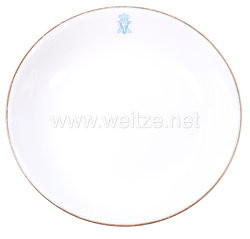
Kingdom of Prussia - Fusilier Regiment "Königin" (Schleswig-Holsteinisches) No. 86

large porcelain bowl from the Officers' Casino with regimental cipher, diameter 26 cm, KPM, condition 2
394207
285,00

Kingdom of Prussia - Fusilier Regiment “Königin” (Schleswig-Holsteinisches) Nr. 86

large porcelain bowl from the Officers' Casino with regimental cipher, diameter 26 cm, KPM, condition 2
394206
285,00

Prussian Notepad in the Form of a Hussar Saber Pouch

Circa 1900. Red leather with embossed decoration, interior with linen lining and tear-off sheets, the upper approximately three pieces removed. Height approximately 12.5 cm. Condition 2.

First time in our inventory! A very fine accessory for the Hussar display case!
478483
450,00

Prussia Plaster Plaque with Portrait of King Friedrich Wilhelm III (*1770, † 1840)

Circa 1900. Round plaque with profile portrait of the King in half-relief, diameter approximately 8.5 cm, verso with stamp “Preussischer Kulturbesitz ...”, below number “3079”. Condition 2.
475983
95,00

Prussia Partially Hand-Colored Cabinet Photo of a Soldier in the 2nd Guard Uhlan Regiment

Location Berlin, circa 1910. Dimensions 10.6 x 16.5 cm. Condition 2.

431989
40,00
431981
40,00
15,00

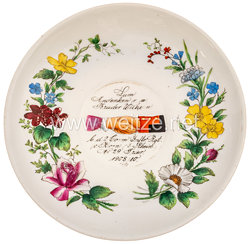
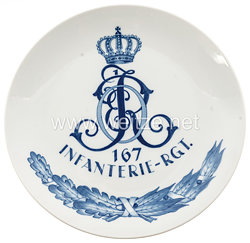
Prussia Commemorative Plate "Zum And. v. m. Enkel..." Infantry Regiment Markgraf Karl (7th Brandenburg) No. 60

Garrison Weißenburg, 1900. Porcelain, partially colored, with gilt rim. Diameter 16.3 cm. Condition 2.
382714
60,00

Prussia Iron Cross 1914: Patriotic Coffee Cup

circa 1914/15. Manufactured by KPM porcelain manufactory. Tall coffee cup in Empire style, hand-painted with Iron Cross 1914, with rich gold decoration and encircling laurel band. Complete with matching saucer. Height of cup approximately 12 cm. Manufacturer's mark on base as well as Iron Cross indicating wartime production. Condition 2+.
518580
400,00

Prussia Flag Nail of the Veterans' Association “IR 163 Association of Officers of the former Schleswig-Holsteinisches Infanterie-Regiment No. 163 March 14, 1925”

circa 1925. Large silver-plated flag nail, finely engraved, height 90 mm, with lateral drill holes for mounting on the flagpole. Condition 2.
482519
120,00

Prussia "Krieger Verein zu Rodenbeck 1873/98 - for 25 Years of Existence"

Circa 1898, silver wearable medal, on original ribbon, Condition 2.
480810
85,00
25,00

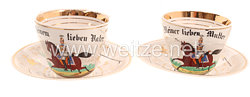
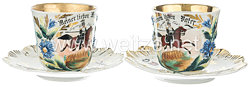
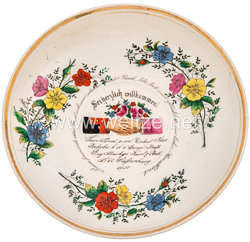
Set of 2 Gift Cups from an Uhlan to “My Dear Father/My Dear Mother”

Circa 1900. 2 cups with saucers. Porcelain with gold rim, partially decorated with semi-relief flowers, hand-painted. Condition 2.
442052
290,00

Prussia Partially Hand-Colored Cabinet Photo of a Soldier in the 2. Garde-Ulanen-Regiment

Location Berlin, circa 1910. Dimensions 10.5 x 16.2 cm. Condition 2.

431976
35,00
20,00

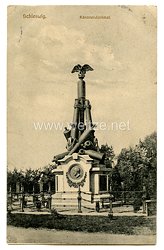
Prussia World War I Photographic Postcard “Schleswig Artillery Monument”

Postmarked “Schleswig 8.8.15 ...”. Condition 2.
428037
10,00

Prussia Cabinet Photo Soldier of the Kaiser Alexander Garde-Grenadier-Regiment Nr. 1

Location Berlin, circa 1900. 6.5 x 10.5 cm. Condition 2.
427573
35,00

Prussia Cabinet Card Photograph Soldier of the 1st Garde-Ulanen-Regiment

Stationed at Potsdam, circa 1900. 6.3 x 10.3 cm. Condition 2.
427566
35,00

Prussia Cabinet Card Photo Soldier in the Gardes du Corps Regiment

Location Potsdam, circa 1900. 6.4 x 10.3 cm. Condition 2.
427490
35,00

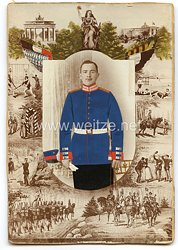
Prussia Photomontage of a Soldier in the Kaiser Alexander Garde-Grenadier-Regiment Nr. 1

Berlin location, circa 1910. Framed color print, soldier's head inserted from photograph, accoutrements partially hand-colored. Dimensions approximately 42 x 52 cm. Frame with minor damage. Condition 2.
412087
125,00

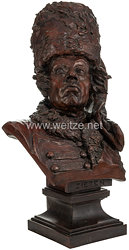
Kingdom of Prussia Large Bust of General Hans Joachim von Zieten under Friedrich II

Produced for the 300th birthday of Zieten in 1899. Highly detailed representation of Zieten in the uniform of a General of Hussars with winged hussar cap and elaborate decorations. The sculpture in bronze, hollow cast and burnished. Signed on reverse by the artist “Karl Janssen”, work number “1810”. Height approximately 74 cm, weight approximately 30 kg. Condition 2.

Hans Joachim von Zieten, also known as Zieten aus dem Busch (born May 14, 1699 in Wustrau; died January 27, 1786 in Berlin) was one of the most famous cavalry generals in Prussian history and a close confidant of King Friedrich the Great. He owed his fame in part to his extraordinary successes in the Silesian Wars. Long after his death, he continued to enjoy high esteem and his life and work were frequently commemorated.

Karl Ludwig Rudolf Janssen (born May 29, 1855 in Düsseldorf; died December 2, 1927 ibid.) was a German sculptor. From 1872 to 1880 he studied at the Royal Prussian Academy of Arts in Düsseldorf. In 1884 he was commissioned to create the sculpture Vater Rhein und seine Töchter for the visit of Kaiser Wilhelm I to Düsseldorf, which pleased the people of Düsseldorf so much that twelve years later—in 1897—he was commissioned to produce a permanent bronze version as a fountain. One year earlier, he had successfully completed a commission for a representative equestrian statue of Kaiser Wilhelm.

A very fine work! Due to its size and execution as a freestanding sculpture, it can be assumed that the piece was originally placed in a prominent location, such as a palace or barracks.

Due to the weight, personal pickup or delivery at a fair is requested.


375935
9.500,00

Prussian Visor Cap for a Member of a Veterans Association

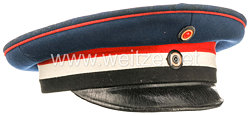
Personal item circa 1910. This is a converted visor cap for enlisted men of the infantry. Blue wool with red piping, the cap band in the “Reich colors”, both cockades for enlisted men on the front. Brown sweatband, reddish-brown lining with maker mark “J. Mackermann ... Aachen ...”. Size 54. Condition 2.
358081
250,00
329596
500,00

Prussian Flag Nail for a Battalion Color for Attaching a Flag Ribbon

Circa 1900. Made of silver, with long retaining screw on reverse, which was screwed through the flagstaff. Lightly used, Condition 2. Rare.
325033
850,00

Kingdom of Prussia Iserlohn Tobacco Box "Freiberg 1762"

circa 1762. Made of brass and copper, lid with inscription "1762 / VICTORIA BEY FREIBERG / 29. Octo. PRINTZ HEINRICHS WAFFEN SIND / BEY FREYBERG SO BEGLUCKT / DASZ MAN DADURCH AUCH NUN / DEN FRIEDEN BALD ERBLICKT", with signature "Keppelman", reverse side shows angel of peace with trumpet and laurel wreath, beside it the coat of arms of Russia; center: Three rulers joining hands. On the left the Russian, in the center the Prussian, on the right the Swedish ruler. Between Prussia and Sweden the Prussian coat of arms, to their right the Swedish coat of arms, with signature "IAKM", width 14.5 cm, height 3.1 cm, typical signs of age and use, condition 2. Very rare.

The Iserlohn tobacco boxes from Iserlohn and surrounding areas were a specialized form of local brass goods manufacturing. They reached the peak of their significance in the 18th century and particularly in the context of Prussian war propaganda during the Seven Years' War. Since the 17th century, the production of brass products existed in Iserlohn and the surrounding area. This includes the manufacture of tobacco boxes. Initially, they were still modeled after examples from the Netherlands.

The boxes were initially hand-engraved as expensive individual pieces, before the stamping technique with steel dies became established from 1754 onwards, which led to the production of larger quantities. This technical innovation resulted in the continued hand-made tobacco boxes from the Netherlands being displaced from the market. The body was often made of copper, while the lid was made of brass. Among the first, the engraver Johann Heinrich Giese (1716–1761) manufactured tobacco boxes in this manner. Friedrich II granted him a monopoly for this in 1755. Later manufacturers are identifiable by signatures on the products.

The motifs on the boxes were diverse. There were boxes with biblical scenes, images of hunting or from social life. Views of cities and much more were embossed. Especially during the Seven Years' War, war and battle scenes were depicted. Thus the producers responded to the hitherto unusually strong patriotic sentiment and veneration for Friedrich II in Prussia and beyond. Above all, the victories of the Prussians in various battles were depicted. The relatively inexpensive boxes found mass sales not only in Prussia, but throughout the northwest of the German Reich extending into the Netherlands. In the further course of the 18th century, the production of tobacco boxes declined. The last documented box was manufactured in 1777.
518495
950,00

Kingdom of Prussia Iserlohn Tobacco Box "Zorndorf 1758"

circa 1758. Manufactured from brass and copper, the lid with inscription "DA IST IA NUN DER ZEHNTE SIEG / NACH UNSERM WUNSCHE EINGETROFFEN / WAS KONNEN WIR BEY DIESEM KRIEG / NICHT VONDEM GROSSEN FRIEDRICH HOFFEN / ER GING AUS MAHREN IN DIE MARCK / DIE RUSSEN WAREN STOLTZ UND STARCK / ES KAM ZUR SCHLACHT: ER WARF SIE NIEDER / DER BESTE KONIG SCHONT SICH NICHT / SEHT! WIE ER IN DIE FEINDE BRICHT / SEIN BLITZEND SCHWERDT TRENNT IHRE GLIEDER", reverse with inscription "BATAILLE BEY ZORNDORF / UNTER ALLERHÖCHSTER ANFÜHRUNG DES KONIGS / VON PREUSSEN FRIEDERICH DEN GROSSEN ÜBER DIE / RUSSEN SIEGREICH ERFOCHTEN 1758. DEN 25. AUGUST", width 15.2 cm, height 3.2 cm, typical age and usage wear, condition 2. Very rare.

The Iserlohn tobacco boxes from Iserlohn and surrounding areas were a specialized form of local brass goods manufacturing. They reached the height of their significance in the 18th century and particularly within the framework of Prussian war propaganda during the Seven Years' War. Since the 17th century, the production of brass products existed in Iserlohn and the immediate vicinity. This included the manufacture of tobacco boxes. Initially, they were still oriented toward models from the Netherlands.

The boxes were initially hand-engraved as expensive individual pieces, before the stamping technique with steel dies prevailed from 1754 onward, which led to the production of larger quantities. This technical innovation resulted in the hand-manufactured tobacco boxes from the Netherlands being displaced from the market. The body frequently consisted of copper, while the lid was made of brass. One of the first to manufacture tobacco boxes in this manner was the engraver Johann Heinrich Giese (1716–1761). Frederick II granted him a monopoly for this in 1755. Later manufacturers are identifiable through signatures on the products.

The motifs of the boxes were diverse. There were boxes with biblical scenes, images from hunting or social life. Views of cities and much more were embossed. Especially during the Seven Years' War, military and battle scenes were depicted. With this, the producers responded to the hitherto unusually strong patriotic sentiment and veneration for Frederick II in Prussia and beyond. Above all, the victories of the Prussians in various battles were depicted. The relatively inexpensive boxes found mass distribution not only in Prussia, but throughout the northwest of the German Empire extending into the Netherlands. In the further course of the 18th century, the production of tobacco boxes declined. The last documented box was manufactured in 1777.
518412
950,00

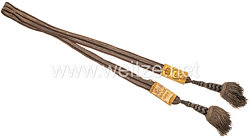
Prussia Flag Ribbon for a Battalion Color for Participation in the 1864 Campaign against Denmark

The ribbon of the War Commemorative Medal of 1864 in the 3.5 cm wide version for battalion colors, both sides with riveted crossed swords, at the lower end with black/silver tassel of metal thread, overall length approx. 62.5 cm. Typical wear and age signs, condition 2.

Remnants of Prussian colors are extremely rare, as these were predominantly taken to the Soviet Union after World War II and for the most part destroyed.
518409
1.750,00

Kingdom of Prussia Iserlohn Tobacco Box "Martinique 1762"

Brass and copper, lid with inscription "DER ENGLÄNDER GLORIEUSE EROBERUNG MARTINIQUE D. 4. FEBRUARY 1762" (The English Glorious Conquest of Martinique, February 4, 1762), underside with royal coat of arms, width 13.5 cm, height 3 cm, small variant. Typical signs of use and age, condition 2. Very rare

The Iserlohn tobacco boxes from Iserlohn and surrounding areas were a specialized form of local brass goods manufacturing. They reached their peak significance in the 18th century, particularly within the context of Prussian war propaganda during the Seven Years' War. Since the 17th century, the production of brass products existed in Iserlohn and the surrounding region. This included the manufacture of tobacco boxes. Initially, production was still oriented toward models from the Netherlands.

The boxes were initially hand-engraved as expensive individual pieces, before embossing technique with steel dies prevailed from 1754 onward, leading to the production of larger quantities. This technical innovation resulted in the hand-made tobacco boxes from the Netherlands being displaced from the market. The body frequently consisted of copper, while the lid was made of brass. One of the first to manufacture tobacco boxes in this manner was the engraver Johann Heinrich Giese (1716–1761). Friedrich II granted him a monopoly for this in 1755. Later manufacturers are identifiable through signatures on the products.

The motifs on the boxes were diverse. There were boxes with biblical scenes, images of hunting or from social life. Views of cities and much more were embossed. Especially during the Seven Years' War, war and battle scenes were depicted. The producers thereby responded to the unusually strong patriotic sentiment and veneration for Friedrich II in Prussia and beyond. Primarily the victories of the Prussians in various battles were depicted. The relatively inexpensive boxes found mass distribution not only in Prussia, but throughout the northwest of the German Reich and into the Netherlands. In the further course of the 18th century, the production of tobacco boxes declined. The last verifiable box was manufactured in 1777.
518405
850,00

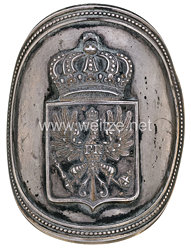
Kingdom of Prussia Seal for a Cuirassier Officer

circa 1860. Military seal for seal impressions, transverse oval sealing surface of brass with engraved cuirassier helmet above crossed rifle with fixed bayonet and side arm, with original turned dark wooden handle, width of sealing surface 24.98 mm, total height approx. 8 cm, maker: "B. Held, Magdeburg". Condition 2.
518359
300,00

Prussia Single Epaulette for an Official

Circa 1880/90. Heavily aged, the braid and coat of arms shield loose, the cloth backing with old repairs. Condition 3-4.
500334
75,00

Prussia World War I Silver Pocket Watch as Honor Gift from the Royal Projectile Factory in Spandau to “Worker Karl Krüger” 1916

The pocket watch with silver case with gilt edges and enameled dial with small seconds, the lever escapement functional (no guarantee), on the dial the manufacturer “Longines”. The outer cover with the Imperial Crown and the cipher “W”, inside the cover the dedication “For 25 years of faithful service to Worker Karl Krüger Royal Projectile Factory in Spandau 16.11.16.”, engravings of the watchmaker, on the edge the number “
1157923”. The movement cover exterior with the applied semi-relief portrait of Kaiser Wilhelm II surrounded by oak leaves engraved into the cover and the Imperial Crown, interior with the silver content hallmark “0,800” as well as the “Auerhahn” hallmark, below that the Reich silver mark with the crescent moon and Imperial Crown, below that the number “3297511”. The movement with the manufacturer “Longines” and the number “3297511”, the case with the Auerhahn hallmark. Condition 2.
465065
1.450,00
45,00

Prussia Cabinet Photo Soldier in Kaiser Alexander Garde-Grenadier-Regiment Nr. 1

Location Berlin, circa 1900. 6.1 x 10.4 cm. Condition 2.
427530
35,00

Prussia “Travel Passport” of the “Royal Prussian Residential City of Potsdam...” for “Ferdinand Geliner” from the year 1806

Printed form with handwritten additions on paper. With seal. Dimensions approximately 35.8 x 21 cm. Condition 2.
500420
250,00

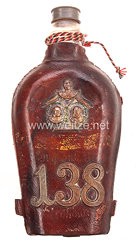
Prussian Reservist's Flask for a Soldier in the 3rd Lower Alsatian Infantry Regiment No. 138

Circa 1888. Glass flask with leather cover, front decorated with applied images of the “Three Emperors” Kaiser Wilhelm II, below him Kaiser Wilhelm I and Friedrich III, below the regimental number “138”, the leather on the reverse with heart-shaped cutout, through which a photograph of two women is visible. Complete with zinc lid and short cord. The seam of the leather cover separated at top. Condition 2-.

A very early piece. The regiment was only established in 1887.
431746
180,00

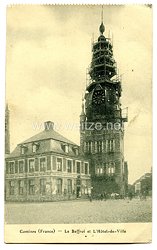
Prussia World War I Photographic Postcard "Comines ..."

Stamped "S.B. I. Res. I. R. 11" and handwritten "...Musketier Apel Res Inf. Regt. No 11 ...". Condition 2.

Reserve Infantry Regiment No. 11 was established in 1914 in Glatz (Staff & I. Bn.), Schweidnitz (II. Bn.) and Münsterberg (III. Battalion).
428051
15,00
427766
45,00

Prussia Cabinet Photo Sergeant Royal Protection Police Berlin

Circa 1900. 7.9 x 17.7 cm. Condition 2. Very rare!
427753
45,00

Painting of Frederick the Great after the Battle of Kolín

Frederick II of Prussia after the Battle of Kolín, copy after Julius Schrader (1815-1900), dated 1853. Oil on canvas, relined, on old stretcher frame. Famous depiction of the King, seated on a well trough and leaning on his cane in front of a farmstead, signed lower right “Julius Schrader” and dated “1853”. Image dimensions 39 x 51 cm, framed dimensions 68 x 78 cm. Condition 2.
The painting is based on a drawing by Johann Christoph Frisch, which was first translated into oil by Julius Schrader in 1849. This work is now housed in the Museum der bildenden Künste in Leipzig. 
418947
15.000,00

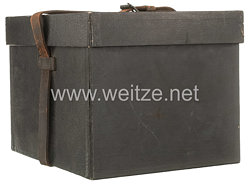
Kingdom of Prussia 1st Guards Regiment on Foot Storage Case

Location Potsdam, circa 1910. Black rigid cardboard case, dimensions approximately 20 x 21.5 x 28 cm, lined internally with yellow silk, lid features gilt imprint “I. Garde Regt: zu Fuss,” exterior with label “I. Garde Regt. z.F.”. Side buckle missing, but straps complete.
375839
450,00
368619
500,00

Preußen Reiterstatuette als Geschenk Generalfeldmarschalls Prinz Leopold von Bayern an das Westfälische Dragoner-Regiment Nr. 7

Standort Saarbrücken. Datiert 1909. Die Reiterstatuette ein feiner Bronzeguss auf ca. 25 cm hohen grünem Marmorsockel. Grundmaß des Sockels ca. 32.5 x 18.5 cm. Gesamthöhe ca. 60.5 cm. Gewicht geschätzt 20 Kg. Vorne auf dem Sockel die Plakette mit der Inschrift «Den gastlichen Prinz Leopold-Dragonern in dankbarer Erinnerung an den 12.9.1908».
Die Statuette zeigt einen Kesselpauker des (bayerischen) Garde du Corps aus der Zeit König Maximilian I. Joseph († 1825). (Später wurde das Regiment in 1. Kürassier und dann in 1. Schwere Reiter-Regiment umbenannt). Prominent an der Statuette die beiden großen Pauken mit dem prächtigen Behang, darauf das bayerische Wappen unter dem Wappenzelt, seitlich mit den beiden Löwen. Die Schabracke an den Flanken mit der Chiffre «♔MJ», auch der große Helm, seitlich mit den typischen "liegenden Löwen", vorne auf dem Kamm mit der Chiffre «♔MJ».
Der Paukenschlegel rechts fehlt, links der Figur ein Band, möglicherweise hing hier ein Pallasch, der nun fehlt, vorne fehlt ein Band des Zaumzeugs. Zustand 2.

Chef des Dragoner-Regiments Nr. 7 war Prinz Leopolds von Bayern. Die Wahl des Motives (Ein Pauker der bayerischen Garde du Corps) und die Kostbarkeit des Objektes weisen auf den Prinzen selbst als Schenkenden hin. Der Anlass wird ein Besuch des Regiments-Chefs bei "seinem" Regiment gewesen sein. Als Aufstellungsort kann man das Offizierskasino annehmen. 1917 wurde das Regiment auch nach ihm benannt: Dragoner-Regiment General-Feldmarschall Prinz Leopold von Bayern (Westfälisches) Nr. 7. 

Aufgrund des Gewichtes und der Empfindlichkeit des Objektes wird um eine Abholung oder Übergabe auf einer Messe gebeten.

504760
3.500,00

Prussian Porcelain Figurine “Leibgarde Hussar Mounted on Patrol”

This piece was manufactured by Rosenthal, Germany. Detailed realistic depiction, hand-painted in color, with artist signature “G. Oppel” on the underside, height approximately 23.5 cm. Undamaged, condition 2+.


503859
1.500,00

Prussia Small Box "Rob. Werres Sohn Jeweler Wuppertal"

Circa 1900. Dimensions approximately 8.5 x 2.5 x 6 cm. One side of the lid missing. Condition 2-.
499703
20,00

Prussia 5 Flag Nails of the Veterans' Association in Kiel

circa 1925. The flag nails partially of silver, partially silver-plated, all with corresponding engraving, removed from the flagpole, condition 2.
482728
150,00

Prussian Flag Nail for a Battalion Color for Attaching a Flag Streamer

reverse with long retaining screw, which was threaded through the flagstaff.
476699
650,00

Prussia Framed Portrait of Major General Karl Friedrich Hülsen

This is a framed print of a photograph of a contemporary painting of the General. The mounting dates from circa 1900. Dimensions approximately 20.5 x 26.5 cm. Condition 2.

Major General Karl Friedrich Hülsen (*1794, † 1858) served from 1851 to 1855 as Commander of the Füsilier-Regiment Fürst Karl-Anton von Hohenzollern (Hohenzollernsches) Nr. 40.

https://de.wikipedia.org/wiki/Füsilier-Regiment_„Fürst_Karl-Anton_von_Hohenzollern“_(Hohenzollernsches)_Nr._40
https://wiki.genealogy.net/FR_40
https://de.wikipedia.org/wiki/Karl_Friedrich_Hülsen
473892
45,00

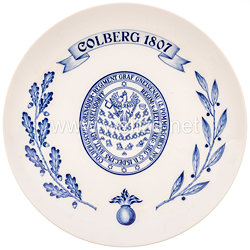
Prussia Meissner Regimental Plate for the Colberg Grenadier Regiment Graf Gneisenau (2nd Pomeranian) No. 9

Porcelain plate with blue decoration, underside marked with crossed swords mark, diameter approximately 25.5 cm. Condition 2.
435976
650,00

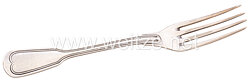
Prussian Silver Fork for the Officers' Mess of Fusilier Regiment Prince Heinrich of Prussia (Brandenburg) No. 35

Garrison location Brandenburg a.H. circa 1900. The handle engraved with “FHR35”. On the reverse the maker “G. Echterling” and silver hallmark “800”. Length approximately 21 cm. Condition 2.
434853
150,00
40,00
35,00

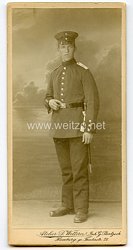
Prussia Cabinet Photo Feldwebel in an Infantry Regiment

Circa 1900. 7.8 x 16.2 cm. Minor damage. Condition 2-.
427699
20,00

Prussia Large “Pavilion Seal” with the Great Arms of Frederick II

Metal striking. Diameter 12.8 cm. At the center the crowned pavilion with the two “Wild Men” at the sides, in the middle the crowned coat of arms, at the edge the inscription Friederic II. .... Condition 2.
499746
80,00

Prussia Silver Pocket Watch as Honorary Gift from the Royal Powder Factory Spandau to Employee "Friedrich Schwarz for 25 Years of Loyal Service..."

Circa 1910. The pocket watch with silver case and enameled dial with small seconds, the lever movement functional (no guarantee), on the dial the manufacturer “Alpina”, the outer cover decorated with the Imperial Crown and the cipher “W” in oak leaf wreath, inside the cover the manufacturer's mark “UH” in shield and the designation “Ancre”, on the rim the case number “858”, around the manufacturer's mark the dedication engraving “Friedrich Schwarz for 25 Years of Loyal Service from the Royal Powder Factory Spandau.”, the movement cover exterior with finely engraved portrait of Kaiser Wilhelm II in gilded oak leaves with the Imperial Crown, the cover interior again with the stamp “Ancre” and “UH” as well as the stamp with silver content “0.800” and the capercaillie hallmark (silver content 800-1,000) above it, on the right side the Reich silver stamp with the crescent moon and Imperial Crown, below the serial number “139858”, the movement again with the stamp “UH” and serial number “139858”, the case stamped on the rim with the number “858” and the capercaillie hallmark. Condition 2.

The Alpina company was originally founded as “Union Horlogère” (UH) in 1883 by Gottlieb Hauser in Switzerland and had branches in Biel, Geneva, Besançon and Berlin. From this developed the company “Alpina”, which was registered in 1908.
The Royal Powder Factory was founded in 1717 by Friedrich Wilhelm I. Initially the factory was located on the northern bank of the Spree. In the 1830s it was relocated to Spandau. In 1919 it had to be closed due to disarmament after World War I.

464824
1.350,00

Prussian Reservist Stein for Reservist “Holthausen” of the Westphalian Uhlan Regiment No. 5

Garrison Düsseldorf 1909. Tall glazed stoneware stein with 1 liter capacity, relief-decorated and painted surface. Without lid (!). Height 23.5 cm. Condition 2.
433790
320,00

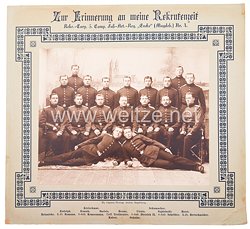
Prussia Group Photograph “In Remembrance of My Recruit Training” Fußartillerie-Regiment Encke (Magdeburgisches) Nr. 4

Location Magdeburg, circa 1910. Dimensions approximately 33.5 x 31 cm. Condition 2.
430997
45,00
427805
30,00

Prussia World War I Cabinet Photo Non-Commissioned Officer in an Infantry Regiment

Produced in Magdeburg 1916. 5.8 x 14.2 cm. Condition 2.
427701
20,00

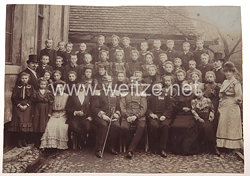
Prussia Photograph of School Class with Teachers and Two Officers

Circa 1900. Dimensions 21.1 x 15.1 cm. Condition 2.
421562
20,00

Prussia Postcard from a Soldier of Eisenbahn-Regiment Nr. 3

Garrison Hanau 1912. Front depicts a group of soldiers from the regiment. Condition 2.


421522
25,00

Prussian Medallion with Portrait of King Wilhelm I (b. 1797, d. 1888)

At the neck opening with the artist's signature “B. Afinger 1869”. Bronzed cast iron. Diameter approximately 20.5 cm. Verso marked by the Lauchhammer art foundry “Eigenthum Lauchhammer”. With hanging loop for wall mounting. Condition 2.

https://de.wikipedia.org/wiki/Bernhard_Afinger
475946
450,00

Prussia Silver Pocket Watch as Honorary Gift from the Royal Artillery Workshop Spandau to “Hammerführer Ferdinand Podehl” 1898

The pocket watch with silver case with gilded bezels and enameled dial with subsidiary seconds, the lever movement functional (no guarantee), on the dial the number “37668”.
The outer lid with the Imperial Crown and the cipher “W”, inside the lid the manufacturer's mark “Seeland” as well as “M” in anchor (Fabrique d'Horlogerie Seeland, Madretsch and La Chaux-de-Fonds, Switzerland; registered 1891), below the stamp with the silver content “0.800”, beside it capercaillie hallmark (silver content 800-1,000), below the inscription “Dem Hammerführer Ferdinand Podehl für 25jährige treue Dienste in der Kgl. Artilleriewerkstatt Spandau 1873 1898”, between them the Imperial silver stamp with the crescent and Imperial Crown, below the serial number “37668”, on the edge engravings of the watchmaker.
The movement cover exterior with the applied relief portrait of Emperor Wilhelm II surrounded by oak leaves and the Imperial Crown engraved into the cover, interior again the Imperial silver stamp with the crescent and Imperial Crown and the silver content “E0.800F” as well as the capercaillie hallmark, below the serial number “37668”.
The movement with the manufacturer's mark “Seeland” as well as “M” in anchor and the serial number “224138”. Condition 2.

The Artillery Workshop was located south of the Spandau Citadel, above the Spandau railway station. It was built in 1868. Artillery pieces were finished there and also carriages and accessories were manufactured.
464855
1.450,00

Prussia Reservist Stein for a Reservist of the 5th Westphalian Infantry Regiment No. 53

Garrison Köln 1903. 0.5-liter stoneware stein with polychrome decorations and pewter lid. The inscription with the names of comrades on the reverse faded, the lid somewhat loose. Condition 2-.
458963
280,00

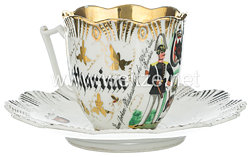
Prussia Garde-Kürassier-Regiment Set of 2 Cups “To My Dear Father/To My Dear Mother”

Berlin 1897. 2 cups each with saucers. Porcelain with gold rim and polychrome hand-painting, inscription “Dedicated to the joyful Christmas celebration by your son Heinrich Westphal – 5th Squadron Garde-Kürassier Regiment Berlin 1897.” Minor signs of use and aging. Condition 2.
449231
450,00

Prussia Partially Hand-Colored Cabinet Photo of a Soldier in the Garde-Füsilier-Regiment

Location Berlin, circa 1910. Dimensions 10.6 x 16 cm. Condition 2.

431985
45,00

Prussia World War I Photographic Postcard “Warsaw” sent by a member of the 1st Kurhessian Field Artillery Regiment No. 11

Postmarked ...22. Inf. Div. 16.2.15..., handwritten “Art Reg 11”. Condition 2.
428001
15,00

Prussia Cabinet Card Photograph Soldier of the 1st Guard Field Artillery Regiment

Berlin location, circa 1900. 6.3 x 10.3 cm. Condition 2.
427751
35,00

Prussia Cabinet Photo Soldier in Königin Elisabeth Garde-Grenadier-Regiment Nr. 3

Location Charlottenburg, circa 1900. 6.6 x 10.5 cm. Condition 2.
427554
30,00

Prussia - Finial for a Regimental Color from the Era of King Friedrich Wilhelm III (1797-1840)

Circa 1815. Gilt brass, in the center the cipher “FRW”, fluted socket. Overall height 23 cm. Typical age and wear marks, the original gilding preserved to 65%. Condition 2.
422293
2.500,00

Prussia Wall Plaque “Crown Prince of Prussia”

Circa 1960/70. Ceramic. Diameter approximately 12 cm. Maker’s mark on reverse “...Thomas Seyfarth”. Condition 2.
504541
45,00

Prussia Saucer as Birthday Gift to a Soldier in Infantry Regiment von Lützow (1st Rhenish) No. 25

Rastatt 1910. Porcelain plate with gold rim and polychrome decoration. Diameter approx. 16.5 cm. Condition 2.
500804
45,00

Prussia Framed Photograph of a Lieutenant in Magdeburgisches Pionier-Bataillon Nr. 4

Circa 1910. Dimensions approximately 31 x 23.5 cm. Condition 2.
500731
45,00

Imperial German Navy Trumpet Banner of the Music Corps of the I. Seebataillon

Kiel garrison, circa 1900. The banner made of white silk. On the obverse, the cipher of the I. Seebataillon, the Imperial Crown with flowing ribbons over crossed anchors above the battalion number “I” in finest hand embroidery executed in gold metallic thread. On the reverse, the crowned coat of arms of the Grand Duke of Baden with grand order decoration and heraldic mantle, in finest hand embroidery with gold and silver threads, in the 4 corners with golden oak leaf sprays. Three sides bordered with golden fringe. Dimensions 49 x 50 cm. The attachment loops for the trumpet are missing at the top. Only slight signs of use and age, in beautiful condition.

Extremely rare, in over 35 years of business this is the 1st trumpet banner of the Imperial Seebataillon that we have been able to offer, we know of no other example.

Friedrich II (born 1857, died 1928) was the last Grand Duke of Baden from 1907 to 1918. In 1905 he was appointed Colonel General with the rank of Field Marshal. As such, he was Chief of the Imperial I. Seebataillon in Kiel. He donated the trumpet banners and the kettledrum covers for the music corps, which is why these are decorated with the Grand Ducal Baden coat of arms.


496944
6.500,00

Prussian Top Hat and a Pair of Gloves

Circa 1910. The top hat with maker from Düsseldorf. Top hat and box slightly damaged. Condition 3.
475539
50,00
15,00
427797
25,00

Prussia Cabinet Photograph Soldier of the Königin Elisabeth Garde-Grenadier-Regiment Nr. 3

Stationed at Charlottenburg, circa 1900. 6.4 x 11 cm. Condition 2.
427730
30,00

Prussia Cabinet Photo Soldier in I./II. Battalion of the 1st Foot Guards Regiment

Stationed at Potsdam, circa 1900. 6.4 x 12.6 cm. Condition 2.
427488
40,00

Prussia Cabinet Photo Soldier in Kaiser Franz Garde-Grenadier-Regiment Nr. 2

Location Berlin, circa 1900. 6.3 x 10.2 cm. Condition 2.
427477
25,00

German Empire 1871-1918 Photograph of an Official

Circa 1900. Dimensions 7.4 x 16.7 cm. Condition 2.
421551
20,00

Prussia Jubilee Flag Ribbon for the Battalion Colors of Infantry Regiment "von Voigts-Rhetz" (3rd Hanoverian) No. 79

Location Hildesheim. Jubilee flag ribbon, which was awarded by Kaiser Wilhelm II on the occasion of the renewal of the old colors and standards. Black/silver striped flag ribbon, with 2 tassels, 2 applied brass bands, one with the Imperial crown, the other with Royal crown "W II", reverse with the dates "1 January 1900" and "1 January 1900 - 3 January 1838". Distinct signs of use and age, condition 2-.


386304
2.500,00

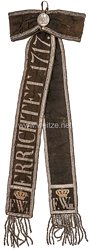
Prussia Secular Standard Ribbon for the Flag of the Kürassier-Regiment Königin (Pommersches) Nr. 2

Location Pasewalk, circa 1835. The secular standard ribbon consisting of three parts, a bow and 2 bandeaus, the three parts connected by means of a heavy silver button with Prussian eagle. Heavy black fabric with silver braid and silver bullion, the left ribbon with inscription "ERRICHTET 1717." and "F.W.I.", the right ribbon "F.W.III.", reverse side "1835". With minor damage. Condition 2.

Remnants of Prussian flags are extremely rare, as these were mostly taken to the Soviet Union after World War II and largely destroyed.


359755
6.500,00

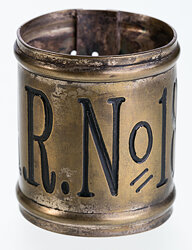
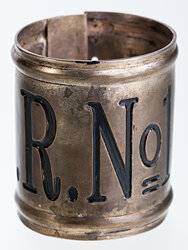
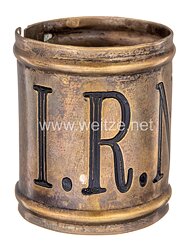
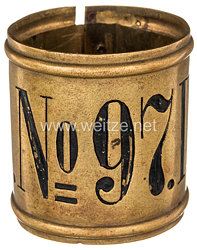
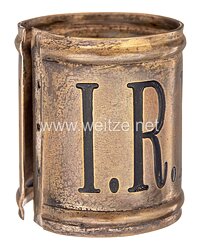
Prussia Flag Ring of the Standard of the 1st Ermland Infantry Regiment No. 150

Garrison Allenstein. Silver-plated brass ring, engraved “I.R. NO. 150”. Clear signs of wear, detached from flagstaff, condition 2-. Very rare.
141775
500,00

Prussia Plaster Plaque with Portrait of the “Great Elector” Friedrich Wilhelm I. (*1688, † 1740)

Circa 1800. Oval plaster plaque with portrait of Friedrich Wilhelm I. as half-relief in profile as military commander in armor with marshal's baton and oak leaf wreath. Dimensions approximately 7.5 x 8.8 cm. Reverse with maker's mark and number “4823”. With attachment for wall hanging. Minor damage. Condition 2-.
475980
150,00

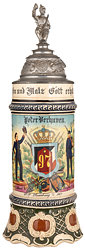
Prussian Reservist Stein for Reservist “Verhuven” of the 1st Upper Rhine Infantry Regiment No. 97

Garrison Saarburg 1907. Tall glazed stoneware stein with 0.5 liter capacity, the surface relief-decorated and painted. On the lid a toasting soldier. Height 31.5 cm. Condition 2.

435837
350,00

Prussia Large Letters Patent of Nobility for Chamber Director Carl Ludwig von Rabe, 1825

Letters patent of nobility written on parchment from the year 1825, 11 text pages with original signature of King Friedrich Wilhelm III and countersigned by Prince Wittgenstein, head of the Ministry of the Royal House. Finely painted armorial page, in gold-embossed red leather binding, with the crowned “FW” and surrounding ornaments on the cover. Large seal in silver seal capsule with elaborately knotted black/silver cord, complete with both silver tassels. Rare historical document in exceptionally fine condition.

Carl Ludwig Heinrich Rabe, born 1776, jurist, 1807 Government and Domain Councillor, 1812 Director of the Domain Chamber of Prince Ferdinand of Prussia, then of Prince August, 1816 also Saxe-Weimar, Privy Councillor of Justice, died 1872.
489729
3.000,00

Prussia/Hesse Large Cabinet Photograph “Group of Soldiers at Mainz Garrison”

Circa 1900. Dimensions 35.5 x 29.5 cm. Condition 2-.
458763
30,00

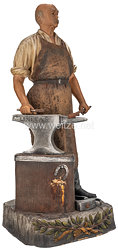
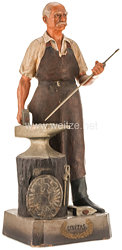
German Empire 1871 - 1918 Table Decoration Statuette of Bismarck as Blacksmith of the German Empire

Circa 1900. Lifelike representation of Bismarck as a blacksmith, holding a sword in his left hand and a hammer in his right. On the anvil the inscription “Unitas” (Unity). Ceramic, polychrome painted. Height approx. 47 cm. Weight 2.5 kg. The base with minor impact marks. Condition 2.
375517
850,00

Prussia Meissner Regimental Plate for Infantry Regiment von Grolmann (1st Posen) No. 18

Home garrison Osterode. Circa 1925. Porcelain plate with blue decoration, underside marked with crossed swords mark, diameter approximately 25 cm. Condition 2.
491798
350,00

Kingdom of Saxony Cabinet Photo of a Feldwebel in the Royal Saxon 4th Field Artillery Regiment No. 48

Location Dresden, circa 1900. Dimensions approximately 10.5 x 16.5 cm. One corner damaged. Condition 2-.
449717
25,00

Prussia Hand-Colored Photograph of a Soldier in Infanterie-Regiment von Stülpnagel (5. Brandenburgisches) Nr. 48

Location Cüstrin, circa 1900. Frame dimensions approximately 7.2 x 10.2 cm. With easel back support. Condition 2.
412559
40,00

Prussia Commemorative Plate “In Memory of My Brother...” in Infanterie-Regiment von Horn (3rd Rhenish) No. 29

Garrison Trier, 1910. Porcelain, partially colored, with gold rim. Diameter 16.5 cm. Condition 2.
382713
65,00
r