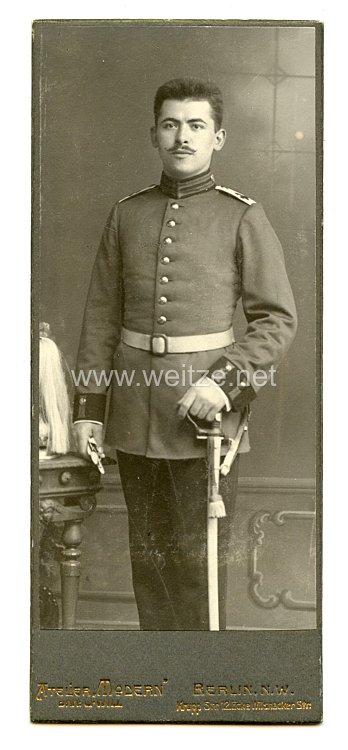
Prussia Cabinet Photo Private First Class in the 1st Guard Field Artillery Regiment, Mounted Division
This cabinet photograph depicts a Gefreiter (lance corporal) of the 1st Guard Field Artillery Regiment, mobile detachment, and dates from around 1900 in Berlin. Such photographic documents represent important testimonies of Prussian military history and the photographic culture of the German Empire.
The 1st Guard Field Artillery Regiment belonged to the most prestigious units of the Prussian army. It was established in 1816 as the Guard Field Artillery Brigade and received its final designation in 1859. The regiment was part of the Guard Corps with headquarters in Berlin and surrounding areas. The mobile detachment (fahrende Abteilung) differed from the horse artillery in that the gun crews rode on limbers and guns, while in horse artillery each man had his own horse.
Cabinet card photography became established in the 1860s as the standard format for portrait photography, partially replacing the smaller carte-de-visite format. With dimensions of approximately 11 x 16.5 cm for the cardboard mount, it offered more space for detailed representations. The dimensions given here of 4.9 x 11.8 cm correspond to the actual photographic image on the card. Around 1900, cabinet photographs were the preferred medium for military portraits as they effectively displayed uniform details and decorations.
The depicted Gefreiter represents the lowest non-commissioned officer rank in the Prussian army. This rank was introduced in 1859 and replaced the earlier designation of Unteroffizier. The Gefreiter stood between the common soldier and the non-commissioned officer and typically wore distinction marks on the sleeves. In field artillery, enlisted men and non-commissioned officers wore the characteristic dark blue uniform with red facings typical of the artillery branch.
The Guard units enjoyed special prestige in the German Empire. They recruited their personnel according to stricter criteria than line regiments, with particular emphasis on height, appearance, and reliability. The Guard Field Artillery played an important representative role in military parades and ceremonies in Berlin. The regiment participated in the Wars of Unification in 1864, 1866, and 1870/71 and was decorated multiple times for its achievements.
In the period around 1900, the German army was in a phase of modernization. The field artillery received new gun types, particularly the revolutionary Field Cannon C/96, which was later developed into the famous FK 96 n.A. This period marks the transition from black powder to smokeless powder and from bronze barrels to steel guns with recoil mechanisms.
The photographic documentation of soldiers served several functions: it was used for personal remembrance and was often sent to family members. For many young men, military service represented an important phase of life that should be photographically recorded. The photographs were typically made in professional studio ateliers that specialized in military portraits and were often located near barracks.
The condition designation “Zustand 2” in the description corresponds to the common classification of collectibles, where 1 represents the best and 5 the worst condition. A condition 2 indicates a well-preserved specimen with only minor signs of use, which is quite remarkable for photographs over 120 years old.
Such military-historical photographs are today important sources for uniformology, social history, and the everyday history of the military. They document not only official uniform regulations but also show individual wearing styles and decorations. For collectors and museums, they represent valuable documents that provide insight into the lives of soldiers in the German Empire.