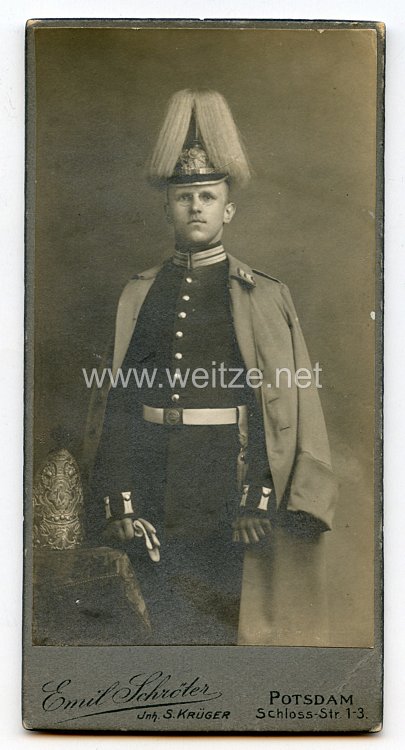
Prussia Cabinet Photo Soldier in I./II. Battalion of the 1st Foot Guards Regiment

Stationed at Potsdam, circa 1900. 6.4 x 12.6 cm. Condition 2.
427488
40,00

Prussia Cabinet Photo Soldier in I./II. Battalion of the 1st Foot Guards Regiment

This cabinet photograph depicts a soldier of the 1st Foot Guards Regiment (1. Garde-Regiment zu Fuß), one of the most prestigious units of the Prussian Army. The photograph was taken around 1900 in Potsdam, the garrison town of this elite regiment and royal residence of the Prussian kings.

The 1st Foot Guards Regiment was founded in 1806 and belonged to the Royal Prussian Guard. It was directly subordinated to the Prussian royal house and was considered one of the most distinguished military formations of the German Empire. The regiment was stationed in Potsdam and traditionally consisted of several battalions. The designation “I./II. Bataillon” on the photograph refers to the specific affiliation of the depicted soldier to the first or second company of the respective battalion.

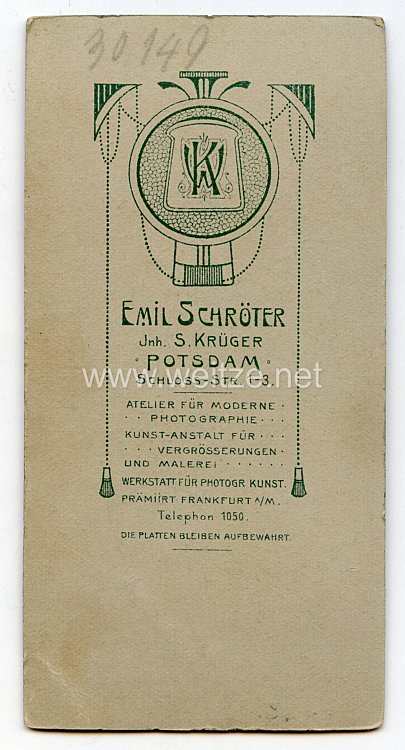
Cabinet photographs or cabinet cards were a popular photographic format during the period between approximately 1870 and 1910. With dimensions of about 10 x 15 cm for the cardboard mount (here 6.4 x 12.6 cm for the actual photograph), they were larger than the earlier carte-de-visite format and were preferred for portrait photography. Soldiers frequently had themselves photographed in full uniform to send these images as mementos to family and friends or to keep for themselves. The photographs were usually taken in professional photo studios that had established themselves in garrison towns.

Around 1900, the German Empire under Kaiser Wilhelm II was at the height of its power. The army enjoyed high social prestige, and military service was considered an honorable duty. The Guard regiments recruited their soldiers according to particularly strict criteria. In addition to military suitability, height, appearance, and social background were also considered. The minimum height for guardsmen was significantly higher than for regular infantrymen.

The uniform of the 1st Foot Guards Regiment was distinctive and splendid. It included the typical dark blue tunic (Waffenrock) of the Prussian infantry with red facings and collar. The headgear consisted of the Pickelhaube, the iconic leather helmet with metal spike, adorned with the Guard star. The guardsmen wore special insignia and distinctions that differentiated them from line infantry, including the characteristic Guard lace (Gardelitzen) on collar and cuff patches.

The regiment played an important role in ceremonial occasions at the Prussian court. It provided honor guards at state receptions and participated in parades. Military training was strict and comprehensive, with great emphasis placed on drill, discipline, and military precision. The Guard soldiers were considered the military elite and role models for the entire army.

Potsdam as the regiment's garrison had been the center of Prussian military power since Frederick the Great. The city housed numerous barracks, parade grounds, and military facilities. Social life was heavily influenced by the military, and the officers of the Guard regiments belonged to the social elite.

The period around 1900 marks a phase of relative peace, which was already overshadowed by increasing tensions in Europe. The 1st Foot Guards Regiment would participate in numerous significant battles during World War I from 1914 onward and suffer heavy losses. After the end of the monarchy in 1918 and with the dissolution of the Prussian Army as a result of the Treaty of Versailles, this tradition-rich regiment was also disbanded.

Photographs like this one are important historical sources today. They document not only uniforms and military equipment but also provide insight into the living world and self-perception of soldiers of that era. The condition rating of 2 indicates a well-preserved photograph with only minor signs of aging to be expected.

r