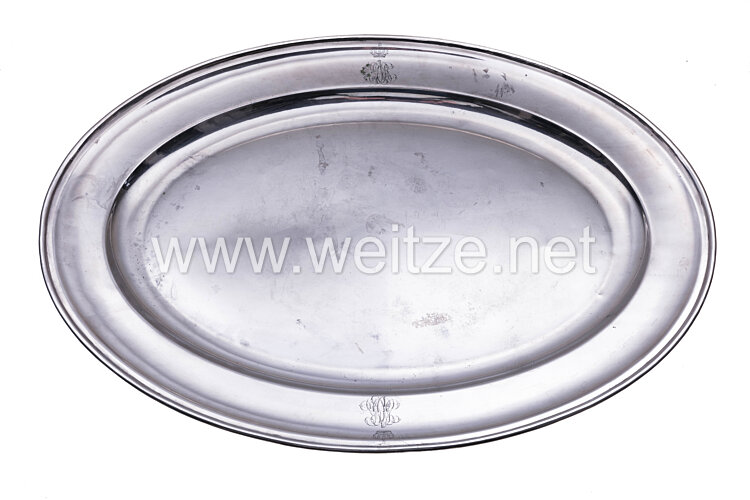
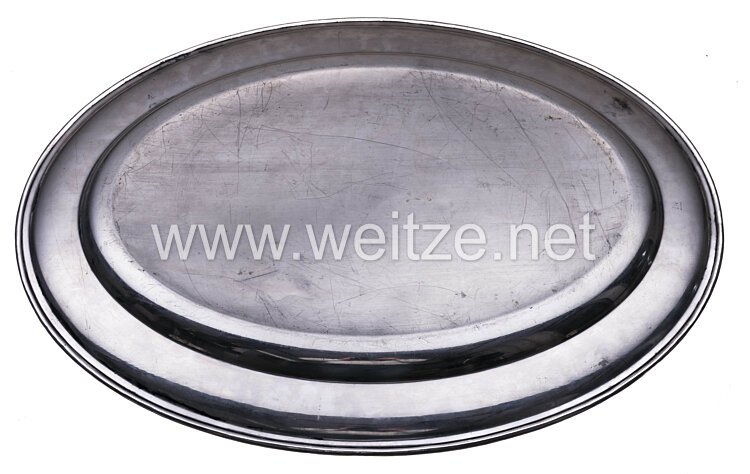
Prussia Large Oval Silver-Plated Serving Tray or Meat Platter from the Property of Infantry Regiment “Bremen” (1st Hanseatic) No. 75

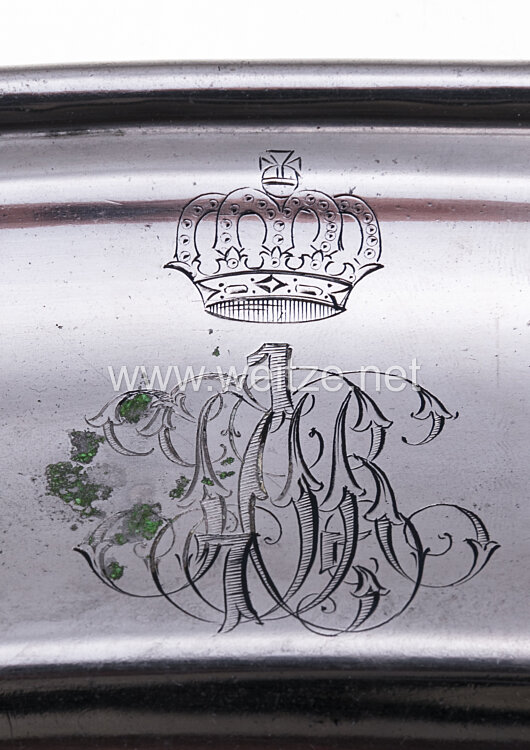
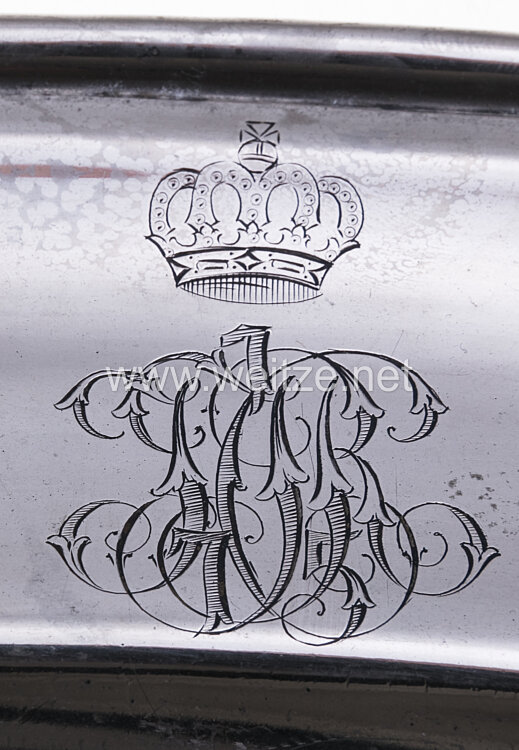
Two engraved monograms on upper rim, dimensions approximately 72 x 53 cm, monogram with minor damage, condition 2.
277635
280,00

Prussia Large Oval Silver-Plated Serving Tray or Meat Platter from the Property of Infantry Regiment “Bremen” (1st Hanseatic) No. 75

This large oval silver-plated serving tray from the possession of the Infantry Regiment “Bremen” (1st Hanseatic) No. 75 represents a significant testament to Prussian military culture during the German Empire and the associated officers' societies. Such magnificent pieces of table silver were an integral part of social life in the officers' messes of the German Army and served not only practical purposes but also symbolized tradition, esprit de corps, and the social standing of the military elite.

The Infantry Regiment “Bremen” No. 75 was established on October 1, 1866 in Bremen and was one of three Hanseatic infantry regiments in the Prussian Army. Following the Second Schleswig War and the Austro-Prussian War of 1866, the Hanseatic contingents were integrated into the Prussian Army. The regiment bore the designation “1st Hanseatic” and was garrisoned in the Hanseatic city of Bremen, which gave it a special position in local society.

The regiment's formation occurred in the context of army reforms following the founding of the German Empire. The regiment initially consisted of three battalions and was later expanded to include a fourth. The troops were recruited mainly from Bremen and the surrounding Lower Saxon region. The regiment participated in the Franco-Prussian War of 1870-71 and fought in several significant battles, including those at Beaumont and Sedan. For its achievements, the regiment was honored with various decorations.

The regiment's officer corps maintained, as was customary in the Prussian Army, a pronounced mess culture. The officers' casino was not merely a place for meals but above all a social center where tradition was cultivated, camaraderie fostered, and military experiences exchanged. The furnishings of these casinos often reflected the representational needs of the respective regiments and included valuable furniture, paintings, porcelain, and indeed table silver.

Silver-plated serving dishes and trays like this specimen, with its considerable dimensions of approximately 72 x 53 centimeters, were used for festive occasions such as regimental celebrations, officers' gatherings, or receptions in honor of high-ranking guests. The two engraved monograms on the upper rim could indicate donors or significant personalities of the regiment, possibly former commanders or distinguished officers. Such personalized objects document the close connection between officers and their military unit.

The use of silver-plated material rather than solid silver was quite common and made it possible to acquire representative table settings at more affordable costs. The silver-plating technique was highly developed in the 19th century, and quality pieces could maintain their luster for decades. The craftsmanship of such objects testifies to the importance attached to appropriate representation befitting one's station.

During World War I, Infantry Regiment No. 75 suffered heavy losses. The regiment fought on various fronts, initially in the West and later also in the East. Like many other regiments, it was repeatedly reinforced and reorganized. After the German defeat in 1918 and the dissolution of the Imperial Army pursuant to the provisions of the Treaty of Versailles, the regiment was disbanded. The maintenance of tradition was later continued by various veterans' associations.

The fate of regimental property after 1918 varied. Many valuable objects from officers' messes passed into private ownership, were preserved by traditional associations, or found their way into museums. Table silver and other representative objects today document the material culture of the Prussian-German Army and are important sources for military and cultural history.

This serving tray is not merely an artisanal object but a historical testimony to Prussian military tradition, Bremen's Hanseatic identity, and the social structures of the German Empire. It recalls an era when military honor, camaraderie, and tradition represented central values and found visible expression in material testimonies. For collectors and historians, it represents an authentic piece of German military history of considerable documentary and cultural-historical value.