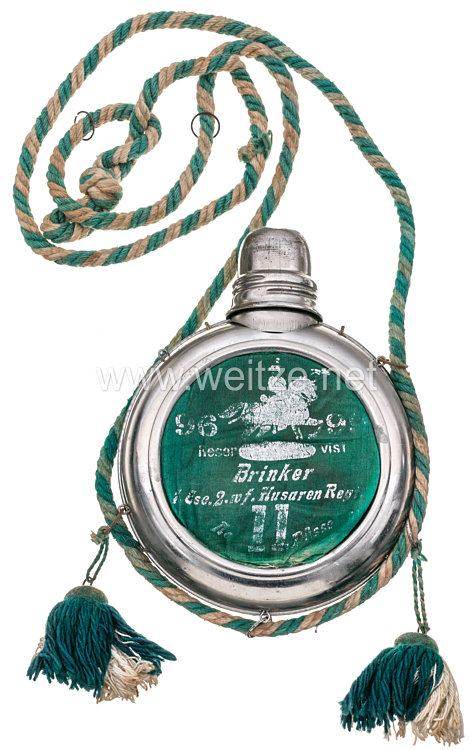
Prussian Reservist Canteen of a Veteran of the 2nd Westphalian Hussar Regiment No. 11, 1st Squadron
The regiment was stationed in Düsseldorf until 1906, then in Crefeld.
This reservist's drinking flask belonging to a former member of the 2nd Westphalian Hussar Regiment No. 11, 1st Squadron, provides impressive documentation of the military commemorative culture of the German Empire in the final years of the 19th century. Such flasks were not official military equipment but personal mementos that reservists had made upon completing their active service.
The 2nd Westphalian Hussar Regiment No. 11 was established on October 1, 1866, in Düsseldorf and served under the patronage of the King of Prussia. The garrison remained in Düsseldorf until 1906, when the regiment was transferred to Crefeld (now Krefeld). The regimental colors were distinctive: dark blue attila with yellow braiding and fastenings, and a red czapka (shako). These colors were reflected in various military mementos, including the carrying cords on drinking flasks.
Reservist Brinker, whose name appears on the flask, served from 1896 to 1899 in the 1st Squadron. This three-year service period corresponded to the standard military conscription term in the Prussian cavalry. After completing active duty, soldiers were transferred to the reserve, where they remained liable for service for additional years. The transition to reservist status was a significant event, often celebrated with the commissioning of personal commemorative items.
Reservist mementos developed into a significant phenomenon of German military culture during the second half of the 19th century. Besides drinking flasks, these included painted reservist steins, carved tobacco pipes, photo albums, and various other objects. These items fulfilled multiple functions: they served as personal reminders of military service, as status symbols in civilian society, and as expressions of solidarity with comrades and regiment.
The flask described here exhibits typical features of this object category: a metal frame with heart-shaped panel, a glass bottle inside, and elaborate painting. The heart-shaped design was particularly popular among cavalry regiments. The interior painting typically displayed military motifs such as cavalry scenes, regimental insignia, garrison views, or patriotic symbols. Scenes of camaraderie or humorous depictions of soldiers' life were also frequently portrayed.
The reverse side of the flask was covered with green fabric, upon which service dates and regimental affiliation were applied in silver lettering. The choice of fabric color often corresponded with regimental colors or held symbolic significance. The carrying cord in regimental colors completed the ensemble and enabled the flask to be worn at reservist meetings and other festive occasions.
Such flasks were manufactured by specialized craftsmen and artists in garrison towns. In Düsseldorf, an important Prussian garrison city on the Rhine, a flourishing trade in military mementos existed. Production required various skills: metalworking for the frame, glass painting for decoration, textile processing for the fabric covering, and engraving or painting for inscriptions.
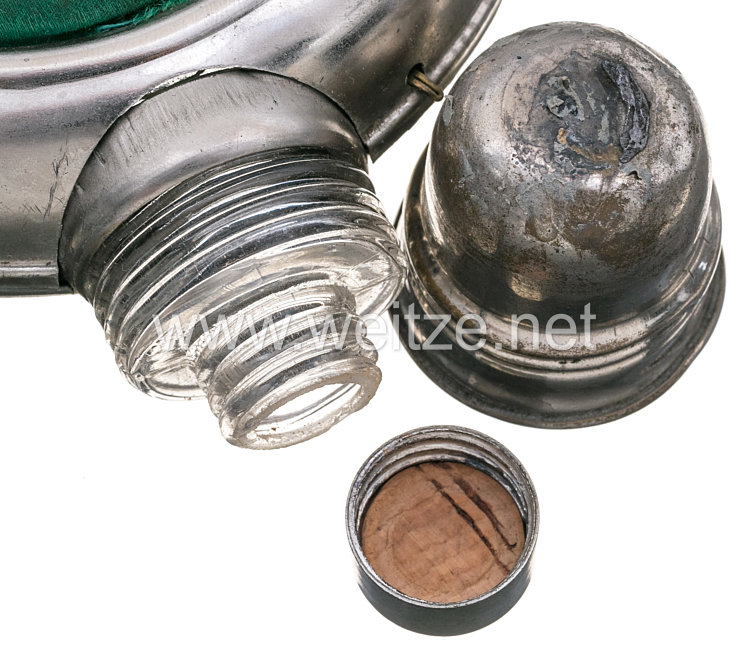
The quality and execution of such mementos varied considerably depending on the purchaser's financial means. The flask described here, with its elaborate painting and complete original accessories, suggests a high-quality execution. The drinking cup lid, which served as a practical element for actual drinking, was standard equipment for such flasks.
The year 1899, when Reservist Brinker completed his service, falls within the reign of Kaiser Wilhelm II, an era characterized by intensified militarism and nationalism. Veneration of the military permeated all social classes, and reservist status enjoyed high esteem. Veterans' associations and warrior societies played an important role in social life, and reservist mementos were proudly displayed at meetings of these organizations.
Today, such reservist drinking flasks are valuable historical documents that provide insights into military culture, social history, and the material culture of the German Empire. They document not only the formal military history of individual regiments but also the personal experiences and emotional bonds of soldiers to their service time. As objects of everyday culture, they complement official military history with important perspectives.
Preserving such objects presents challenges due to their mixed materials. Glass, metal, textiles, and painted surfaces react differently to environmental influences. The flask described here, with its well-preserved painting, represents a fortunate example of a memento that has survived for over 120 years.
The 2nd Westphalian Hussar Regiment No. 11 participated in various military campaigns and maneuvers during its existence and was part of the complex military structure of the Prussian and later German army. Objects like this flask connect us directly to the individuals who served and help humanize military history beyond battles and campaigns. They remind us that military service was a formative experience for millions of young men in the Imperial era, shaping identities and social relationships that extended far beyond active duty.