Prinz Heinrich von Preußen: silberne "Einladungskarte" der Deutsch-Amerikanischen Bürgerunion der Stadt Kansas City anlässlich seines Staatsbesuchs 1902
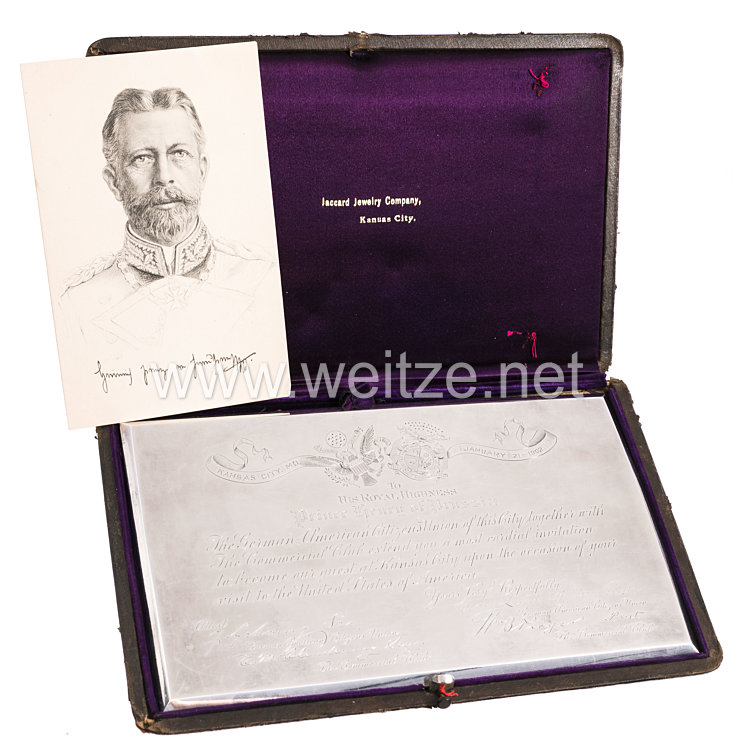
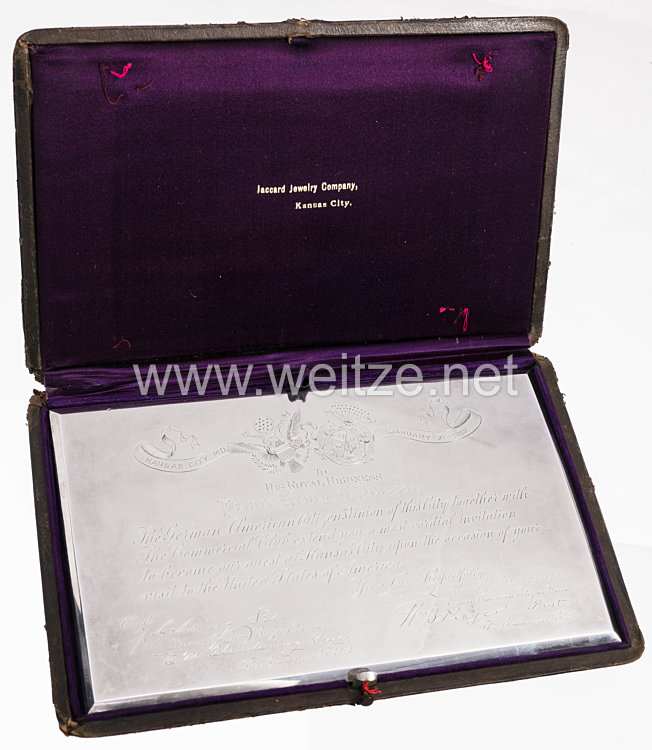
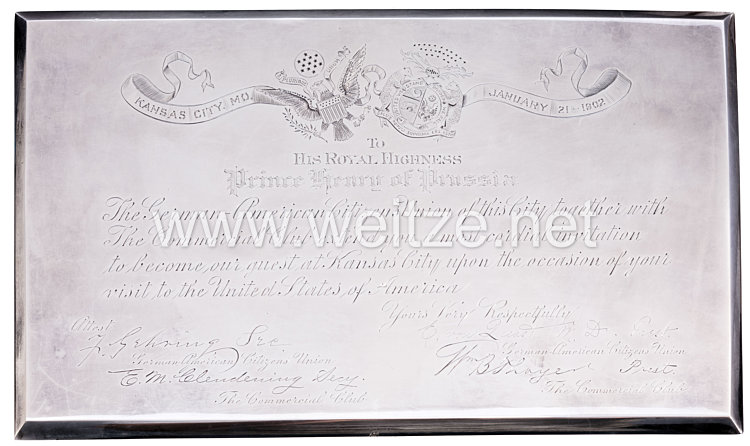
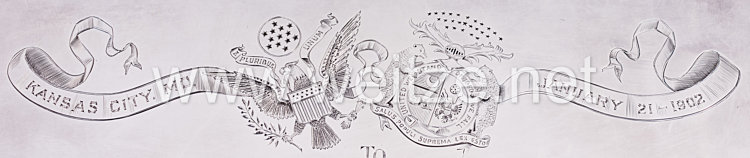
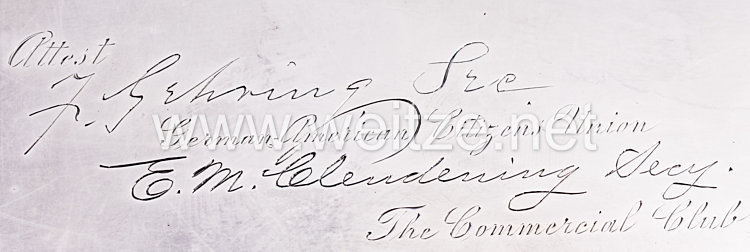
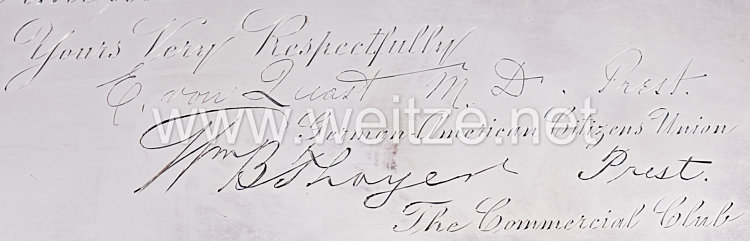
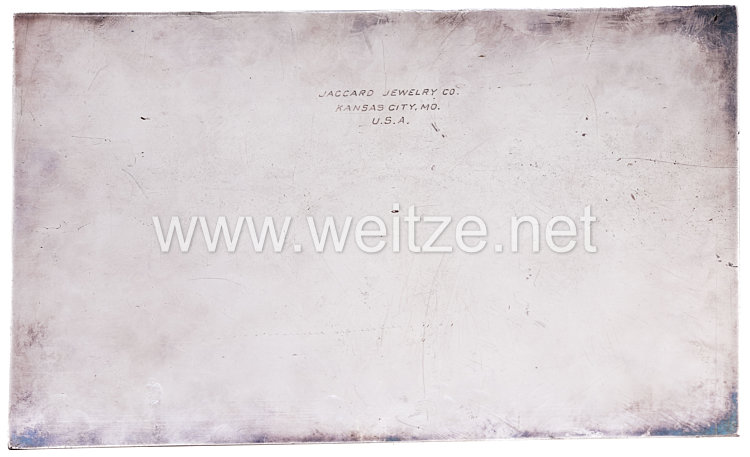
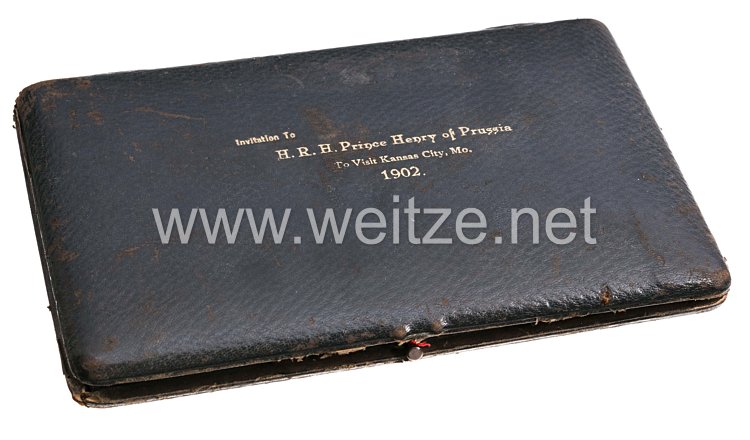
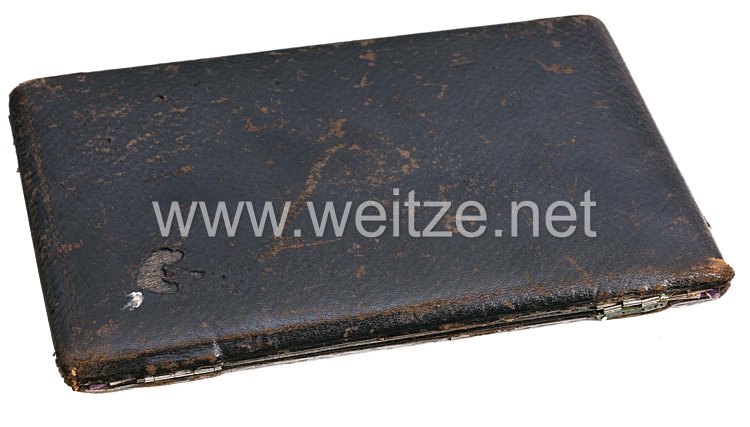
Große massiv silberne rechteckige Platte mit sehr schöner Gravur: amerikanischer Hoheitsadler und Stadtwappen Kansas City, Mo January 21 - 1902", darunter der fein gravierte Text.: "To His Royal Highness Prince Henry of Prussia - The German-American Citizens Union of this City together with The Commercial Club extend you a most cordial invitation to become our guest at Kansas City upon the occasion of your visit to the United States of America. Yours very respectully" mit den 4 Faksimile Unterschriften der Vorsitzenden der beiden Vereinigungen. Fertigung aus 925er Silber, Gewicht 935 Gramm, 13 x 20 x 0,5 cm. Rückseitig "Jaccard Jewelry, Co. Kansas City Mo. U.S.A.". Komplett im original Präsentationsetui, mit dunklem Leder bezogen und Goldaufdruck "Invitation to H.R.H. Price Henry of Prussia to Visit Kansas City, Mo. 1902". Innen gefüttert mit dunkelblauem Samt und Seide.
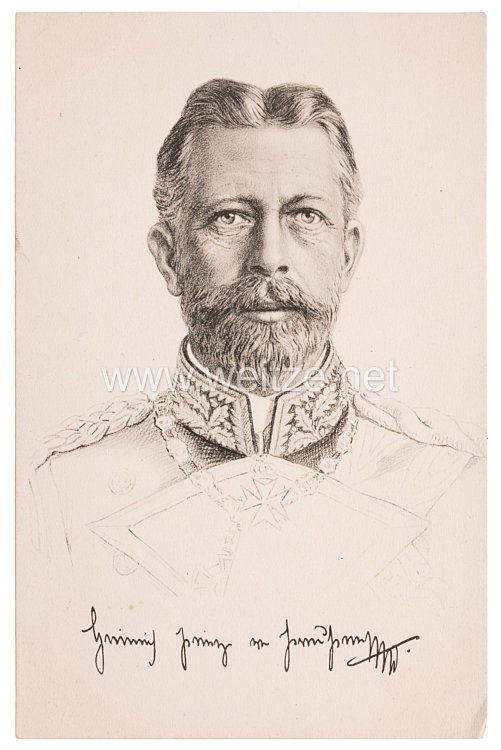
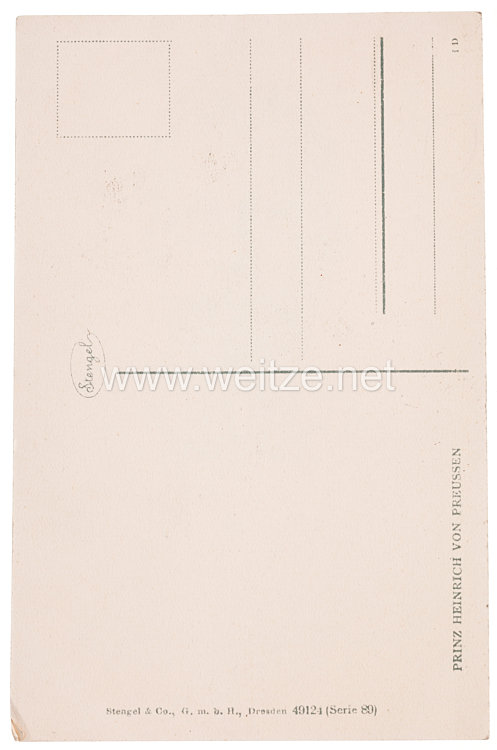
Die Einladungskarte und das Etui mit leichten Altersspuren, Kratzer, Gesamtzustand 2. Dazu eine original Postkarte in Kaiserlicher Marineuniform.
Heinrich von Preußen (* 14. August 1862 in Potsdam; † 20. April 1929 in Hemmelmark).
Albert Wilhelm Heinrich von Preußen war ein Sohn des späteren Kaisers Friedrich III. und Enkel Kaiser Wilhelms I. Seine Mutter, Kaiserin Victoria, war die älteste Tochter der britischen Queen Victoria. Heinrich war der jüngere Bruder Kaiser Wilhelms II.
Kaiser Wilhelm II. sandte seinen Bruder, Prinz Heinrich, vom 22. Februar bis 11. März 1902 auf eine diplomatische Goodwill-Tour durch die USA, auf der er in 18 Tagen in einem Sonderzug 4000 Meilen zurücklegte, dabei 25 Städte der Ostküste und des mittleren Westens besuchte und in zahlreichen Paraden und Empfängen die amerikanische Bevölkerung als liberaler und demokratischer Aristokrat begeisterte. Aufgrund des gedrängten Programms konnte er sich nur in wenigen Städten länger als vier Stunden aufhalten, darunter in New York, wo er der Schiffstaufe der neuen Yacht Meteor III seines Bruders am 25. Februar durch Alice Roosevelt beiwohnte, in Cambridge zur Übergabe zahlreicher deutscher Skulpturen und Statuen als Geschenk Kaiser Wilhelms II. an das Germanic Museum (heute im Busch-Reisinger-Museum) und um in der Harvard University die Ehrendoktorwürde in Empfang zu nehmen, außerdem verweilte er länger in Washington, Chicago, St. Louis, Milwaukee, Cincinnati und Philadelphia. Hochbedeutendes amerikanisches Geschenk aus dem preußischen Herrscherhaus.
Die Einladungskarte und das Etui mit leichten Altersspuren, Kratzer, Gesamtzustand 2. Dazu eine original Postkarte in Kaiserlicher Marineuniform.
Heinrich von Preußen (* 14. August 1862 in Potsdam; † 20. April 1929 in Hemmelmark).
Albert Wilhelm Heinrich von Preußen war ein Sohn des späteren Kaisers Friedrich III. und Enkel Kaiser Wilhelms I. Seine Mutter, Kaiserin Victoria, war die älteste Tochter der britischen Queen Victoria. Heinrich war der jüngere Bruder Kaiser Wilhelms II.
Kaiser Wilhelm II. sandte seinen Bruder, Prinz Heinrich, vom 22. Februar bis 11. März 1902 auf eine diplomatische Goodwill-Tour durch die USA, auf der er in 18 Tagen in einem Sonderzug 4000 Meilen zurücklegte, dabei 25 Städte der Ostküste und des mittleren Westens besuchte und in zahlreichen Paraden und Empfängen die amerikanische Bevölkerung als liberaler und demokratischer Aristokrat begeisterte. Aufgrund des gedrängten Programms konnte er sich nur in wenigen Städten länger als vier Stunden aufhalten, darunter in New York, wo er der Schiffstaufe der neuen Yacht Meteor III seines Bruders am 25. Februar durch Alice Roosevelt beiwohnte, in Cambridge zur Übergabe zahlreicher deutscher Skulpturen und Statuen als Geschenk Kaiser Wilhelms II. an das Germanic Museum (heute im Busch-Reisinger-Museum) und um in der Harvard University die Ehrendoktorwürde in Empfang zu nehmen, außerdem verweilte er länger in Washington, Chicago, St. Louis, Milwaukee, Cincinnati und Philadelphia. Hochbedeutendes amerikanisches Geschenk aus dem preußischen Herrscherhaus.