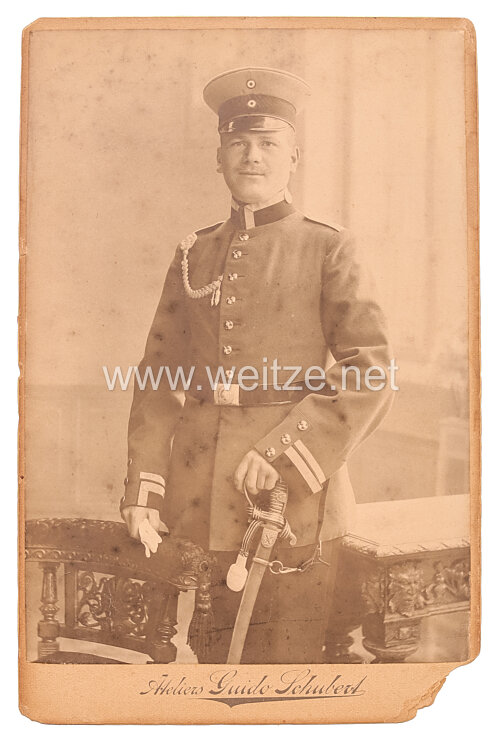
Kingdom of Saxony Cabinet Photo of a Feldwebel in the Royal Saxon 4th Field Artillery Regiment No. 48

Location Dresden, circa 1900. Dimensions approximately 10.5 x 16.5 cm. One corner damaged. Condition 2-.
449717
25,00

Kingdom of Saxony Cabinet Photo of a Feldwebel in the Royal Saxon 4th Field Artillery Regiment No. 48

The Royal Saxon 4th Field Artillery Regiment No. 48 represents a significant part of the military tradition of the Kingdom of Saxony within the German Empire. This cabinet card, photographed around 1900 in Dresden, shows a Feldwebel (sergeant major) of this distinguished regiment and provides us with a fascinating glimpse into the uniforms and military life of Saxon artillery at the turn of the century.

The 4th Field Artillery Regiment No. 48 was established during the army reforms after 1867, when the Kingdom of Saxony adapted its military structures to meet the requirements of the North German Confederation and later the German Empire. The regiment belonged to the XII (Royal Saxon) Army Corps and had its peacetime garrison in Dresden, the royal capital. Being quartered in the Saxon capital gave the regiment special importance and prestige.

The field artillery formed the backbone of the artillery arm in the German Army. Unlike the heavy foot artillery or fortress artillery, it was designed for mobile operations and equipped with towed guns that could be quickly repositioned in battle. Around 1900, the field artillery was equipped with modern Field Gun C/96 with a caliber of 7.7 cm. These guns represented the technological state of the art at the time, though they would soon be replaced by revolutionary recoil-operated guns.

The Feldwebel depicted in the photograph held one of the most important non-commissioned officer positions in the regiment. As the highest-ranking NCO of a battery or platoon, the Feldwebel was the central figure between the enlisted men and the officer corps. His duties included training soldiers, supervising drill and service operations, and managing equipment. In the artillery, he bore particular responsibility for the technically demanding operation of the guns and the precise execution of firing exercises.

The uniform of a Saxon field artilleryman around 1900 was distinctively designed. The artillery traditionally wore dark blue tunics with black collars and black cuffs, featuring the typical red piping of the artillery branch. The Feldwebel was recognizable by his silver braids and insignia that indicated his rank. On his head he wore the Pickelhaube, the characteristic helmet of the German military, which in the Saxon artillery featured a special ornament. The exact distinctions and execution of uniform parts were detailed in the uniform regulations of the Kingdom of Saxony.

Cabinet photographs like this one were a widespread medium for documenting military careers around 1900. With standard dimensions of approximately 10.5 x 16.5 cm mounted on cardboard, they represented an important form of personal and family remembrance. Soldiers frequently had themselves photographed in uniform by professional photographers, especially upon promotions or special occasions. In garrison cities like Dresden, numerous photo studios specialized in military portraits, expertly staging uniforms as well as orders and decorations.

The military significance of the regiment was particularly evident during annual maneuvers and inspections. The XII Army Corps regularly conducted large exercises where the field artillery demonstrated its firepower and mobility. Training was strict and followed the provisions of the drill regulations, which regulated down to the smallest detail the handling of guns and cooperation with the infantry.

The early 20th century marked a time of transition for the artillery. Technical development accelerated, and new tactical concepts fundamentally changed warfare. The 4th Field Artillery Regiment No. 48 would soon face its test under completely different conditions in World War I. The mobile field artillery of 1900 would develop into the principal weapon of a material-intensive trench warfare.

Historically speaking, this cabinet photograph documents not only the career of a single non-commissioned officer, but also provides us with valuable information about the military culture of the Kingdom of Saxony, the uniforms of the Imperial era, and the social significance of military service in the Wilhelmine period. Such photographic testimonies are today important sources for military historical research and uniform studies.