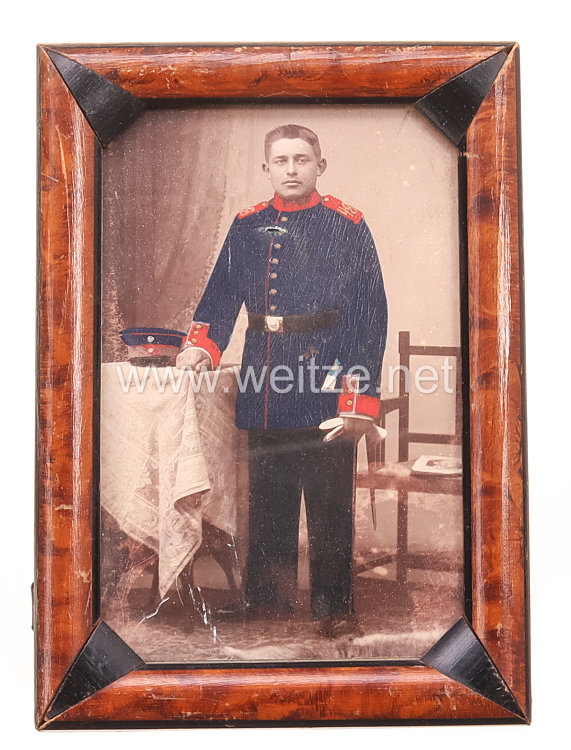
Prussia Hand-Colored Photograph of a Soldier in Infanterie-Regiment von Stülpnagel (5. Brandenburgisches) Nr. 48
This partially hand-colored photograph depicts a soldier of the Infantry Regiment von Stülpnagel (5th Brandenburg) No. 48, taken around 1900 at the garrison location of Cüstrin. Such photographs held great significance for soldiers and their families during the Wilhelmine era and represent valuable military-historical documents today.
The Infantry Regiment No. 48 belonged to the traditional units of the Prussian Army. It was established in 1860 as the 5th Brandenburg Infantry Regiment and received the honorary name “von Stülpnagel” in 1889 after Lieutenant General Joachim von Stülpnagel (1799-1882), who distinguished himself in the Schleswig-Holstein Wars and the Austro-Prussian War of 1866.
The garrison town of Cüstrin (today Kostrzyn nad Odrą in Poland) was an important Prussian fortress city at the confluence of the Warta and Oder rivers. The city had a long military tradition and served as a strategically important stronghold in the Brandenburg province. Regiment No. 48 was stationed there and formed an integral part of the local garrison.
Hand-colored photographs of this era represent a special art form. Black-and-white photographs were subsequently hand-painted with color, with particular emphasis on military insignia, epaulettes, buttons, and uniform details. This coloring was labor-intensive handwork and made the photographs valuable keepsakes. The typical colors of the Prussian infantry - such as the Prussian blue of the uniform, red facings, and golden buttons - were thus preserved for posterity.
Around 1900, the German Empire was in the Wilhelmine Era under Kaiser Wilhelm II. The army enjoyed the highest social prestige, and military service was a matter of honor for young men. The Prussian infantry was organized according to strict regulations recorded in the Kriegs-Ranglisten (War Ranking Lists) and service regulations.
The uniform of the Prussian infantry around 1900 consisted of the dark blue tunic with regiment-specific insignia, the leather Pickelhaube helmet with metal fittings, and the characteristic side arm. Each regiment had its own distinctions visible on collar and cuff facings. Regiment No. 48 bore specific colors and insignia that distinguished it from other Brandenburg regiments.
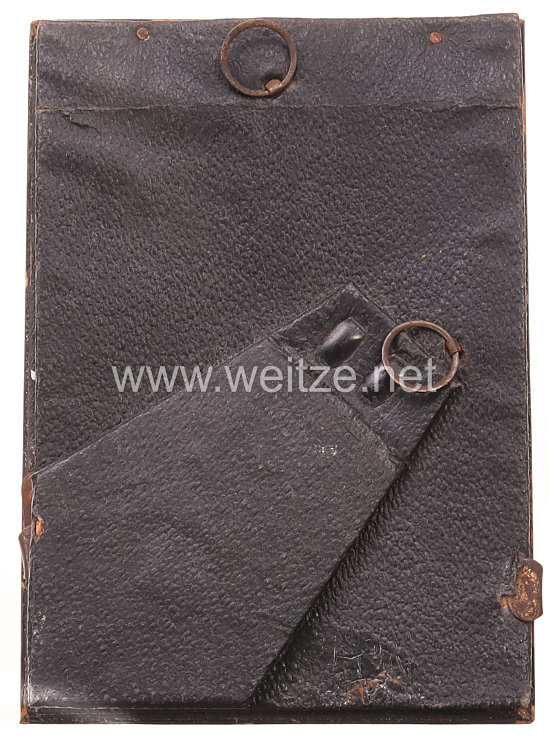
Such portrait photographs were typically produced in professional studio ateliers or by photographers specializing in military photography in garrison towns. Soldiers had themselves photographed in full uniform, often upon entering military service, on special occasions, or before leaving the army. The photographs were offered in various formats, from large cabinet cards to small formats like the present frame measuring approximately 7.2 x 10.2 cm.
The frame with stand was a typical presentation form of this period. These frames allowed the photographs to be displayed on dressers, sideboards, or mantelpieces. They were often made of cardboard, wood, or metal and sometimes elaborately decorated. The compact format made them ideal mementos that also served as gifts to family members or fiancées.
The Infantry Regiment No. 48 later participated in the First World War and was deployed on various fronts. The old traditions and peacetime uniforms were fundamentally changed by the reality of modern warfare. Photographs like this one therefore document an era that definitively ended with the outbreak of World War I in 1914.
For collectors and military historians, such hand-colored photographs are of considerable value. They enable precise identification of uniforms, regimental affiliations, and rank insignia. The coloring helps reconstruct the actual colors of historical uniforms, which is often difficult with purely black-and-white images. Moreover, they are testimonies to the photographic techniques and social life of their time.
The condition rating “Condition 2” indicates a well-preserved object with possibly slight signs of use, which is remarkable for a photograph over 120 years old. Such documents are today important sources for military-historical research and uniform studies.