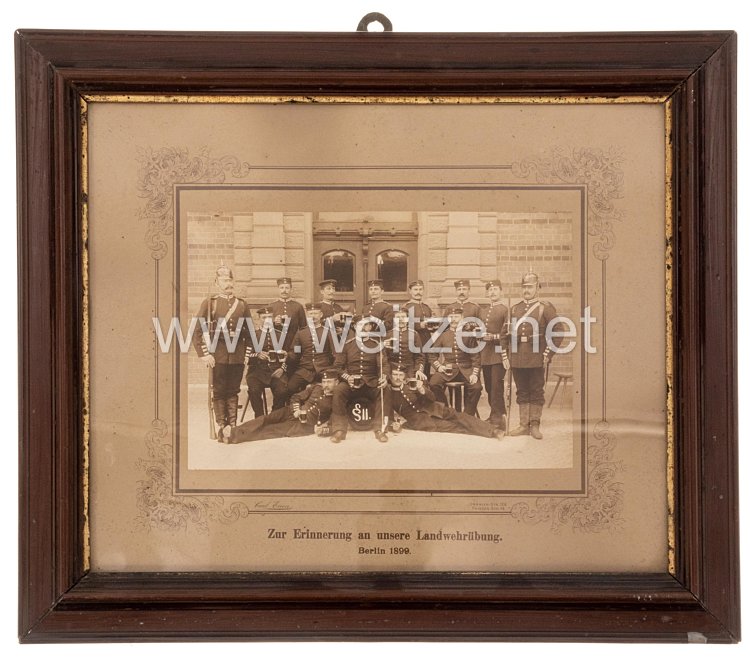
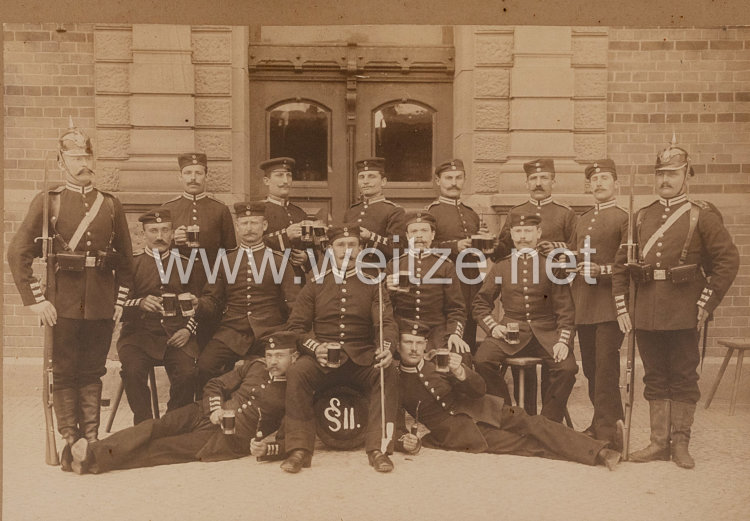
Prussia Guard-Landwehr Framed Photograph “In Remembrance of Our Landwehr Training Berlin 1899”

Dimensions approx. 42.5 x 36 cm. Condition 2.


412075
75,00

Prussia Guard-Landwehr Framed Photograph “In Remembrance of Our Landwehr Training Berlin 1899”

The framed photograph titled “Zur Erinnerung an unsere Landwehrübung Berlin 1899” (In Memory of Our Landwehr Exercise Berlin 1899) represents a significant artifact of Prussian military history from the late 19th century. Such commemorative pieces were widespread in the Imperial German Army and document the important role that the Garde-Landwehr (Guard Reserve) played in the military system of the German Empire.

The Prussian Landwehr had been an essential component of the military system since the army reforms of the early 19th century. Following the devastating defeats against Napoleon, Prussia introduced a three-tier military system from 1813 onwards under reformers such as Gerhard von Scharnhorst and August von Gneisenau. Alongside the standing army and the reserves, the Landwehr formed the third pillar. It comprised men who had already completed their active service but remained liable for military duty until the age of 39.

The Garde-Landwehr held a special position within this system. As part of the Prussian Guard, which was directly subordinate to the King, it enjoyed higher prestige than regular Landwehr formations. Guard Landwehr units were primarily stationed in the imperial capital Berlin and its immediate vicinity. They recruited from reservists who had previously served in Guard regiments, which gave them an elite character.

The year 1899, when this exercise took place, fell during a period of relative stability and growing military power of the German Empire under Kaiser Wilhelm II. The German Army was undergoing modernization and expansion. The Naval Laws of 1898 and 1900 aimed to develop Germany into a major naval power, while the army continued to be regarded as the strongest land force in Europe.

Regular Landwehr exercises were an essential component of military readiness. Reservists were required to report for multi-day or multi-week exercises at specific intervals to maintain their military skills and learn current tactical developments. These exercises typically took place during the summer months and included drill, shooting practice, maneuvers, and tactical training.

The tradition of documenting such exercises through commemorative photographs developed in the second half of the 19th century, parallel to the spread of photography. Photographers regularly accompanied military units and offered participants the opportunity to have group or individual portraits made. These were then frequently presented in ornate frames and inscribed with appropriate captions.

Such framed photographs served multiple functions. They served as personal mementos of shared military service, strengthened the esprit de corps and camaraderie among soldiers, and demonstrated membership in the military estate – an important social status in Wilhelmine Germany. The military enjoyed high prestige in society, and visible affiliation with a military institution, especially the prestigious Guard, was an expression of social standing.

The typical design of such commemorative pieces usually included a central group photograph of the participants in uniform, often supplemented by individual portraits of officers, images of buildings or military installations, and decorative elements such as flags, coats of arms, or patriotic symbols. The framing was usually elaborate, underscoring the value and significance of the memento.

The military uniform of the Garde-Landwehr around 1899 essentially corresponded to that of active Guard troops, though it often featured simplified elements. The characteristic Pickelhaube (spiked helmet), the hallmark of the Prussian-German army, was also worn by Landwehr units. Specific insignia and distinctions indicated affiliation with the respective branch and unit.

In historical context, such documents are today of invaluable worth for military historical research. They provide authentic visual information about uniforms, military organization, social structures within the army, and the significance of the military in the social life of the Imperial era. Additionally, they enable insights into the individual biographies of the people depicted and their family traditions.

The preservation of such objects presents particular challenges. Photographs from this period are sensitive to light, moisture, and mechanical damage. The framing provided some protection but could also lead to damage through unsuitable materials or mounting methods. The indicated condition 2 suggests good preservation with possibly minor age-related and usage-related traces.

Today, such military-historical documents are sought-after collectibles that possess both cultural-historical and personal commemorative value and represent an authentic testimony to a bygone era of German history.