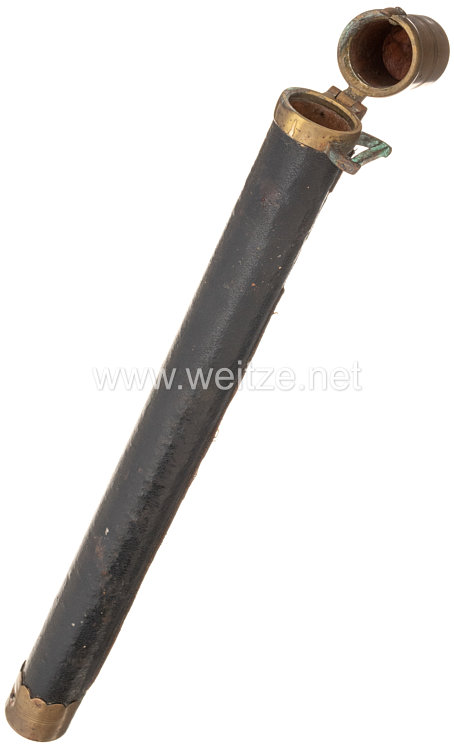
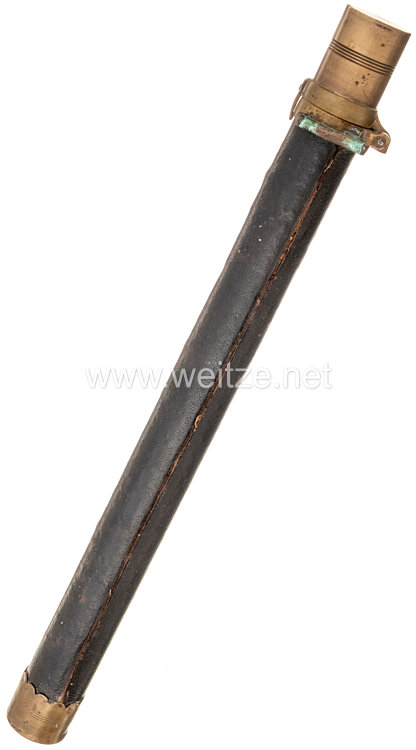
Prussia Case for Fife/Whistle; Infantry Regiment Graf Bülow von Dennewitz (6th Westphalian) No. 55
The whistle/fife was carried by the buglers of the foot troops. The case was worn immediately behind the side arm.
This case for a transverse flute or fife originates from the Infantry Regiment Graf Bülow von Dennewitz (6th Westphalian) No. 55 of the Prussian Army and dates to approximately 1910. This black leather case with brass fittings, clearly stamped with the regimental number “55,” represents an important aspect of military signaling in the German Empire.
Infantry Regiment No. 55 bore the honorary name Graf Bülow von Dennewitz in honor of Prussian General Friedrich Wilhelm Bülow von Dennewitz (1755-1816), who particularly distinguished himself in the Wars of Liberation against Napoleon. As the 6th Westphalian Infantry Regiment, it was stationed in the Province of Westphalia, with garrisons in Detmold, Höxter, and Bielefeld. These locations fostered the regiment's strong regional connection with the Westphalian population.
In the Prussian and later Imperial German Army, acoustic signals played a central role in the tactical command of troops. While mounted units used trumpets and cavalry bugles, the buglers of the foot troops carried fifes and transverse flutes. These instruments were particularly suitable for infantry, being lighter to transport and playable even while marching.
The infantry fife served to transmit various commands and signals on the battlefield and during garrison duty. Through established signal sequences, orders such as fall in, march, halt, or various tactical maneuvers could be transmitted over considerable distances, which was indispensable in times before electronic communication.
The case is made of black leather, a robust and weather-resistant material that protected the delicate flute from damage and weather conditions. The brass fittings served both for reinforcement and for attachment to the soldier's belt. The impressed stamp “55” clearly identified the equipment item as property of the regiment and facilitated the administration and assignment of equipment pieces.
According to Prussian uniform and equipment regulations, the case was worn directly behind the side arm on the belt. This position was carefully chosen: the fife remained easily accessible but neither hindered the soldier's freedom of movement nor access to other equipment items. The side arm itself was the bayonet that every infantryman carried on his belt.
The period around 1910 marked a transitional phase in military communication. While traditional acoustic signals still belonged to the standard repertoire, more modern means of communication were gradually being introduced. Nevertheless, the training of buglers remained an important component of basic military training. These soldiers were specially trained and enjoyed a special status within their company.
Training as a bugler required musical talent and discipline. Signalers had to master the entire range of tactical signals flawlessly, as confusion in combat could have fatal consequences. Training manuals and regulations of the Prussian Army precisely specified which signals were to be blown in which situations.
The stamping with the number “55” followed the Prussian system of regimental numbering, which enabled clear identification of all troop units. Every infantry regiment of the Prussian Army bore a unique number that was affixed to all equipment items, from knapsacks to belt buckles to instrument cases. This served not only administrative purposes but also fostered esprit de corps and regimental tradition.
Such equipment items are today important witnesses to the military history of the German Empire. They document the material culture of the army, the everyday reality of soldiers, and the technical standards of the time. The case represents the care with which even smaller equipment items were treated and the well-conceived organization of the Prussian military administration. For collectors and historians, such objects offer valuable insights into an era that was to end dramatically with the First World War.