Prussia Secular Standard Ribbon for the Flag of the Kürassier-Regiment Königin (Pommersches) Nr. 2

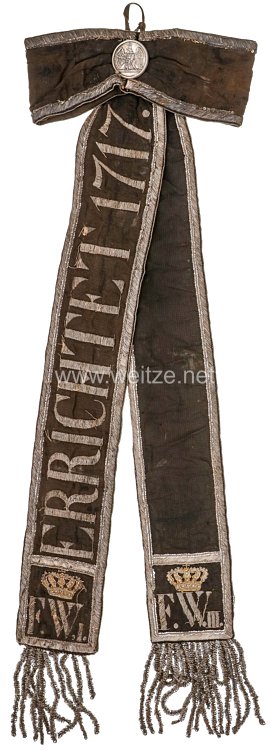
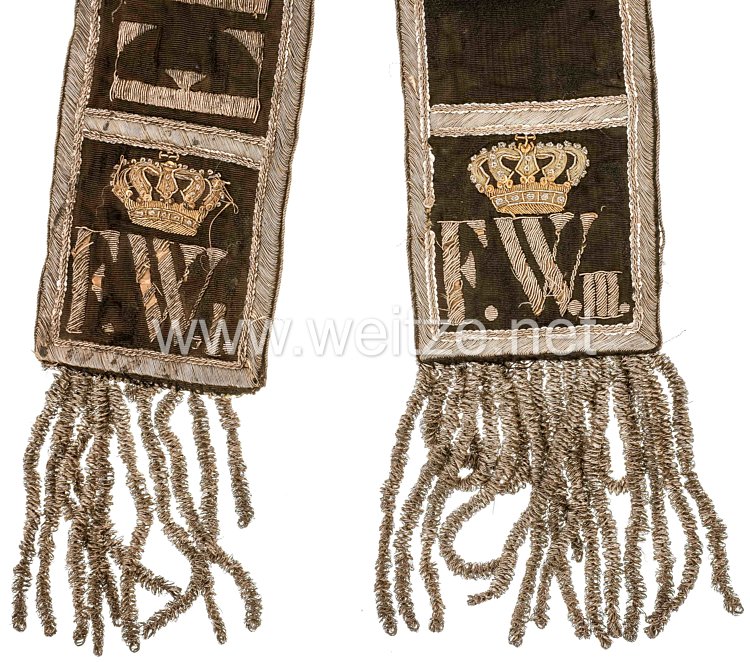
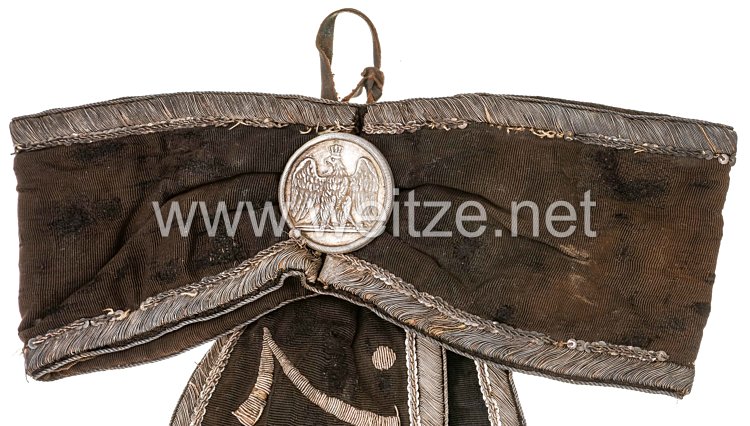
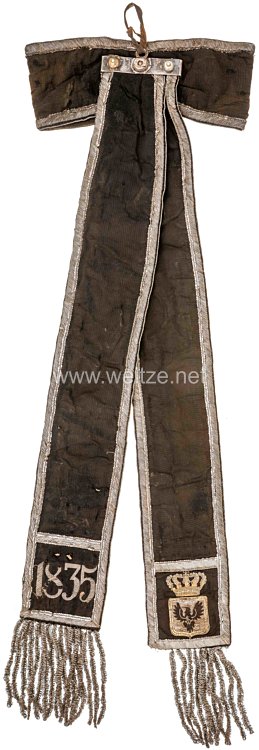
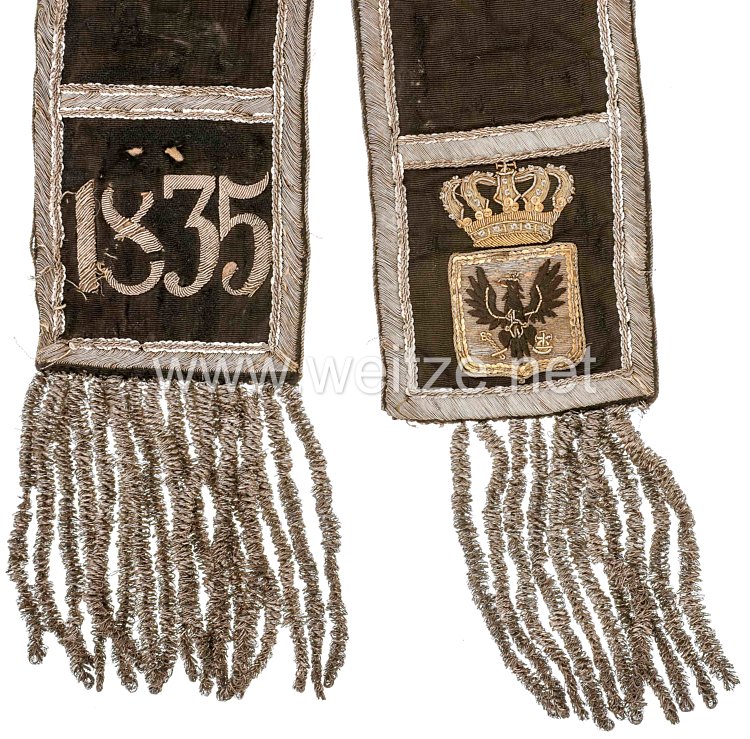
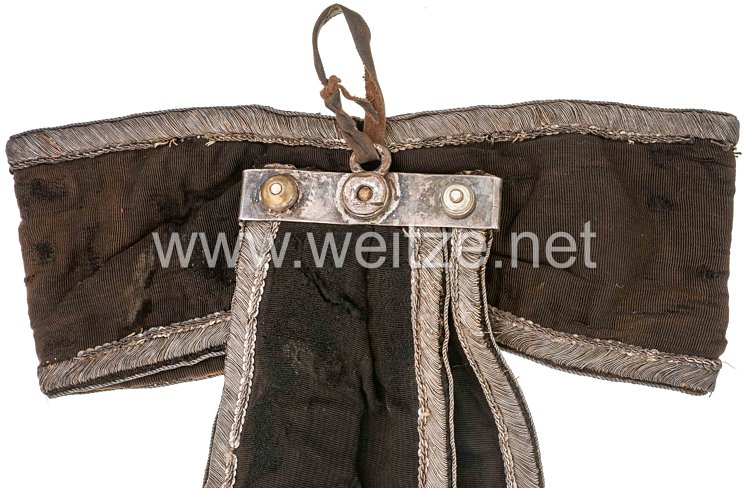
Location Pasewalk, circa 1835. The secular standard ribbon consisting of three parts, a bow and 2 bandeaus, the three parts connected by means of a heavy silver button with Prussian eagle. Heavy black fabric with silver braid and silver bullion, the left ribbon with inscription "ERRICHTET 1717." and "F.W.I.", the right ribbon "F.W.III.", reverse side "1835". With minor damage. Condition 2.

Remnants of Prussian flags are extremely rare, as these were mostly taken to the Soviet Union after World War II and largely destroyed.


359755
6.500,00

Prussia Secular Standard Ribbon for the Flag of the Kürassier-Regiment Königin (Pommersches) Nr. 2

The Secular Standard Ribbon of the Cuirassier Regiment Queen (Pomeranian) No. 2 represents an extraordinarily rare testimony to Prussian military history from the early 19th century. This three-part standard decoration, consisting of a bow and two bandeaus, was created around 1835 to commemorate the regiment's centennial jubilee and embodies the deeply rooted tradition of the Prussian cavalry.

The Cuirassier Regiment Queen (Pomeranian) No. 2 was established on June 6, 1717 under King Frederick William I in Pasewalk, as evidenced by the inscription “ERRICHTET 1717” (Established 1717) and the initials “F.W.I.” on the left ribbon. The cuirassiers formed the heavy cavalry of the Prussian army and were regarded as an elite unit, equipped with breastplates (cuirasses) and heavy palashes. The regiment was stationed in the Pomeranian garrison town of Pasewalk and developed over the decades into one of Prussia's most distinguished cavalry formations.

The secular celebration in 1835 took place under King Frederick William III, whose initials “F.W.III.” are noted on the right ribbon. Such centenary celebrations were observed with particular ceremony in the Prussian army. On these occasions, regiments frequently received new colors or additional standard ribbons that symbolized historical continuity and military tradition. The year “1835” on the reverse precisely documents the year of this significant jubilee celebration.

The elaborate execution of the standard ribbon reflects the high esteem accorded to such regimental insignia. The heavy black fabric with silver braid and silver bullion corresponds to the typical colors of Prussia. The heavy silver button with the Prussian eagle, connecting the three parts, is a characteristic element of Prussian heraldry and underscores the official character of the object. The use of silver and the elaborate workmanship demonstrate the material and symbolic significance of these flag ornaments.

Standard ribbons were an integral component of Prussian regimental colors and served not only for decoration but also for identification and honor. According to Prussian regulations, colors were adorned with such ribbons on special occasions that documented historical events, battles, or jubilees. They were usually attached to the flag staff below the flag cloth's tip and, together with the flag finial and other decorations, formed an ensemble of high symbolic power.

The historical significance of Cuirassier Regiment No. 2 is underscored by its participation in numerous campaigns. The regiment fought in the Silesian Wars under Frederick the Great, in the Wars of Liberation against Napoleon, and later in the wars of German unification in the 19th century. Such standard ribbons often carried the memory of these military successes and embodied the esprit de corps of the troops.

The state of preservation of this standard ribbon is remarkable, albeit with minor damage. This is quite understandable given its age and historical circumstances. The extraordinary rarity of Prussian flag remnants results from the events of World War II. The overwhelming majority of Prussian militaria, particularly flags and standards, were transported to the Soviet Union after 1945. There, most of these historical objects were systematically destroyed as symbols of Prussian militarism. Only a few examples survived in private collections or through fortunate circumstances.

The provenance of such objects today is of immense historical and museological importance. They enable material access to Prussian military history and cavalry tradition. The standard ribbon from Pasewalk documents not only the history of a single regiment but also represents the broader culture of military honor and tradition preservation in the Kingdom of Prussia.

For modern historical research, such authentic objects are indispensable sources. They supplement written records and illustrate the material culture of the Prussian military. The careful documentation and preservation of these rare remnants contribute to understanding an era that significantly shaped German and European history.

r