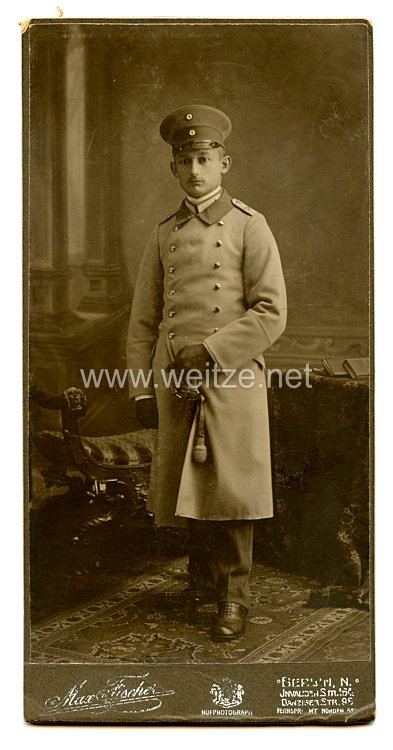
Prussia World War I Cabinet Photo of an Officer in an Infantry Regiment in Undress Tunic and Overcoat
This cabinet photograph depicts a German officer from an Infantry Regiment during World War I, photographed around 1914. Measuring 10.3 x 20.8 cm, it corresponds to the classic cabinet card format that served as the standard for portrait photography between the 1870s and 1920s.
The officer in this image wears two characteristic uniform pieces of the Prussian Army: the small tunic (Waffenrock) and the overcoat. The small tunic was the regular dress uniform of the German officer corps and differed significantly from the great tunic through its shorter, more tailored cut. This uniform jacket typically reached to the middle of the thigh and was closed with a row of buttons. The uniform was usually made of dark blue cloth, with different regiments wearing distinctive facings and trim colors, known as Waffenfarben (branch colors).
Prussian infantry traditionally used white branch colors, visible on collars, cuff patches, and shoulder straps. The exact design of the uniform followed the Dress Regulations of the Prussian Army, which detailed precisely how officers of various ranks and branches were to dress.
The overcoat also depicted in the photograph was an indispensable component of an officer's wardrobe. The officer's overcoat in the Prussian army was typically gray, later field gray, and served both representative and practical purposes. It was worn over the uniform and provided protection against weather conditions. Officers' coats were made from high-quality cloth and often featured velvet collars.
The year 1914 marks a decisive turning point in German military history. With the outbreak of World War I in August 1914, an era of magnificent, colorful uniforms came to an end. The requirements of warfare quickly led to the introduction of more practical, less conspicuous field uniforms. Traditional uniforms designed for parades and peacetime were increasingly replaced by field gray, more functional clothing.
Cabinet photographs like this one were extremely popular during the Wilhelmine Era. They were produced in professional studios, often with artfully painted backgrounds or studio props. Officers preferred to be photographed in full uniform to document their social status and military position. These photographs were mounted on sturdy cardboard and frequently bore the photographer's stamp on the reverse, with their name and address.
The officer corps of the Prussian Army enjoyed high social prestige in the German Empire. The officer profession was a privilege reserved mainly for the nobility and upper bourgeoisie. The uniform was not merely service clothing but a symbol of honor, duty, and social position. Officers wore their uniforms even at civilian occasions and social events.
The Infantry formed the backbone of the Imperial Army. In 1914, Prussia possessed numerous infantry regiments that were numbered consecutively and often carried additional traditional names. Each regiment had its own history and traditions, which were partially reflected in uniform design.
The specific details visible in such photographs—the arrangement of buttons, the style of collar, the type of shoulder boards—allow military historians to identify the officer's rank and often his specific regiment. The epaulettes and collar insignia were particularly important indicators of rank and branch of service.
Photography studios in German garrison towns did thriving business with military portraits. The cabinet card format was ideal for display in homes and for distribution to family members. Officers would often have multiple copies made to send to relatives or exchange with comrades, creating a visual network of military fellowship.
Photographs like these possess great historical value today. They document not only uniform history but also the individuals who fought in World War I. Many of these officers who had themselves photographed in 1914, full of optimism and sense of duty, would not survive the war or returned as changed men. The cabinet photograph thus stands symbolically for an epoch that ended irrevocably with World War I.
For collectors and historians, such photographs offer valuable insights into military everyday culture, uniform studies, and the social history of the German Empire. They are authentic testimonies of an era that, despite its temporal proximity, already appears distant and foreign.