Prussia Flag Finial for Infantry and Artillery Battalion Colors

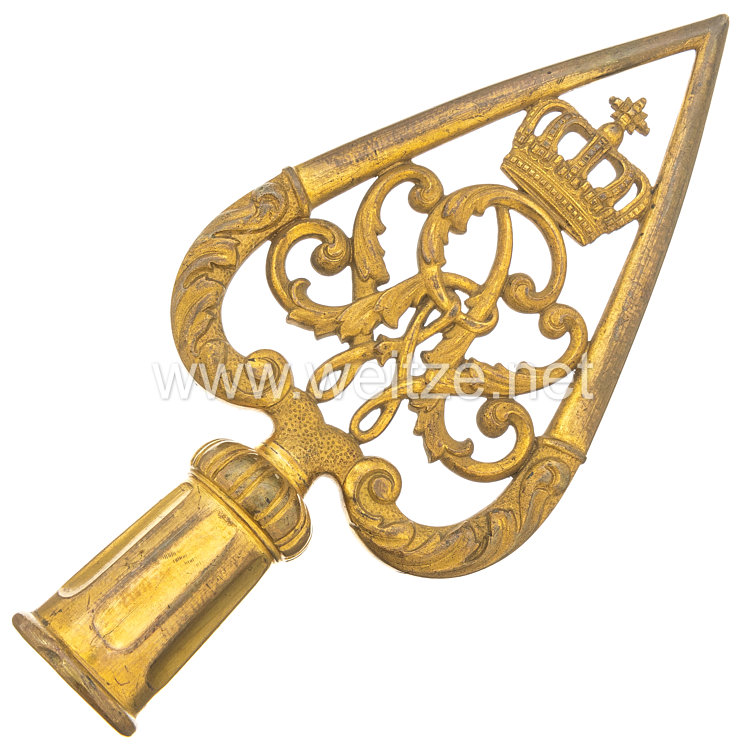
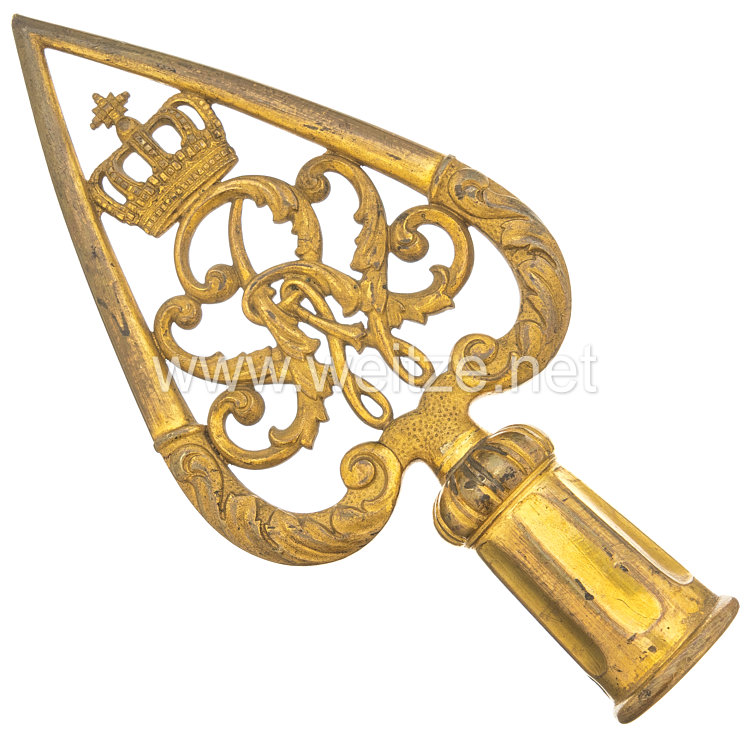
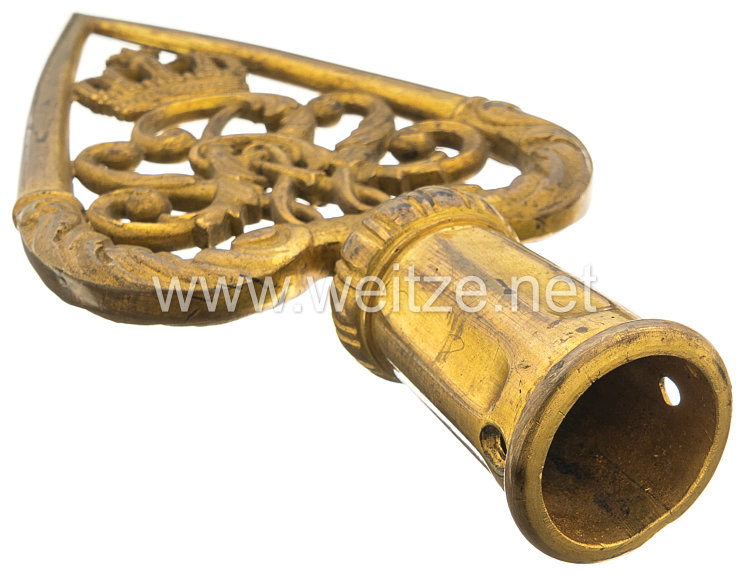
circa 1870. The flag finial in fire-gilded brass bronze, at center the crowned cipher “WR”. Complete with socket for the flagstaff. Overall height approximately 22 cm. Used piece with typical age-related wear, slightly bent (backward), in beautiful untouched original condition.
435929
2.500,00

Prussia Flag Finial for Infantry and Artillery Battalion Colors

The Prussian flag finial for battalion colors of the infantry and artillery from around 1870 represents a significant testament to military tradition and royal symbolism in the German Empire. These objects were far more than mere decorative elements – they embodied the honor, pride, and loyalty of Prussian troops toward their monarch.

The finial described here bears the crowned cipher “WR,” standing for Wilhelm Rex (William the King). This refers to King Wilhelm I of Prussia, who reigned from 1861 to 1888 and was proclaimed the first German Emperor in 1871. The period around 1870 marks a decisive epoch in Prussian-German history: The Franco-Prussian War of 1870/71 led to the founding of the German Empire and Wilhelm I's coronation as Emperor in the Hall of Mirrors at Versailles on January 18, 1871.

The manufacture from brass bronze with fire-gilding corresponds to the high craftmanship standards of Prussian military equipment of that era. Fire-gilding was an elaborate process in which a gold-mercury amalgam mixture was applied to the metal surface and subsequently heated to vaporize the mercury, leaving behind a permanent gold layer. This technique guaranteed not only a magnificent appearance but also resistance to weathering.

Prussian battalion colors were precisely regulated by various army ordinances and Royal Cabinet Orders. The design of flags and their finials followed strict regulations that detailed size, material, symbolism, and execution. The flag finial formed the crowning conclusion of the flagpole and was a widely visible sign of royal authority. Each battalion carried its colors with pride, and the loss of a flag in battle was considered the greatest disgrace.

The socket at the lower end of the flag finial enabled secure attachment to the flagpole. The total height of approximately 22 centimeters corresponds to the usual dimensions of such flag finials from the Wilhelmine era. The slight backward bend described here is characteristic of pieces that were actually used in service – possibly caused by the weight of the flag in wind or through handling during military ceremonies.

Flags played a central role in the Prussian military system. They served not only as rallying points in combat but were also symbols of the honor and tradition of the unit. At ceremonial occasions, parades, and oath-taking ceremonies, the colors were always present. The flag oath personally bound soldiers to their king and their colors. The ceremony of flag consecration was a significant event in the life of a battalion, during which the new flag was often received from the hands of the monarch or a high-ranking representative.

The distinction between infantry and artillery flags lay mainly in details of the flag cloth design, while the flag finials were often uniformly designed. The royal cipher as a central element emphasized the direct bond of the troops to the person of the king – a fundamental principle of the Prussian military constitution.

After the defeat in World War I and the abdication of Emperor Wilhelm II in November 1918, these monarchical symbols lost their official function. Many flags were hidden by their units or handed over to veterans' associations to protect them from confiscation. The Weimar Republic introduced new, republican flags, while the imperial symbols increasingly ended up in museums, archives, or private collections.

Today, such flag finials are important military-historical documents that provide insight into the symbolic world, craftsmanship, and military culture of the 19th century. The “untouched original condition” described here with its characteristic signs of age makes the piece particularly valuable for collectors and historians, as it has preserved the authentic patina of time and has not been falsified by later restorations.

The study of such objects contributes to understanding Prussian-German military history and illustrates the significance of symbols and rituals for the identity and cohesion of military units in the 19th century.