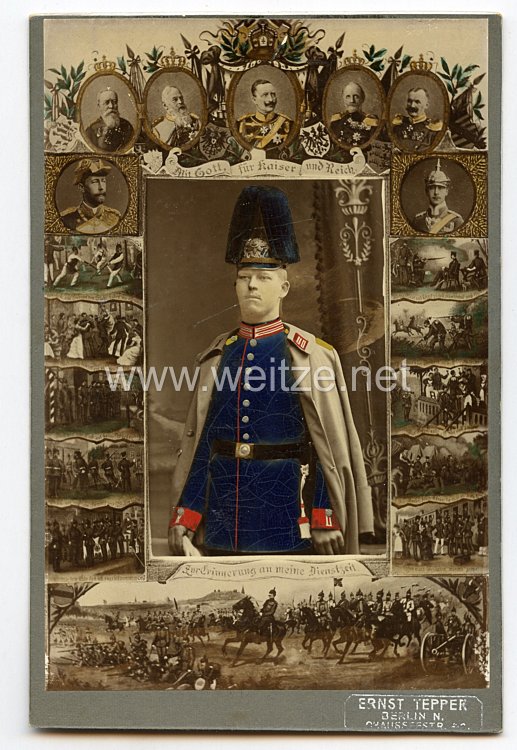
Prussia Partially Hand-Colored Cabinet Photo of a Soldier in the Garde-Füsilier-Regiment
The Garde-Füsilier-Regiment (Guard Fusilier Regiment) was among the most prestigious units of the Prussian Army and later the German Empire. This partially hand-colored cabinet photograph from around 1910 documents a soldier from this elite unit and represents an important epoch of German military history shortly before the outbreak of World War I.
The Garde-Füsilier-Regiment was founded in 1791 as the Füsilier-Bataillon von Rohdich and received the designation 1. Garde-Regiment zu Fuß (1st Foot Guards Regiment) in 1806. In 1888, it was renamed Garde-Füsilier-Regiment, under which name it existed until the end of World War I. The regiment was stationed in Berlin-Moabit and later in the Maikäfer Barracks in Berlin.
The uniform of the Garde-Füsilier-Regiment around 1910 followed Prussian military tradition with specific distinctions for Guard units. Soldiers wore the characteristic Waffenrock (dress tunic) in dark blue with the typical distinctions for fusiliers. The Gardelitzen (Guard lace) on collar and cuff flaps indicated membership in the Guards. The headgear consisted of the Pickelhaube (spiked helmet) with the Prussian eagle and Guard star, an unmistakable symbol of Prussian military power.
Cabinet photography developed in the second half of the 19th century into a popular medium for military portraits. The format of approximately 10.6 x 16 cm was standardized and mounted on sturdy cardboard, often with the photographer's name and address on the reverse. The partial coloring of photographs was a laborious technique in which certain elements such as uniform parts, medals, or insignia were subsequently hand-colored. This emphasized military distinctions and gave the image a special effect.
Around 1910, the German Empire under Kaiser Wilhelm II was at the height of its military presence. The army was massively expanded, and the military played a central role in society and politics. For young men, service in a Guard regiment meant not only military honor but also social prestige. The Guard regiments recruited their soldiers according to strict criteria, with reliability and often a certain social background considered alongside physical aptitude.
Having such a portrait made in a Berlin photo studio was a significant event for soldiers and their families. These photographs served multiple purposes: they were mementos for the family, documents of military service, and expressions of pride in belonging to an elite unit. Many soldiers had themselves photographed in full uniform to commemorate their military career.
The Garde-Füsilier-Regiment participated in numerous military parades and ceremonies in Berlin and was closely connected to the Prussian royal house. During state visits and official occasions, the regiment frequently provided the honor guard. This representative function underscored the importance of the Guard units for the self-image of the Prussian-German monarchy.
With the outbreak of World War I in August 1914, the Garde-Füsilier-Regiment was deployed on various fronts. The unit fought in Belgium, France, and later also on the Eastern Front. The heavy losses of the war also struck the Guard regiments hard. The end of the monarchy in 1918 simultaneously meant the end of the traditional Guard units. The regiment was dissolved as part of demobilization.
Today, such cabinet photographs are important historical sources for military and social history. They document not only uniforms and equipment but also the significance of the military in Wilhelmine society. The partial coloring makes these photographs particularly valuable as they provide authentic information about colors and details of uniforms that would be lost in pure black-and-white images.
For collectors and historians, these photographs represent a fascinating testimony to a bygone era. They combine photographic artistry with military-historical documentation and offer insights into a time that would be forever changed by World War I.