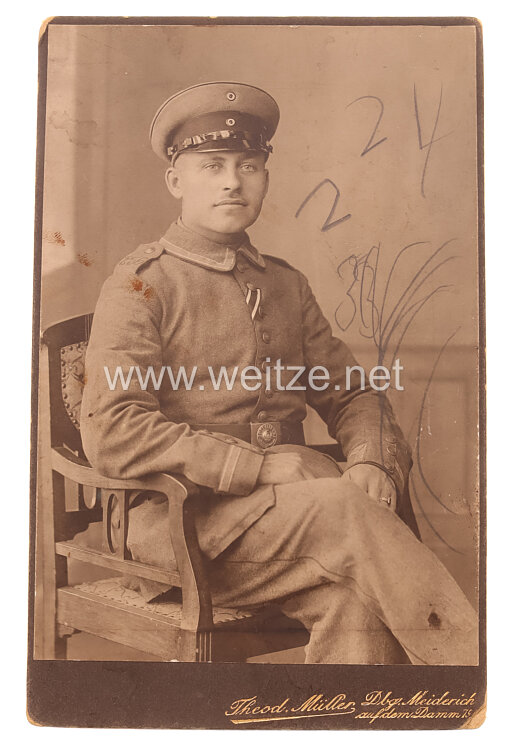
Prussia World War I Cabinet Photo of a Non-Commissioned Officer in Field-Gray Uniform of Reserve Infantry Regiment No. 256
This cabinet photograph depicts a non-commissioned officer (Unteroffizier) of the Reserve Infantry Regiment No. 256 in field-gray uniform during the First World War, taken around 1916. Such photographic portraits represent important historical documents that provide insights not only into the military uniforms and rank insignia of the Imperial Army, but also into the social and cultural significance of military service in Imperial Germany.
The Reserve Infantry Regiment No. 256 was established as part of the comprehensive mobilization at the beginning of World War I. With the declaration of war in August 1914, the German Army was massively expanded, and numerous new regiments were formed from reservists and newly conscripted soldiers. Regiment No. 256 belonged to the 256th Infantry Division, which was established in spring 1917 and was primarily deployed on the Western Front. Regiments with three-digit numbers were typically wartime formations created only after the outbreak of war.
The field-gray uniform worn by the depicted non-commissioned officer had been gradually introduced in the Prussian and German Army from 1907/1910, replacing the previously used colorful parade uniforms for field service. The color “field gray” provided better camouflage on the modern battlefield, where machine guns and artillery had made traditional, conspicuous uniforms a deadly risk. The uniform consisted of a single-breasted field tunic (Model 1907/10) with standing collar, cloth trousers, and boots or puttees.
The rank of Unteroffizier (non-commissioned officer) was an important position in the military hierarchy. NCOs formed the backbone of the army and were responsible for the immediate leadership and training of enlisted men. They wore characteristic rank insignia that varied depending on the exact rank level (Unteroffizier, Vizefeldwebel, Feldwebel) and time period. Typically, these consisted of braid trim on the collar and shoulder straps. The Prussian Army strictly distinguished between NCOs with and without sword knot (Portepee), with the latter being designated as “Deckoffiziere” and enjoying higher status.
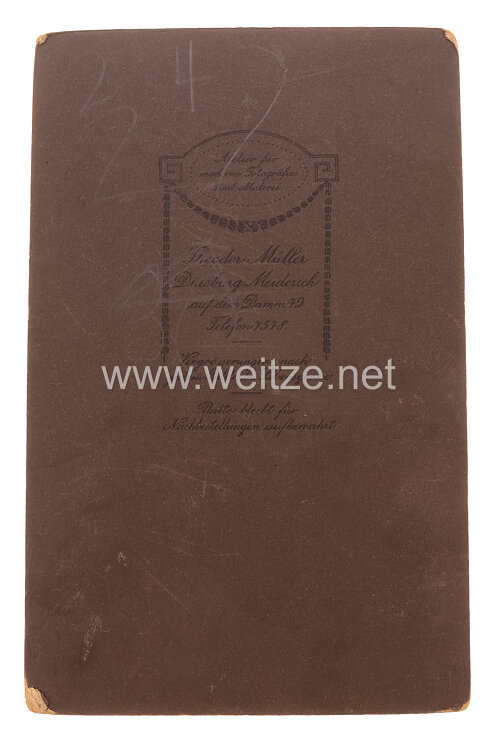
The cabinet format of the photograph, measuring approximately 10 x 16 cm, was a standardized portrait format that had been popular since the 1860s. During World War I, military portrait photography experienced an unprecedented boom. Soldiers had themselves photographed in professional studio ateliers before their deployment to the front or during home leave, to leave their families a memento. These photographs served both personal and social functions: they documented pride in military service and served as keepsakes during a time of great uncertainty.
The dating to around 1916 falls into a phase when World War I had fully developed its industrialized and material-intensive character. After the failed offensives of 1914 and 1915, an exhausting trench warfare had developed on the Western Front. The Battle of Verdun and the Battle of the Somme in 1916 claimed hundreds of thousands of casualties and shaped collective memory as symbols of modern warfare. For a non-commissioned officer in a reserve regiment, this often meant deployment on the front line, organizing trench garrisons, and leading his squad under the most extreme conditions.
Photographic studios in the homeland and also in cities near the front offered their services specifically for soldiers. The photographs were usually taken against neutral backgrounds or painted backdrops. The soldier wore his best walking-out uniform, often with all awarded decorations and insignia. Such portraits were deliberately staged and intended to convey a dignified, proud image of the soldier that corresponded to ideals of duty fulfillment and military honor.
After the war, these photographs acquired new significance as memorial objects. For many families, they were the only remaining images of fallen relatives. They were kept in family albums, framed and hung on walls, or placed on domestic memorial altars. The mass distribution of such military portraits contributed to the development of a specific culture of remembrance that continues to shape the collective perception of World War I to this day.
From a military-historical perspective, such cabinet photographs are valuable sources for uniform studies, the social history of the military, and the everyday history of war. They document the diversity of regiments, the development of uniforms, and allow conclusions about recruitment, military organization, and the social composition of the armed forces of the German Empire.