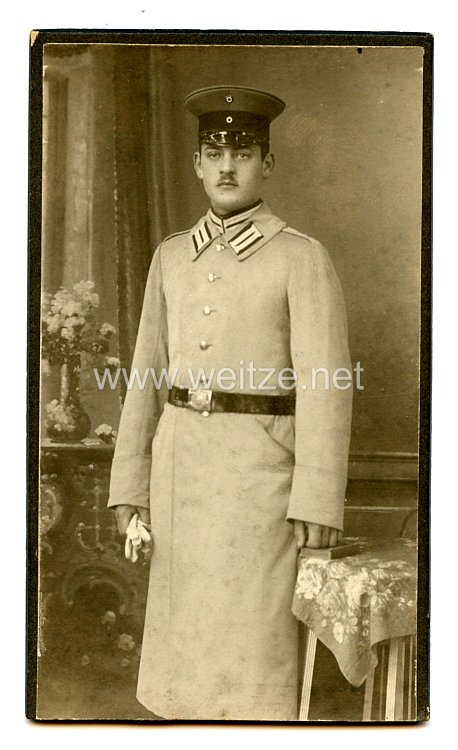
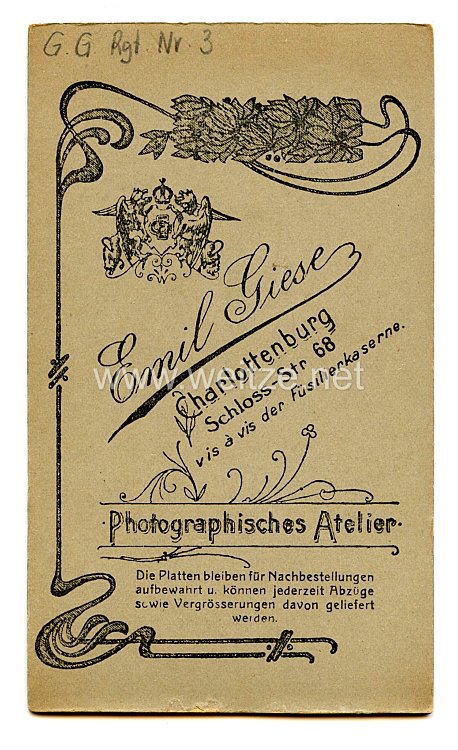
Prussia Cabinet Photograph Soldier of the Königin Elisabeth Garde-Grenadier-Regiment Nr. 3
This cabinet photograph depicts a soldier of the Queen Elisabeth Garde-Grenadier Regiment No. 3, taken around 1900 at the garrison location of Charlottenburg. Such photographic portraits represent significant testimony to Prussian military culture in the late Imperial period and document the tradition and pride associated with service in a Guards regiment.
The Garde-Grenadier Regiment No. 3 was among the most prestigious units of the Prussian Army. It was founded in 1814 as the 2nd Guard Regiment on Foot and received the designation Kaiser Franz Garde-Grenadier Regiment No. 2 in 1826. Following the death of Emperor Franz II of Austria, the regiment was renamed in 1853 as the Queen Elisabeth Garde-Grenadier Regiment No. 3, in honor of the Prussian Queen Elisabeth Ludovika of Bavaria, consort of King Friedrich Wilhelm IV. This naming underscored the close connection between the royal house and the Guards troops.
The garrison at Charlottenburg held great strategic importance for the Prussian Guard. The barracks in Charlottenburg, then still an independent suburb west of Berlin, housed several Guards units and developed into an important military location. Proximity to the residential capital of Berlin enabled the Guards troops to fulfill their ceremonial duties while simultaneously serving as a military reserve for the capital.
The period around 1900 marks an era of intense military modernization in the German Empire under Wilhelm II. Simultaneously, the Guards regiments preserved their traditional uniforms and ceremonies that emphasized their historical significance. The Garde-Grenadiers wore characteristic uniforms with the Grenadier cap, a tall headdress that traced back to the historical elite Grenadier troops of the 18th century.
Cabinet photographs were a popular portrait format during the period between approximately 1870 and 1910. With a standard size of about 11 x 16.5 cm for the cardboard mount, they were larger than the earlier carte-de-visite photographs and smaller than large-format studio portraits. Soldiers frequently had themselves photographed in uniform to document their military service and create mementos for family and comrades. These photographs were produced in professional studios often located near barracks and garrisons.
The photographic portrait of a soldier possessed high symbolic value in Wilhelmine society. The uniform represented not only military affiliation but also social standing and patriotic sentiment. For young men, military service was an important rite of passage, and the photographic portrait in uniform documented this life stage. For members of the Guard, this held particular significance as these units were considered the military elite.
The Garde-Grenadiers played an important role in military parades, royal ceremonies, and as honor guards. Their training was particularly intensive, and selection criteria for service in the Guard were strict. In addition to military capabilities, height, appearance, and social background were also considered. Service in a Guards regiment often opened doors for later military or civilian careers.
The regiment participated in the most important military conflicts of the 19th century, including the Wars of Liberation, the Wars of Unification of 1864, 1866, and 1870/71. In World War I, the regiment fought on various fronts and suffered heavy losses. With the end of the monarchy in 1918 and the dissolution of the old army, the regiment was also disbanded.
Such cabinet photographs are valuable historical documents today. They provide insights into uniforming, military culture, and the social history of the Imperial period. For military historians, uniform researchers, and collectors, they offer authentic visual material for researching Prussian-German military history. The photographic quality and preservation of such images varies, with well-preserved examples being particularly valued.