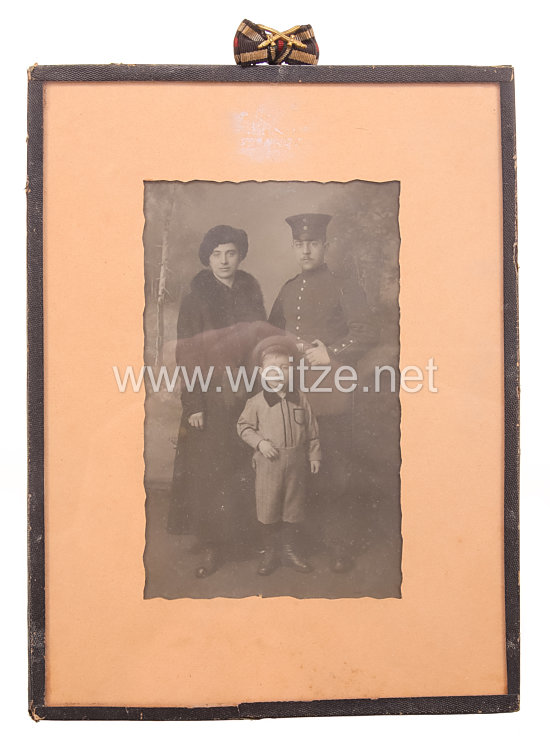
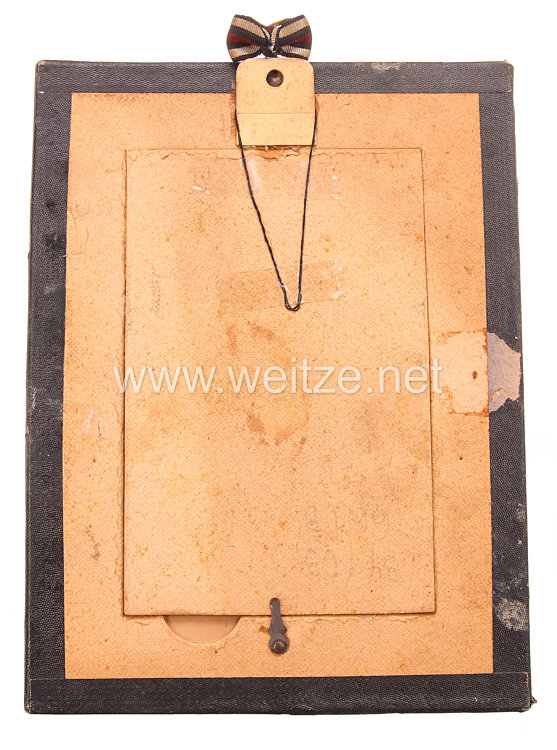
Prussia World War I Framed Photograph of a Soldier with his Family

Circa 1915. Approximately 15 x 20 cm. Condition 2.
412482
30,00

Prussia World War I Framed Photograph of a Soldier with his Family

The framed photograph of a Prussian soldier with his family from the First World War era, dated around 1915, represents a significant cultural and social phenomenon of that epoch. Such photographs were far more than mere mementos; they served as material connections between the front lines and home, documenting the profound impact of war on German family life.

By 1915, the German Empire was already in the second year of the devastating world war. Initial war enthusiasm had given way to sobering reality as men fought on various fronts – the Western Front in France and Belgium, the Eastern Front against Russia, and other theaters of war. The Prussian Army formed the backbone of German military forces and provided the largest contingent of soldiers.

Photography as a medium had firmly established itself by the First World War. Studio photographic portraits had become increasingly affordable since the 1860s, and by 1914, photography was an integral part of bourgeois and even lower-middle-class life. War photography in the form of private family portraits followed certain conventions: soldiers typically had themselves photographed in full uniform, often with their families, to create a lasting memorial before departing for the front or during home leave.

The framing of such photographs held particular significance. It transformed the simple photograph into a treasured family heirloom that received a place of honor in the home. In Wilhelmine society, these framed photographs were often placed on dressers, cabinets, or pianos, where they symbolically maintained the presence of the absent family member. The framing signified appreciation and gave the image a quasi-sacred character.

The military context of these photographs is inseparably linked with Prussian military tradition. The Prussian Army had played a central role in German history since the reforms after 1806. The uniform a soldier wore in such photographs was not merely service dress but a symbol of duty fulfillment, honor, and patriotic sentiment. Different military branches – infantry, cavalry, artillery, pioneers – were recognizable by distinct uniform details, insignia, and equipment.

By 1915, the war had already claimed hundreds of thousands of casualties. The reality of modern mechanized warfare with its trenches, machine gun fire, and gas attacks stood in stark contrast to the often idealized photographic representations. Nevertheless, these images fulfilled an important psychological function: they preserved the illusion of normalcy and familial continuity during a time of fundamental upheaval.

The social-historical significance of such photographs can hardly be overstated. They document not only military ranks and uniforms but also family structures, clothing customs, photographic conventions, and the material culture of the time. For historians, they are valuable sources for researching the everyday history of the First World War, gender roles, and the history of mentalities.

The preservation of such photographs over more than a century testifies to their emotional significance for subsequent generations. Many of these framed images became family relics, passed down from generation to generation, often accompanied by orally transmitted stories about the fate of the depicted soldier. They commemorate individual life stories within one of the most catastrophic conflicts of modern history, which claimed over 17 million lives and fundamentally changed Europe.

Today, such photographs hold both historical and collectible value. They are preserved in museums, archives, and private collections, serving historical education and commemorative culture. They urge engagement with history and remind us of the human costs of military conflicts.

r