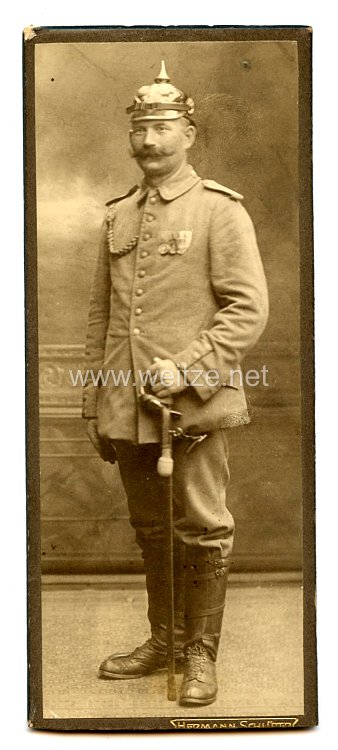
Prussia World War I Cabinet Photo Non-Commissioned Officer in an Infantry Regiment
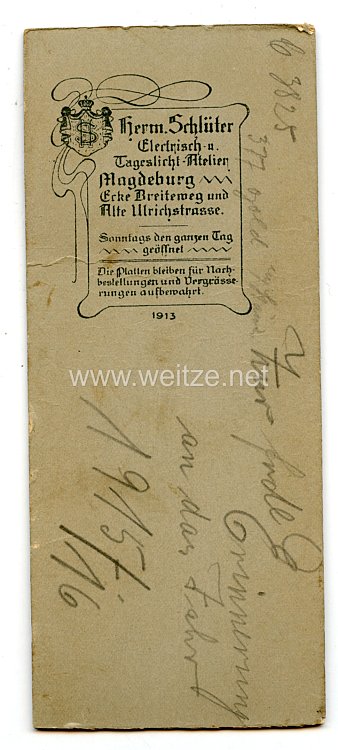
This cabinet photograph depicts a non-commissioned officer (Unteroffizier) of an infantry regiment in the Prussian Army during World War I. Created in 1916 in Magdeburg, this portrait photograph documents a crucial moment in German military history and represents the photographic practices of the war years.
Cabinet card photography had been the preferred format for portrait photography since the 1870s, gradually replacing the smaller carte-de-visite format. With dimensions of approximately 4 x 6 inches for the photograph mounted on a card of about 4.5 x 6.5 inches, this format provided sufficient space for detailed representations of uniforms and decorations. During World War I, military portrait photography experienced an enormous surge, as soldiers had themselves photographed before deployment to the front or during home leave to leave a memento for their families.
The rank of Unteroffizier (non-commissioned officer) represented an important position in the Prussian-German Army. NCOs formed the backbone of the military hierarchy and were responsible for the direct leadership of enlisted men. They functioned as the vital link between common soldiers and officers. The NCO ranks included various grades, including Unteroffizier, Sergeant, Vizefeldwebel (Vice Sergeant Major), and Feldwebel (Sergeant Major). Promotion to NCO rank occurred after appropriate service time and proven performance, as well as completion of special training courses.
The Prussian Infantry formed the numerically largest part of German forces in World War I. At the outbreak of war in 1914, the German Empire possessed numerous infantry regiments organized into various army corps. The infantryman's uniform was changed in 1915 from the traditional Prussian Pickelhaube (spiked helmet) to the more practical steel helmet, which is also reflected in photographic representations of this period. The field uniform was field-gray, marking a distinct departure from the colorful peacetime uniform.
The city of Magdeburg was a significant garrison town in Prussia. The city housed several military installations and served as an important training and administrative location. During World War I, wounded soldiers were treated here, reservists were trained, and troops were prepared for deployment to the front. The numerous photo studios in Magdeburg profited from the strong military presence and specialized in soldier portraits.
The year 1916 marked a turning point in World War I. The Battle of Verdun and the Battle of the Somme claimed hundreds of thousands of casualties and demonstrated the brutal reality of modern trench warfare. The German war economy became increasingly strained, and initial war enthusiasm gave way to a sober recognition of the reality of war. Nevertheless, military photography remained an important medium for maintaining morale and documenting individual war service.
The photographic practice of wartime followed established conventions. Soldiers were typically photographed in full uniform, often with their equipment and weapons, against neutral backgrounds or before painted backdrops. Poses were usually formal and reflected military bearing. Photographers employed professional lighting techniques to highlight the details of uniforms, rank insignia, and any decorations.
Such cabinet photographs served multiple functions: they served as personal mementos for family members, as documents of military service, and as expressions of pride and fulfillment of duty. After the war, these photographs became important keepsakes and historical documents that provide insight into uniforming, military hierarchy, and social aspects of World War I.
The preservation of such photographic documents is of great historical significance. They enable present generations to recognize the individual faces behind the statistics of war and to understand the human dimension of this global conflict. Cabinet photographs like this are valuable sources for military historical research and uniform studies.