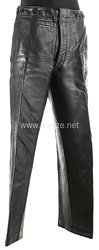
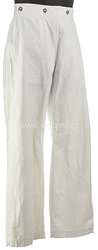
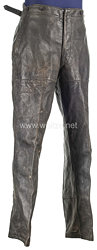
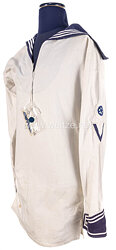
who was killed in action on November 1, 1943, during the loss of his boat U-405 in the central North Atlantic.
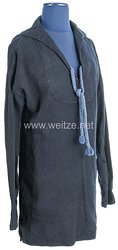
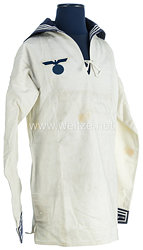
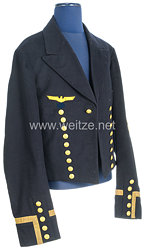
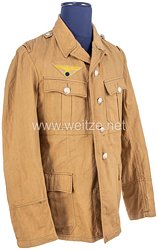
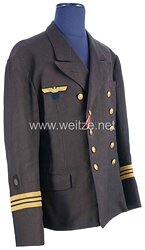
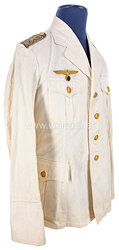
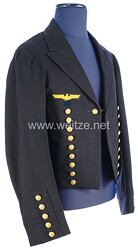
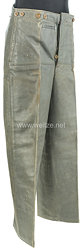
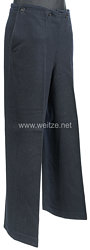
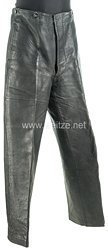
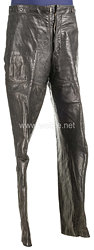
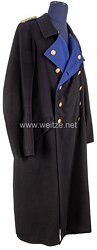
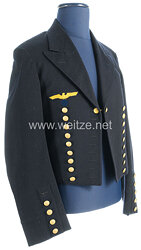
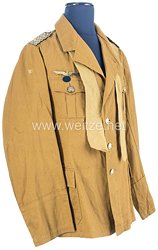
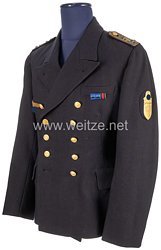
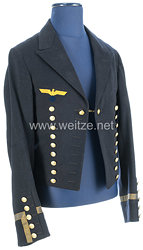
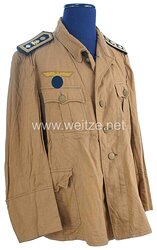
Tunic made of dark blue fine gabardine, complete with all insignia. Hand-embroidered bullion breast eagle hand-sewn, on the sleeves 3 gold rank stripes, above them the career insignia for naval officers, on the chest loops for 2 pin-on badges and a ribbon bar, ribbon of the Iron Cross 2nd Class. On the right chest loops for the Spanish Cross. Inside tailor's label and name of the wearer "Averbeck & Bröskamp Berlin W.", "R.H.Hopmann Aug.1943". Sleeve length 64 cm, chest circumference 42 cm, length 67 cm, condition 2+
On the Sinking of U-405
On the 23rd day of her eighth and final patrol, November 1, 1943, U-405 was engaged by the destroyer USS Borie at coordinates 49°00′N 31°14′W. The destroyer initially attacked with depth charges, whereupon U-405 surfaced—presumably forced by the explosions. Borie then rammed the German U-boat. After the collision, the destroyer temporarily lay atop the U-boat, and while both vessels were locked together, a fierce battle ensued with small arms.
This engagement was unique: Unlike most modern naval engagements, it was decided by ramming and close combat. Normally, the superior armament and greater buoyancy reserve of the destroyer would have been decisive. However, in this unusual case, Borie could not depress her 4-inch and 3-inch guns low enough, while the entire armament of the U-boat could be effectively employed. Borie's crew had only a few small arms, while the open deck structures of the U-boat offered no protection.
In the ensuing fierce firefight, dozens of German sailors were killed as they desperately tried to man the 88mm deck gun. Among the casualties were men hit with a knife or with the shell casing of a 4-inch gun.
At this point, approximately 35 of the 49 German crew members had been killed or swept overboard. Borie was heavily damaged and could only move at reduced speed, while the U-boat remained maneuverable. Thanks to its tighter turning radius, U-405 initially neutralized Borie's superior firepower. Commander Hopmann maneuvered the heavily damaged boat with impressive skill.
Borie then turned off her searchlight, hoping the U-boat would attempt to escape and thus expose itself to better fire. Indeed, U-405 attempted to flee. Borie switched her searchlight back on, turned to bring her guns and depth charge projectors to bear, and opened fire.
The German submariners came under the impact of shallow-set depth charges and a 4-inch shell, whereupon the boat was stopped. Borie's crew observed approximately 14 German sailors in yellow rubber boats leaving the sinking U-boat, signaling their surrender with gestures. Commander Hutchins ordered cease fire—some men appeared wounded and were being carried into the boats on stretchers.
The last man to leave the heavily damaged boat wore an officer's cap. U-405 sank slowly stern-first at 02:57 hours and exploded underwater, presumably from scuttling charges detonated by the last officer.
Commander Hutchins later reported:
“As the submarine sank, a cheer went up that could probably be heard all the way to Berlin. The men embraced each other and slapped shoulders. During the entire action, there were moments that seemed almost comical—especially when we had the U-boat virtually wedged beneath us. Their greatest dream had always been to engage a U-boat, force it to surface, and sink it with gunfire. This action exceeded all expectations.”
The survivors of U-405 fired flares. Borie's crew assumed these were distress signals and approached to recover the men—to within approximately 50 to 60 yards (about 45-55 meters). But in reality, the Germans were summoning another U-boat, which responded by firing a flare itself.
A lookout on Borie shortly reported a torpedo that narrowly missed. The destroyer had to turn away and protect herself. While maneuvering, Borie unintentionally ran through U-405's life rafts, while the Germans fired another flare.
Neither side could rescue survivors—all 49 crew members of U-405 were lost.
Borie lost three officers and 27 sailors and was so heavily damaged that she could not be towed. The next day, her crew received orders to abandon ship, and she was sunk by gunfire from USS Barry.
Overview of Military Career
Entry and Training (1926-1931)
01.04.1926: Entry into the Reichsmarine as officer candidate.
Basic training in Stralsund, followed by shipboard training on Niobe and the cruiser Emden.
Further courses at the Naval Academy Flensburg-Mürwik (including torpedo, communications, barrier, infantry, and artillery courses).
Final shipboard training on Elsass and Schleswig-Holstein
Early Assignments (1930-1933)
1930-1931: Watch officer on the cruiser Königsberg.
1931-1933: Platoon and company commander in Wilhelmshaven (I. Ship's Company Division of the North Sea).
Service in World War II (1939-1943)
1939-1940: First Officer on the destroyer Hermann Künne, which was deployed in the Battle of Narvik in 1940.
Participation in the ground combat around Narvik in Marine Battalion “Kohte”.
Subsequently staff assignments with Naval Group Command East and North.
U-Boat Service (1941-1943)
1941: Training as U-boat commander (U-boat training division, torpedo school, gunnery course).
19.08.1941 – 01.11.1943:
Commander of U-405.
01.11.1943: U-405 sunk in the central North Atlantic—total loss.
The commander, Korvettenkapitän Hopmann, was posthumously awarded the German Cross in Gold.