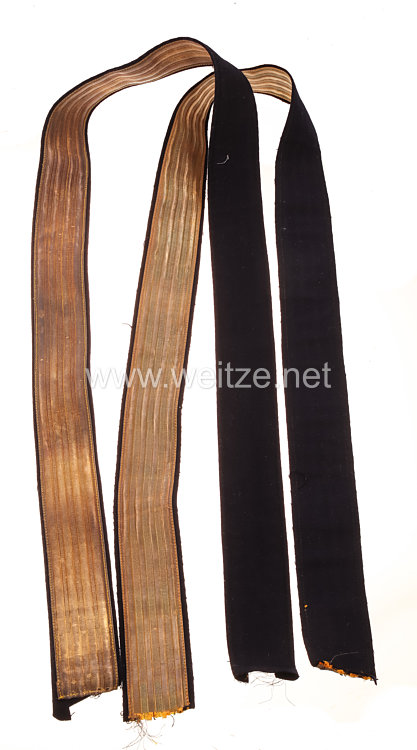
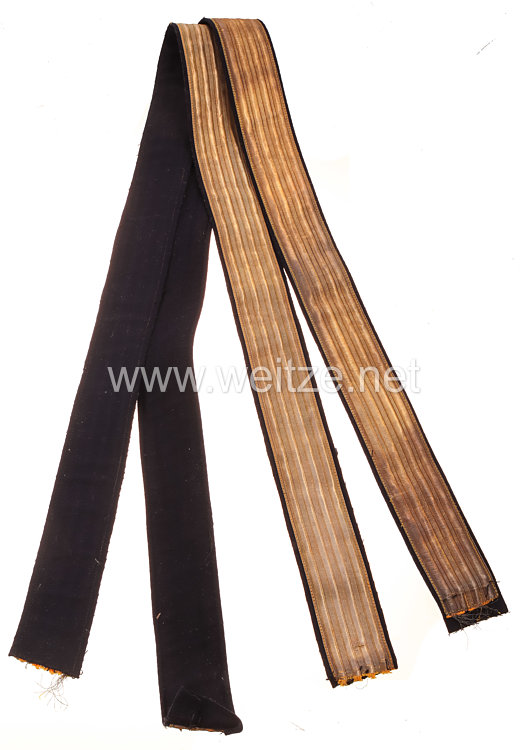
Kriegsmarine Set of Lampasses for Mess Dress Uniform
Kriegsmarine Trouser Stripes for the Dress Uniform: Insignia of the German Naval Officer Corps 1935-1945
The golden trouser stripes (Lampassen) for the long dark blue trousers of the Kriegsmarine dress uniform represent an essential component of the formal dress uniforms worn by the German naval officer corps during the Third Reich era. These narrow golden stripes, attached along the outer seams of the dark blue uniform trousers, served not merely as decorative elements but primarily as rank insignia and symbols of membership in the officer class.
Historical Context and Uniform Development
With the official renaming of the Reichsmarine to Kriegsmarine on June 1, 1935, by Adolf Hitler, a comprehensive reorganization of uniform regulations also took place. The Kriegsmarine deliberately connected to the traditions of the Imperial German Navy, with the dress uniform representing one of the most prestigious uniform variants. This uniform was worn at representative occasions, official receptions, social events, and ceremonial functions.
The Kriegsmarine uniform regulations, published in several editions between 1935 and 1944, provided detailed specifications for the manufacture and wearing of all uniform components. The dress uniform consisted of a dark blue tunic with standing collar, long dark blue trousers with golden stripes, and various accessories such as sword knots and white gloves.
Manufacturing and Materials
The trouser stripes were manufactured from gilt metal thread or gilt metallic yarn woven onto a backing fabric. Production was carried out by specialized military equipment manufacturers who had to maintain strict quality standards. The typical width of officer stripes measured approximately 3-4 mm for naval officers and could vary according to rank. Admirals wore broader stripes than junior lieutenants.
The length of the stripes, as indicated in the described object at approximately 110-115 cm, corresponds to the typical trouser seam length and extended from the waistband to the lower hem. The stripes were expertly sewn on by military tailors, with particular attention paid to exact alignment along the outer seam.
Rank Identification and Wearing Practice
The golden stripes on the dress uniform were reserved exclusively for officers. While enlisted ranks and non-commissioned officers wore no trouser stripes, these golden lines marked the clear separation between the officer corps and other ranks. This tradition originated from Prussian-German military traditions of the 19th century, where trouser stripes were already common in the cavalry and later also in the navy.
The Full Dress Uniform differed from the undress uniform through additional orders and decorations as well as the use of the sword instead of the sidearm. Both variants, however, featured the characteristic golden trouser stripes.
Condition and Collector Value
The described object shows typical signs of wear: the gilding has faded in some places, indicating regular wear and natural aging processes. The fact that the stripes were removed from the uniform is a common phenomenon with historical militaria. Often uniforms were disassembled after the war's end, either to preserve individual components or to render compromising uniform pieces unrecognizable.
The slightly different lengths of 110 and 115 cm are normal, as the stripes for the left and right trouser seams could vary slightly due to human anatomy and cutting patterns. Adjustment to the individual wearer's height also played a role.
Post-War Period and Museum Significance
After the collapse of the Third Reich in May 1945, wearing Kriegsmarine uniforms was prohibited. Many uniform pieces were destroyed, hidden, or stripped of their insignia. Surviving pieces such as these trouser stripes are today important witnesses to naval history and are preserved by museums, collectors, and research institutions.
For military-historical research, such objects offer valuable insights into the material culture of the Kriegsmarine, the manufacturing techniques of the period, and the social hierarchies within the military organization. They document the continuity of Prussian-German military traditions as well as the specific manifestations of the National Socialist era.
The trouser stripes of the dress uniform thus embody a small but significant detail of the comprehensive uniform culture of the German Kriegsmarine – a silent testimony to a vanished military order and its ceremonial representation.