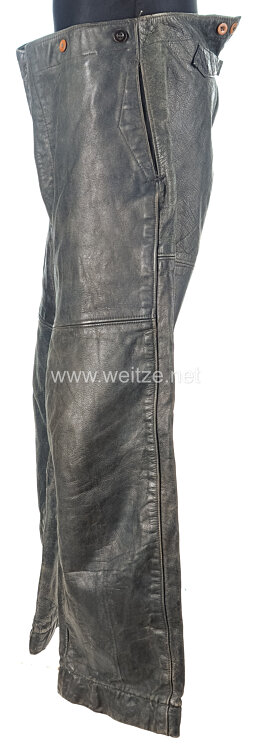
Kriegsmarine Black Leather Trousers

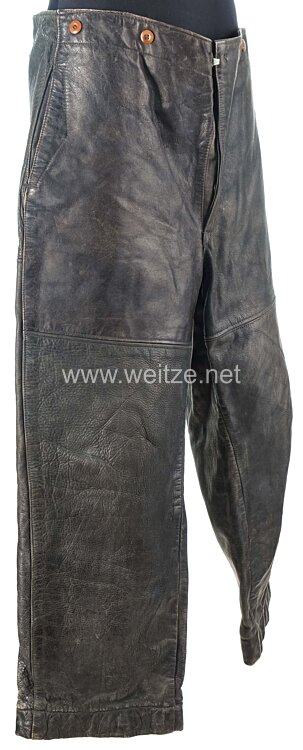
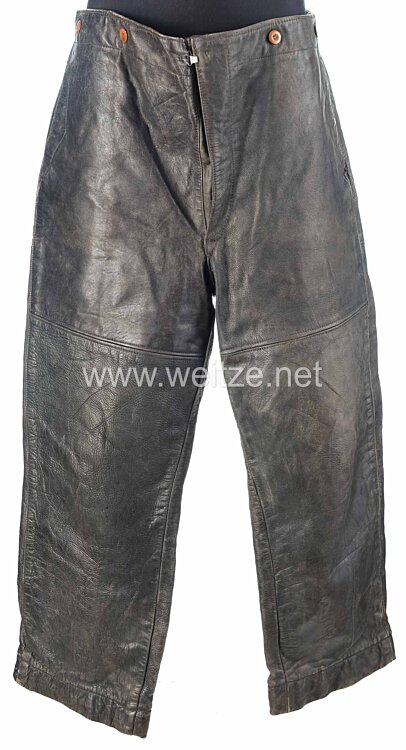
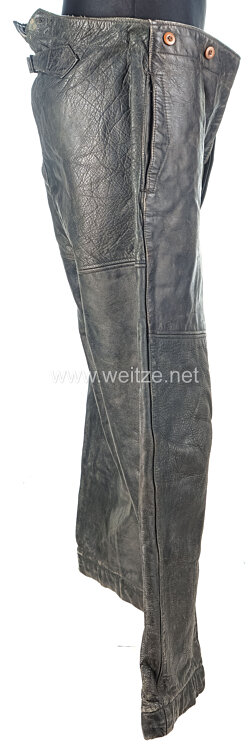
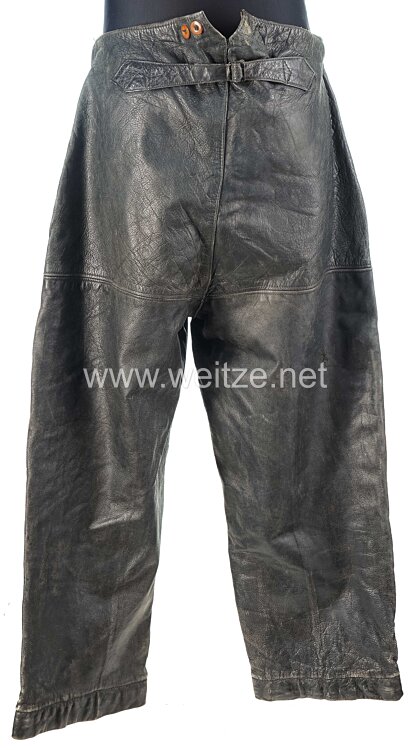
Blackened leather trousers, two diagonal side pockets without flaps, left trouser pocket with KM acceptance stamp “Eagle over M”. Blue-gray linen lining inside, with manufacturer's label. Wear marks on the leather. Waist circumference 94 cm, length 99 cm, worn, but the leather is still supple, Condition 3
463789
450,00

Kriegsmarine Black Leather Trousers

This black leather trousers of the Kriegsmarine represents a characteristic garment of the German naval forces during World War II. Such leather trousers were worn by various ranks of the Kriegsmarine and constituted an important component of working and protective clothing on board ships.

The Kriegsmarine, officially founded on June 1, 1935, developed an extensive system of uniforms and equipment items designed to meet the special requirements of naval service. Leather clothing played an important role, particularly for crews of submarines, smaller warships, and members of technical services. Leather provided protection against moisture, oil, and mechanical stress in the harsh conditions of life at sea.

The acceptance stamp with eagle over M found on this object is an authentic mark of military quality control. The “M” stands for Marine (Navy), and the Reich eagle symbolizes state acceptance. Such stamps were applied by authorized inspection officers after the garments had been examined for their quality, workmanship, and compliance with manufacturing regulations. This was part of the Wehrmacht's strict procurement system designed to ensure standardization and quality assurance.

The construction of the trousers with two diagonal side pockets without flaps corresponds to the practical orientation of military work clothing. The blue-gray linen lining served both comfort and protection of the leather from the inside. The black coloring of the leather was typical for naval clothing and corresponded with the traditional dark color scheme of naval uniforms.

Leather clothing was produced during the war by various manufacturers who were under contract to the High Command of the Kriegsmarine (OKM). The manufacturer's label present on the object documents this civilian-military production chain. Manufacturers had to adhere to strict specifications regarding material, workmanship, and measurements.

The dimensions of the trousers (waist circumference 94 cm, length 99 cm) suggest an average to robust wearer. Such garments were produced in various sizes and issued through the military clothing system. The fact that the leather remains supple despite signs of wear testifies to the quality of the material and possibly appropriate storage over the decades.

In the context of submarine warfare, leather trousers were particularly popular among U-boat crews. The cramped, humid conditions aboard submarines required robust, water-resistant clothing. Leather clothing also provided some protection when working on machinery and in confined spaces.

After the war ended in 1945, large quantities of Wehrmacht material were confiscated, destroyed, or transferred to collections. Personal equipment items such as leather trousers often found their way into private hands as souvenirs. Today, such objects represent important testimonies of military history and are preserved by museums, research institutions, and private collectors.

The military-historical significance of such garments lies in their testimonial value for the material culture of the Kriegsmarine. They document manufacturing processes, procurement systems, wearing habits, and the everyday reality of naval service beyond the major naval battles. For researchers, original clothing items with acceptance stamps and manufacturer labels provide valuable information about the complex system of Wehrmacht supply.

In today's examination of military material culture, increasing emphasis is placed on understanding such objects in their historical context without glorifying them. They serve as material sources for understanding the organizational structures, logistics, and daily life in the armed forces of the Third Reich.