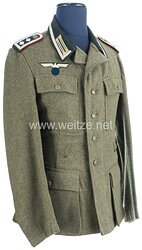
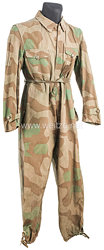
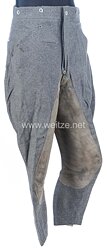
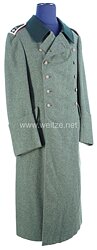
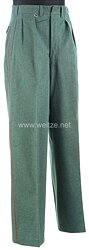
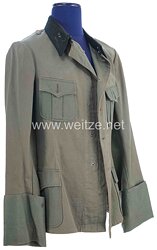
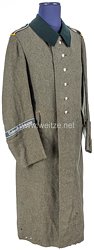
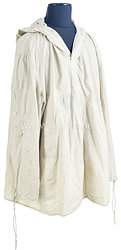
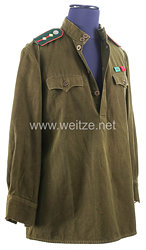
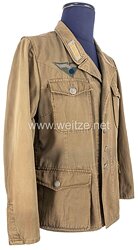
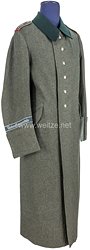
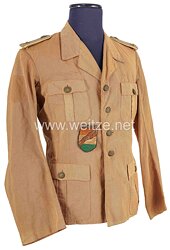
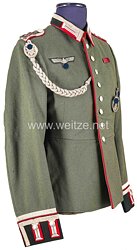
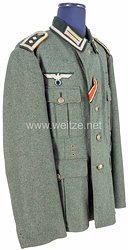
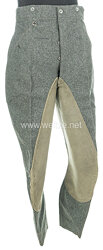
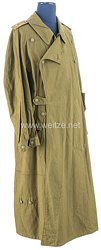
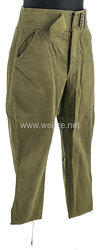
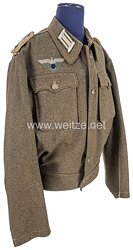
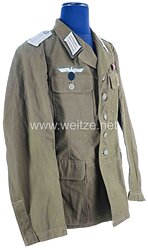
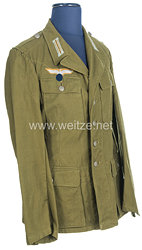
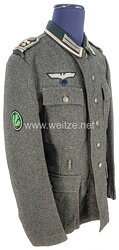
Kammerstück, um 1943. Fertigung aus dem aus schwarzem Panzertuch, komplett mit allen Effekten. Über dem Bevo-gewebter Brustadler hat der Offizier einen Metallfaden handgestickten Offiziersbrustadler aufgenäht. Die Kragenspiegel per Hand vernäht, die Totenköpfe aus Aluminium, durch den Kragen durchgesteckt. Matte Schulterstücke mit aufgelegter Regiments-Nr. 5, das linke Schulterstück mit truppeninterner Überschubschlaufe, ein rosa/goldgelber Streifen (evtl. die Aufklärungsabteilung des Regiments), mit Schlaufen. Die Knöpfe aus schwarzem Bakelit. Auf der Brut kleine Feldspange mit 2 Auszeichnungen. Auf der Brust mit kleine Bandschlaufe Eisernes Kreuz 2. Klasse und Winterschlachtmedaille, auf der Brust mit 4 Auszeichnungen: das Eiserne Kreuz 1. Klasse wurde vom Träger durch ein EK 2 "ersetzt", oben an die Schlaufe angenäht. Wahrscheinlich hat der Träger sein reguläres EK 1 verloren. Weiterhin das Panzerkampfabzeichen in Silber, Feinzink, H.Aurich, Verwundetenabzeichen in Schwarz und Reichssportabzeichen in Bronze. Innen mit dem typischen grünen Futter, die Kammerstempel noch erkennbar. Maße : Schulterbreite 43 cm, Armlänge 56 cm, Brustumfang 90 cm, Länge Hinten 48 cm.
Die Panzerjacke wurde den ganzen Krieg über getragen im Landserjargon "einmal Moskau und zurück..", mit deutlichen Trage- und Altersspuren, noch ungereinigt, Zustand 2-3.
Dazu das abgetrennte, besondere Mützenabzeichen der Panzer-Abteilung Sardinien: der Sardinienschild, handgestickt auf schwarzem Tuch, deutlich getragen.
Die typische Panzerjacke eines Frontoffiziers, ein Stück mit großer Austrahlung. Wir konnten die Uniform und das Mützenabzeichen direkt aus der Familie erwerben. Extrem selten, in über 35 Geschäftsjahren ist dies das 1. Mützenabzeichen der Panzer-Abteilung Sardinien, welches wir anbieten können.
Das Panzer-Regiment 5 wurde am 15. Oktober 1935 mit zwei Abteilungen aufgestellt und der 3. Panzer-Division unterstellt, Friedensstandort Wünsdorf. 1939 Teilnahme am Polenfeldzug. Ab dem 10. Mai 1940 nahm das Regiment im Rahmen der 3. Panzer-Division am Westfeldzug teil. Ab August 1940 begann die Umrüstung des Regiments zum Einsatz in Nordafrika. Einsatz in Afrika. Das Regiment ging gemeinsam mit der Panzer-Abteilung 190 bei der Kapitulation der deutschen Streitkräfte in Afrika am 13. Mai 1943 vollständig verloren. Die Wiederaufstellung erfolgt im Juli 1943 aus der durch den Wehrkreis V aufgestellten Panzer-Abteilung Sardinien. Diese wurde dabei auf 3 Kompanien verstärkt. Die Abteilung unterstand danach der 90. Panzer-Grenadier-Division und wurde in Italien eingesetzt.
472904