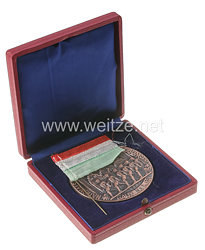
Ehrenpreis in Form einer silberner Zigarrenkiste. Auf dem Deckel mit dem Wappen von München mit Hoheitsadler, darunter mit schöner Widmungsgravur "EHRENPREIS des Oberbürgermeisters der Hauptstadt der Bewegung - Radländerkampf Deutschland-Italien - 3. Etappe Innsbruck-München 9.7.39". Maße 11 x 17 x 5 cm, auf der Unterseite "800" Silber punziert. Innen mit Holz ausgeschlagen, die Facheinteilung fehlt. Leichte Gebrauchs- und Altersspuren, mit schöner Patina, Zustand 2.
Dazu ein signiertes Portraitfoto "Ludwig Hörmann, Deutscher Straßenmeister 1939".
Dazu aus dem Jahr 1952 ein weiterer Ehrenpreis in gleicher Größe, ebenfalls in Form einer Zigarrenkiste, auf dem Deckel mit Widmungsgravur "Dem Deutschen Meister der Berufsstraßenfahrer 1952 in Anerkennung gewidmet - Zweirad-Gesellschaft m.b.H. Frankfurt a.M., auf der Unterseite "835" Silber punziert.
Ludwig Hörmann (* 6. September 1918 in München; † 19. Juni 2001) war ein deutscher Radrennfahrer. Ludwig Hörmann, „Wiggerl“ genannt, galt als der erfolgreichste und populärste Münchner Radrennfahrer der Nachkriegszeit. Als Amateur war er zunächst Mitglied im Verein RV Express, später im Verein RC Amor München. 1940 siegte er im Rennen Rund um die Hainleite. Er errang neunmal den deutschen Meistertitel auf der Bahn und auf der Straße, mit seinem jüngeren Bruder Hans war er 1951 im Zweier-Mannschaftsfahren siegreich (seinen ersten Straßentitel gewann er ebenfalls 1951). Beide hatten bereits 1942 die Meisterschaft in der Mannschaftsverfolgung gewonnen. Hörmann galt auch in der ersten Meisterschaft nach dem Zweiten Weltkrieg als Favorit des Rennens. Der Start wurde ihm von den verantwortlichen Funktionären des deutschen Berufsradsports jedoch verweigert, da Hörmann darauf bestand, für die Verwendung des vorgeschriebenen Materials eine Prämie zu erhalten. Von den in den 1950er Jahren in Deutschland ausgetragenen Profirennen gewann er 1951 den Großen Preis der Weinstraße. Internationale Bekanntheit erlangte er bei der Straßenweltmeisterschaft der Profis 1952 in Luxemburg, als er hinter dem Schwenninger Heinz Müller und dem Schweizer Gottfried Weilenmann den dritten Platz belegte. Zudem konnte er fünf Sechstagerennen gewinnen. 1954 beendete er seine erfolgreiche Karriere.
470828