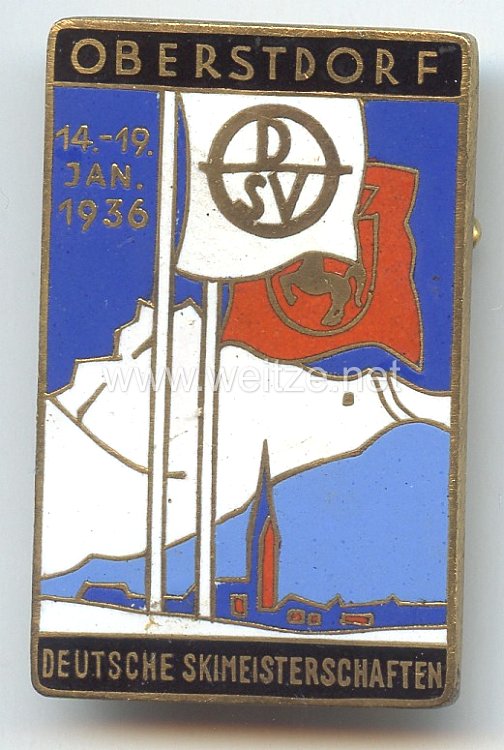
Third Reich - Official Participant Badge "DSV - Deutsche Skimeisterschaften Oberstdorf 14.-19.Jan.1936"
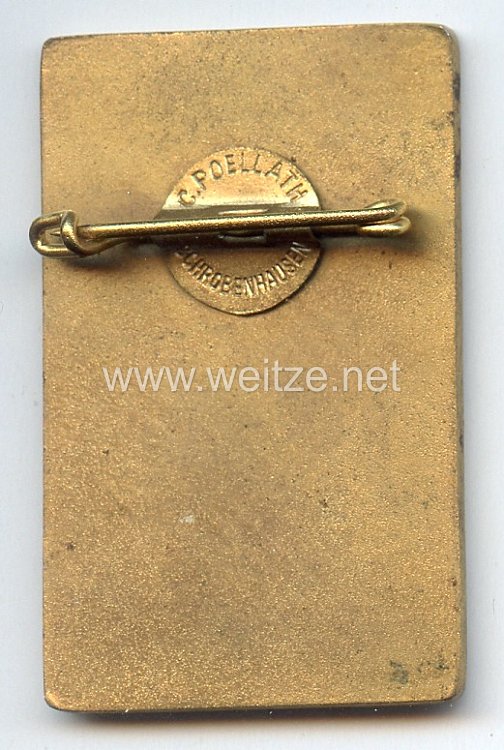
The official participant badge from the German Ski Championships in Oberstdorf held from January 14-19, 1936, represents a significant artifact of sports history during the Third Reich. This enameled base metal badge, manufactured by the renowned firm C. Poellath of Schrobenhausen, documents a period when German skiing was state-sponsored and instrumentalized for propagandistic purposes.
The German Ski Championships of 1936 took place immediately before the IV Olympic Winter Games in Garmisch-Partenkirchen, held from February 6-16, 1936. This temporal proximity was hardly coincidental: the championships served as important preparation and qualification for the Olympic competitions. Oberstdorf in the Allgäu region had developed since the late 19th century into a significant center of German winter sports and possessed the necessary infrastructure for international competitions.
The German Ski Association (DSV - Deutscher Skiverband) had been the central organization for skiing in Germany since its founding in 1905. After the Nazi seizure of power in 1933, the association, like all sports organizations, was integrated into the National Socialist system and placed under the Reich Sports Leader. The organization of sporting events and the awarding of badges now fell under strict state regulations and served to represent the regime.
The manufacture of this badge by C. Poellath is of particular significance. Founded in 1778, the company had developed during the 19th and early 20th centuries into one of Germany's leading manufacturers of orders, decorations, and sports badges. Christian Poellath and his successors supplied both civilian and military institutions. During the Nazi era, the company produced numerous official badges, decorations, and awards for party, state, and sports associations. The quality of Poellath products was legendary, particularly the fine enamel work and precise craftsmanship.
Participant badges like this one were issued to active competitors, officials, and important guests of the event. They served as identification during the championships and were subsequently kept as mementos. Unlike winner's medals or performance badges, participant badges document mere presence at a sporting event, yet still possess high historical and collectible value.
The year 1936 marks a high point of National Socialist sports propaganda. The two Olympic Games in Garmisch-Partenkirchen and Berlin were meant to demonstrate the supposed superiority of the German system. Winter sports occupied a special position, as they were considered particularly “Nordic” and “Germanic” and fit into the regime's racist ideology. The promotion of skiing was intensified, infrastructure expanded, and international competitions strategically used as propaganda platforms.
The technical execution of the badge corresponds to the standards of the time: a base body of base metal (usually brass or bronze) was decorated with colored enamel, which was fused into recessed areas. This enameling technique enabled durable, colorfast badges that would not fade even with frequent wear. Attachment was accomplished via a pin with clasp soldered to the reverse.
From a historical perspective, such badges document the penetration of all societal spheres by the Nazi regime. Even sporting events were politically instrumentalized and incorporated into the propaganda machine. The awarding of official badges was subject to state control and served the visual representation of the system.
For collectors and historians, participant badges like this are important sources for sports history and the history of the Third Reich. They allow conclusions about the organization of sporting events, the role of sports in Nazi society, and the material culture of the period. The preservation of such objects in museums and collections serves historical research and documentation of this era.
The Poellath company exists to this day and is among Germany's most traditional manufacturers of orders and decorations. Products from the Nazi period are now regarded as historical documents and subjected to scholarly examination.