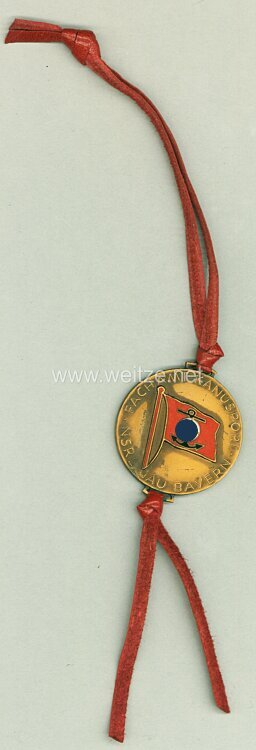
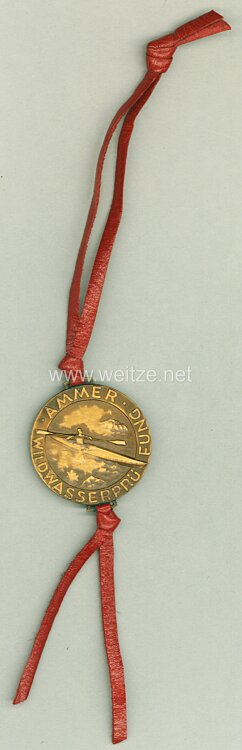
NSRL Seesport - Gau Bayern Fachamt Kanusport - Participant Badge "Ammer Whitewater Qualification"
The NSRL Seesport - Gau Bayern Fachamt Kanusport Participant Badge “Ammer Whitewater Examination” represents a fascinating chapter in the history of organized sports in National Socialist Germany. This partially enameled badge with its characteristic red leather suspension ribbon documents the systematic integration of canoeing into the state organizational structures between 1933 and 1945.
The Nationalsozialistische Reichsbund für Leibesübungen (NSRL), or National Socialist League of Physical Exercise, was founded in 1938 as an umbrella organization after the German Reich League for Physical Exercise (DRL) was restructured. The NSRL assumed central control over all sports associations and clubs in the German Reich. This coordination of sports served the ideological penetration of all areas of life and the physical fitness of the population in accordance with National Socialist ideology.
The Fachamt Kanusport (Canoeing Department) within the NSRL was responsible for organizing and supervising all canoe racing, canoe touring, and whitewater sports. The subdivision into various Gaue corresponded to the territorial organization of the NSDAP. Gau Bayern (Bavaria District) encompassed the territory of the Free State of Bavaria and, due to its numerous rivers and lakes as well as alpine regions, represented a significant center for water sports.
The Ammer, a 185-kilometer-long river in Upper Bavaria that flows through the Ammer Mountains and joins the Isar near Moosburg, offered ideal conditions for whitewater activities. Particularly the sections in the upper course through the Ammer Gorge presented demanding challenges for canoeists. The whitewater examination on the Ammer was considered a significant qualification within Bavarian canoeing.
The system of performance badges and examinations in NSRL canoeing was strictly hierarchical. Athletes had to progress through various levels, with the whitewater examination representing an advanced qualification. These examinations included both theoretical knowledge about hydrology, boat materials, and safety techniques, as well as practical skills in dealing with difficult current conditions, eddies, and obstacles.
The design of the badge followed typical conventions of National Socialist sports badges. Partial enameling was a common manufacturing technique in which certain areas of the metal badge were filled with colored enamel while other areas remained blank or embossed. The red leather suspension ribbon corresponded to the NSRL system's color codes, with different sports and performance levels marked by different colors.
Seesport (water sports) as an umbrella term encompassed all water sports within the NSRL system, including sailing, rowing, canoeing, and motorboat sports. The promotion of water sports had, in addition to the sporting aspect, paramilitary significance, as these skills were considered useful for military purposes.
The awarding of such participant badges was subject to strict criteria. Athletes had not only to meet sporting requirements but also to conform to ideological guidelines. Participation in examinations and competitions was generally only possible for “Aryan” members, while Jewish and other athletes classified as “non-Aryan” were systematically excluded.
After the end of World War II in 1945, the NSRL and all its subdivisions were dissolved by the Allies. All badges, certificates, and documents of these organizations lost their official validity. In the postwar years, German sports had to be completely reorganized, with democratic structures deliberately created and the separation of sports and politics pursued.
Today, such badges possess exclusively historical and collection value. They document a dark chapter in German sports history and demonstrate the totalitarian penetration of all areas of society by the Nazi regime. Museums and historical collections preserve these objects as witnesses to the era, whereby the historical context and critical examination of the National Socialist past must always be paramount.
The badge serves as a reminder of how sports can be instrumentalized and placed in the service of an inhumane ideology. At the same time, it documents the long tradition of whitewater sports in Bavaria and the athletic achievements that were accomplished independent of the political system.