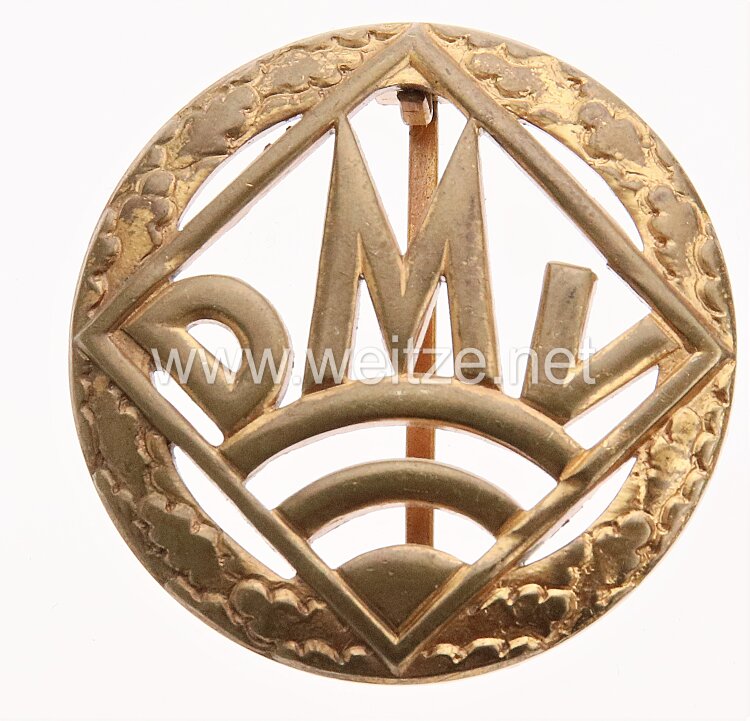
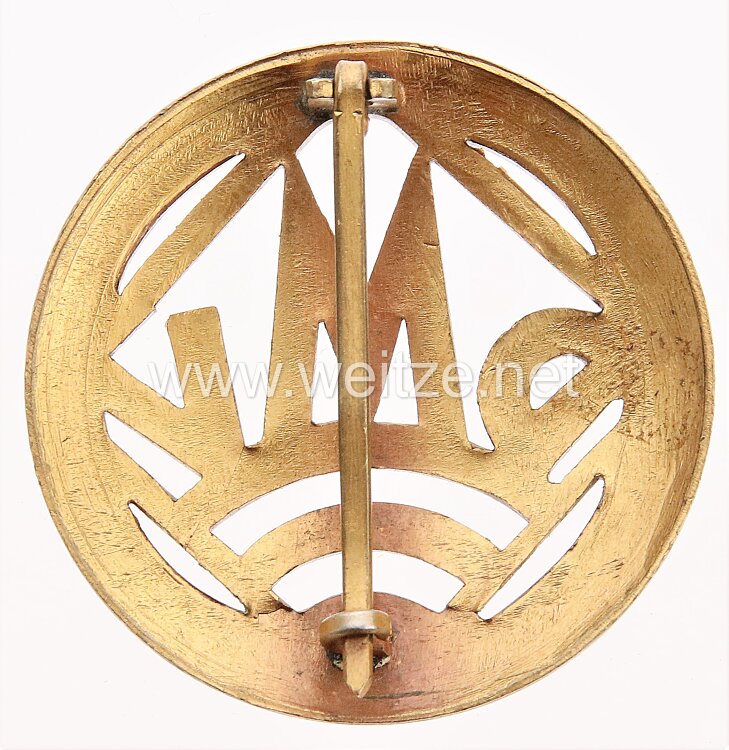
German Motor Sports Association Performance Proficiency Badge in Gold
The Gold Performance Testing Badge of the German Motorsport Association (Deutscher Motorsport-Verband, DMV) represents a significant testimony to German motorsport history of the 20th century. This badge was awarded in recognition of exceptional sporting achievements in motor vehicle operation and represents the close connection between technical progress, sporting ambition, and organized motorsport culture in Germany.
The German Motorsport Association had its roots in the early German automobile movement. After World War I, Germany experienced a rapid upswing in motor vehicle development, and with it grew the need for an organized structure for motorsport. The DMV developed into one of the leading organizations that not only organized competitions and events but also established standards for driving skills and technical competence.
The Performance Testing Badge was part of a tiered award system. It typically existed in three levels: Bronze, Silver, and Gold, with Gold representing the highest distinction. To obtain the gold badge, participants had to pass demanding tests in various disciplines. These included practical driving skills, technical knowledge of vehicle mechanics, orientation drives, and often theoretical knowledge of traffic rules and vehicle technology.
The present example consists of gold-plated base metal and is attached to a long pin, which was typical for German sports badges of this era. The construction with a long pin allowed wearing on civilian clothing or sportswear. The gilding emphasizes the value and significance of this highest performance level.
During the Weimar Republic (1919-1933), motorsport in Germany experienced a golden age. The automobile became increasingly accessible, and motorsport evolved from an elite pastime to a broader social phenomenon. Motorsport associations like the DMV played an important role in democratizing automobile sports and promoting technical education.
With the Nazi seizure of power in 1933, the entire German sports landscape underwent coordination (Gleichschaltung). Motorsport was increasingly instrumentalized for propaganda purposes. The National Socialist Motor Corps (NSKK) assumed a dominant role in German motor vehicle affairs from 1933. Many existing motorsport organizations were integrated into Nazi structures or had to adapt their activities.
Despite these political changes, performance badges like that of the DMV retained their significance as proof of practical skills. The examinations themselves remained demanding and required genuine competence. For many Germans, such awards were not primarily politically motivated but rather expressions of sporting ambition and technical competence.
The examination content for the gold badge was extensive. Candidates typically had to demonstrate their ability to safely operate vehicles under various conditions, diagnose and repair technical problems, and successfully complete longer orientation drives without modern navigation aids. The examinations often spanned several days and tested both physical endurance and mental concentration.
After World War II in 1945, all National Socialist organizations were dissolved, and organized motorsport also had to be rebuilt. In the Western zones and later the Federal Republic of Germany, the General German Automobile Club (ADAC) emerged as the leading organization, while in East Germany separate structures were created. Historical badges from the pre-1945 period became collectors' items and testimonies of a bygone era.
Today, such DMV performance badges are sought-after collectors' items that document both the technical and social-historical development of motorsport. They recall a time when the automobile was still a relatively new phenomenon and driving competence represented a special distinction. The condition rating “2” indicates a well-preserved specimen, which is remarkable for objects of this type and age.
The significance of such badges lies not only in their material composition but especially in their historical testimonial value. They document the development of traffic education, the professionalization of motorsport, and the social importance attached to technical skills in the first half of the 20th century. These artifacts provide insights into how societies valued mechanical competence and how sporting achievements in the emerging field of motorization were recognized and celebrated.