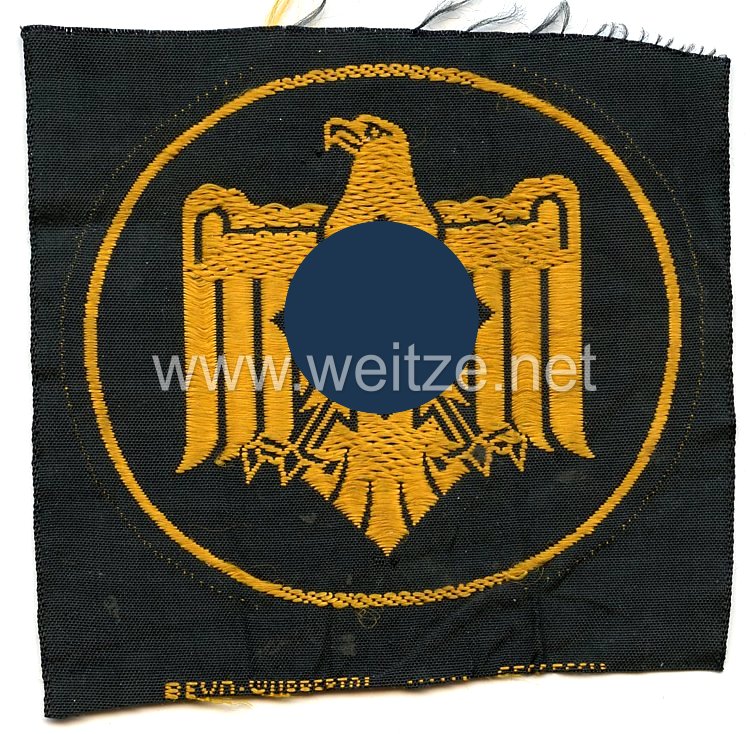
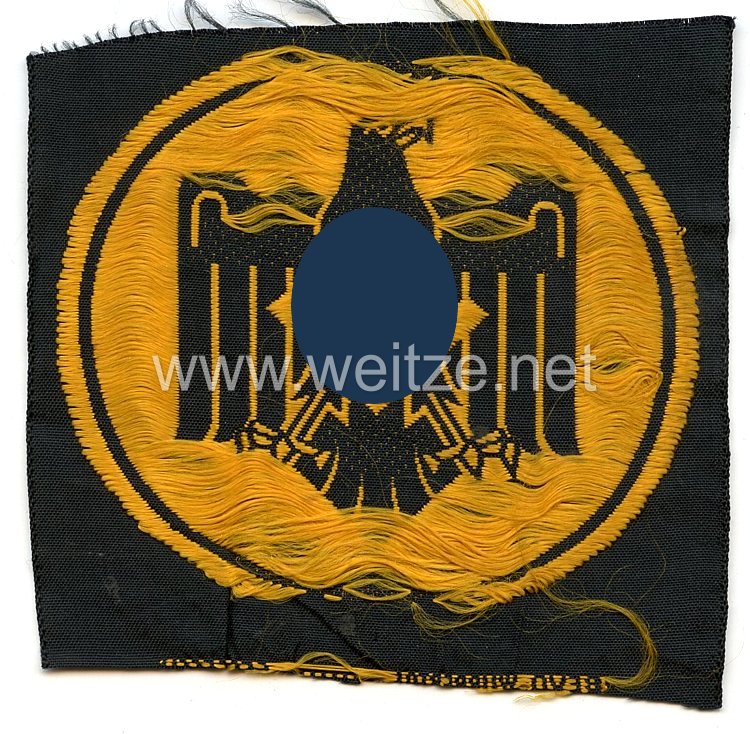
National Socialist League of the Reich for Physical Exercise (NSRL) - Membership Badge for Sports Uniform
Price per piece: 35 Euro.
Condition may vary slightly.
The National Socialist Reich League for Physical Exercise (Nationalsozialistischer Reichsbund für Leibesübungen, NSRL) represented the central organization for sports and physical training during the Third Reich. This institution embodied the National Socialist ideology of physical fitness as an integral component of the volksgemeinschaft (people's community) and military preparation.
In December 1938, the NSRL was created through the merger of the German Reich League for Physical Exercise (Deutscher Reichsbund für Leibesübungen, DRL) with the SA sports organization. Under the leadership of Reichssportführer Hans von Tschammer und Osten, who had held this position since 1933, all German sports were coordinated and placed in service of the National Socialist state. After von Tschammer und Osten's death in 1943, Artur Axmann briefly assumed leadership.
The NSRL was directly subordinate to the NSDAP and the Reich Ministry of the Interior. The organization was divided into 22 specialized departments representing various sports, including track and field, swimming, gymnastics, football, and other disciplines. By 1939, nearly all German sports clubs and associations had been integrated into the NSRL.
Sports in National Socialism did not primarily serve individual fitness or athletic competition in the traditional sense. Rather, physical training was understood as a means of creating a “defense-capable people.” The National Socialist leadership viewed athletic activities as preparation for military service and as an instrument for shaping the “Aryan” ideal human.
This militarization of sports was evident in the close connection between the NSRL and the Wehrmacht. Athletic exercises were increasingly linked with pre-military training, and many training methods were oriented toward military requirements.
The woven membership badge for sports attire described here served to identify NSRL members during athletic activities. Such badges were an integral part of the comprehensive system of uniforms, rank insignia, and decorations that characterized all National Socialist organizations.
The woven design was a common manufacturing technique for cloth badges of this period. It allowed for permanent, washable attachment to sports clothing and was cost-effective for mass production. Typically, NSRL badges displayed the organization's characteristic symbol: a stylized swastika in combination with athletic elements or the initials NSRL.
The NSRL's membership numbers were considerable. By the outbreak of World War II in 1939, the organization comprised several million members in thousands of clubs throughout the German Reich. Membership was formally voluntary, but social pressure to participate was substantial, especially for adolescents and young adults.
Each member received corresponding badges and identification cards that had to be worn at official sporting events and exercises. These visible markers of affiliation served both for identification and demonstration of integration into the National Socialist volksgemeinschaft.
With the beginning of World War II in 1939, the role of the NSRL fundamentally changed. While many male athletes were drafted for military service, the organization increasingly focused on the physical training of youth, women, and men in war-essential occupations. Sporting events were progressively used for propaganda purposes.
The NSRL existed until the end of the Third Reich in May 1945. After the German capitulation, the organization was dissolved and banned by the Allies along with all other National Socialist institutions.
Today, badges and equipment items from the NSRL are objects in military-historical and contemporary history collections. They document the comprehensive penetration of all areas of life by National Socialist ideology, including sports, which were traditionally considered apolitical. For historical research, such artifacts provide important insights into the everyday culture and organizational structures of the Third Reich.
The preservation and scholarly examination of such objects serves to understand the totalitarian mechanisms of National Socialism and warns of the dangers of instrumentalizing sports and culture for political and military purposes.