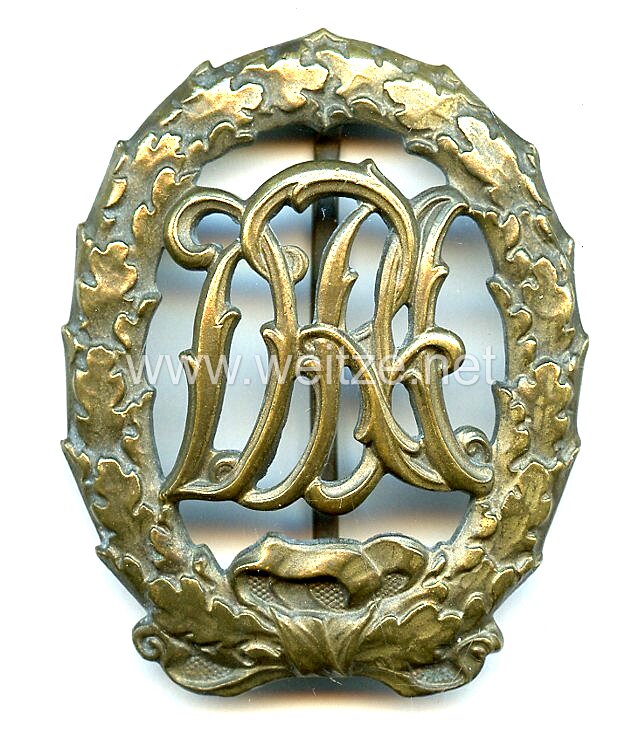
German Sports Badge 1919-1934 DRA in Bronze

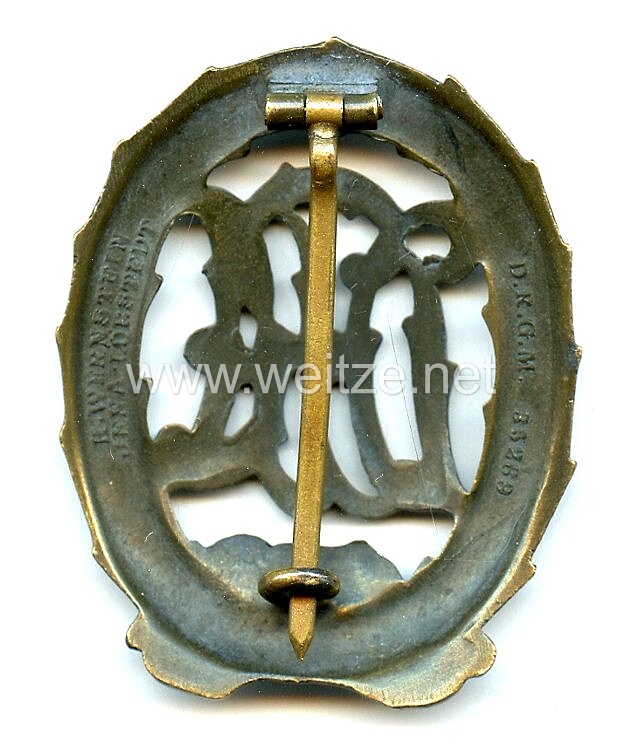
Non-ferrous metal, reverse with manufacturer's marking “Wernstein Jena-Löbstedt” “D.R.G.M. 33918”. Condition 2.
456832
30,00

German Sports Badge 1919-1934 DRA in Bronze

The German Gymnastics and Sports Badge (Deutsches Turn- und Sportabzeichen - DRA) in its form from 1919 to 1934 represents a significant epoch in the history of German mass and competitive sports. This bronze badge documents the development of the gymnastics and sports movement in the Weimar Republic, a period of profound social upheaval following World War I.

The creation of this sports badge is inextricably linked to the tradition of the German gymnastics movement, which traces back to Friedrich Ludwig Jahn. After World War I, the German Reich Committee for Physical Exercise (Deutscher Reichsausschuss für Leibesübungen - DRA) was founded in 1919, serving as an umbrella organization for various gymnastics and sports associations. Under its aegis, a unified sports badge was created to promote and document the physical fitness of the population.

The present specimen bears the manufacturer's mark “Wernstein Jena-Löbstedt” as well as the designation “D.R.G.M. 33918”. The abbreviation D.R.G.M. stands for “Deutsches Reichsgebrauchsmuster” (German Reich Utility Model), a protective right that existed in Germany between 1891 and 1945. This marking confirms the authentic origin and legal protection of the design. The Wernstein company in Jena-Löbstedt was among the established manufacturers of orders, decorations, and sports badges in the Weimar Republic.

The bronze badge represented one of several levels that athletes could achieve by completing various performance tests. The examinations typically included disciplines from athletics, swimming, and gymnastics. Requirements were graded according to age groups and gender, aiming to ensure comprehensive physical fitness.

The design of these early sports badges reflected the ideals of the gymnastics movement: physical training, discipline, and community spirit. In the Weimar Republic, sports held special significance as they were understood as a means of overcoming the consequences of war and promoting public health. Simultaneously, the gymnastics and sports movement was also a field of political conflict between different ideological camps.

The timeframe 1919-1934 marks an important caesura in German sports history. With the Nazi seizure of power in 1933, a fundamental restructuring of German sports began. In 1934, the German Gymnastics and Sports Badge in its previous form was replaced by the Reich Sports Badge (Reichssportabzeichen), which was more heavily ideologically charged and embedded in National Socialist physical culture.

The choice of bronze indicates the middle performance level. Besides bronze, the badges were also awarded in silver and sometimes in other versions, depending on the achievement and frequency of acquisition. The non-ferrous metal from which this piece is made was a common material for awards and badges during this period, as it could be produced cost-effectively in larger quantities.

For research purposes, such objects are of considerable value as they provide insight into everyday culture, sports history, and the material culture of the Weimar Republic. The manufacturer's marking also allows conclusions about production locations and the economic organization of award manufacturing in this era.

The condition rating of 2 indicates good preservation, which is remarkable for objects from this period. Many of these badges were worn in everyday life and show corresponding signs of use, or were lost during the turbulent history of the 20th century.

In summary, this German Gymnastics and Sports Badge from 1919-1934 documents an important phase of German sports history between two world wars, a time when organized sports increasingly gained social importance while simultaneously becoming subject to political instrumentalization.