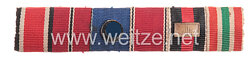
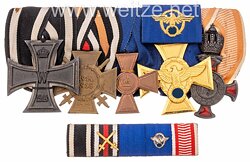
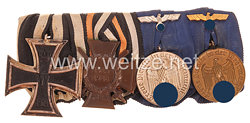
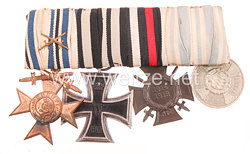
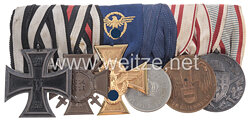
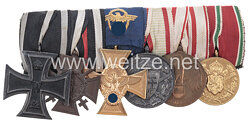
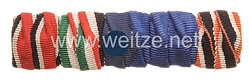
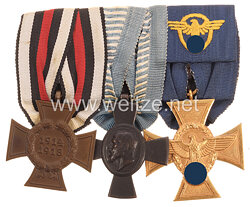
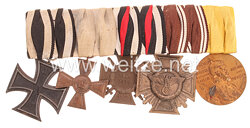
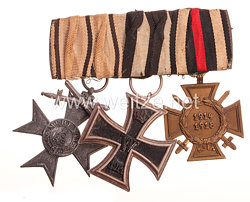
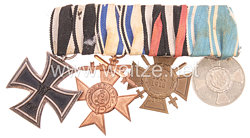
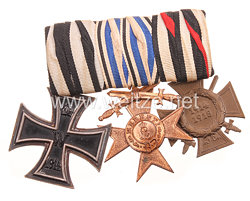
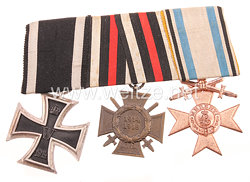
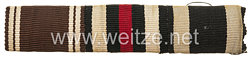
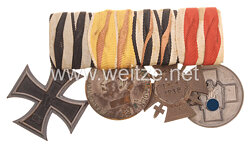
circa 1938. Large medal bar with 16 decorations: Prussia Iron Cross 1939 2nd Class. Prussia Royal House Order of Hohenzollern Knight's Cross with Swords. Bavaria Military Order of Merit - decoration missing. Saxony Albrecht Order Knight's Cross 1st Class with Swords, silver gilt. Lippe-Detmold War Merit Cross 1914. Honor Cross for Combatants 1914-1918. Wehrmacht Long Service Awards for 25 and 12 Years with ribbon eagles. Prussia Order of the Crown 4th Class. Waldeck Merit Cross 4th Class. Saxony-Weimar Order of the White Falcon - decoration missing. Ernestine House Order Knight's Cross 1st Class, manufactured in gold. Schwarzburg Merit Cross 3rd Class. China Campaign Medal in steel for non-combatants. Prussia Centenary Medal for the 100th Birthday of Kaiser Wilhelm I 1897. Austria Military Merit Cross 3rd Class with War Decoration.
The medal bar shows clear evidence of wear, the red cloth backing on reverse heavily damaged by moth damage, in good overall condition.
Included is a detailed 13-page analysis from 2022 by the noted historian Daniel Krause regarding this medal bar. A press photograph reproduced therein, taken in the Reich Chancellery on November 4, 1938, clearly shows v. Rundstedt wearing this medal bar.
A few years ago, a portion of v. Rundstedt's decorations surfaced in America, originating from the estate of a US veteran. In addition to the medal bar, these included the Grand Cross of the Order of the Roman Eagle, the Hungarian Order of Merit 1st Class, the Serbian Order of the White Eagle 2nd Class, and 2 additional medals. At that time, the Royal House Order of Hohenzollern Knight's Cross with Swords was missing. This piece has been added to the medal bar.
A historic medal bar of one of the most renowned German field marshals, of historical significance.
Karl Rudolf Gerd von Rundstedt (born December 12, 1875 in Aschersleben, Province of Saxony; died February 24, 1953 in Hannover) was a German officer who ultimately achieved the rank of Generalfeldmarschall and commanded large military formations and army groups on multiple fronts throughout the war. His most important position was that of Commander-in-Chief West, which he held - with several interruptions - between 1940 and 1945.
Price upon request.
478243