Medal Bar of a Prussian Soldier in World War I and Police Officer in the Third Reich
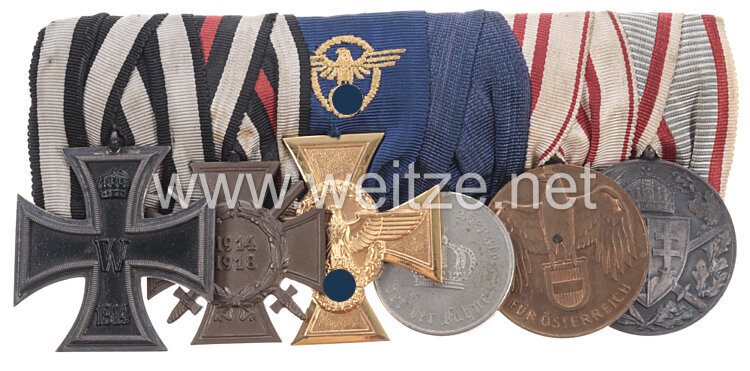
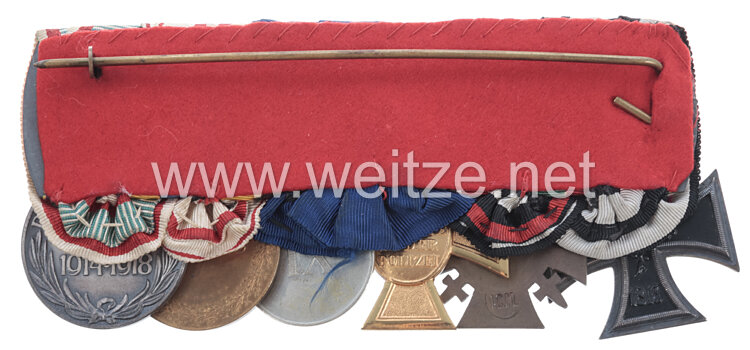
This medal bar combines six military and civil decorations, telling the remarkable life story of a man who served both as a Prussian soldier in World War I and later as a police officer in the Third Reich. Such medal bars are important historical documents that connect individual biographies with the major political and military upheavals of the 20th century.
The Iron Cross 2nd Class of 1914 was one of the most significant Prussian and later German military decorations. King Friedrich Wilhelm III originally established it in 1813 during the Wars of Liberation against Napoleon. At the beginning of World War I, it was re-instituted by Kaiser Wilhelm II on August 5, 1914. The second class was worn on a ribbon and was the most common grade of this decoration. Approximately five million Iron Crosses 2nd Class were awarded during World War I, reflecting the massive mobilization and casualties of this first industrial mass warfare.
The Honor Cross for Combatants 1914-1918, also known as the Hindenburg Cross, was established by Reich President Paul von Hindenburg on July 13, 1934. This decoration was intended to honor all German participants in World War I and distinguished between front-line combatants (with swords), war participants without front-line service (without swords), and bereaved family members. The version for front-line combatants was received by those who had demonstrably participated in combat operations. The establishment of this decoration during the Weimar Republic also served political purposes and was meant to integrate the veteran community.
The Police Service Decoration for 25 Years with ribbon eagle documents a long career in police service. The Prussian police system developed into a professionalized authority during the 19th century. Service decorations for long and faithful service were traditionally important in the German civil service system. The ribbon eagle on this decoration marks the era of the Third Reich (1933-1945), during which the police became increasingly integrated into the National Socialist system of power and instrumentalized for political repression. From 1936, the police were subordinated to Heinrich Himmler as Reichsführer-SS and Chief of German Police.
The Prussian Service Decoration for IX Years (nine years) was part of a graduated system of service decorations in the Kingdom of Prussia. These medals were awarded for 9, 15, 25, and more years of service and were common in both military and civil contexts. They reflect Prussian values of duty, loyalty, and constancy that shaped the Prussian understanding of the state.
The two commemorative medals for World War I from Austria-Hungary indicate that the bearer possibly participated in joint operations of the Central Powers or had special connections to the allies of the German Empire. The Austrian War Commemorative Medal (Karl-Truppenkreuz) was established in 1916 by Emperor Karl I, while the Hungarian variant was awarded separately. The Dual Monarchy of Austria-Hungary was the German Empire's most important ally in World War I, and military cooperation on the Eastern Front, in Italy, and in the Balkans was intensive.
This medal bar represents typical career patterns of the era. Many men who fought in World War I subsequently sought stability in government service. Police service offered veterans an opportunity to use their military experience in civilian structures. The continuity from the Empire through the Weimar Republic to the Third Reich is evident in such individual biographies.
From a curatorial perspective, such medal bars are valuable historical objects. The combination of decorations, wear marks, and the type of mounting provide insights into wearing customs and the value the bearer placed on his awards. For historical research, they are important sources for social and cultural history.
Objective examination of such militaria requires historical contextualization. They are witnesses to a time of great conflicts and political upheavals that fundamentally changed Germany and Europe. They document individual life paths in an age of extremes and help us better understand the complex continuities and ruptures of German history in the 20th century.