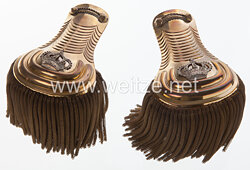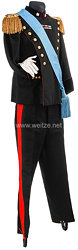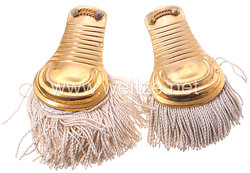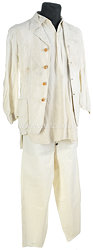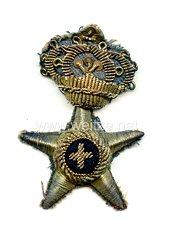
Lightweight tropical field tunic, called “Saharina”, manufactured 1941. Made from very light cotton fabric, 4 applied breast pockets, button placket with 5 brown Bakelite buttons, complete with all insignia. On the collar with applied golden stars, shoulder boards of woven silver brocade with hand-embroidered crowned national eagle in gold and 4 golden rank stars on red cloth backing as Marshal of Italy, silver shoulder buttons, shoulder boards with loops. Sewn onto the chest are Graziani's decorations: the top row with 3 embroidered crowns with crossed swords as insignia for 3-time promotion for war merit. Below in 3 rows the ribbons of 15 (!) decorations: 1. Military Order of Savoy Grand Cross, 2. and 3. 2 Silver Medals for Military Valor “Al Valore Militare”, 4. and 5. 2 Bronze Medals for Military Valor “Al Valore Militare”, 6. Order of Saints Maurice and Lazarus Grand Cross, 7. Order of Saints Maurice and Lazarus Golden Medal of Honor for 50 Years of Service, so-called “Medaglia Mauriziana”, 8. Order of the Crown of Italy Grand Cross, 9. Bronze Medal “Lungo Comando”, 10. Libya Campaign Medal 1911-1912, 11. Officer Service Decoration Cross for 40 Years, 12. Colonial Order of the Star of Italy Grand Cross, 13. War Commemorative Medal 1915-1918 for 4 Years, 14. Commemorative Medal “Unità d'Italia 1848-1918”, 15. Ethiopia Campaign Medal for Combatants. On the right upper arm with 4 hand-embroidered golden stripes for 4-time wounding in war. Inside with woven tailor's label “Unione Militare sede di Roma”, with handwritten wearer designation “SE Maresciallo d'Italia R. Graziani, Data 16-9-41”. At the waist left and right with sewn loops for the missing cloth belt. Together with matching long tropical trousers, the fabric somewhat lighter.
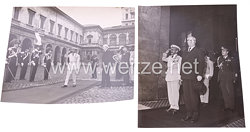
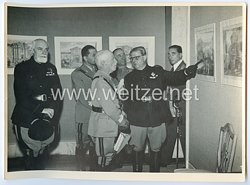
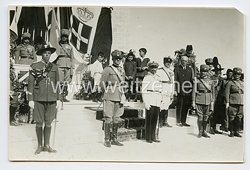
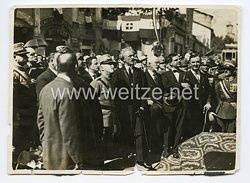
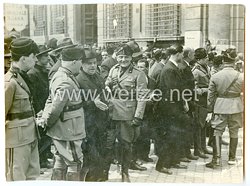
The field tunic and trousers are clearly worn and show typical wear and aging signs. A very beautiful photo can be found on the internet of Marshal Graziani during a visit by Generalfeldmarschall Kesselring, in which Graziani is wearing exactly this uniform!
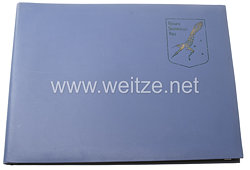
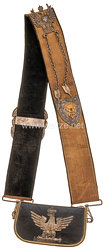
In addition, a large gift bracelet from the Askari combat group “Banda Allopiano” of the II. Corpo Armata (Army Corps) to Marshal Graziani as a memento of the anniversary of the conquest of Adua, Ethiopia Campaign, 1936: Large hinged silver bracelet, hollow worked and decorated in typical North African style, front with enameled plate, hand-painted: a charging Askari before the Adua monument. On the inside with dedication engraving “Al Vincere de Etiopia Rudolfo Graziani nell aniverario della riconquista di Adua G'le Ascari fedeli del gruppo 'Banda Allopiano' del II C.A. Ottobre 1936 - XIV.” (English = To the Victor over Ethiopia Rudolfo Graziani on the anniversary of the reconquest of Adua - the faithful G'le Ascari of the “Banda Allopiano” Group of the II. Army Corps October 1936 – XIV. (the 15th year according to Fascist calendar)). Complete in blue presentation case, on the lid with initials “R. G.” printed in gold. Slight signs of use and age, condition 2.
Price upon request:
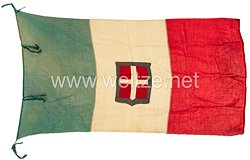
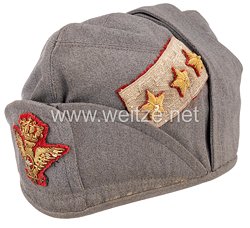
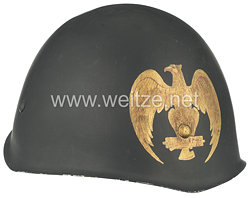
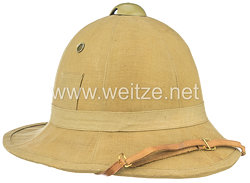
A historically significant ensemble of museum importance from the estate of arguably the most significant Marshal of Italy Rudolfo Graziani, on the German side comparable only to Generalfeldmarschall Rommel.
Ex collection Dott. Spada, Italy.
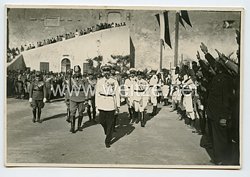
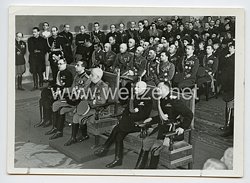
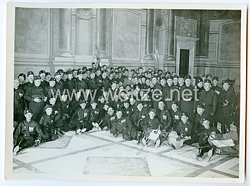
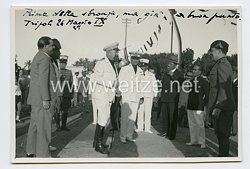
Marshal Rodolfo Graziani, Marquis of Neghelli (* August 11, 1882 in Filettino, Province of Frosinone; † January 11, 1955 in Rome) was a leading Italian military officer and politician during the rule of Italian Fascism. Graziani gained notoriety for his role in the Second Italo-Libyan War (1922-1932). Having arrived in Libya as the youngest colonel of the Italian Army in October 1921, Graziani received the main credit for the conquest of Tripolitania and in 1929/30 also for the occupation of Fezzan. As a counter-guerrilla specialist, he modernized the methods of desert warfare and relied not only on rapidly advancing units with armored vehicles supported from the air, but also on unbridled brutality. Notorious for his fascist adherence to principles, Graziani earned a reputation as the “Butcher of Arabs” and repeatedly ordered mass executions. After being appointed by Mussolini as Vice Governor of Cyrenaica in spring 1930, Graziani set about the “pacification” of this Libyan region according to his proven pattern. In a letter to Governor-General Pietro Badoglio, he compared the situation in the troubled region to an “abscess” that must be ruthlessly cut out so that the infected body could heal again. He became Vice Governor (1930-1934), after which he was briefly Governor of Italian Somaliland (1935-1936) and as such Commander-in-Chief of the southern invasion troops during the Italian war of aggression against the Empire of Abyssinia. The units commanded by Graziani systematically and comprehensively deployed poison gas. During his subsequent term as Viceroy of Italian East Africa, Graziani established an occupation regime based on terror. As Governor-General of Italian Libya (1940-1941), Graziani directed the failed invasion of Egypt after Fascist Italy's entry into World War II, whereby he fell out of favor with Mussolini. Only after the fall of the Mussolini regime and the founding of the Fascist Republic of Salò (R.S.I.) did Graziani serve under the Duce as its Minister of Defense (1943-1945) and supported the troops of the German Wehrmacht firmly on the side of the Repubblica Sociale Italiana. From his headquarters he commanded the Italian units fighting on the German side until the Allies had occupied large parts of Northern Italy and resistance was hardly possible. Despite the hopeless situation, he did not consider capitulation until the very end, but continued to have deserters executed. On April 29, 1945, one day after Mussolini had been shot by partisans, Graziani surrendered to U.S. troops in Milan. On the same day, as Marshal of Italy, together with SS-Obergruppenführer and General of the Waffen-SS Karl Wolff as “Plenipotentiary General of the German Wehrmacht in Italy”, he signed the Armistice of Caserta, whereby the capitulation of all German and republican Italian forces in the north of the country became effective in the night of May 2 to 3, 1945.