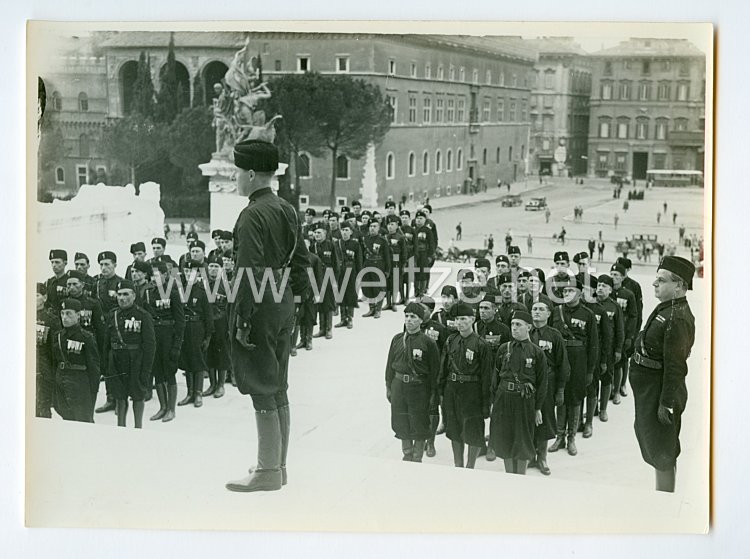
Kingdom of Italy Press Photo: Parade of the Blackshirts Milizia Volontaria per La Sicurezza Nazionale (MVSN)
This press photograph documents a march of the Blackshirts of the Milizia Volontaria per la Sicurezza Nazionale (MVSN), the fascist party militia of the Kingdom of Italy. This historical image, measuring approximately 22 x 16 cm, provides an authentic glimpse into the paramilitary organizations of fascist Italy and their public staging.
The MVSN was officially established on January 14, 1923, by royal decree, after Benito Mussolini had come to power in October 1922 through the so-called “March on Rome.” The organization emerged from the original Squadre d'Azione, the paramilitary combat units of the fascist movement that had made themselves known through political violence and street fighting since 1919. The transformation into a state militia was intended to institutionalize these combat units and bring them under state control, while they simultaneously maintained their function as an instrument of fascist power projection.
The designation “Blackshirts” (Camicie Nere) referred to the characteristic black uniform that became the symbol of Italian fascism. This uniformity had its origins in the post-war period, when the first fascist action groups chose black shirts as practical and intimidating clothing. The black was deliberately chosen and stood in contrast to the red shirts of the Garibaldini, while simultaneously recalling the uniforms of Italy's elite troops from World War I.
The MVSN was directly subordinate to the Duce, Benito Mussolini, and functioned parallel to the regular royal army. The organization was divided into legions, cohorts, and centuries, deliberately drawing on Roman antiquity and its military terminology. This conscious reference to the Roman Empire was characteristic of fascist ideology, which presented Italy as the successor and restorer of the ancient imperium.
Press photographs like the present one played a central role in fascist propaganda. Marches and public displays of military power were essential elements of fascist rule. These events served multiple purposes: they demonstrated the alleged strength and unity of the regime, were meant to intimidate the population while simultaneously inspiring enthusiasm for fascist ideology. The careful choreography of such marches, the strict uniformity, and military discipline were intended to convey the impression of an unstoppable, modern, and efficient power.
The press photography system experienced considerable control and instrumentalization under fascism. The Istituto Nazionale LUCE (L'Unione Cinematografica Educativa), founded in 1925, controlled photographic and film reporting. Images of MVSN marches were deliberately used for domestic and foreign propaganda to spread the image of a strong, militarily potent Italy.
Membership in the MVSN was initially voluntary but increasingly became a necessity for careers in public service and the fascist party. At its height, the militia comprised several hundred thousand members and was divided into various specializations, including the MVSN Ferroviaria (railway), the MVSN Portuale (ports), and the MVSN Forestale (forestry).
During World War II, MVSN units fought on various fronts, including North Africa, the Balkans, and the Eastern Front. However, the military effectiveness of the Blackshirts frequently fell short of expectations, as ideological indoctrination often took precedence over professional military training.
After Mussolini's deposition on July 25, 1943, and the founding of the Repubblica Sociale Italiana (RSI) in German-occupied northern Italy, the MVSN was transformed into the Guardia Nazionale Repubblicana. With the final collapse of the fascist regime in April 1945, the organization was dissolved.
Photographic documents like the present one possess considerable historical value today as primary sources for researching Italian fascism, its staging practices, and its visual propaganda. They document not only military-historical aspects but also the mechanisms of totalitarian rule and mass mobilization in interwar Europe.