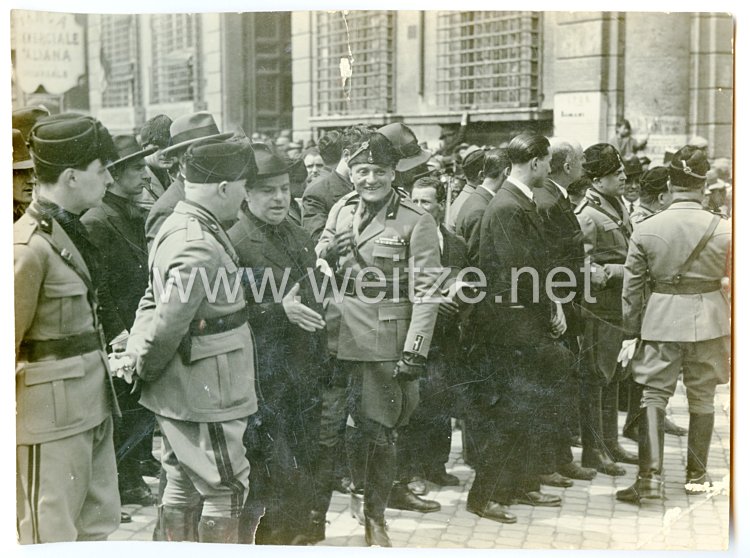
Kingdom of Italy Press Photograph: Italian Officers at a Rally

Dimensions approx. 24 x 18 cm, torn, condition 2.
398786
20,00

Kingdom of Italy Press Photograph: Italian Officers at a Rally

Press Photography in the Kingdom of Italy: Officers at Public Rallies

This press photograph documents Italian officers at a public rally during the era of the Kingdom of Italy (Regno d'Italia, 1861-1946). Such images represent important contemporary historical documents that provide insight into military culture, political staging, and propaganda practices of the Italian state.

The Kingdom of Italy emerged in 1861 through the unification of Italian states under the leadership of the House of Savoy. Under King Victor Emmanuel II and his successors, Italy developed into a European power with colonial ambitions. The role of the military was central to national identity formation and the foreign policy of the young nation-state.

Press photographs like this gained enormous significance particularly from the 1920s onward under Benito Mussolini's fascist regime. Fascist Italy systematically employed visual propaganda to demonstrate state power and mobilize the population. Rallies with military participation were a central element of this staging policy. The Italian armed forces (Regio Esercito) were presented as symbols of national strength and unity.

The uniforms of Italian officers underwent several developmental phases in the Kingdom. After unification in 1861, Italian military dress initially drew heavily on French models. The characteristic grigioverde (grey-green) uniform was introduced in 1909 and remained the standard color of the Italian army until the end of World War II. Officers wore different uniform variants depending on occasion and branch of service: dress uniforms (alta uniforme) for ceremonial occasions, service uniforms (ordinaria) for daily duty, and field uniforms (campagna) for combat deployment.

The press work and photographic documentation of military events became increasingly professionalized in early 20th-century Italy. During World War I (1915-1918), Italy established systematic structures for war reporting and photographic documentation for the first time. The Comando Supremo, the supreme command of the Italian armed forces, set up its own press offices that controlled and directed the flow of information.

In the fascist era beginning in 1922, this control was massively expanded. The Ministero della Cultura Popolare (Ministry of Popular Culture), colloquially known as MinCulPop, supervised the entire media landscape including photographic reporting from 1937 onward. Photographs of military rallies served to demonstrate power, order, and national unity.

Rallies with military participation occurred in various contexts: on national holidays such as the anniversary of Italian unification or the anniversary of the March on Rome (October 28), at victory celebrations following military successes like the conquest of Ethiopia in 1936, at oath-taking ceremonies and flag oaths, and during visits by high-ranking state or military dignitaries. Officers played a central representative role at such events.

The technical quality of press photographs from this period varied considerably. Professional images were taken with high-quality plate cameras or, from the 1920s onward, with more modern small-format cameras. The images were used for newspapers, illustrated magazines such as La Domenica del Corriere, or for propaganda purposes. The typical format of approximately 24 x 18 cm corresponds to the standard sizes then common for press prints.

The preservation of such historical photographs is of great importance for historical research. They document not only military aspects but also social conditions, crowds, urban spaces, and the staging practices of authoritarian regimes. For collectors and historians, original prints represent important primary sources that provide insight into the visual culture and propaganda mechanisms of the 20th century.

After World War II and the end of the monarchy in 1946, the significance of such photographs changed fundamentally. What once served to glorify the regime now became study material for critical examination of fascism and militarism. Today, such press photographs are indispensable documents for researching 20th-century Italian history.