Hannover

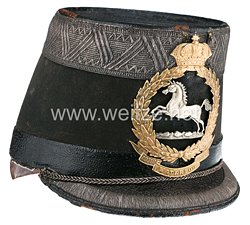
Kingdom of Hannover Shako (Kepi) Model 1859 for a Field Grade Officer of the Line Infantry Regiments from the period of the Austro-Prussian War 1866

Circa 1860. Tall shako, slightly inclined forward, body of felt covered externally with black cloth, the top, trim edging, and front visor of black lacquered leather, complete with all fittings. For the officer, silver cord around the lower edge and at the edge of the front visor with embroidery of silver thread; for the field grade officer, the broad three-part silver officer's braid with four gold stripes runs around the upper edge. Front emblem features the “Leaping Horse” in silvered execution, framed by the gilt laurel wreath with crown and motto ribbon «18 Jun Waterloo 1815», with attached inventory tag «1061» from the Royal Hanoverian collection at Marienburg Castle. Complete with field insignia bearing the cipher «GRV». Interior with finely tabbed lining of gold-embossed morocco leather, the front visor lined in green. With chin strap. Size approximately 58. Beautifully preserved, only the body slightly warped. Condition 2.

Extremely rare as a shako for a field grade officer! A shako as worn by a field grade officer during the Battle of Langensalza in the Austro-Prussian War of 1866. This piece comes from the Royal Hanoverian collection at Marienburg Castle and was sold at the Sotheby's auction at Marienburg near Hildesheim in October 2005. Due to its provenance from the “Royal Rifle and Armory Chamber”, it can be assumed that the shako belonged to King Georg V himself or to Prince Ernst August.
509358
6.500,00

Kingdom of Hanover Shako (Kepi) Model 1865 for an Officer in the 3rd Jäger Battalion from the Period of the Austro-Prussian War 1866

Location Goslar. Circa 1866. Flat, forward-sloping shako, the body made of felt, externally covered with black cloth, overlaid by a second fabric band covering both ventilation grilles, the top, edge binding and the straight front visor made of black lacquered leather, complete with all fittings. On the front as emblem the oval shield with the “leaping horse” in the center, surrounded by a laurel wreath, topped with the royal crown, fitted with the cockade for the 3rd Battalion. Complete with the inserted black horsehair plume. Interior with fine spliced lining of gold-embossed morocco leather. Accompanied by a contemporary collection label, probably from the royal collection at Marienburg Castle with the inscription “Jäger-Offizier”. Size approximately 55. Without chin strap. The body slightly warped, the fabric cover with two moth holes. Uncleaned. Condition 2.

Extremely rare, of museum significance!

This piece originates from the royal Hanoverian collection at Marienburg Castle, which was auctioned at Sotheby's in October 2005 at Marienburg near Hildesheim.

Such shakos were worn at the Battle of Langensalza in the Austro-Prussian War 1866.


509337
4.500,00

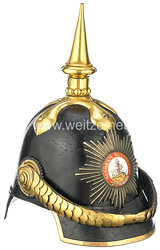
Kingdom of Hannover Model 1849 Helmet for an Officer of the Crown Prince Dragoon Regiment from the Period of the “Second Schleswig War”

Garrisons Osnabrück, Lingen, Quackenbrück, Aurich. Circa 1860. Tall leather helmet, complete with all fittings. Front plate featuring the “rampant horse” with crown applied above. Domed scale chains attached to rosettes with brass slotted screws, on the right the large cockade of the Kingdom of Hannover. Cross-shaped peak base, the neck with ball decoration, the spike removable. Interior with leather lining. Size approximately 56. The skull slightly warped, one of the bracket nuts replaced in period, another missing, the tongue of the leather strap of the scale chain torn off. Condition 2.
488051
5.500,00

Kingdom of Hanover Pickelhaube Model 1847 for an Officer of the 1st or Leib-Regiment

circa 1850. Elegant tall leather helmet, complete with all fittings in gilt finish. Front helmet plate featuring the large yellow trotting horse (without the motto “Waterloo”!). Cross-shaped base with ball screws (1 missing), tall spike, curved scale chin chains, on the right the large leather officer's cockade, angular front visor. Interior with laced leather lining. Interior front visor lined in green, rear neck guard lined in black. Only lightly worn in very fine untouched original condition.

Very rare! The Pickelhaube following the Prussian model was introduced in 1847 initially only for the Garde-Regiment and then in the same year also for the Leib-Regiment (1st Regiment). In 1850 the line regiments were also equipped with it. The Leib-Regiment was the only regiment that did not carry a motto from the Napoleonic era, as it was only formed in 1838 from detachments of other regiments.
490594
5.500,00

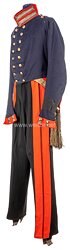
Kingdom of Hannover Uniform of King Ernst August I as General and Chief of the Guard Hussar Regiment; Uniform of the Ernst August Monument (!!)

The uniform ensemble from circa 1845-1850 consisting of twelve individual pieces:
#1. Fur busby of finest brown-white fur with the bag of fine red cloth. At the front as emblem for the Guard Hussar Regiment the gilt bandeau with the three battle honors “Peninsula Waterloo El Bodon”, the surface grained, the letters polished, above this separately applied the gilt royal crown of finest craftsmanship quality. The chin strap of black lacquered leather with black velvet backing and gilt chain reinforcement, attached at the sides to gilt semi-relief lion heads. The extra high parade plume of white particularly soft and approximately 39 cm long heron feathers, at the base with short yellow feathers, the “feather basket” particularly elaborate with small gilt plates and gilt thread embroidery, the parade plume inserted into the fur busby in a gilt socket and fixed with a screw. Complete with the line of silver thread with yellow interweaving. Inside with very fine, almost parchment-like leather sweatband with gilt printing and finest lining of light blue silk cloth. Size approximately 57. Very well preserved. Only the bag with two small moth traces. Accompanying label “Royal Guelph Museum. Uniform piece, belonging to the Hanoverian Hussar uniform of King Ernst August.”
#2. The dolman/pelisse of fine soft dark blue cloth with rich gilt braiding and five rows of 18 gilt buttons each, the middle row of spherical buttons, the other four rows with hemispherical buttons, on the sleeves the special officer's braid for the Guard Hussar Regiment, the high standing collar, the sleeves, the button panels and the hem for officers of the Guard Regiment with gray fur trim, on the shoulders the “caterpillars” of silver wire with yellow cords and two gilt rank stars each for the general. On the left sleeve with the black silk mourning band. The pelisse well lined, inside with red silk cloth. Very well preserved, the lining inside with an approximately five cm long thin tear.
#3. The parade attila of fine soft dark blue cloth with rich gilt braiding and five rows of 18 gilt buttons each, the middle row of spherical buttons, the other four rows with hemispherical buttons, on the sleeves the special officer's braid for the Guard Hussar Regiment, the high standing collar, the chest (under the braiding) and at the hem with broad gilt braid, on the shoulders the “caterpillars” of silver wire with yellow cords and two gilt rank stars each for the general. On the left sleeve with the black silk mourning band. The attila is more lightly lined, inside with red silk cloth, the hem inside reinforced with red leather. Attached on a cord the remnant of a typical label from the royal Hanoverian collection.
#4. Parade bandolier and cartridge box. The parade bandolier of red leather, wrapped with red velvet cloth, applied the silver braid with gilt interweaving, gilt escutcheon with the two priming wires on gilt chains attached to the gilt lion head suspension, gilt buckles. The cartridge box covered with red morocco leather, the sides and lid mounted with gilt brass, on the lid applied in silver the crowned star with the motto “Nec aspera terrent” as well as the bandeau “Peninsula Waterloo El Bodon”. Attached the inventory tag “1501” of the royal Hanoverian collection Marienburg Castle.
#5. Sash of silver braid with auxiliary strap. Attached on a cord the remnant of a typical label from the royal Hanoverian collection.
#6. Sabretache of red leather, the lid with rich decoration in gilt and silver thread embroidery on red cloth, above the crown, below the cipher “EAR” over a trophy of arms. Complete with the three carrying straps and the attached under-buckle belt, also of red leather, decorated with gilt braid and with gilt fittings. Attached the label “Royal Family Museum. No. 1 Hanoverian Guard Hussar Uniform [...]”.
#7. Eagle-head saber with slightly curved double-fullered blade on both sides approximately 84.5 cm long and 2.8 cm wide, the lower third on both sides with gilt engravings. Gilt stirrup guard with finely chased eagle head, leather-wrapped grip with intact silver wire binding. Attached the inventory tag “149” of the royal Hanoverian collection Marienburg Castle. Polished steel scabbard with two brass ring bands. Very well preserved!
#8. Boot trousers of fine dark blue cloth with thin red piping, the waistband outside trimmed with black silk, inside with white silk. The black horn buttons all preserved. The instep straps on buttons for removal.
#9. A second pair of boot trousers of fine dark blue cloth with thin red piping, inside with gray-blue silk lining. The buttons complete. Attached label of the royal Hanoverian collection. The instep straps on buttons for removal.
#10. The spurs of gilt brass with intact strapping of blackened leather. Inside punched with a downward-opening “horseshoe” and therein the letter “S”.
#11. Shabraque of dark blue cloth with red zigzag border trimmed in gilt-embroidered galloon, the edge piped in gilt embroidery. On the sides brown leather applications for protection against abrasion from the rider's legs. The underside protected by black cloth. On the leather application at left with old inventory label "Hannover Guard Hussar Shabraque 1893 from Penzing".
#12. The officer's bridle after English model with rosette and “tassel” decoration of brown leather, complete with the head, breast and crupper harness.


An exhibition piece of great historical and museum significance of which we are very proud to present to you!

The pieces all originate from the royal collection at Marienburg Castle and were sold at the 2005 Sotheby's auction.
At this auction the pieces were acquired by a renowned “Hannover collector” and came from him into our possession.
The pieces in turn originate from the personal property of King Ernst August I (King from 1837-51).
This is precisely the uniform that the King wears on the Ernst August Monument in Hannover, which was created in 1861 by Albert Wolff.
Dating to the year 1849 is a portrait by the court painter Karl Wilhelm Friedrich Oesterley, which shows the King again in precisely this uniform. This portrait achieved wide distribution including as a postcard motif and may also have served as the model for the equestrian statue.
The individual pieces were not sold together at the 2005 Sotheby's auction, also because in the house collection the pieces were kept separately from one another. The collector deserves credit for recognizing the pieces in their historical value and correctly attributing and uniting them.
The association is unquestionable and can be determined apart from the museum label also solely from the high quality of the pieces, the rank on pelisse and dolman and the dating concordance.
Furthermore, sabers with eagle heads were reserved only for the King. The bridle can also be found in its details on the equestrian statue. The shabraque is also clearly recognizable here. The original took a “detour” via the exile collection in Penzing, Austria back to Marienburg.
502974

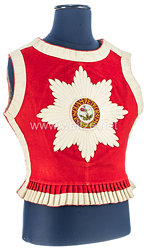
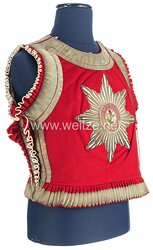
Kingdom of Hanover Supravest for Enlisted Men of the Garde du Corps circa 1860

with breast star of the Order of St. George on both sides, red wool vest with white border trim all around, applied breast star with hand-embroidered center in enlisted men's quality, side closure with hooks, light linen lining inside, in fresh color and lightly worn condition.

This supravest originates from the armory of the guard of the King of Hanover. In total there were approximately 20 vests for enlisted men and 3 for officers, which were auctioned at Sotheby's in October 2005 at Marienburg near Hildesheim.
476337
1.500,00

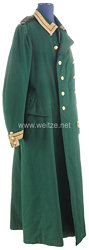
Kingdom of Hanover Court Master Huntsman Coat

circa 1860. Heavy dark green coat, double row of buttons, gilt buttons bearing the Hanoverian coat of arms, one button missing on the back. Collar and cuff flaps with wide double gold lace trim. The shoulder boards with applied rank star are covered with mourning crepe. Lightly worn in good condition.

This piece comes from Marienburg Castle from the Sotheby’s auction of the Royal House of Hanover 2005.
411499
850,00

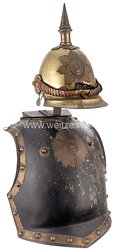
Kingdom of Hanover Helmet and Cuirass for Enlisted Men of the Garde-Kürassier-Regiment – formerly hung as wall decoration in Marienburg Castle

Circa 1860. Tall helmet of tombac with large stepped front visor, complete with all fittings in gilded finish. On the front, the large star of the Order of St. George of Hanover with the motto “Nunquam Retrorsum”, below it the applied bandeau “Peninsula Garzia Hernandez Waterloo”. Attached to the bandeau is the inventory plaque of Marienburg Castle. Large domed scale chains on oval rosettes with brass cross screws, on the right the Hanoverian cockade in leather. Brass cross-piece with detachable iron spike. Interior with black leather lining, the front visor painted green, the rear neck guard painted black. Size approximately 57. The helmet externally somewhat aged, the gilding mostly worn off.
The breastplate of the cuirass is a chamber piece of black-lacquered cast steel with rivets and decorative strips of brass, centrally applied the large crowned star with the “Leaping Horse” in the center and the motto “Nec Aspera Terrent”. The lacquer with significant chipping. The original lining still preserved inside. The cuirass stamped “17.” on the underside.
In the collar area, a wooden board with a holder for the helmet was already attached in the 19th century, with holes drilled on both sides in the shoulder area for attaching the support wires that held the ensemble on the wall.
Helmet and cuirass somewhat aged in still untouched and uncleaned condition.

A very fine ensemble which hung in the Welf Castle Marienburg. It was sold at the Sotheby's auction in October 2005.
452904
7.000,00

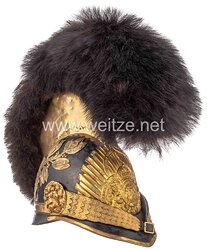
Kingdom of Hanover Officer's Helmet for the 3rd Cambridge Dragoons Regiment

Garrisoned at Celle. Circa 1835. Tall “caterpillar helmet” of the finest quality, complete with all fittings in gilt execution. The body of black lacquered leather, the bell lined with felt. At the front, a tall brass shield gilt with an edging of oak leaf decoration, centrally applied with the genuine silver (!) star of the House Order with swords, at center the “Hanoverian horse” and the motto “nec aspera terrent”, above it the royal crown, below it separately applied the also genuine silver (!) honor bandeau with laurel decoration and the battle honors “Peninsula Waterloo Göhrde”. Large convex scale chains attached to half-relief lion heads. On both sides the cut guards in serpent or tendril form. On the left side of the helmet the label of the royal collection at Marienburg Castle. The helmet topped with black leather comb with gilt brass fittings and black wool caterpillar, at front applied the half-relief lion head of gilt brass. Interior with fine black silk lining, on the sides black velvet, in the bell a large label of the supplier “C.A. Wagner Königl. Hof-Hutmacher Hannover”. Size estimated 53/54. Very well preserved! Condition 2.

Extremely rare! This is the only helmet of this regiment known to us! And only the second dragoon helmet we have been able to offer on the market in over 40 years!

The helmet comes from the royal collection at Marienburg Castle, which was auctioned at Sotheby's auction at Marienburg near Hildesheim in October 2005. Based on the provenance and the high quality of the helmet, we assume that the helmet originated from royal ownership.

The “3rd Cambridge Dragoons Regiment” was formed around 1833 from the “3rd (Göttingen) Duke of Cambridge Hussars Regiment” and the “4th (Lüneburg) Crown Prince Hussars Regiment”. Around 1835, officers were equipped with this helmet model. In 1849/50, the helmet based on the Prussian pattern was introduced. The helmet presented here was therefore worn for only approximately 15 years.


507420
19.500,00

Kingdom of Hanover Model 1862 Helmet for Officers of the Horse Artillery from the Austro-Prussian War of 1866

Elegant leather helmet, complete with all fittings. The tall leather skull with large front peak with brass edging, mounted on top gilt brass bandeau with the inscription “Waterloo Goehrde”, this broken in the center front and old repair, black velvet band running around the helmet with incorporated gilt chains, above this on the right the crowned cipher “GRV” (King of Hanover 1851-1866), on the left the socket with white plume holder, black bearskin caterpillar extending from the rear over the comb to the front peak, the rail of the large front peak broken in the center. Interior with black leather sweatband, without liner, with original chin strap. Size approximately 56. Condition 2.

A rare and very well-preserved object of museum quality! Certainly one of the rarest helmets of the Hanoverian Army.

The helmet was introduced in the Hanoverian Army in 1862 and worn only until 1866. It was modeled after the helmets of the Horse Artillery in the “King's German Legion”. The helmet was exclusively reserved for the Horse Artillery, which in 1866 consisted of only two batteries and was stationed in Wunstorf, comprising perhaps 6 officers in total. The bandeau refers to the Battle of Goehrde in 1813 and Waterloo in 1815, in which Hanoverian contingents participated.
The Hanoverian Army was able to achieve a tactical victory at Langensalza in 1866, but had to surrender to Prussian superiority. In the same year, Hanover was annexed by Prussia. King Georg V had fled into exile and refused to the end to recognize the annexation.
In 1867, the reorganization of the Hanoverian artillery units already took place. The Horse Artillery was absorbed into the newly formed Feldartillerie-Regiment von Scharnhorst (1. Hannoversches) Nr. 10.
486365
7.500,00

Kingdom of Hannover Attila and Sash of a Hussar of the Garde-Husaren-Regiment from the Era of George V

Stationed at Verden, circa 1860. The attila of dark blue heavy-weight cloth with yellow braiding and three rows of half-spherical and spherical brass buttons. Interior with original “jean-like” lining, the sleeve lining with stamp of a costume repository from Hannover. Worn condition, minor period repairs. 

Very rare! The Garde Husaren Regiment wore these attilas at the Battle of Langensalza on June 27, 1866.
509365
2.500,00

Kingdom of Hannover Surcoat for Enlisted Men of the Garde du Corps circa 1860

with breast star of the Order of St. George on both sides, red wool vest with surrounding white trim, applied breast star with hand-embroidered center in enlisted men's execution, hooks on sides for closure, light linen lining inside, in fresh color and lightly worn condition.

This surcoat originates from the armory of the Guard of the King of Hannover. In total there were approximately 20 vests for enlisted men and 3 for officers, which were auctioned at Sotheby's in October 2005 at Marienburg near Hildesheim.
476335
1.500,00

Kingdom of Hanover Pair of Boots for a Cuirassier/Gardes du Corps Officer

Circa 1850. Pair of elegant black boots made of fine patent leather. Height approximately 56.5 cm, sole length approximately 27 cm. Complete with buckle-on spurs. Condition 2.

The boots originally came from the Welf auction at Marienburg Castle and were sold by Sotheby's in October 2005.
Such boots were also worn by cavalry officers of other countries such as Prussia.
471940
2.000,00

Kingdom of Hanover Officer's Shako for Guards Regiment

circa 1860. Black felt shako with needle-felt covering in early pattern with horizontal visor. Complete with applied Guards star, the center of fine hand-painted porcelain, below which the bandeau “Peninsula - Waterloo” within laurel wreath. Black patent leather chinstrap with button rosettes. Topped with officer's plume socket in silver bullion, centered with monogram “GR V”. Interior with sewn leather lining. Size approximately 54. Worn piece in good condition, rare.
498145
4.500,00

Kingdom of Hannover Shako (Kepi) Model 1859 for an Officer of the Line Infantry Regiments from the Period of the Austro-Prussian War 1866

Circa 1860. Tall shako, slightly inclined forward, the body made of felt, covered externally with black cloth, the top, edge trim and front visor made of black lacquered leather, complete with all fittings. For the officer, silver officer’s braid running around the top edge, silver cord around the lower edge and at the edge of the front visor with embroidery in silver thread. On the front as emblem the “Leaping Horse” in silvered finish, framed by the gilded laurel wreath with crown and motto ribbon «18 Jun Waterloo 1815», the cross of the crown is missing (!). Complete with the field insignia bearing the cipher «GRV». Interior with finely paneled lining of gold-embossed morocco leather, the front visor lined in green. With chin strap. Size approximately 57. Very well preserved. Condition 2.

Very rare!

Such shakos were worn by the Line Infantry at the Battle of Langensalza in the Austro-Prussian War 1866.
509369
3.500,00

Kingdom of Hanover Shako (Kepi) Model 1859 for a Sergeant in the Line Infantry Regiments from the Period of the Austro-Prussian War 1866

Private property item, circa 1860. Tall shako, slightly inclined forward, the body made of felt, covered externally with black cloth, the top, edge binding and front visor made of black lacquered leather, complete with all fittings. For the sergeant, around the upper edge with white embroidered wool braid with yellow piping. On the front as emblem the “Prancing Horse” in silvered finish, framed by the gilt laurel wreath with crown and motto ribbon «18 Jun Waterloo 1815», with attached inventory tag «683» from the Royal Hanoverian Collection at Marienburg Castle. Complete with the field insignia made of nickel silver sheet with gilt “sun,” stamped on reverse «II A 14». Interior with finely spliced lining of gold-embossed morocco leather, the front visor lined in green. Without chinstrap. Size approximately 56. Very well preserved. Condition 2.

Very rare!

This piece comes from the Royal Hanoverian Collection at Marienburg Castle and was auctioned at the Sotheby's auction at Marienburg near Hildesheim in October 2005.

Such shakos were worn by the Line Infantry at the Battle of Langensalza in the Austro-Prussian War of 1866.
509368
3.000,00

Kingdom of Hanover Shako (Kepi) Model 1859 for an Officer of the Garde-Regiment from the Period of the Austro-Prussian War 1866

Circa 1860. Tall shako, slightly inclined forward, body constructed of felt, exterior covered with black cloth, top, trim edging and front visor of black lacquered leather, complete with all fittings. For the officer, silver officer's braid runs around the upper rim, silver cord around the lower rim and at the edge of the front visor with silver thread embroidery. Applied to the front is a silver star with finely enameled center depicting Saint George slaying the dragon and the motto “numquam retrorsrum” (Never backward), below which is separately applied the silver honor bandeau “Peninsula Waterloo”. Complete with field insignia bearing the cipher “GRV”. Interior with finely tabbed lining of gold-embossed morocco leather, front visor lined in green, in the crown the remnant of an old seal, on the front of the body handwritten owner's name “Rede[...]”, on the left side remnants of a signature “...S...”. With chin strap. Size approximately 56. Well preserved, old tear to the left of the emblem. Condition 2.

Very rare! A shako as worn by an officer of the Garde-Regiment during the Battle of Langensalza in the Austro-Prussian War 1866.
509361
4.500,00

Kingdom of Hanover Supra Vest for an Officer of the Garde du Corps

Circa 1860. Red wool vest with white piping, the hem and armholes pleated, trimmed throughout with silver braid, applied on chest and back the Guard star in the form of the Order of St. George in silver embroidery with colored medallion. Side closures with hooks, on the left hip the vest was laced with a cord, which is also still present. Interior with white silk lining. Very fine condition with fresh colors. Condition 2.

Extremely rare! Only three examples of an officer's supra vest are known worldwide. This piece comes from the Royal House of Hanover and was sold at the Sotheby's auction at Marienburg near Hildesheim in October 2005.


452366
15.000,00

Kingdom of Hanover Sash of a Hussar Non-Commissioned Officer from the Era of Georg V

circa 1860. The sash of yellow braid with white slides and tassels. Worn condition 2.

The sashes of enlisted men were, in contrast, reversed in color with white braid and yellow slides and tassels. 
511726
1.000,00

Kingdom of Hannover Fur Busby for Officers of the Garde-Husaren-Regiment

Garrison Hannover, circa 1850. Tall fur busby of brown fur. Complete with all fittings. Front mounted with fire-gilt non-ferrous metal crown above the battle honors scroll “Peninsula - Waterloo - El Bodon”, gilt chain mail on brown velvet base, attached at sides to hooks with large lion heads. Red bag firmly sewn in place. Complete with silver barrel sash with yellow stripes and tassels. Complete with original white heron feather parade plume with yellow base, lower end with gilt four-leaf mounting with retaining screw for attachment in socket mounted in the upper edge of the body. Interior with brown leather lining and reddish-brown silk lining. Lightly worn in beautiful untouched original condition! 
Extremely rare, a magnificent piece of museum-quality rarity, offered by us for the first time in over 35 years of business.

In 1813, the Hanoverian army already consisted of 3 hussar regiments. With the reformation of the cavalry in 1816, the number of hussar regiments was even increased to four. In 1833, the cavalry was reformed again and all regiments were now classified as dragoons. However, as early as 1838, the cavalry was reorganized once more and hussar regiments were created again. These included the Garde-Husaren-Regiment and the Königin-Husaren-Regiment. As late as 1847, the regiments received fur busbies with red and crimson bags respectively. In 1866, the regiment participated in the war against Prussia.


490405
20.000,00

Kingdom of Hannover Shako for Subaltern Officers of the Line Infantry Regiments

circa 1860. Tall black felt shako with needle felt covering. Complete with applied shako plate: the leaping horse within a crowned laurel wreath, below the bandeau “8. Juni Waterloo 1813”, upper encircling silver braid for subaltern officers. The plume holder is missing, interior without lining. Worn condition, Grade 3.
An attic find, still untouched.
294798
1.250,00