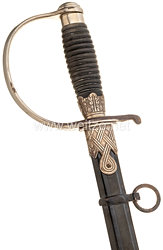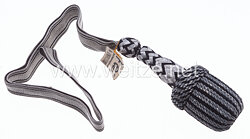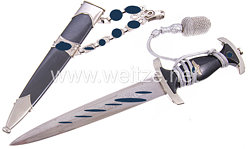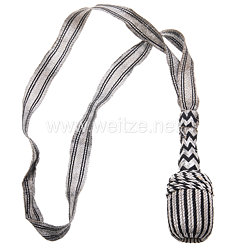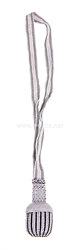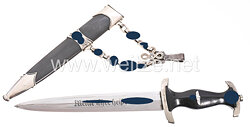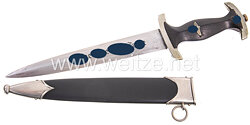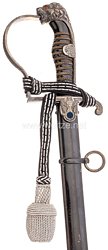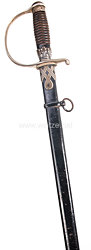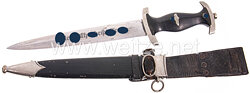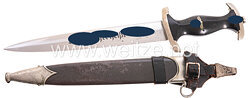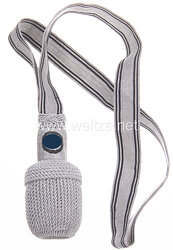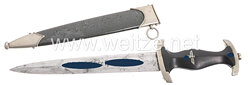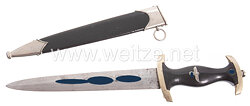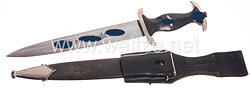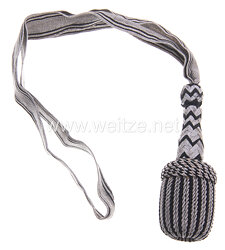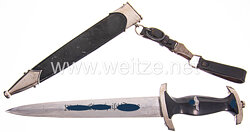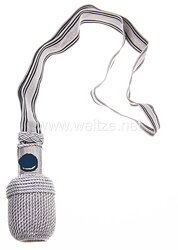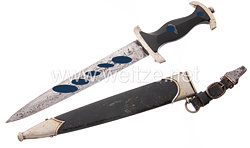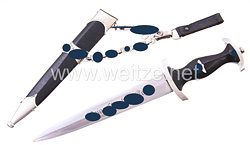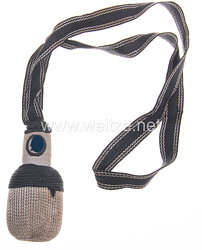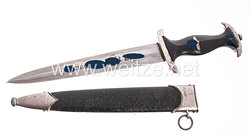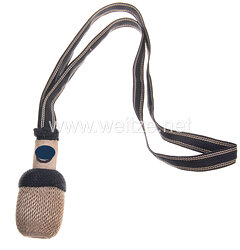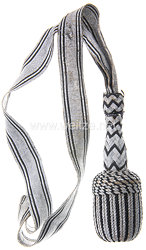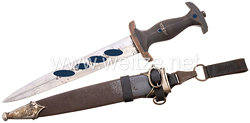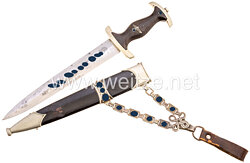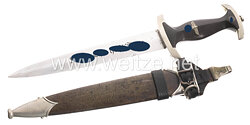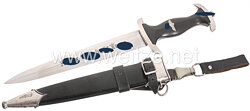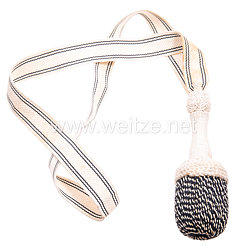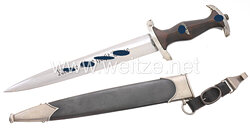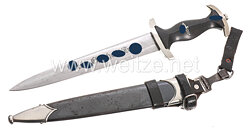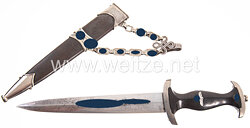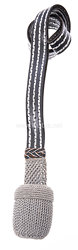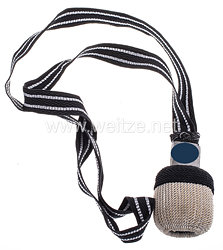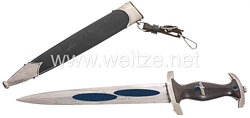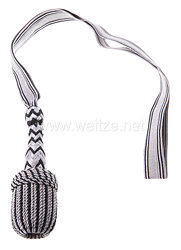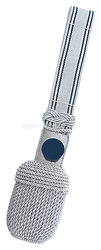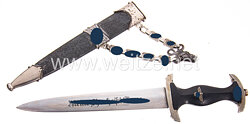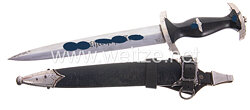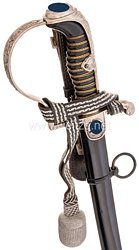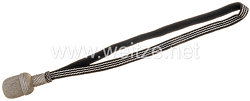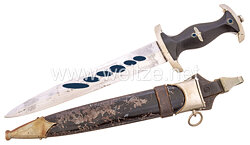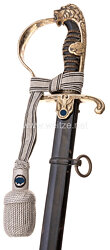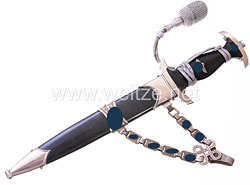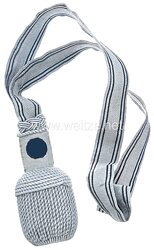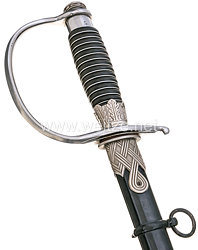
Manufactured circa 1937. Excellent condition blade by maker “Pet. Dan. Krebs, Solingen”. The hilt with typical early nickel fittings with black grip, intact wire wrapping, original inset emblem, the background blued. The pommel plate and crossguard stamped with the SS runes in octagon, the maker's mark of Otto Gahr workshops in Munich. At the top the pommel cap with fine engraving of the initial “S” for Schwerk in Germanic style, the cipher is mirrored to use it as a seal. Under the pommel cap is the internal double screw thread, which is very typical for these early daggers. The steel scabbard with over 90% of the original black lacquer, the scabbard fittings with original bluing. Attached is the original officer's portepee. The dagger is lightly worn, in good untouched original condition, condition 2.
Included is the original letter from Reichsführer-SS Heinrich Himmler, dated “Berlin SW 11, April 22, 1937”:
“Dear Comrade Schwerk!
I inform you that on the occasion of our Führer's birthday and on the basis of your merits as SS-Oberführer and Regional Commander of the Deutscher Reichskriegerbund, I have awarded you the SS Dagger.
The presentation and official award of the SS Dagger will take place in a ceremonial form at a later date.
Carry the dagger with honor!
Heil Hitler! Yours, H. Himmler”.
Also included is the original reply letter from Schwerk to Himmler, on letterhead “Deutscher Reichskriegerbund.. Regional District Southeast The Regional Commander SS-Oberführer”, dated Breslau, June 4, 1937:
“To the Reichsführer-SS Personnel Office Berlin SW 11
For the award of the SS Dagger by decree of April 20, 1937, I express my most sincere thanks. - The presentation took place in ceremonial form at a leaders' conference of SS-Oberabschnitt Southeast on June 3 of this year by Gruppenführer von dem Bach.
It is for me as an old soldier a self-evident matter of honor to carry the dagger with honor for the rest of my life.
Heil Hitler! Schwerk SS-Oberführer”.
At the bottom of the letter is the receipt stamp of the SS Personnel Office, dated June 5, 1937. Both letters hole-punched, in good condition.
This dagger is illustrated in the reference book by Thomas T. Wittmann “Exploring The Dress Daggers and Swords of the German SS” on page 369. Also included is a COA from 2022 from our highly esteemed colleague and edged weapons expert Thomas T. Wittmann.
The SS Honor Dagger for Leaders was personally awarded by the Reichsführer-SS with a certificate. The regular officer's dagger, which could be privately procured or officially issued (with SS runes on the blade), had no SS runes on the hilt fittings to distinguish it.
Oskar Schwerk (born July 16, 1869 in Hünern, Kreis Trebnitz; died November 14, 1950) was a German Major General and SS-Obergruppenführer. He entered the 3rd Lower Silesian Infantry Regiment No. 50 as an officer cadet on October 15, 1887. In 1889 promoted to Second Lieutenant, in 1896 to First Lieutenant. Schwerk was transferred to Infantry Regiment No. 154 on April 1, 1897 and subsequently served as adjutant at the local district command from October 1, 1898 to September 18, 1901. In the same function, Schwerk then served with the 31st Infantry Brigade, promoted to Captain in 1902. In 1905 appointed company commander in Infantry Regiment “Herwarth von Bittenfeld” (1st Westphalian) No. 13 in Münster. Concurrent with his promotion to Major, Schwerk became adjutant of the 2nd Division in Insterburg on February 21, 1911. In 1914 commander of III Battalion in the 3rd Upper Silesian Infantry Regiment No. 62 in Ratibor. With this regiment, Schwerk fought after the outbreak of World War I in France at Neufchâteau, on the Meuse and in the battles at Varennes and Vaubecourt-Fleury. On November 12, 1914, Schwerk became commander of the 4th Lower Silesian Infantry Regiment No. 51. In the further course of the war, the regiment participated with the 11th Division in the Winter Battle in Champagne, in June/July in the fighting in Artois, and in September/October 1915 in the Autumn Battle at La Bassée and Arras. This was followed by trench warfare west of Péronne and in January/February 1916 the fighting at Frise. Meanwhile, Schwerk had become Lieutenant Colonel on January 27, 1916. In summer and autumn, Schwerk participated with his regiment in the Battle of the Somme and was able to repel enemy attacks several times in his sector. For these achievements he was awarded the Order Pour le Mérite on September 21, 1916.
In spring 1917, Schwerk stood with his regiment in heavy defensive fighting in the St. Laurent-Tilloy lez Mosslaines sector. In the Easter Battle at Arras, the British overran the first two positions of his front sector. Schwerk then withdrew with his staff to the third position and from there successfully directed the defense against the enemy infantry advancing under the protection of a tank, preventing the breakthrough attempt of April 9, 1917. Schwerk was wounded so severely by a shell hit the following day that amputation of his left leg became necessary. For his personal commitment, he was then awarded the Oak Leaves to the Pour le Mérite on May 2, 1917, as the first regimental commander.
Since he was no longer fit for field duty due to his severe injury, he was appointed Inspector of Military Penal Institutions on January 18, 1918 after his recovery and promoted to Colonel on July 15, 1918. In mid-September 1918 followed his appointment as Commandant of Berlin. With the end of the Empire and the proclamation of the Republic, Schwerk handed over this post to his successor Otto Wels on November 9, 1918, under whom he served as Second Commandant until Christmas Eve. He was then transferred to Breslau and appointed Inspector of the local Landwehr Inspection. In this function he organized the security police of the Silesian capital until his retirement from active military service on January 31, 1920.
After his retirement, Schwerk was 1st Chairman of the Officers' Association of the former 4th Lower Silesian Infantry Regiment No. 51 and leader of the Provincial War Veterans' Association for Silesia. As such, he was also leader of SA Reserve II in Silesia. In the SA he reached the rank of Standartenführer.
On May 20, 1937, he applied for membership in the NSDAP and was accepted retroactively to May 1 of the same year (membership number 5,420,196). Member of the SS (SS number 276,825), most recently promoted to SS-Obergruppenführer on July 16, 1944. In addition to his function as Regional Leader Southeast of the NS-Reichskriegerbund, he was also Gau Leader Southeast and District Leader Breslau-Stadt for this organization. Schwerk received the honorary rank of Major General on August 27, 1939, the so-called Tannenberg Day. During World War II, he was also from September 1943 to May 1945 the Gauleiter's Commissioner for the Unified Direction of War Veterans' Associations Gau Lower Silesia.