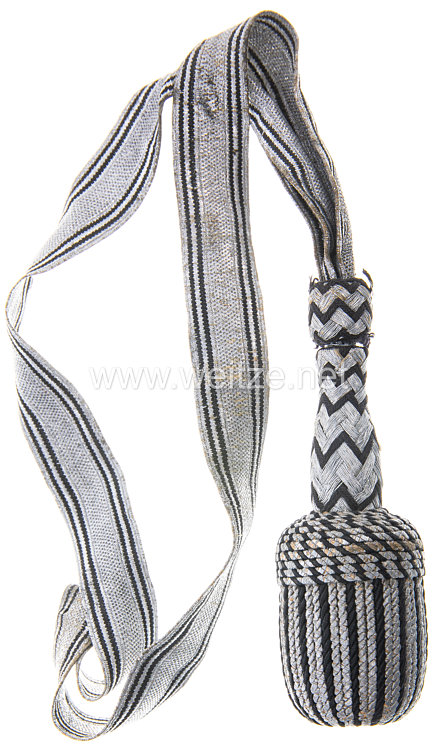
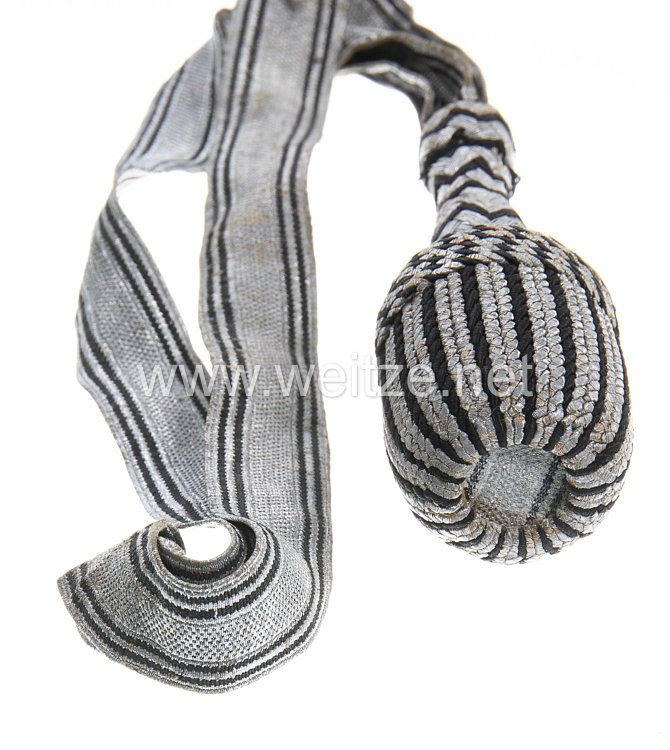
Schutzstaffel (SS) NCO Sword Knot for Sidearm

Made of aluminum thread, with black interwoven strands, showing signs of age and use, very well preserved. Condition 2
449442
850,00

Schutzstaffel (SS) NCO Sword Knot for Sidearm

The SS Non-Commissioned Officer's Sword Knot for the side arm represents a characteristic distinguishing feature of the National Socialist Schutzstaffel, worn by non-commissioned officers of this organization between 1933 and 1945. This military equipment component served not only a practical purpose but also symbolized the rank and membership in one of the most influential and feared organizations of the Third Reich.

The sword knot or Portepee has a long military tradition dating back to the 18th century. Originally conceived as a wrist strap to prevent the loss of weapons in combat, it evolved over time into an important rank insignia. In the Prussian and later German military tradition, different versions of the sword knot identified the various grades of non-commissioned officers and officers.

The SS was founded in 1925 as Adolf Hitler's bodyguard and developed under Heinrich Himmler from 1929 into a powerful paramilitary organization. With the Nazi seizure of power in 1933, the SS expanded rapidly and established a comprehensive system of rank insignia, uniforms, and equipment that deliberately distinguished itself from the Wehrmacht.

The non-commissioned officer's sword knot described here was manufactured from aluminum thread, which was typical for SS versions. Unlike the Wehrmacht, which used silver-colored or matte silver materials, the SS frequently used aluminum for its rank insignia and equipment items. The black interwoven threads in the sword knot are characteristic of SS non-commissioned officers and correspond to the general color scheme of SS uniforms, in which black played a dominant role.

The structure of such a sword knot typically consisted of several components: the sliding knot attached to the handle of the side arm, the braided body with the characteristic black interweavings, and the tassel at the lower end. The workmanship and quality varied depending on the time of manufacture and manufacturer, with early pre-war examples generally showing higher craftsmanship quality than late wartime productions.

The side arm itself was an important component of the SS uniform. Various models were used over the years, including the Model 1933 and later variants. The sword knot was attached to the handle or to a special ring on the hanger and served both to secure the weapon and to demonstrate the rank of its wearer.

The manufacture of such sword knots was carried out by specialized companies that often also produced other military effects. Quality control and compliance with regulations were strictly monitored, especially in the early years. However, with the progression of the war and increasing material shortages, simplified versions were also produced.

After 1945, many SS insignia and equipment items were destroyed as part of denazification. Surviving examples were often taken as war trophies or later entered collections. Today, such objects are important historical witnesses to a dark era of German history and are used in museums and educational institutions to educate about the National Socialist dictatorship.

The scientific study of such militaria today takes place under strictly historical-pedagogical considerations. In Germany, the handling of Nazi symbols is legally regulated, and the use of such symbols outside scientific, artistic, or educational contexts is prohibited. Research into these objects serves to understand the mechanisms of totalitarian rule and the role of symbolic representation in dictatorial systems.

The preservation of the specimen described here, with its signs of age and use, documents the authentic use by an SS non-commissioned officer during the National Socialist era and makes it an important historical document of this epoch.

r