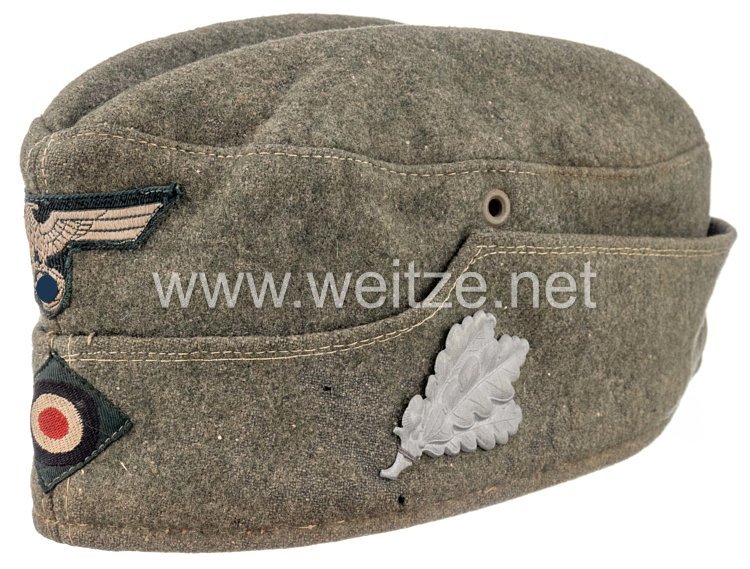
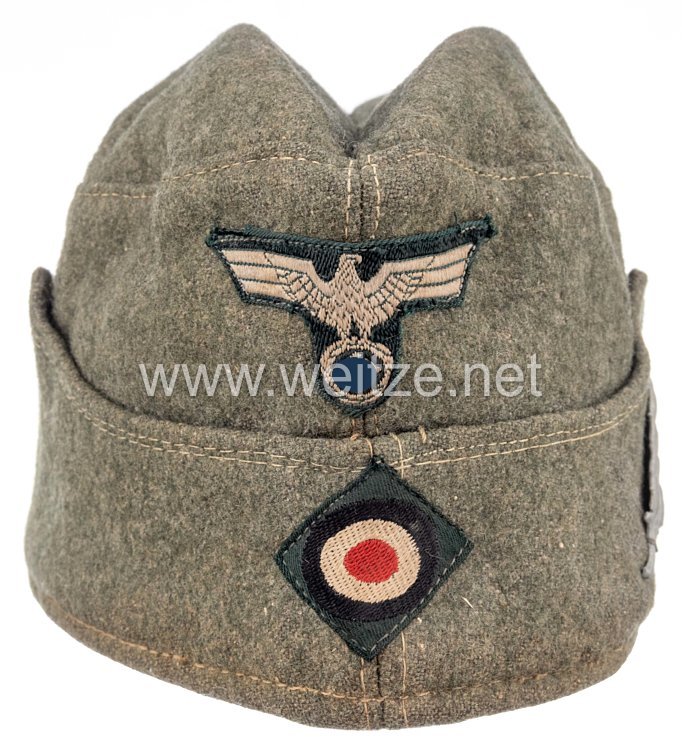
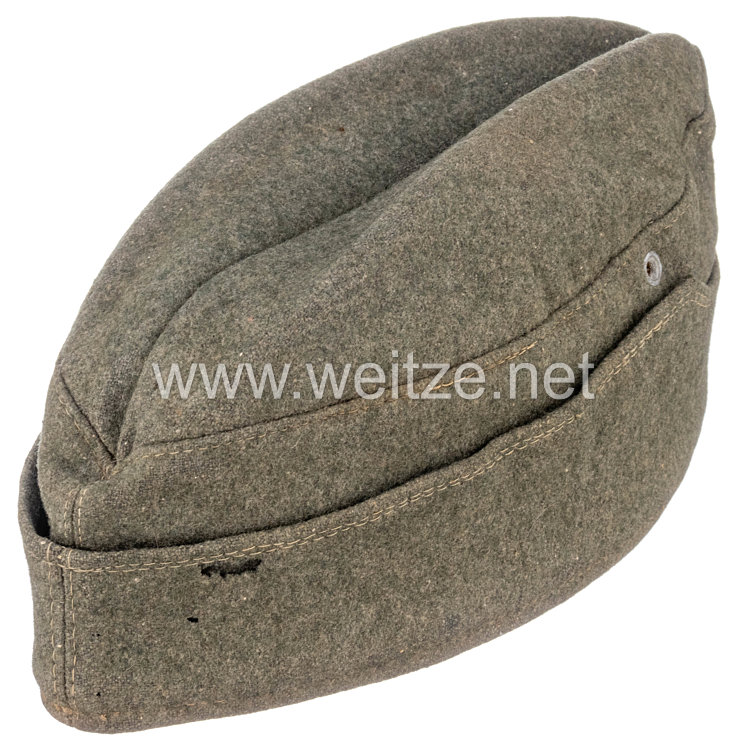
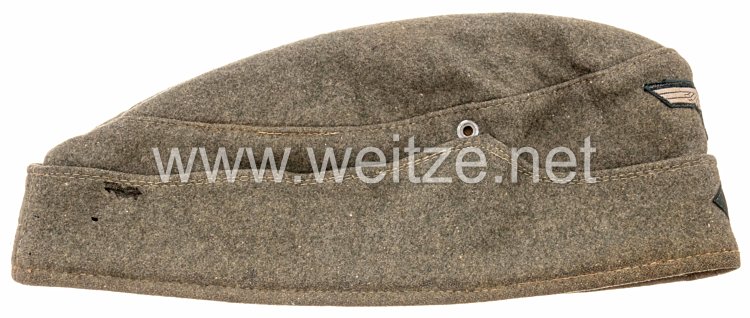
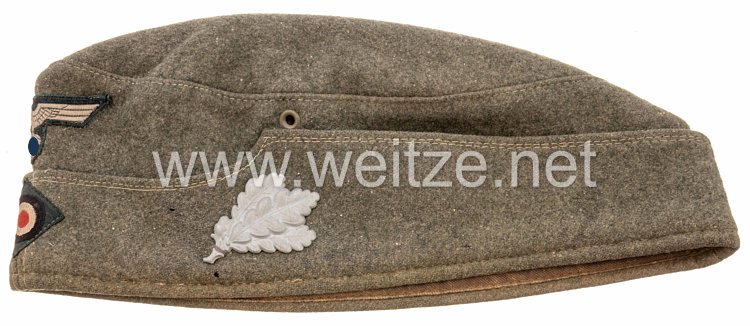
Wehrmacht Overseas Cap for Enlisted Men of the Jäger Troops

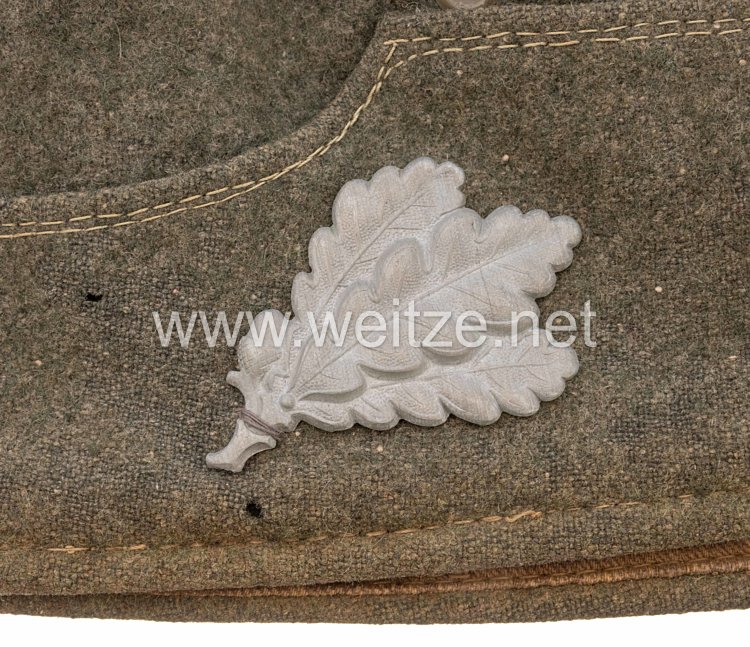
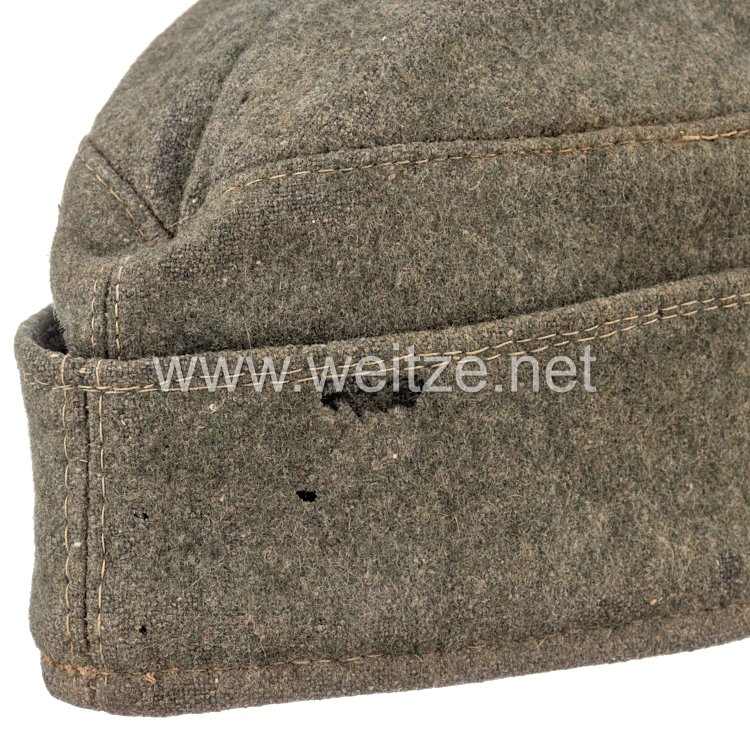
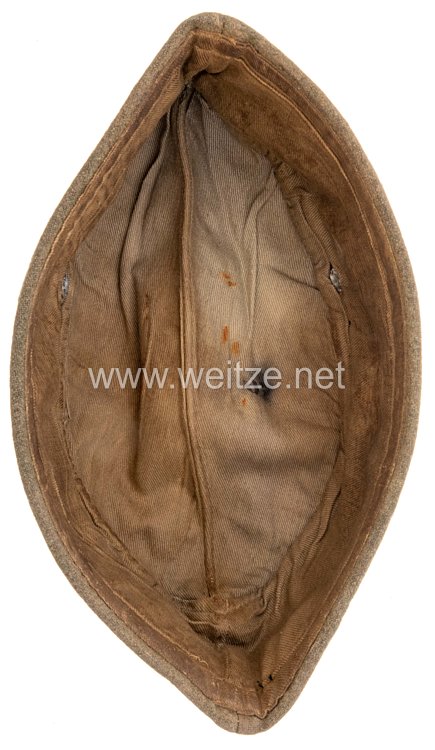
circa 1941. Manufactured from field-gray wool cloth, complete with Bevo-woven eagle insignia and cockade, metal Jäger troops badge sewn and clipped to the side. Moth damage to right rear. Size approximately 60. Heavily used condition.
447599
650,00

Wehrmacht Overseas Cap for Enlisted Men of the Jäger Troops

The Wehrmacht Schiffchen (field cap M34/38) represented the most common headgear of the German ground forces during World War II. The specimen described here belonged to a member of the Jägertruppe (light infantry), a specialized infantry unit of the Wehrmacht, and dates to around 1941.

The Schiffchen was officially introduced by Army Service Regulation (HDv) 43/5 on December 2, 1935, replacing the older Reichswehr headgear. The characteristic shape earned its name from its resemblance to an upturned boat. The Schiffchen was made of field-gray wool cloth and manufactured in various sizes, with size 60 corresponding to a head circumference of approximately 60 centimeters.

The Jägertruppe of the Wehrmacht traced its lineage to the traditional Prussian Jäger battalions of the 19th century. These units were originally conceived as light infantry and distinguished themselves through special mobility and terrain training. In the Wehrmacht, the Jäger battalions and later Jäger divisions formed specialized infantry formations frequently deployed in difficult terrain, particularly in forested and mountainous regions.

The present Schiffchen bears three essential insignia: the BEVO-woven national eagle, the Reich cockade, and the laterally attached metal badge of the Jägertruppe. The national eagle with outstretched wings, clutching a swastika in its talons, was machine-woven using a special weaving process by the company Bandfabrik Ewald Vorsteher (BEVO) in Wuppertal. This weaving technique enabled cost-effective mass production while maintaining consistent quality.

The black-white-red cockade symbolized the connection to the German national flag and the military traditions of the Imperial era. It was attached directly above the eagle on the front of the Schiffchen. The laterally fastened metal badge of the Jägertruppe typically displays crossed rifles or similar insignia, identifying the wearer as a member of this branch of service.

The dating to around 1941 falls during a significant phase of World War II. Following the successful Blitzkrieg campaigns in Poland and France, Germany was transitioning to Operation Barbarossa, the invasion of the Soviet Union on June 22, 1941. Jäger units played an important role in these operations, especially in reconnaissance and deployment in forested or impassable areas.

The described heavily used condition with moth damage to the rear indicates actual frontline service. Schiffchen were worn extensively in field service, particularly during activities where the steel helmet was not required. The moth damage suggests that the piece was stored under unfavorable conditions for an extended period after the war.

The production of Wehrmacht uniforms and equipment was carried out by numerous civilian suppliers throughout the German Reich. Quality varied considerably depending on the manufacturer and production year. Toward the end of the war, from 1943/44 onward, material quality deteriorated significantly due to raw material shortages. The specimen described here from 1941 still originates from a phase when production standards were relatively high.

For collectors and historians, such headgear is of considerable documentary value. It provides insights into the organizational structure of the Wehrmacht, the production methods of the German war economy, and the daily life of soldiers. The combination of national eagle, cockade, and branch insignia allows precise attribution to troop type and time period.

It is important to emphasize that such military-historical objects have significance exclusively in a scientific, educational, or collector context. They document a dark chapter of German history and serve as a warning and for education. The Wehrmacht was deeply implicated in the crimes of the National Socialist regime, which must always be considered when historically contextualizing such objects.

The Jägertruppe maintained distinct traditions that set them apart from regular infantry units. Their training emphasized marksmanship, initiative, and independent action in small units. The green color traditionally associated with Jäger units (though not visible on the field-gray Schiffchen) symbolized their forest warfare heritage. During the Wehrmacht period, Jäger divisions were considered elite formations, often used as mobile reserves or for particularly difficult assignments.