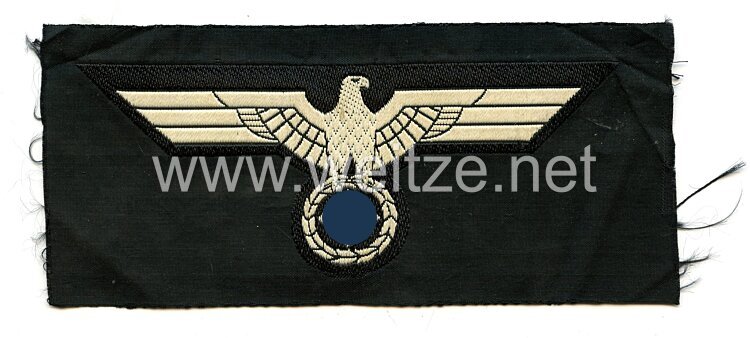
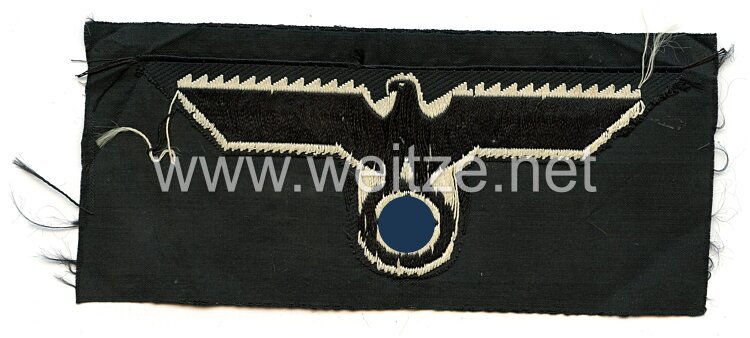
Wehrmacht Heer Breast Eagle for Enlisted Men Panzer Troops
The Wehrmacht chest eagle for enlisted personnel of the Panzer troops represents a characteristic insignia of the German armed forces during World War II. This specific version in Bevo weaving technique displays the national eagle in white on a black background and was designated for members of the armored forces.
The Bevo weaving technique, named after the Barmer Bandweberei Vohwinkel company, revolutionized the production of military insignia in the 1930s. This machine weaving technique enabled cost-effective mass production while maintaining consistently high quality. The insignia were woven directly in the appropriate colors, guaranteeing exceptional detail accuracy and durability.
The Wehrmacht's Panzer troops were established as an independent branch of service after the Nazi seizure of power in 1933. The first Panzer divisions were formed as early as 1935, representing a paradigm shift in German military strategy. The characteristic black uniform of tank crews had practical reasons: it was meant to conceal oil stains and dirt that were inevitable when working on and in armored vehicles.
The chest eagle was introduced according to the Army regulation of February 17, 1934 and had to be worn on the right breast of the field tunic. For enlisted men and non-commissioned officers without sword knot, the eagle in the form present here was prescribed: white on black ground for the Panzer troops, in contrast to other branches that used different color combinations.
The manner of wearing was precisely defined in the Wehrmacht's dress regulations. The eagle was sewn approximately 15 centimeters below the shoulder seam on the right breast. The correct position was important for the uniform appearance of the troops and was checked during inspections.
The symbolism of the eagle reaches far back in German military history. The rightward-facing eagle with spread wings, holding the swastika in its talons, was the official national emblem of Nazi Germany. On military uniforms, a distinction was made between the chest eagle and the sleeve eagle, which were worn at different positions.
The production of these insignia was carried out by numerous manufacturers throughout the German Reich. Besides the eponymous Bevo company, other ribbon weaving mills were also commissioned with production. Industrial mass production was necessary to meet the enormous demand of the Wehrmacht, which grew to over 18 million soldiers by 1945.
An unworn specimen like the one described here is rare today. Most surviving insignia show signs of wear, as they were worn or stored during the war or in the post-war period. The unworn condition suggests that this insignia was either never issued or kept as a replacement piece.
After the end of the war in 1945, all symbols of the Wehrmacht and National Socialism were banned according to the Control Council Laws. The public wearing of such insignia is still punishable under ยง86a of the German Criminal Code, unless it serves purposes of civic education, defense against unconstitutional activities, art, science, research, or teaching.
For military-historical collections, such original pieces are important testimonies of uniform studies and textile history. They document the technical skills of textile production, the organizational structures of the Wehrmacht, and the visual representation of military units. Museums and scientific institutions preserve these objects as educational tools and research objects.
Engaging with such military-historical objects requires special responsibility. They serve the historical reappraisal of a criminal dictatorship and a war of aggression that cost millions of people their lives. A factual, scientific examination of these relics contributes to understanding this dark era and helps comprehend the mechanisms of totalitarian rule.
The study of Wehrmacht insignia also provides insights into the industrial capacity of Nazi Germany and the extensive logistical organization required to equip millions of soldiers. The standardization of insignia, the quality control systems, and the distribution networks reveal much about the military-industrial complex of the period.