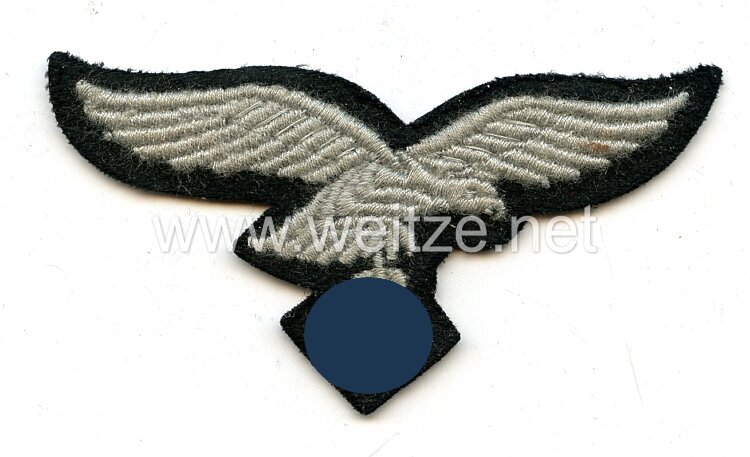
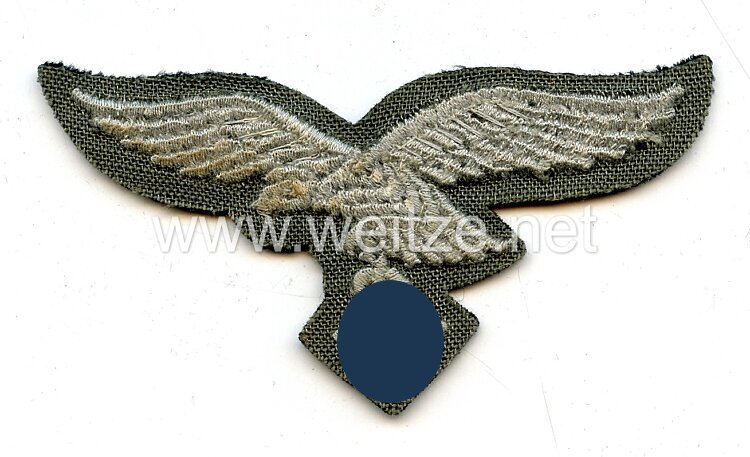
Luftwaffe Side Cap Eagle for Enlisted Men LW-Fallschirm-Panzerkorps “Hermann Göring”
The Luftwaffe Schiffchen eagle for enlisted ranks of the LW-Fallschirm-Panzerkorps Hermann Göring represents a remarkable example of Third Reich military insignia and embodies the complex organizational development of this elite unit during World War II.
The Fallschirm-Panzerkorps Hermann Göring evolved from the original Regiment General Göring, a guard unit established in 1935 as a police formation. Reichsmarschall Hermann Göring, Commander-in-Chief of the Luftwaffe, continuously expanded this unit. In 1942, the regiment was enlarged to become Brigade Hermann Göring and received tanks, making it one of the first armored units of the Luftwaffe. By 1943, the unit had grown to become the Division Hermann Göring, and finally in 1944 it became the Fallschirm-Panzerkorps Hermann Göring with multiple divisions.
The Schiffchen eagle, worn on the Schiffchen (side cap), was an essential component of the Luftwaffe uniform. For enlisted men and non-commissioned officers, the eagle was produced in machine-embroidered form on black cloth backing, in contrast to the hand-embroidered or metal badges worn by officers. The black base color was characteristic of the Luftwaffe and distinguished it from the green or field-gray fabrics of other Wehrmacht branches.
The design of the eagle followed the Heeresverordnungsblatt guidelines for Luftwaffe insignia. The stylized eagle with outstretched wings clutched a swastika in its talons, as was standard for all Wehrmacht national emblems. Machine embroidery enabled cost-effective mass production for ordinary soldiers while ensuring a uniform appearance.
The Fallschirm-Panzerkorps Hermann Göring was a unique formation within the German armed forces. Although part of the Luftwaffe, it fought primarily as a ground force and possessed heavy tanks, artillery, and motorized infantry. This dual nature was reflected in its uniforms: soldiers wore Luftwaffe uniforms with characteristic blue branch colors but fought in roles traditionally reserved for the Army.
The unit saw intensive combat action on multiple fronts. In North Africa, Brigade Hermann Göring fought in Tunisia in 1943. After evacuation to Sicily, it participated in the defense of the island in July 1943. Later, the division fought in Italy, where it was involved in heavy fighting at Anzio and Monte Cassino. From 1944 onwards, parts of the corps were transferred to the Eastern Front, where they participated in desperate defensive battles against the advancing Red Army.
The manufacture of uniform insignia during the war was subject to strict quality controls and specifications. Various manufacturers produced these badges, each with their own subtle variations. Machine embroidery was typically executed on cotton or artificial silk base fabric, with artificial silk or cotton thread for the eagle motif. Quality generally deteriorated toward the end of the war as material shortages forced simplifications and substitute materials.
The wearing of the Schiffchen eagle was prescribed to be affixed on the right side of the side cap. The exact positioning was specified in the Luftwaffe dress regulations. For members of the Fallschirm-Panzerkorps Hermann Göring, this eagle was a sign of belonging to an elite unit directly associated with the second most powerful man in the Third Reich.
Today, such insignia are important objects of study for military historians and collectors. They document not only the uniform history of the Wehrmacht but also the complex organizational structures and rivalries between the various Wehrmacht branches. The worn condition, as described in the present case, testifies to actual field use and gives the object special historical value as an authentic period witness.
Surviving examples vary greatly in condition, depending on storage, use, and the intervening decades. Machine embroidery, while durable, could be damaged by moisture, insects, and mechanical stress. Authenticity is of paramount importance with such objects, as the collector market is unfortunately also affected by reproductions and forgeries.
The Hermann Göring units maintained a controversial reputation. While they were well-equipped and often fought tenaciously, they also represented the personal ambitions of Hermann Göring, who sought to build a private army within the Luftwaffe to rival the Wehrmacht's other branches. This organizational peculiarity reflected the competitive and often dysfunctional command structure of Nazi Germany's military apparatus.