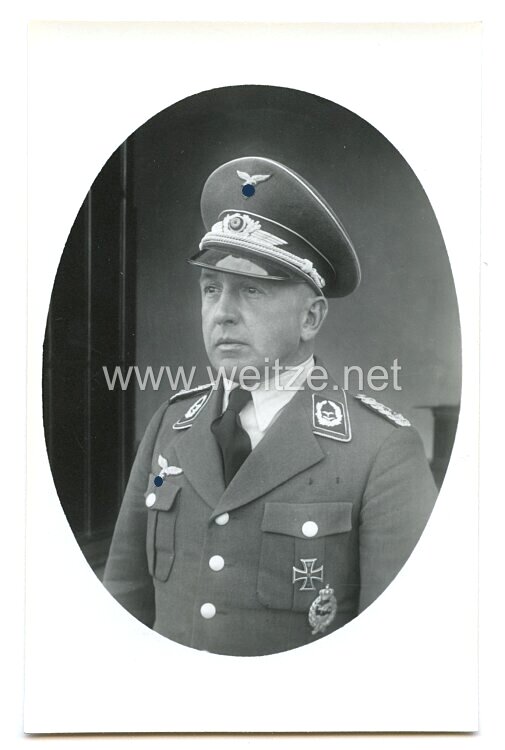
Luftwaffe Photograph, Lieutenant Colonel with Bavarian Pilot's Commemorative Badge
This postcard-sized photograph depicts a Luftwaffe Oberstleutnant (Lieutenant Colonel) wearing the rare Bavarian Pilot's Commemorative Badge, a significant military award from World War I that was permitted to be worn during the Nazi era.
The Bavarian Pilot's Commemorative Badge (Bayerisches Fliegererinnerungsabzeichen) was established on July 8, 1918, by King Ludwig III of Bavaria. It was an award for Bavarian military aviators who served during World War I. The badge could be awarded to officers, non-commissioned officers, and enlisted men of the Bavarian aviation corps who had completed at least three months of front-line flying duty or who had distinguished themselves through exceptional achievements in aviation.
The badge itself consisted of an oval oak wreath in silvered finish, with a crowned Bavarian lion at its center. Above this was depicted a propeller, symbolizing the aviation component. The badge was worn on the left breast of the uniform and was a permanent honor that, unlike many other decorations, could continue to be worn after World War I.
The fact that this photograph shows an Oberstleutnant of the Luftwaffe wearing the Bavarian badge indicates that this officer had already served as an aviator in World War I and continued his career in the officially established Luftwaffe of the Third Reich in 1935. Following the Nazi seizure of power in 1933 and Germany's rearmament, many experienced World War I veterans were integrated into the newly built Wehrmacht.
The wearing of decorations from the Imperial era was explicitly permitted in the Wehrmacht. A decree dated April 7, 1936, regulated the wearing of orders and badges of honor from the Imperial and Weimar Republic periods. World War I veterans who entered the new Wehrmacht wore their old decorations with great pride, as they documented their experience and military career progression.
Photographs like this in postcard format were widespread during the 1930s and 1940s. They served various purposes: as personal mementos, as portraits for family members, or as official photographs for military personnel files. The postcard format (typically about 9 x 14 cm) was a standard format for portrait photographs of this era.
The combination of the Bavarian Pilot's Commemorative Badge and the rank of Luftwaffe Oberstleutnant tells the story of an officer who likely had a remarkable military career. Such officers formed the backbone of the early Luftwaffe, as they possessed valuable practical experience from World War I, when aerial warfare was still in its infancy.
The Bavarian aviation units of World War I held a special position within the German air forces. Bavaria maintained a certain degree of military autonomy within the German Empire and maintained its own air forces with their own decorations and traditions. Famous Bavarian fighter aces such as Rudolf Berthold and others contributed to the development of early aerial warfare.
The postcard format was the standard for military portrait photography during this period. These photographs were produced in studios, often near military installations, and served both official and personal purposes. Officers would distribute copies to family members and keep them in personal albums as documentation of their service.
Photographs like this are today important historical documents that provide insights into the continuity of military careers across different political systems. They also document uniform design, rank insignia, and the decoration system of the Luftwaffe. The condition grade “2” indicates a well-preserved specimen with only minimal signs of use.
For collectors and historians, such photographs are of particular interest as they document the connection between the Imperial aviation corps and the Luftwaffe of the Third Reich and can provide information about individual career trajectories. They represent tangible links to a complex period of German military history and the evolution of aerial warfare.