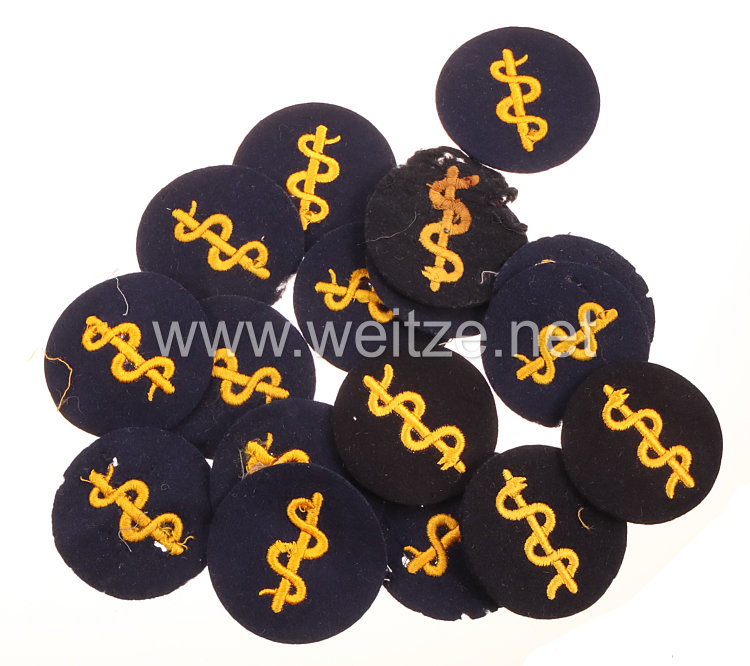
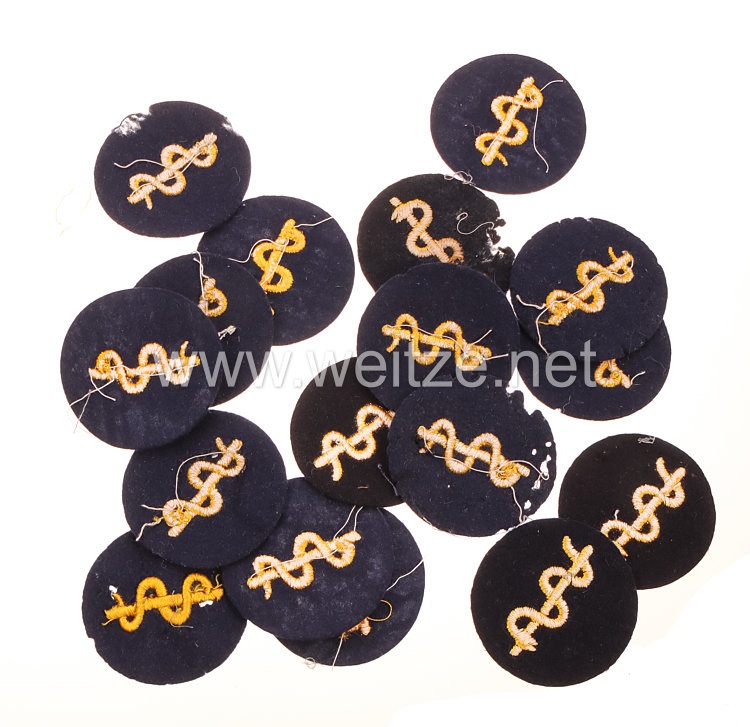
Kriegsmarine Enlisted Personnel Career Sleeve Insignia Medical Orderly
Price per piece: 8 Euro.
Condition may vary.
The Kriegsmarine Career Sleeve Badge for Enlisted Medical Personnel represents an essential element of the German Navy's uniform system during the Second World War. These career badges enabled clear identification of specialized enlisted personnel within the complex organizational structure of the Kriegsmarine and document the continuation of maritime traditions reaching back to the Imperial German Navy of the nineteenth century.
The Kriegsmarine was established on June 1, 1935, when the Reichsmarine was renamed under Nazi rearmament. The Anglo-German Naval Agreement had freed Germany from Versailles Treaty restrictions. The uniform and insignia system of the Kriegsmarine, including career badges, was based on the traditions of the Imperial German Navy and the Weimar Reichsmarine. Official regulations for the Reichsmarine had been issued on April 5, 1921, and were adopted with modifications for the Kriegsmarine in 1935.
The career badge system had been developed during the nineteenth century by the Imperial German Navy and was carried over into subsequent German naval forces. German naval rates were differentiated between various career fields including deck, engineering, weapons systems, medical rates, and technical specialties. The medical career path encompassed all personnel entrusted with medical care, sick bay operations, and health services aboard ships and shore facilities. The rating system within the medical career track ranged from Sanitätssoldat (medical private) through Sanitätsobersoldat (senior medical private) within the enlisted personnel category.
These career badges were manufactured on navy blue wool base cloth and displayed the medical career symbol in yellow or gold embroidery: the Staff of Asclepius, a snake-entwined rod. The color scheme followed official Kriegsmarine regulations, with yellow traditionally being the branch color for medical personnel throughout German military history. For blue uniforms, yellow embroidery on blue background was used; for white summer or tropical uniforms, blue embroidery on white background. Both machine-embroidered versions, which were more common in mass production, and hand-embroidered versions of higher quality existed.
The badge took the form of a cloth sleeve patch in oval or shield form and was worn on the left upper arm, positioned above rank insignia and below any specialty training badges. According to Kriegsmarine regulations (M.Dv. Nr. 153), career path badges on the left upper arm were mandatory for enlisted personnel and had to be correctly affixed. These badges were worn throughout the war on standard navy blue service uniforms and white tropical or summer uniforms.
Various classification variants existed: Beyond the cloth badges for enlisted personnel discussed here, there were also badges for non-commissioned officers, some versions of which were manufactured in metal (zinc with gilt wash) featuring anchor and snake motifs. Additional variants were based on uniform type, including versions for field-gray uniforms of coastal artillery units.
The career badges were produced by various private contractors and official suppliers, both as machine-embroidered and hand-embroidered versions. They served throughout the Kriegsmarine from 1935 to 1945 on naval vessels, shore establishments, hospitals, and medical facilities.
After Germany's defeat in May 1945, the Kriegsmarine was dissolved. The use of all Kriegsmarine insignia ceased. With the founding of the Bundesmarine (West German Navy) in 1956, an entirely new system of uniforming and identification was established. Historical Kriegsmarine badges became collectibles and objects of study for military historians and collectors. Such objects today serve historical research and documentation, illustrating the organizational structure and visual culture of German naval forces during the Second World War.