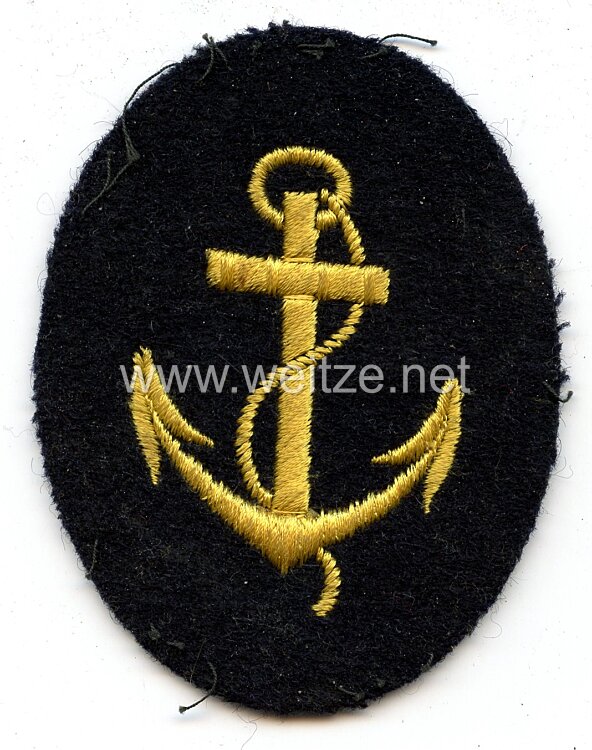
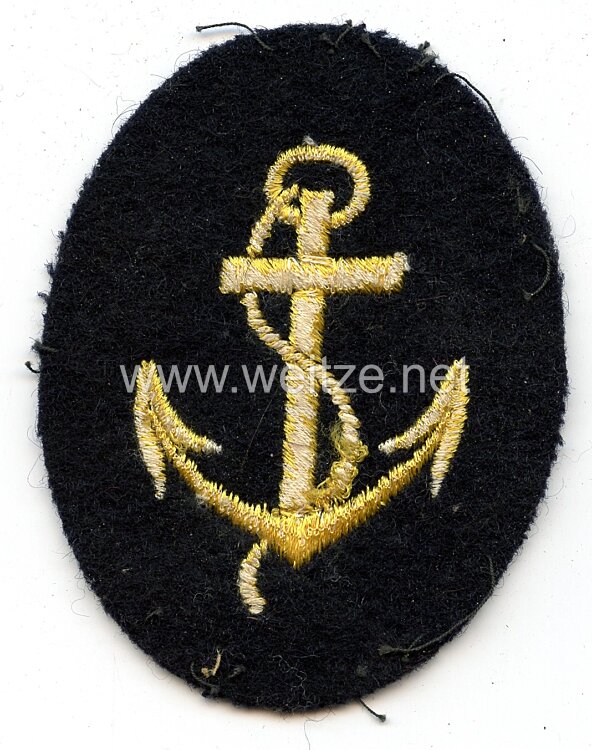
Kriegsmarine Career Sleeve Insignia for Bootsmannsmaat (Boatswain's Mate)
The Kriegsmarine sleeve insignia for the rank of Bootsmannsmaat (Boatswain's Mate) represents an important element of the rank identification system of the German Navy during the Third Reich period from 1935 to 1945. These machine-embroidered badges for the white summer uniform were an essential component of naval uniform regulations and served for immediate identification of rank and career path within the Kriegsmarine.
The Kriegsmarine was officially established on June 1, 1935, after Nazi Germany rejected the restrictions of the 1919 Treaty of Versailles. With the Anglo-German Naval Agreement of June 18, 1935, the systematic construction of a new German war fleet began. Uniform regulations and the rank insignia system were precisely defined and were partly based on traditions of the Imperial German Navy.
The rank of Bootsmannsmaat belonged to the Boatswain's career path, one of the most important career groups within the Kriegsmarine. Career path badges served to distinguish various specializations: Boatswain's path (deck and general ship services), helmsman's, seaman-artillery, torpedo path, and other specialist careers. The Bootsmannsmaat was a non-commissioned officer without sword knot and ranked in the hierarchy between Bootsmann (Boatswain) and Oberbootsmannsmaat (Senior Boatswain's Mate).
The sleeve insignia were worn on both upper sleeves of the uniform and consisted of characteristic chevrons and career path badges. For the white summer blouse, traditionally worn during warmer months or in southern waters, the badges were machine-embroidered in dark thread on a light background. Production followed precise specifications of the Dress Regulations for the Kriegsmarine, issued by the Supreme Command of the Navy (Oberkommando der Kriegsmarine - OKM).
Machine embroidery of these badges was common during the war and enabled efficient production. Private manufacturers and military clothing depots produced these insignia according to standardized regulations. Quality varied depending on manufacturer and production period – early war years often showed higher manufacturing quality than later years, when material shortages affected production.
The Boatswain's career path encompassed basic seamanship skills and was central to daily ship operations. Boatswains were responsible for rigging, anchors, boats, deck equipment, and training of junior ranks. Advancement from ordinary seaman to Bootsmannsmaat required practical experience, theoretical knowledge, and passing examinations.
The use of sleeve insignia had a long tradition in the German Navy, dating back to the Imperial Navy. The system was modernized and systematized in the Kriegsmarine but retained fundamental elements. The visual hierarchy made it possible to recognize at a glance the rank and function of a naval serviceman – a practical necessity in the complex life aboard ship.
During World War II, approximately 1.5 million men served in the Kriegsmarine. They fought on surface vessels, submarines, in coastal batteries, and naval aviation units. The loss rate was particularly high – approximately 30,000 of 40,000 U-boat crew members did not return. Uniforms and insignia were worn under the harshest conditions, from the icy waters of the North Atlantic to the Mediterranean.
Following the unconditional surrender on May 8, 1945, the Kriegsmarine was dissolved. The Allies confiscated or destroyed most ships. Uniform items and insignia were frequently taken as souvenirs or later became collector's items. Today, these objects are historical witnesses of a past era and are preserved in museums, collections, and by militaria enthusiasts.
The study of these insignia contributes to understanding the organizational structure, hierarchy, and daily life in the Kriegsmarine. They are material remnants that provide insight into uniform regulations, production methods, and maritime traditions. For historians and collectors, they offer important information about manufacturing techniques, materials, and the development of military identification systems in the 20th century.