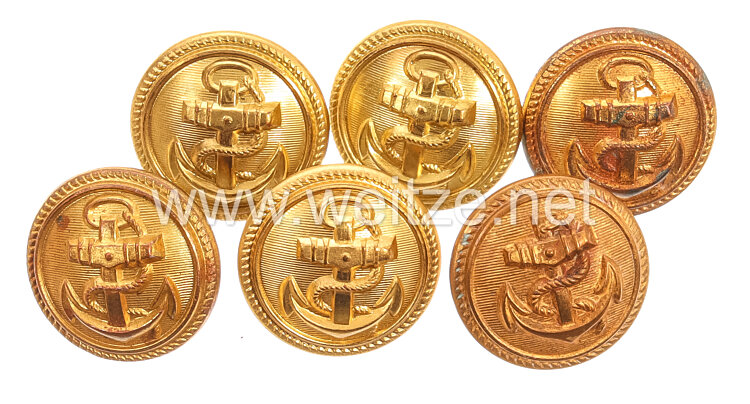
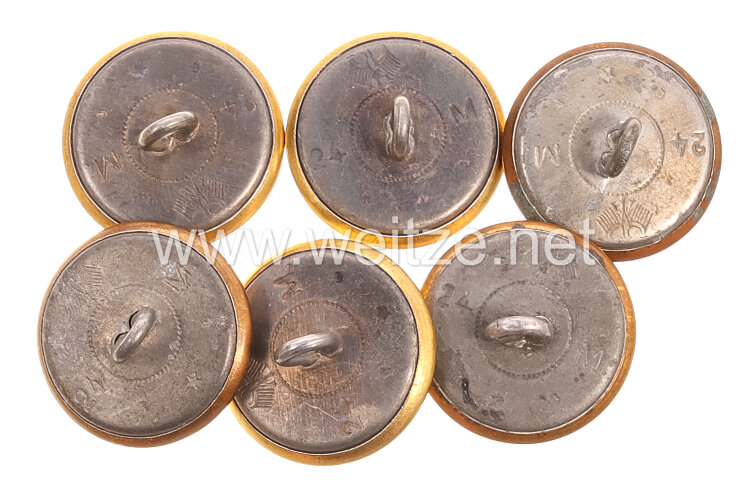
Reichsmarine / Kriegsmarine 6 Uniform Buttons
These six Reichsmarine and Kriegsmarine uniform buttons with a diameter of 24 mm represent a characteristic element of German naval uniforms between 1921 and 1945. These buttons are distinguished by the Reichsmarine eagle embossed on the reverse side, which served as an important national emblem of the German naval forces.
After World War I, the Treaty of Versailles of 1919 dissolved the Imperial Navy, and its successor organization was initially designated as the Provisional Reichsmarine. On January 1, 1921, the official renaming to Reichsmarine took place. This force served under the Weimar Republic and was considerably restricted in size and armament by the terms of the peace treaty. The uniform regulations of the Reichsmarine were oriented toward the traditions of the Imperial Navy but adapted to the new political circumstances.
The uniform buttons were integral components of various types of naval uniforms. The 24-mm diameter corresponds to the medium size, typically used for jackets and coats. Larger buttons were found on overcoats, while smaller examples were used on shirts and as sleeve buttons. The buttons were manufactured from various materials, with metal, often tombac or chrome-plated iron, being most common.
The characteristic feature of these buttons is the eagle embossed on the reverse side, which represented the national emblem of the German Navy. During the Reichsmarine period, the eagle with the Reich coat of arms displayed a classic appearance oriented toward republican symbols. The front of the buttons was usually smooth or featured an anchor motif, the traditional symbol of naval forces.
With the Nazi seizure of power in 1933, a gradual transformation of the armed forces began. On June 1, 1935, the official renaming of the Reichsmarine to Kriegsmarine took place, which served under the supreme command of Grand Admiral Erich Raeder and later Karl Dönitz. This renaming symbolized the military expansionist course of the Nazi regime and the deliberate departure from the restrictions of the Versailles Treaty.
The Kriegsmarine uniform buttons basically retained their shape and size, but the symbolism of the eagle changed. The national eagle was now combined with the swastika, representing Nazi rule. Nevertheless, many buttons from the Reichsmarine period remained in use, which explains why examples with both eagle variants exist.
The manufacture of these uniform buttons was carried out by various specialized companies that worked as suppliers for the Wehrmacht. Well-known manufacturers included firms such as Assmann, Friedrich Linden, and other metalworking enterprises. The buttons were produced in large quantities, as they were wear items and needed to be replaced regularly.
The naval uniform regulations were detailed in the corresponding dress regulations. These regulated not only the placement and number of buttons on various uniform items but also their exact specifications. The Navy placed great emphasis on a uniform and well-groomed appearance of its personnel.
The indicated condition 2 suggests well-preserved examples showing only slight signs of use. This is remarkable for buttons that were worn over decades. Many of these buttons today show oxidation, wear of the embossing, or other signs of aging.
From a military-historical perspective, these uniform buttons document a significant period of German naval history. They represent both the Weimar Republic and the Nazi era and symbolically stand for the transformation of the German naval forces during this turbulent epoch. For collectors and historians, such objects are important study pieces that provide insights into the material culture of military organizations.
Provenance research on such objects is often difficult, as uniform buttons were produced and used in large quantities. Nevertheless, they contribute to the documentation and understanding of military uniform history and are important witnesses of their time.